Traducción al español del texto de llifle.com (adaptación bajo la misma licencia CC-BY-SA).
Descripción
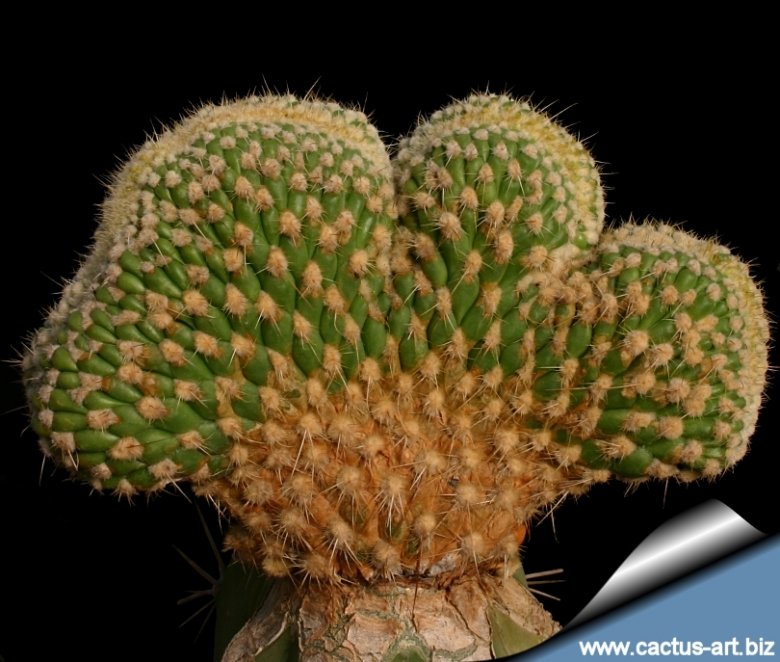
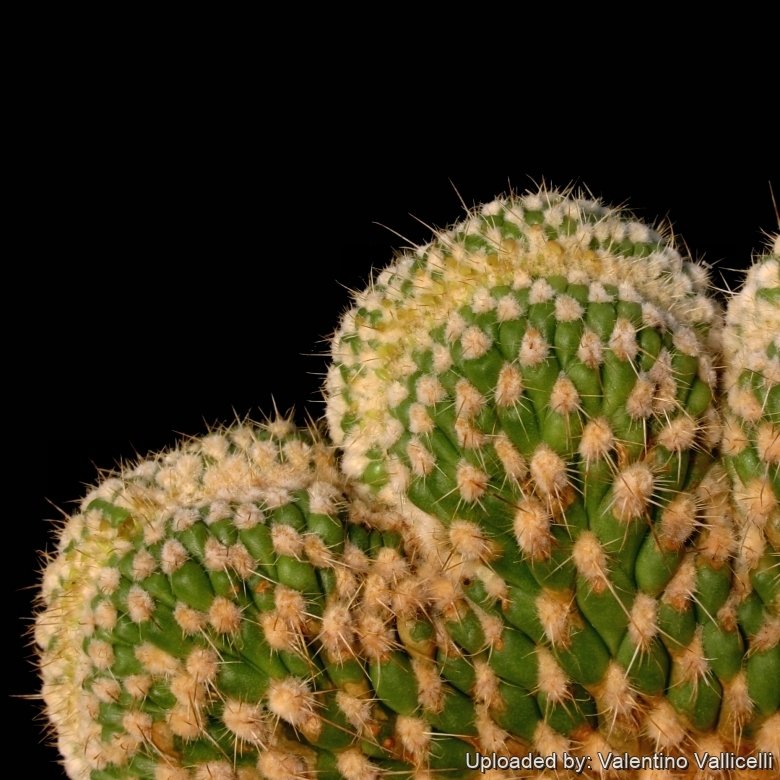
Austrocylindropuntia pachypus típica es un cactus columnar de crecimiento lento, generalmente solitario (a veces ramifica desde la base). Alcanza hasta 1 m de altura, con segmentos de hasta 8 cm de diámetro. La forma cristata es más frecuente en cultivo que la forma columnar normal (que también es bastante rara y muy apreciada por los aficionados).
Origen y hábitat
Perú (al norte de Lima, valle de Chosica), a baja altitud, entre 600 y 1500 m.
Cultivo y propagación
Austrocylindropuntia pachypus f. cristata es una especie de crecimiento lento, bastante sensible a la humedad y difícil de propagar. Por ello se vende injertada.
Necesidades de riego: Necesita un riego moderado durante el período de crecimiento; mantener seca en invierno.
Sustrato: Requiere un sustrato drenante y mineral.
Exposición: A. pachypus necesita pleno sol.
Requisitos de temperatura: Necesita una temperatura relativamente alta (al menos 5-8 °C, según el portainjerto).
Propagación: Se reproduce mejor por injerto, porque los esquejes normalmente no consiguen enraizar o lo hacen muy lentamente e de forma impredecible. Por esta razón la planta se injerta con frecuencia. Austrocylindropuntia subulata se usa a menudo como portainjerto, aunque no es especialmente recomendable por ser demasiado vigorosa y muy sensible al frío.
Bibliografía
Major references and further lectures
- Ostalaza, C., Cáceres, F. & Roque, J. 2013. Austrocylindropuntia pachypus. The IUCN Red List of Threatened Species 2013: e.T151737A555860. http://dx.doi.org/10.2305/IUCN.UK.2013-1.RLTS.T151737A555860.en. Downloaded on 26 March 2016.
- Arakaki, M., Ostolaza, C., Cáceres, F. and Roque, J. “Cactaceae endémicas del Perú.” Revista Peruana de Biología 13(2): 193s-291s. 2006
- N. L. Britton, J. N. Rose: “The Cactaceae. Descriptions and Illustrations of Plants of the Cactus Family.” Vol I, The Carnegie Institution of Washington, Washington 1919
- Curt Backeberg “Die Cactaceae: Handbuch der Kakteenkunde”, Volume 6 G. Fischer, 1962
- Hunt, D., Taylor, N. and Charles, G. “The New Cactus Lexicon.” dh Books, Milborne Port, UK. 2006
- Anderson, E. F. “The cactus family” 2001
- Clive Innes “Complete Handbook of Cacti and Succulents” Van Nostrand Reinhold Company, 01 December 1981
- Urs Eggli, Leonard E. Newton “Etymological Dictionary of Succulent Plant Names” Springer Science & Business Media, 29 June 2013
- Ritter, F. “Kakteen in Südamerika”. Vol. IV. Peru 1239–1692. Friedrich Ritter Selbstverlag, Spangenberg. 1981.
- Brako, L. & J. L. Zarucchi. “Catalogue of the flowering plants and gymnosperms of Peru.” Monogr. Syst. Bot. Missouri Bot. Gard. 45. [= Opuntia pachypus K. Schum.]. 1993.
- Austrocylindropuntia pachypus in: “Encyclopédie: Austrocylindropuntia” by Philippe Corman Succulentopi@ N°11 - Octobre 2014 Pages 13-15. retrieved 27 March 2016 from https://www.cactuspro.com/succulentopia/Succulentopia-N11-2014-10.pdf
- Gilmer K., Thomas H.P., Schulz W., “Beobachtungen an Austrocylindropuntia pachypus 13) (Opuntioideae).” Kakteen und andere Sukkulenten 56: 169-177 (2005)
- Mackie R., “Opuntia pachypus”, British Cactus and Succulent Journal, 16(1): 20 (1998), and “Opuntia pachypus, an update”, British Cactus and Succulent Journal, 18(1): 43 (2000).
- Putnam E.W., “Cactus album n°15, Opuntia pachypus”, National Cactus and Succulent Journal 30(1): 18 (1975)
- PhD Thesis: Cristina Geiger H., “Phytochemical Study of Opuntia Pachypus,” B.S., Catholic University, Lima-Peru.