Publication: Ann. Mus. Colon. Marseille II, 7: 44 1909.
Description
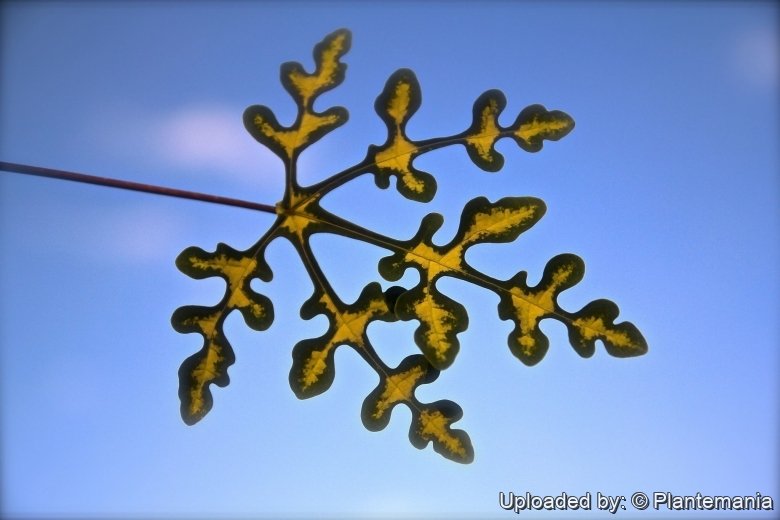
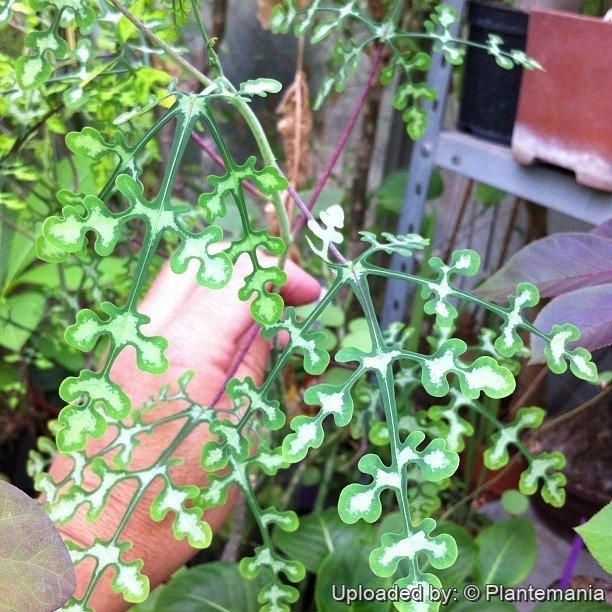
Adenia perrieri is a herbaceous climber growing up to 2 metres, occasionally to 3 metres long, arising from a tuberous rootstock (caudex). The rootstok serves as a water reservoir in times of drought, from it starts a short thin woody stem with one or several year green vining-like stems coming out of it with very lace-like deeply divided leaves in the spring. There is a popular a ‘snowflake’ version of the typical leaves but with white spots on them. This plant is definitely grown for its foliage, not the ‘caudex’. The whole plant is glabrous.
Stems: The caudex is somewhat swollen and can grow to 20 centimetres in diameter and produces one or several year green vines that can reach a height of two or three metres.
Leaves: Variable in shape and size, 5-palmately dissected or divided, leaflets (segments) to 3.5cm long and 1.5cm wide. The leaf shape depends on the location. Places with natural vegetation and without bush fires have plants with the leaf segments being simple. In places where fires regularly occur, plants have leaf lobes that are deeply dissected
Flowers: Small greenish white. The filaments are inserted at or near the throat of the hyphanthium. The disc glands are absent.
Origin and Habitat
Adenia perrieri grows in sandy soil and on basalt rocks and Tsingy limestone pinacles in the Ambongo-Boina region. Madagascar.
Cultivation and Propagation
Adenia perrieri is an interesting addition to a collection, but rarely seen in cultivation.
Growth rate: It grows well, though very slowly, but it possible to increase the speed of growth to some extent by providing adequate amount of water, warmth, and fertilizer during the active growing season, but it’s susceptible to rotting if too wet.
Exposure: It needs light shade, but the caudex should be in the shade, while the leaves prefer some sun. Avoid direct blasting sun in summer. Bright light if grown indoors.
Soil: In pots it needs a very porous potting medium (add pumice, vulcanite, and perlite). It does better in a rather acidic soil.
Waterings: Water frequently while plant is in full growth, but keep dry during the winter after the branches have died back. It rot easily and do NOT like a lot of water when it has no leaves.
Fertilizer: Benefits from moderate doses of a well-balanced, slow-release fertilizer.
Bibliography
Major references and further lectures
- Werner Rauh “Succulent and xerophytic plants of Madagascar”, Volume 1 Strawberry Press, 1995