Publication: Nat. Pflanzenfam., ed. 2 [Engler & Prantl] 18a: 416 1930.
Description
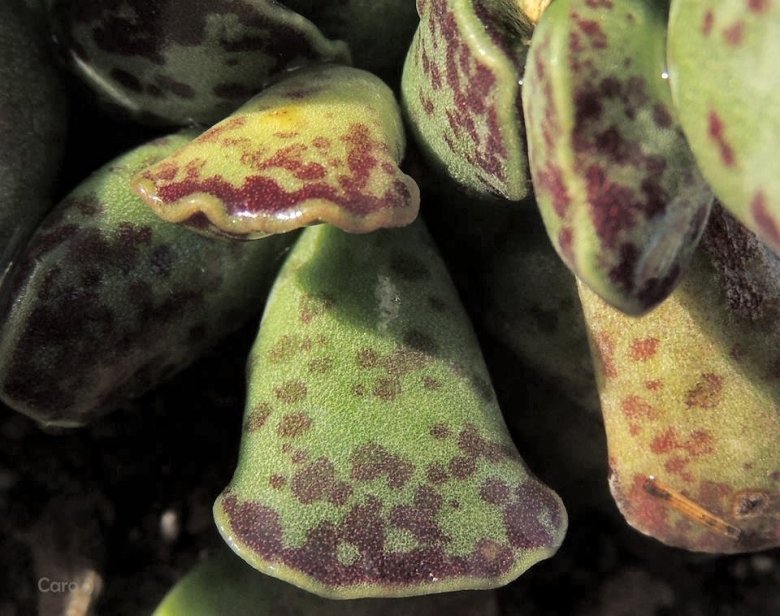
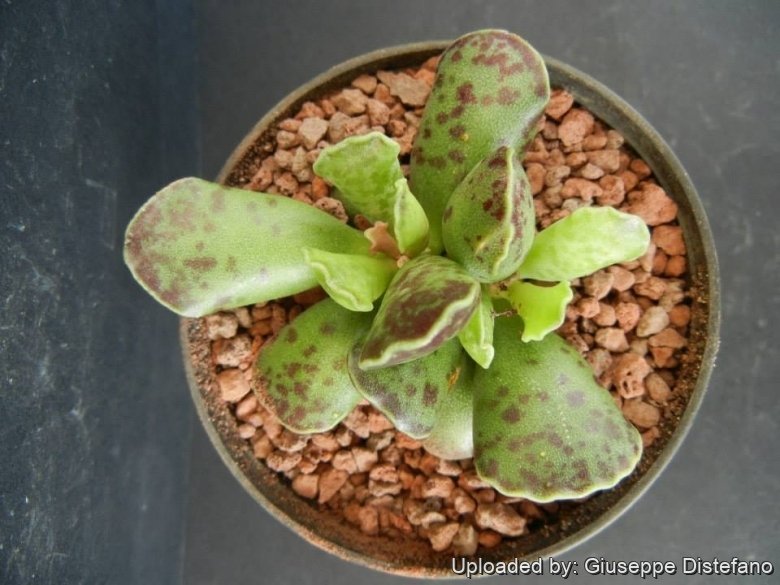
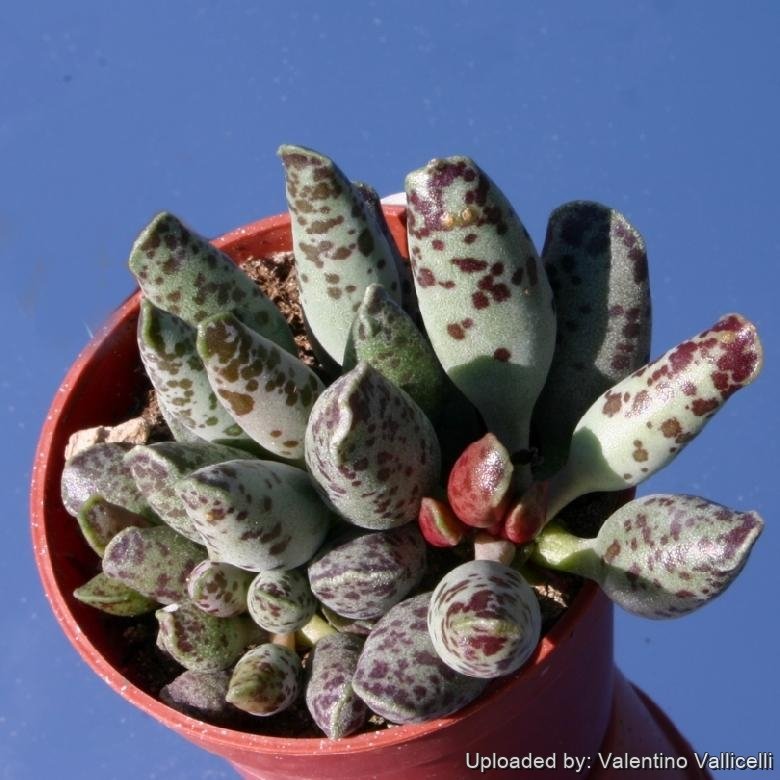
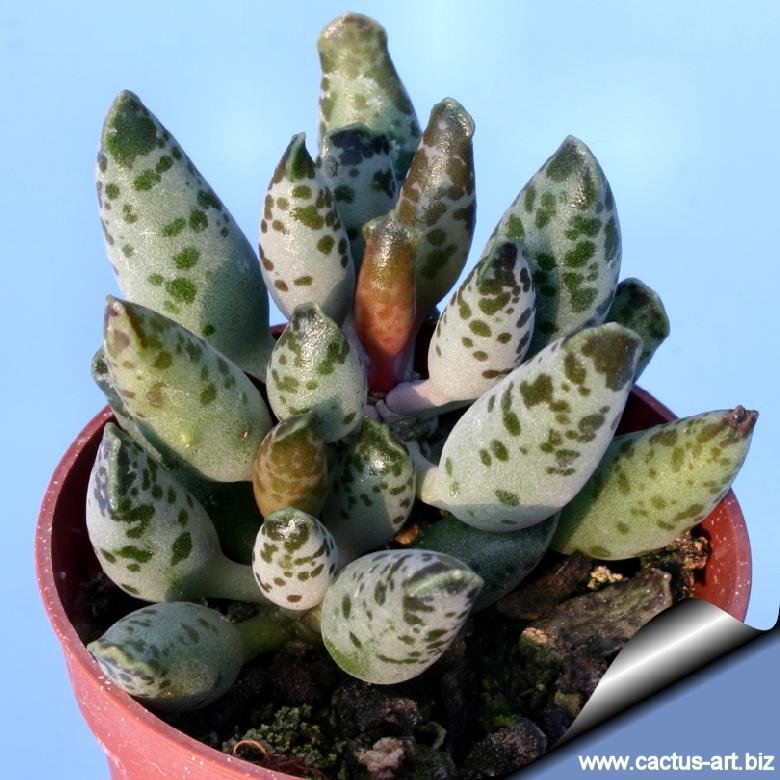
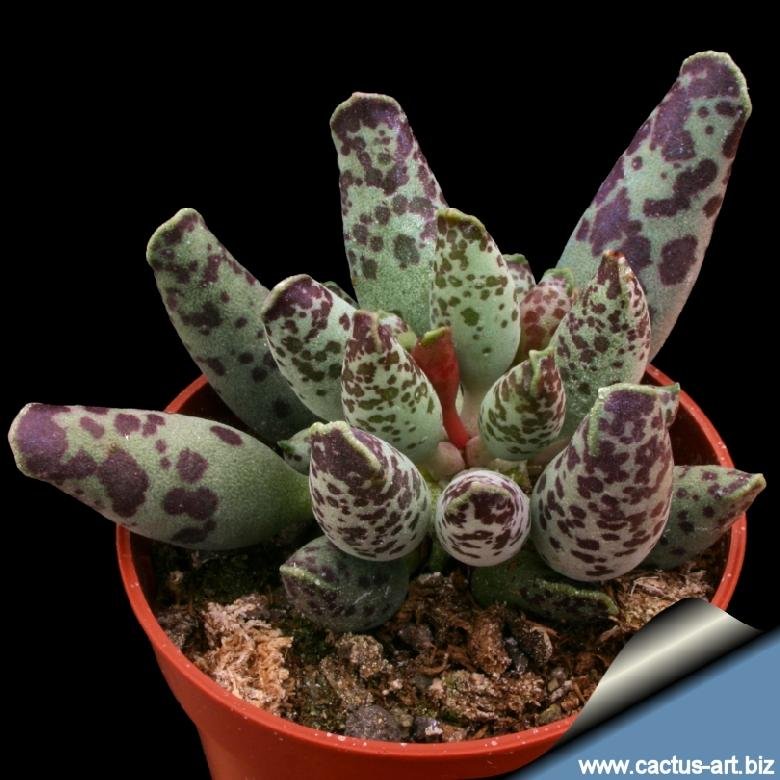
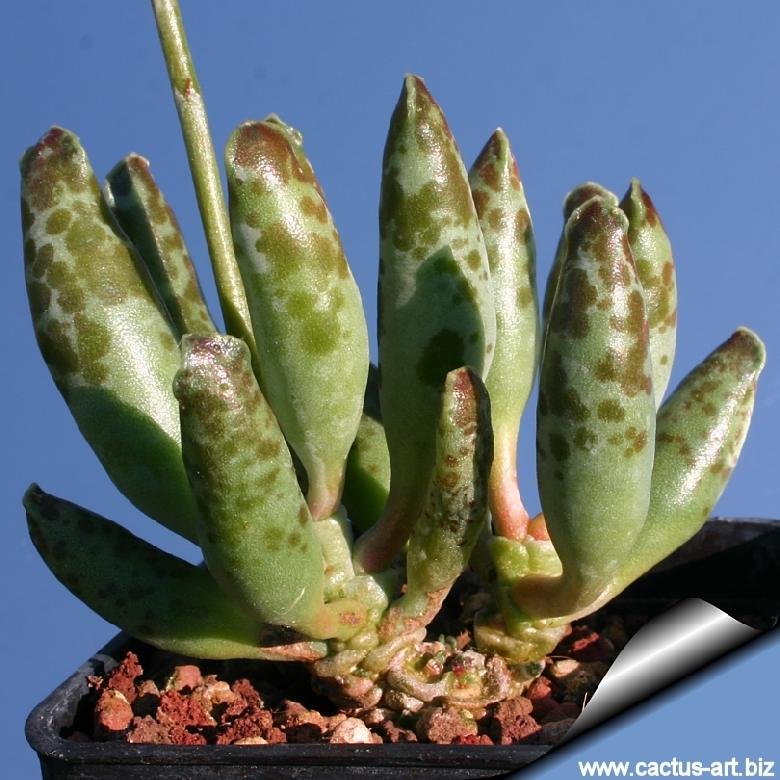
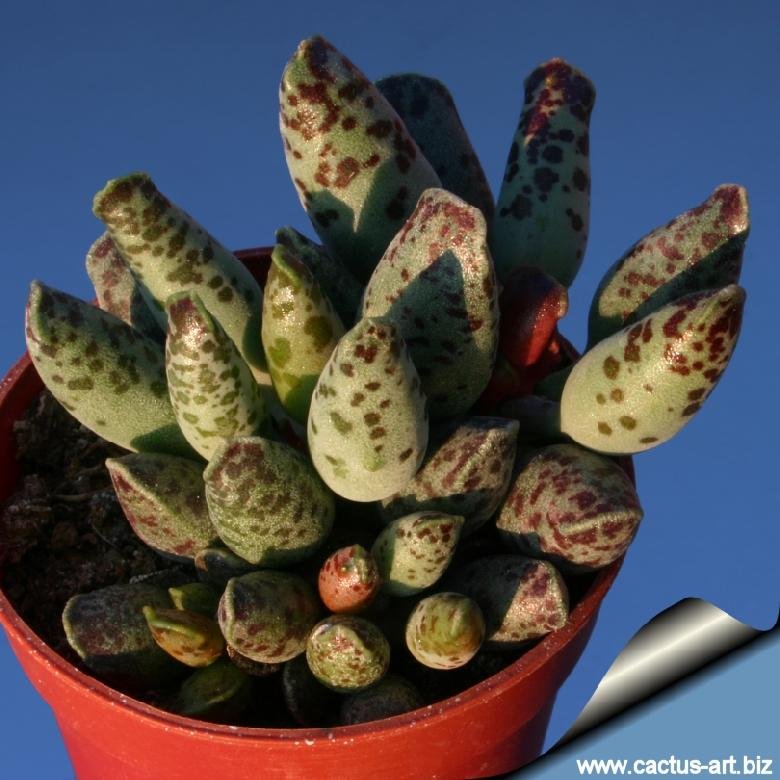
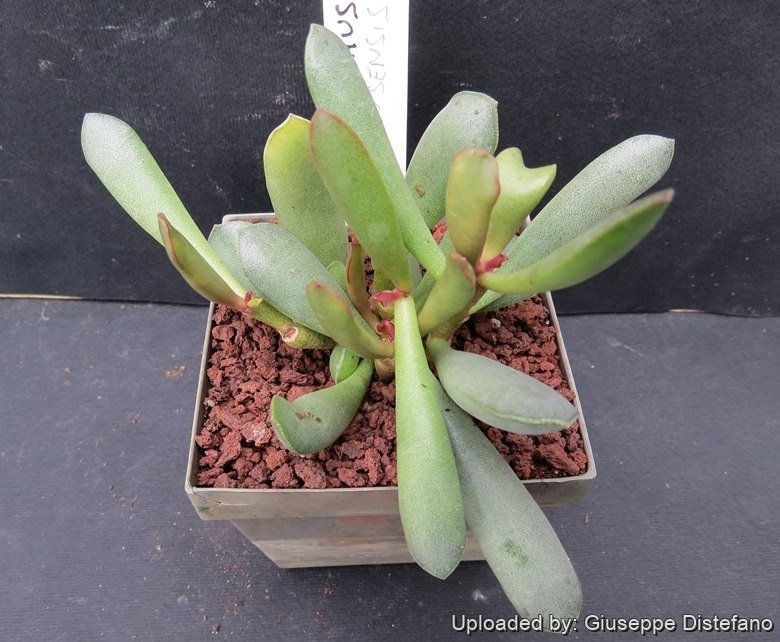
Adromischus cooperi (Club-adromischus) is a dwarf freely branching perennial succulent 2-7 cm tall and 15 cm in spread. It has larger leaves than Adromischus cristatus, plump, narrowed toward the base, pale silver-grey with a hint of duck-egg green and elegantly spotted with rich dark purple.
Stems: Short, spreading, greyish-brown occasionally with aerial roots.
Leaves: Decussate, tubular-shaped to inversely lance-shaped terminal part ovate triangular wider than the leaf with a white, slightly wavy horny leaf margins, 2.5-5 cm long, glossy, grey-green to blue, hairless, distinctly mottled on the upper surface with large purple markings.
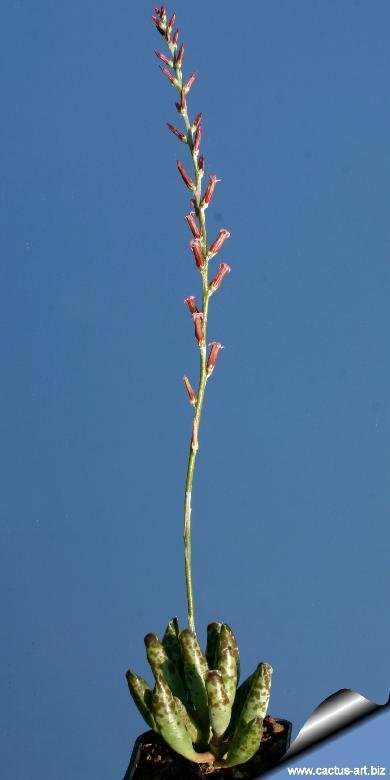
Inflorescences: 35 cm or more long.
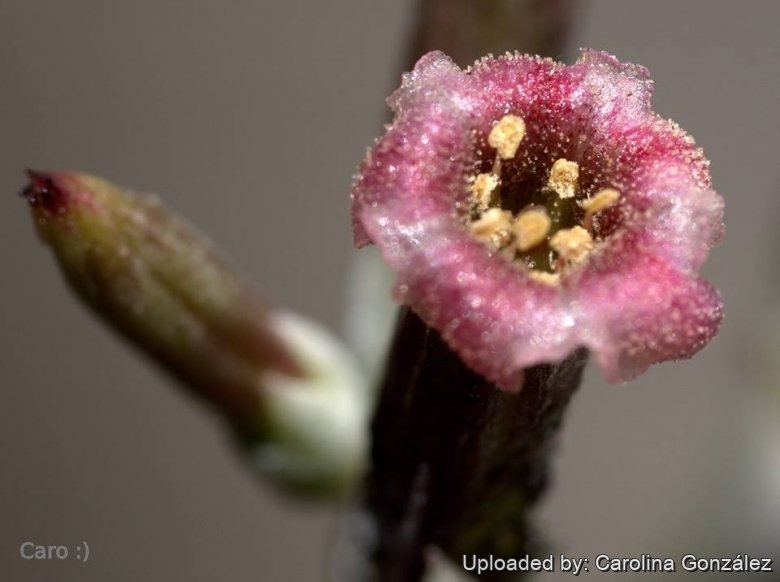
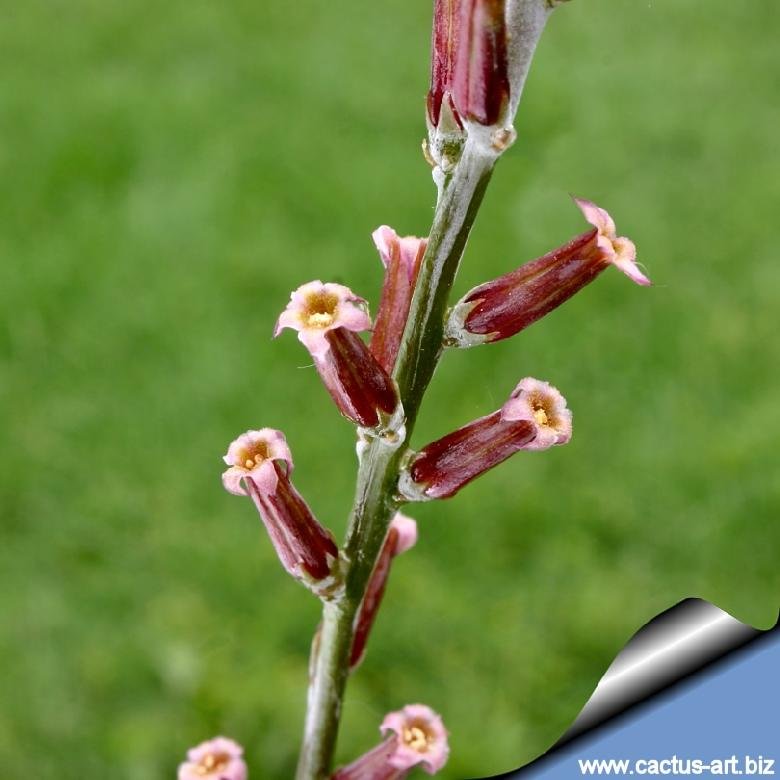
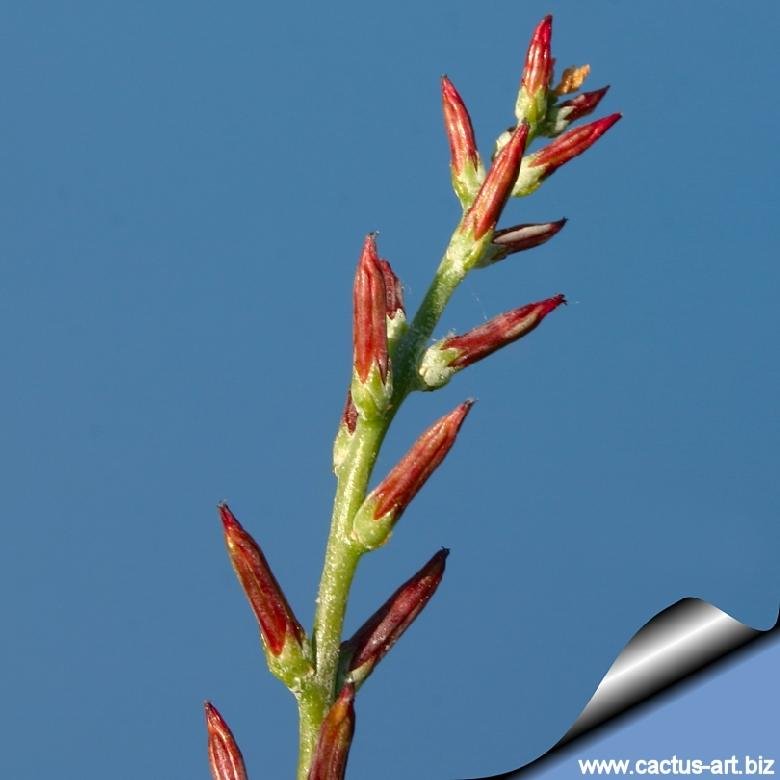
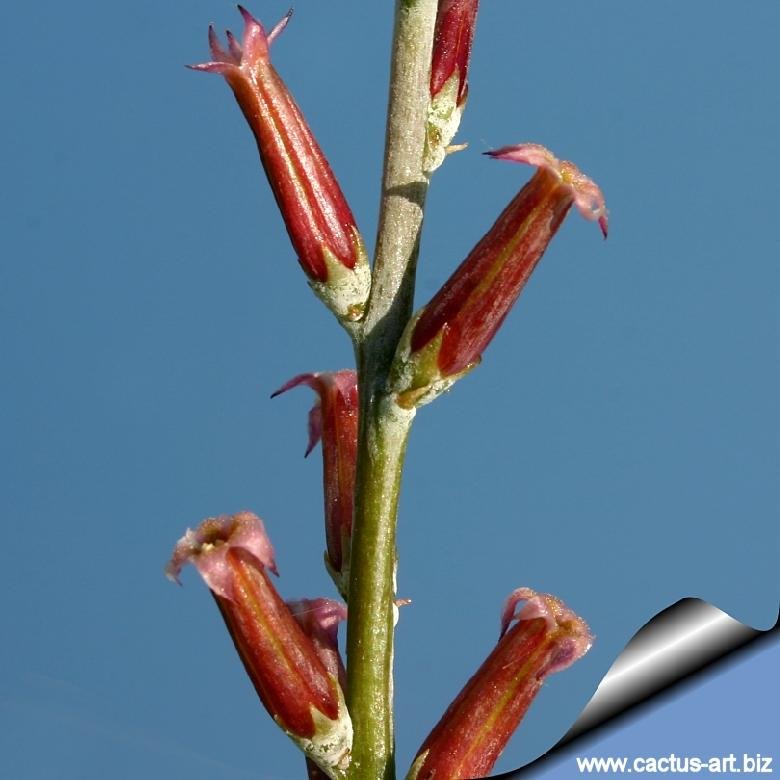
Flowers: Tubular, green-and-red covered in a thick bloom with white-margined, pink or purple lobes and club-shaped hairs in throat and on corolla-lobes.
Blooming season: Summer.
Fruit: Fruit a dry many seeded follicle.
Remarks: Adromischus cooperi and the related Adromischus festivus are so much confused that a considerable amount of Journal space was given up to discussions about them.
Origin and Habitat
Soutvlei, north of Grahamstown in the Zuur Mountains, Eastern Cape, South Africa..
Habitat: This Adromischus is a typical component of the Eastern Cape succulent Thickets.
Cultivation and Propagation
They prefer well-drained soil in a partially shaded position and require a minimum temperature 5°C (But hardy down to -7°C for short periods), with good drainage and dryness in winter to resist the cold. Let the soil dry between soaking, in the wild, it receives rain mostly in spring and fall. Must have very dry atmosphere. They are vulnerable to mealybugs and rarely scale. It is prone to rotting from the tuberous base or from dried inflorescences. As the plant matures, the centre becomes bare. When it does, restart it from side cuttings and throw away the central part.
Propagation: Usually propagate from single leaves (leaf cuttings) or stem cuttings seed propagation is rarely used.
Twist off a leaf and permit it to dry out a couple of days, lay it on the soil and insert the stem end partially into the soil. The original leaf should not be removed until it has dried up. Try to keep the leaf somewhat upright so that the roots are able to grow downward. If grown in a container, bottom watering by immersing the container is recommended.
Bibliography
Major references and further lectures
-
John Pilbeam, Chris Rodgerson, Derek Tribble “Adromischus” Cirio Publishing Services Ltd, 1998
-
Hermann Jacobsen “Abromeitiella to Euphorbia” Blandford Press, 1960
-
Christopher Brickell “RHS Encyclopedia of Plants and Flowers” Dorling Kindersley Ltd, 01/Sep/2010
-
Ernst Van Jaarsveld, Ben-Erik Van Wyk, Gideon Smith “Succulents of South Africa: A Guide to the Regional Diversity” Tafelberg Publishers, Limited, 01/Jul/2000
-
Hermann Jacobsen “A handbook of succulent plants: descriptions, synonyms, and cultural details for succulents other than Cactaceae” Volume 1 Blandford Press, 1960
-
Dr J.P. Roux “Flora of South Africa” 2003
-
Doreen Court “Succulent Flora of Southern Africa” CRC Press, 01/giu/2000
-
Hermann Jacobsen “A handbook of succulent plants: descriptions, synonyms, and cultural details for succulents other than Cactaceae” Volume 1 Blandford Press, 1960
-
Urs Eggli “Illustrated Handbook of Succulent Plants: Crassulaceae” Springer for Science, 01/Jan/2003
-
James Cullen, Sabina G. Knees, H. Suzanne Cubey “The European Garden Flora Flowering Plants: A Manual for the Identification of Plants Cultivated in Europe, Both Out-of-Doors and Under Glass” Cambridge University Press, 11/Aug/2011
From llifle page Adromischus festivus
Description
Adromischus festivus is a dwarf succulent, up to 7 cm tall, leaves 2.5 to 5 cm long. Form groups of stems.
Stem: Knobbly, stout very short, prostrate, with sparse branching. Older plants develop a massive caudex or large swollen area near the ground. Stems lacks root-hairs (unlike Adromischus cristatus)
Roots: Fibrous roots
Leaves: Fat, glabrous, small semi cylindrical, more or less mottled with dark green to red based on the exhibition of the plant to the light. Juvenile leaves can be broad with a long margin.
Flowers: Very small, sessile, white-cream or pinkish with violet tones, dusty looking, on a 25-60cm tall inflorescence.
Fruit: Fruit a dry many seeded follicle.
Remarks: Adromischus festivus and the related Adromischus cooperi are so much confused that a considerable amount of Journal space was given up to discussions about them.
Origin and Habitat
South Africa (High up on mountains in the Eastern Cape, Noorsveld)
Source: Adromischus festivus, LLIFLE - Encyclopedia of living forms, CC-BY-SA, retrieved 2026-10-25.
From llifle page Adromischus cuneatus
Description
Adromischus halesowensis is an elegant dwarf perennial succulent plant known only from one clone in cultivation, forming a compact clusters of terete to narrow cuneate, pale silver-green leaves very lightly spotted, with a small, pointed, horny margin at the tip. In all parts glabrous. It is also easily distinguished from Adromischus cooperi by the glaucous, purple peduncle and red-brown corolla.
Derivation of specific name: The specific name commemorates its only known locality at Halesowen, near Cradock, in the Eastern Cape.
Stems: Spreading, sparsely branched, elongated, ascending closely leafy above the base, prolonged into an erect flower-stalk ending in a few flowered inflorescence.
Leaves: Up 5-7 cm long, below the tip-area to 15-25 mm wide, 12 mm thick, alternate, from base to tip gradually widened, a little teretely narrowed below, from base to centre subterete, from here to tip gradually or on the backside very convex, on the upper side less convex, a little pruinose, glossy, with waxy points towards the tip with small brownish-green or dark green markings, tip-area widely triangular roundish or widely triangular, margins sharpened and horny.
Inflorescence: Flower-scape simple.
Flowers: Solitary or even to 4, 10-l2 mm long, green-red-brown.
Taxonomy: The name Adromischus halesowensis was published as a replacement name for a taxon described in 1940 by Karl von Poellnitz under the illegitimate name Adromischus halesowensis. That was a later homonym of Adromischus cooperi (Thunb.) Lem. (1852), a synonym of Cotyledon cuneata. Tölken, in contribution on the “Crassulaceae to the Flora of southern Africa”, referred this species to Adromischus cooperi, from which it differs not only in its habit of growth but in its very different inflorescence, so some authors consider it a separated good species.
Origin and Habitat
Adromischus halesowensis is endemic to Halesowen, near Cradock, Eastern Cape, Republic of South Africa. This species has long been represented in cultivation by what is probably a single clone. Visitors to Halesowen report that Adromischus cooperi is common there, but so far no one has seen A. halesowensis again since its first description. Land use in the area has changed significantly since 1931, where it may now have become extinct.
Cultivation and Propagation
Adromischus halesowensis is a fairly easy succulent to grow and one of the easier Adromischus species.
Growth rate: It is a popular, fast growing species.
Soil: It prefer well-drained soil.
Repotting: Repot every other years. All species of this genus are happy in small pots.
Exposure: It grows best in a partially shaded position. It got sunburned if exposed to midday sun.
Hardiness: Require a minimum temperature 5°C (But hardy down to -7°C for short periods), with good drainage and dryness in winter to resist the cold.
Watering: It takes more water than cacti, but let the soil dry between soaking, in the wild, it receives rain mostly in spring and fall. Must have very dry atmosphere. Water less in winter but do not allow it to shrivel.
Pest & disease: It is vulnerable to mealybugs and rarely scale. It is prone to rotting from the tuberous base or from dried inflorescences.
Maintenance: As the plant matures, the centre becomes bare. When it does, restart it from side cuttings and throw away the central part.
Propagation: Usually propagate from single leaves (leaf cuttings) or stem cuttings. Leaves easily root and produce new plants. Twist off a leaf and permit it to dry out a couple of days, lay it on the soil and insert the stem end partially into the soil. The original leaf should not be removed until it has dried up. Try to keep the leaf somewhat upright so that the roots are able to grow downward. If grown in a container, bottom watering by immersing the container is recommended.
Bibliography
Major references and further lectures
-
Roy Mottram “A replacement type for Adromischus halesowensis Uitewaal” in: CRASSULACEA No.3 15. April 2013 Published by International Crassulaceae Network - Switzerland
-
Derek Tribble, Adromischus Displayed “ADROMISCHUS HALESOWENSIS Uitewaal” <http://myweb.tiscali.co.uk/adrodisp/halesowensis.htm\> Web. 2 February 2015.
-
Poellnitz, K von (1940) “Zur Kenntnis der Gattungen Cotyledon L. und Adromischus
Lem. Feddes Repertorium specierum novarum regni vegetabilis;” Zeitschrift für systematische Botanik 48: 80-113. Leipzig & Berlin
-
Tölken, H. R. (1985) “Crassulaceae.” In Leistner, O. A. (ed.), “Flora of southern Africa” 14: 37-60. Botanical Research Institute, Pretoria.
-
Hermann Jacobsen “Abromeitiella to Euphorbia” Blandford Press, 1960
Source: Adromischus cuneatus, LLIFLE - Encyclopedia of living forms, CC-BY-SA, retrieved 2026-10-25.
Gallery