Publication: Jard. Fleur. 2(Misc.): 60 1852
Description
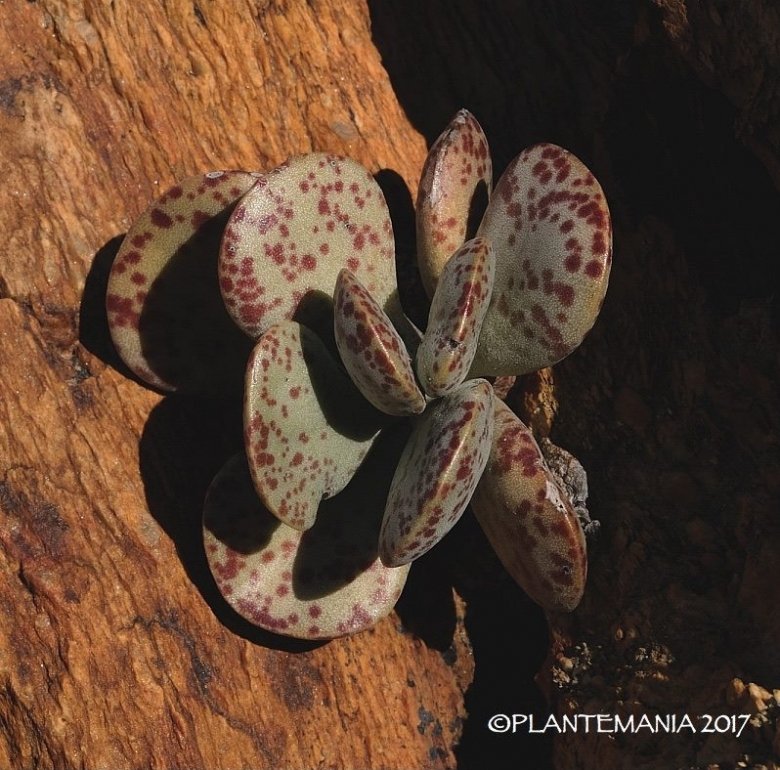
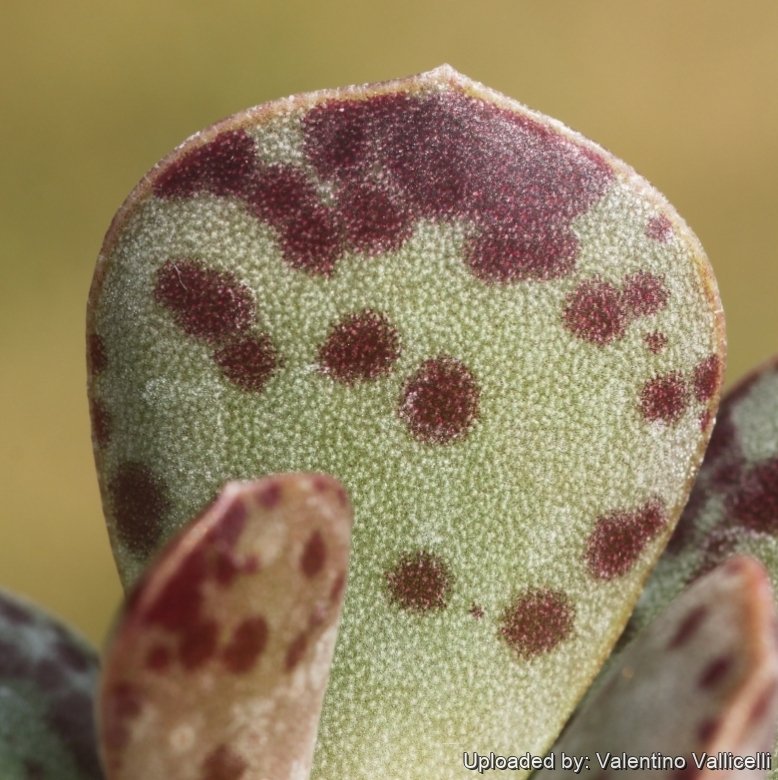
Adromischus maculatus a.k.a. “chocolate-drop” is a nice succulent with fairly flat wedge-shaped leaves, though thick, which are beautifully marked in chocolate colour giving them a marbled appearance.
Habit: Low growing perennials leaf-succulent forming small clusters or mats.
Roots: Fibrous.
Stem: Very short, somewhat woody, decumbent to prostrate up to 15 cm long, little branched
Leaves: Obovate, spatulate or oblanceolate, dorsiventrally flattened, tip obtuse and often mucronate or notched, (25-)30-70(-100) x (15-)20-35(-40) mm, rounded, usually abruptly wedge-shaped but rarely subpetiolate, and with horny margin all round the leaf, green, grey-green to greyish brown, glossy sometimes almost scarlet from the sun rays and with or without dark purple spots, but growing a dark green colour under bushes. The young plants are often without spots.
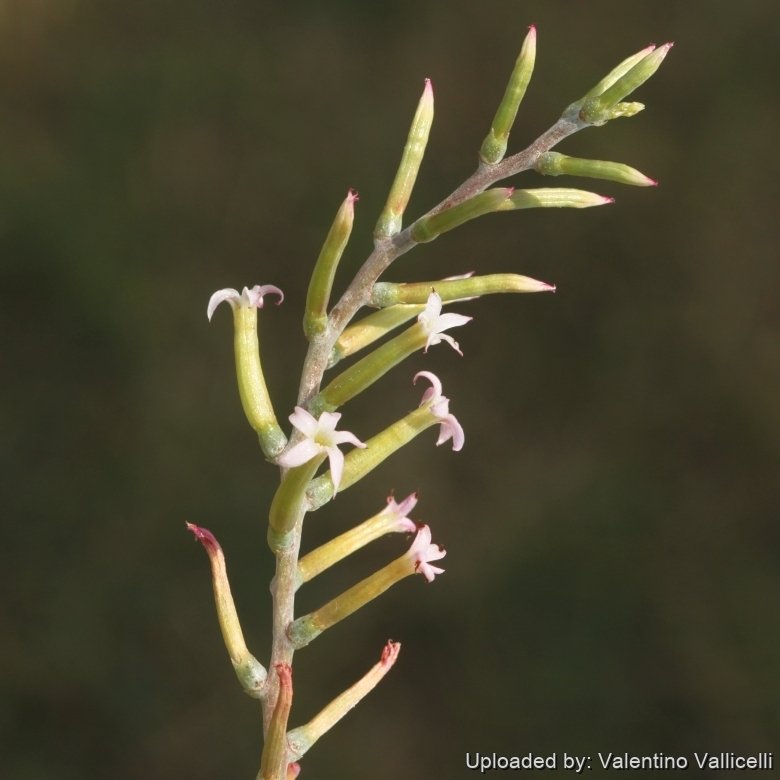
Inflorescence: A thyrse with l(-2)-flowered cymes, grey-green, erect, 20-35 cm tall.
Flowers: Tubular, pale yellowish green. Corolla-lobes 2,5-5 mm acute, white or tinged pale pink. mauve along margins, spreading to recurred. Lower lobes and throat with club-shaped hairs. Anthers not protruding from corolla-tube Pedicels 2-3 mm long. Buds thin, straight gradually tapered toward tips, spreading.
Flowering season: Summer.
Origin and Habitat
South Africa, Cape Province, restricted to the Langeberg Mountains from near Worcester to north of George
Habitat: It grows in usually associated with rock outcrops on higher slopes. Ot grows at fairly high altitudes.
Cultivation and Propagation
Adromischus maculatus is a fairly easy succulent to grow and one of the easier Adromischus species tolerating some frost. It develops quite a massive caudex with age, but plant rarely blooms indoors.
Growth rate: This plant is fairly slow at growing.
Soil: It prefer well-drained soil.
Repotting: Repot every other years. All species of this genus are happy in small pots.
Exposure: It grows best in a partially shaded position but tolerate full sun too. It got sunburned moved suddenly to midday sun.
Hardiness: Require a minimum temperature 5°C (But hardy down to -7°C for short periods), with good drainage and dryness in winter to resist the cold.
Watering: It takes more water than cacti, but let the soil dry between soaking, in the wild, it receives rain mostly in spring and fall. Must have very dry atmosphere. Water less in winter but do not allow it to shrivel.
Pest & disease: It is vulnerable to mealybugs and rarely scale. It is prone to rotting from the tuberous base or from dried inflorescences.
Maintenance: As the plant matures, the centre becomes bare. When it does, restart it from side cuttings and throw away the central part.
Propagation: Usually propagate from single leaves (leaf cuttings) or stem cuttings seed propagation is rarely used. Leaves easily root and produce new plants. Twist off a leaf and permit it to dry out a couple of days, lay it on the soil and insert the stem end partially into the soil. The original leaf should not be removed until it has dried up. Try to keep the leaf somewhat upright so that the roots are able to grow downward. If grown in a container, bottom watering by immersing the container is recommended.
Notes
In the nursery trade Adromischus forms with more-or-less circular (orbicular) leaves were generally called Adromischus maculatus; plants with longer, more squared off leaves were called Adromischus cooperi, and plants with spindle-like leaves were called Adromischus festivus, but the stemless “chocolate-drop” Adromischus widely known in collections and in the nursery trade as Adromischus maculatus is, often one of the forms of Adromischus rupicola. The true Adromischus maculatus is quite different and in most forms is a tall, ascending plant.
From llifle page Adromischus mucronatus
Description
The Cotyledon orbiculata is a robust evergreen succulent shrublet with brittle stems 50-120 cm tall, 80-150 cm wide often quite densely branched. It one of the oldest grown succulents being introduced as long since as 1690 by Mr Bentick that still retains a place in most collections for the magnificent glaucous colour of its foliage and its large flowers of long duration. It is one of the most complex specie, not only because of its seemingly endless range of variation, but also because many of its numerous forms have been formally described. The several varieties and forms enumerated are differing chiefly in the form of their foliage. Leaves, stems and flowers have a waxy bloom.
Stem: Erect or reclining, fleshy, leafless, elongated, up to 1,5 m long and 2 cm in diameter, with the tips growing upward simple or once or twice divided the greater part often buried under ground
Leaves: Opposite, very variable in shape, up to 13 by 7 cm, fleshy, hairless or seldom velvety, usually ± flattened broadly paddle- to spindle-shaped, obovate spatulate, blunt acuminate pale green, grey- green, grey-white, blue-grey with a powdery waxy coating over the whole leaf that helps reflect sunlight and conserve water. Do not touch the leaves or you will damage their bloom. Margins with deep-reddish.
Flowers: In compact paniculate clusters at the end of a sturdy, erect stalk 45-60 cm long, flowers nodding, usually less than 3 cm in lengt, bell-shaped to tubular; corolla ± cylindrical with recurved lobes, externally pink, orange or dull reddish, internally of a fine flesh rose red colour, but yellow varieties also exist. The smell is very strong and something resembling that of decaying roast beef or of some of the fungi. Pollinated mainly by honeybees.
Blooming season: Winter.
Origin and Habitat
Native of a vast arid region in the southwestern zone of South Africa (Karoo region). It is widely cultivated and popular in gardens in many countries. It has naturalized and is often invasive in several subtropical countries like Australia and New Zealand.
Habitat: In the wild, it grows naturally in rugged landscapes and grassy low treeless vegetation in sandy or rocky outcrops often on grassy slopes.
Cultivation and Propagation
Cotyledon undulata is widely grown and not difficult to cultivate. Cotyledons are very responsive to differing cultural conditions both as regards colour, length and shape of leaves, rate of growth and size of plant.
Growth rate: Moderately fast.
Soil: It grows best in sandy-gritty soil. Good drainage is very important as it is prone to root rot.
Fertilization: Feed it once or twice during the growing season with a fertilizer specifically formulated for cactus and succulents (poor in nitrogen), including all micro nutrients and trace elements diluted to ½ the strength recommended on the label.
Watering Needs: It is a very dry-tolerant plant. Water regularly in the growing season, but avoid water-logging and let dry between watering, they should dry out completely during the rest period. The leaves have a white waxy coating over the whole leaf. To preserve this covering, plants should be watered from below. If grown in a container, bottom watering by immersing the container is recommended. It must have very dry atmosphere.
Sun Exposure: It grows in sun or part shade but flowers best in full sun. In summer keep cool and provide some shelter from direct sun during the hottest hours. In shade the body colour will remain more green, while in harsh full sun conditions the foliage can develop its characteristic blue-grey tinge. It can be sunburned if moved from shade/greenhouse into full sun too quickly. The amount of sunlight it can withstand without scorching depends upon the how hot it becomes in the summer in the locale in which it is planted.
Frost Tolerance: Light frost protection required. It requires a minimum temperature of about 5°C, but will take a light frost and is hardy down to -5° C for short periods if it is in dry soil (Lethal temperature in habitat -6 to -10 ° Celsius). USDA zones 9A – 11. In areas prone to frost, grow in an intermediate greenhouse or conservatory, in pots.
Uses: They make wonderful rocker plants in hot, dry areas and also grow well in containers or sunny patios or in a hot corner next to a swimming pool.
Traditional medicine: The Common name,‘Plakkie’, is Afrikaans, meaning to ‘place on’ from its popular and effective use as a poultice (a heated leaf) on boils, corns, warts and abscesses.
Warning: The plants are toxic because to humans and domestic animals, especially sheep and goats. Poisoning may be acute or chronic, the latter due to the cumulative effect of the toxins.
Pests and diseases: May be susceptible to mealybugs and rarely scale. Protect from cold.
Propagation: From seed but it is easily increased by cuttings. Cuttings root easily. It is also possible, to plant the leaves in good, sandy soil where they will take root - members of this family often propagate vegetatively in this way.
Bibliography
Major references and further lectures
-
William Curtis “The Botanical magazine [afterw.] Curtis’s Botanical magazine.” By W. Curtis 1795
-
William Richard John Dean, Suzanne Jane Milton “The Karoo: Ecological Patterns and Processes.” Cambridge University Press, 24/June/1999
-
John (John C.) Manning, Colin Paterson-Jones “Field Guide to Fynbos” Struik, 2007
-
Bothal?a: A record of contributions from the National Herbarium,- Vol. 12 - Page 615 Pretoria (South Africa). National Herbarium – 1976
-
Jacana Education “Lowveld & Kruger Guide” Jacana Media, 01/gen/2004
-
Braam Van Wyk “Photoguide - Wild Flowers of South Africa” Struik, 2000
-
“Knowledge through Color; House Plants” McGill-Queen’s Press (1972)
-
William Henry Harvey “The genera of South African plants: arranged according to the natural system” Volume 1. A.S. Robertson, 1838
-
Sean Hogan “Flora: a gardener’s encyclopedia” Vol. 1 Timber Press (Portland, Or.) 2003
-
Kristo Pienaar “Gardening with Indigenous Plants” Struik, 1994
-
Vandecasteele, Petra; Godard, Paul (2008). “In Celebration of Fynbos.” Struik. ISBN 1-77007-490-2.
-
Wickens, G. E. (1998). “Ecophysiology of economic plants in arid and semi-arid lands. Springer.” ISBN 3-540-52171-2.
-
L. Pappe “Florae capensis medicae prodromus, or, An enumeration of South African indigenous plants used as remedies by the colonists of the Cape of Good Hope” A. S. Robertson, 1850
Source: Adromischus mucronatus, LLIFLE - Encyclopedia of living forms, CC-BY-SA, retrieved 2026-10-25.