Description
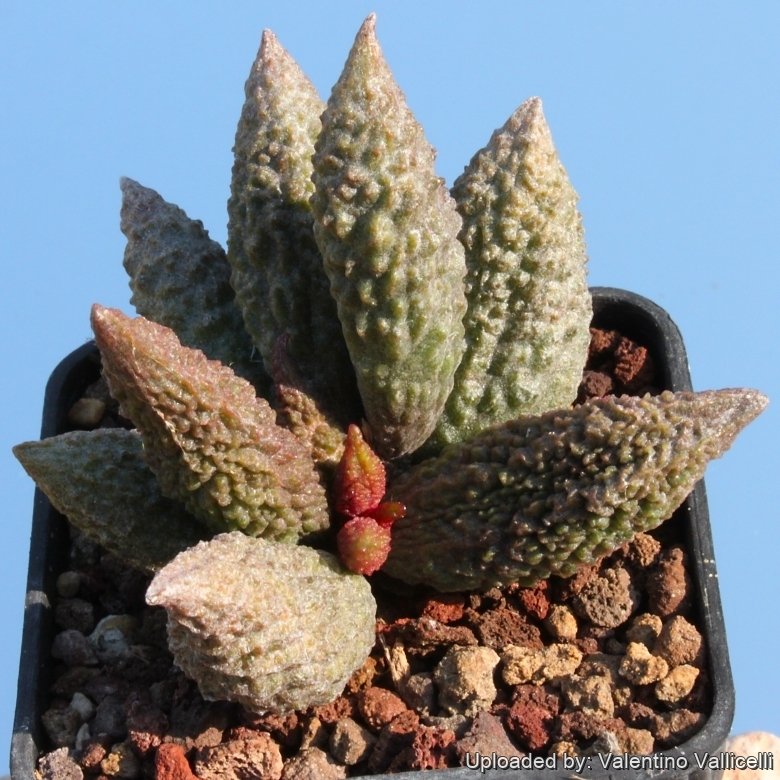
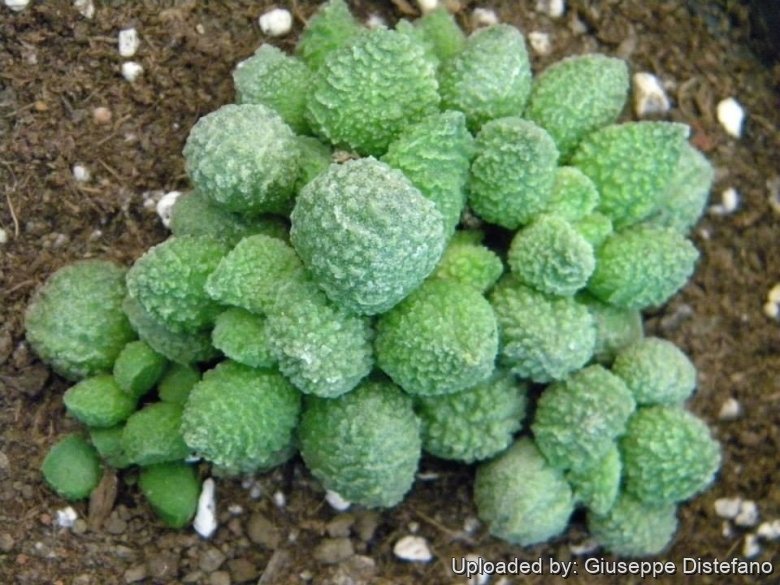
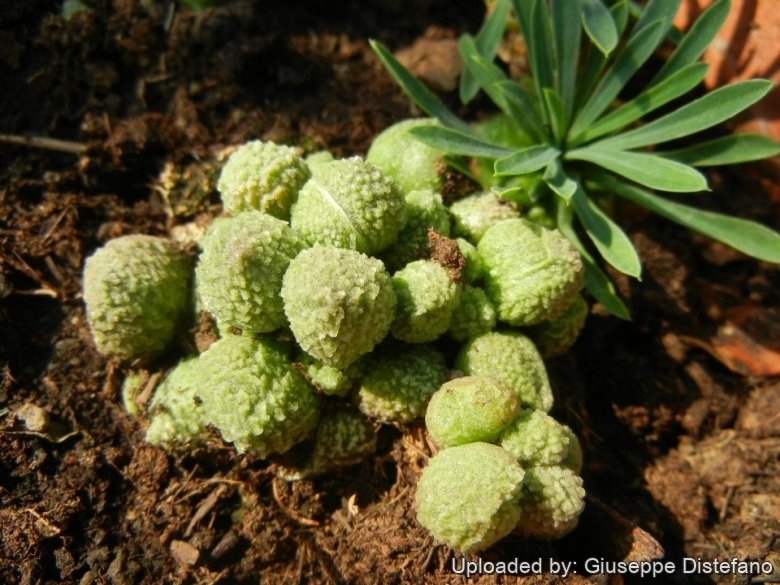
Adromischus marianae var. immaculatus } is one of the innumerable morphological and geographical variant of the very variable Adromischus marianae ). It distinguishes for the cylindrical leaves, but with great variation in marking and texture. This species is highly variable and individuals may be very different one to each other even within the same population. Cultivated plants can be reliably distinguished only when seeds or details of wild source are available.
Habit: It is a much-branched small perennial leaf succulent, with thick stems, occasionally continued in fat fibrous roots.
Stem: Short, thick ascending often constricted at the base.
Leaves: 3-9 cm long, arranged in a spiral on the main stem, oblanceolate or sometime elliptic (rarely obovate), slightly concave on both sides to terete, more-or-less verrucose (or smooth) and never purple-spotted, with an often brown or white raised and horny margin.
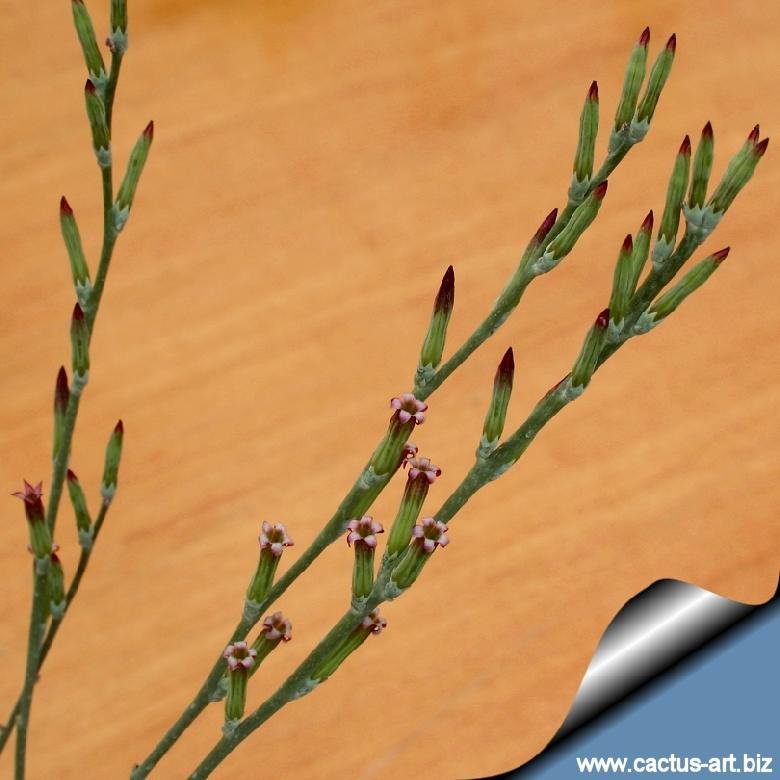
Inflorescence: Spike-like thyrse with 1-flowered cyme 10-25 cm high, grey-green.
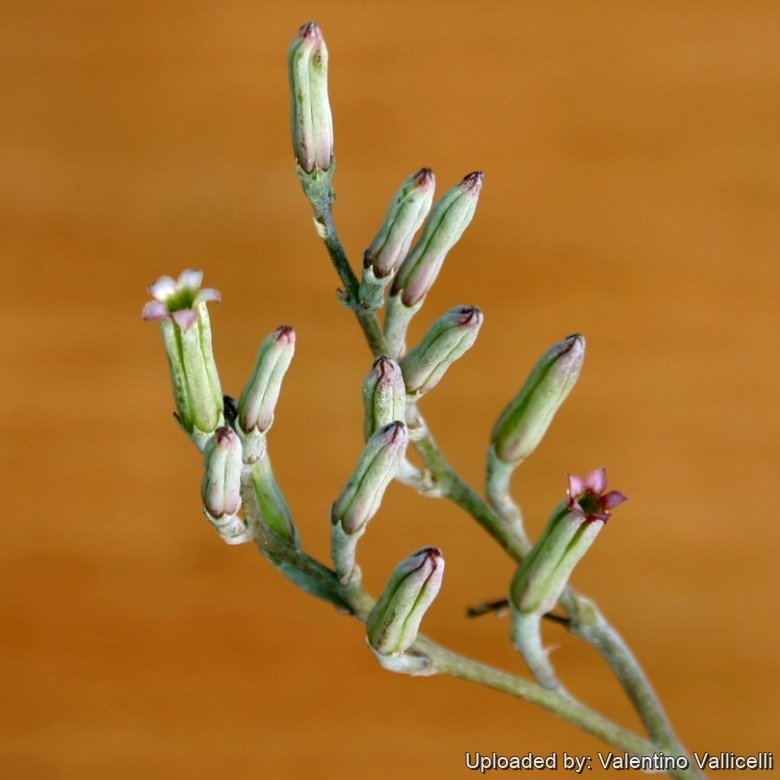
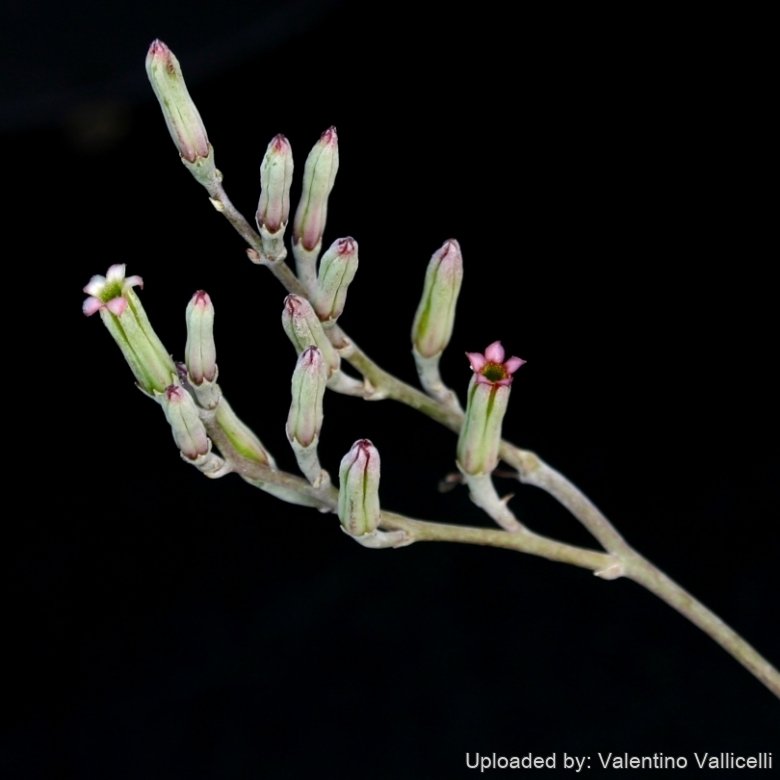
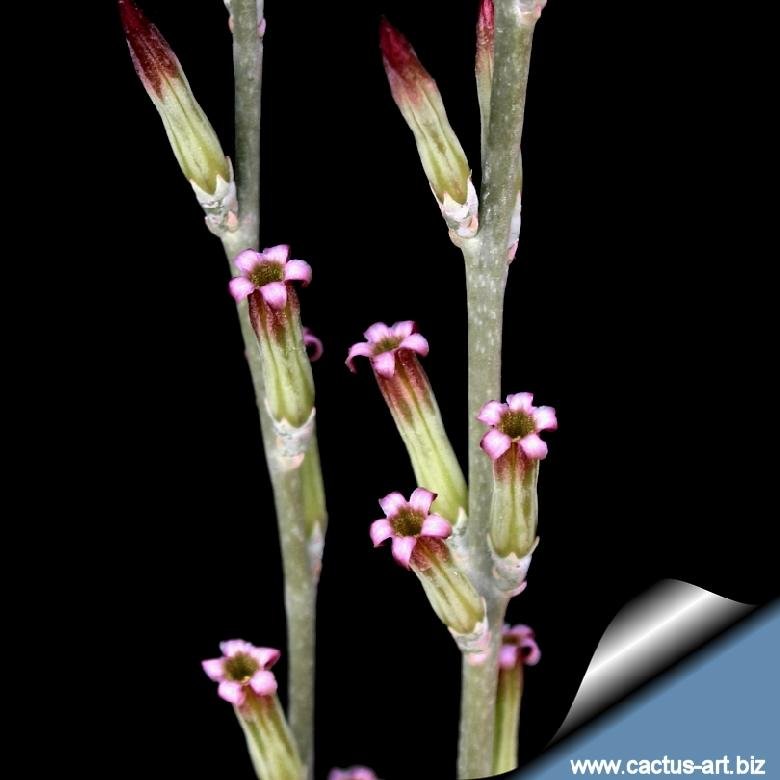
Flowers: Buds terete, slightly grooved. gradually tapered towards tip, erect at first. later spreading. Flowers 1-1,2 cm long, upright, with 5 fused petals pale pink to white, with a thick bloom. Corolla-lobes 2-3 mm long, acute, spreading or recurved, white with purple margins, rough and with club-shaped hairs mainly in throat. Anthers not protruding from corolla tube.
Seeds: Very small.
From llifle page Adromischus herrei
Description
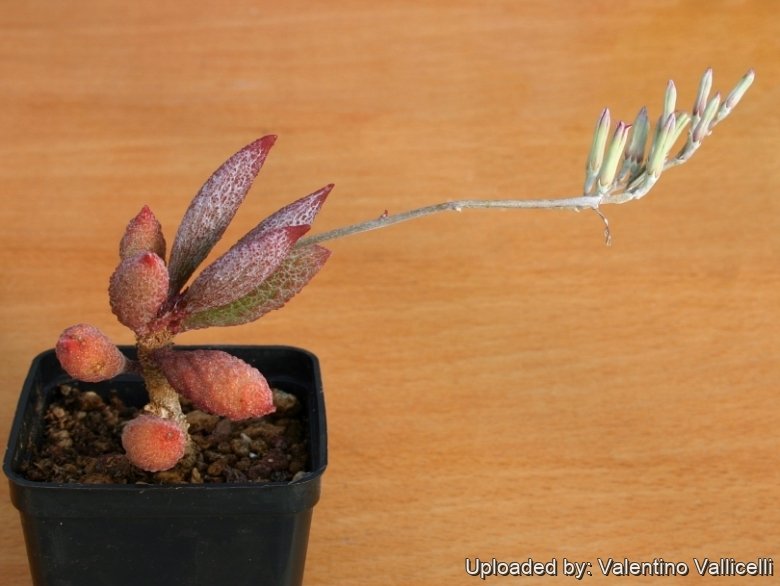
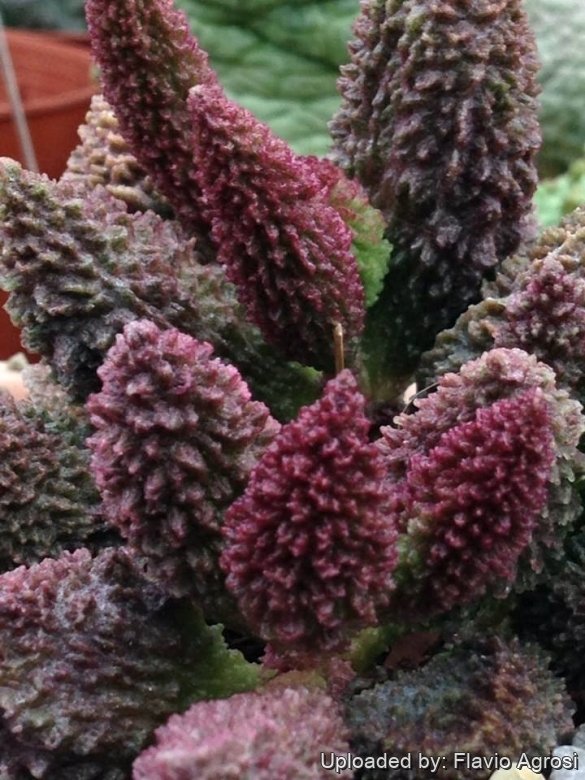
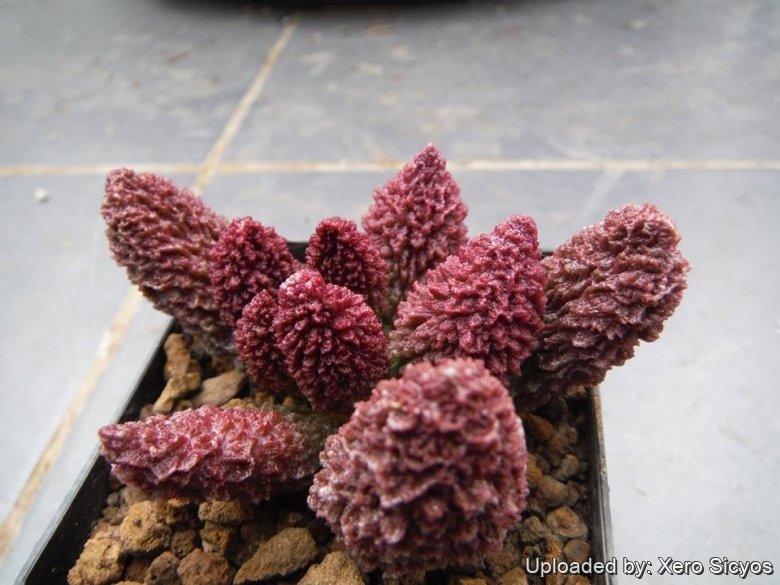
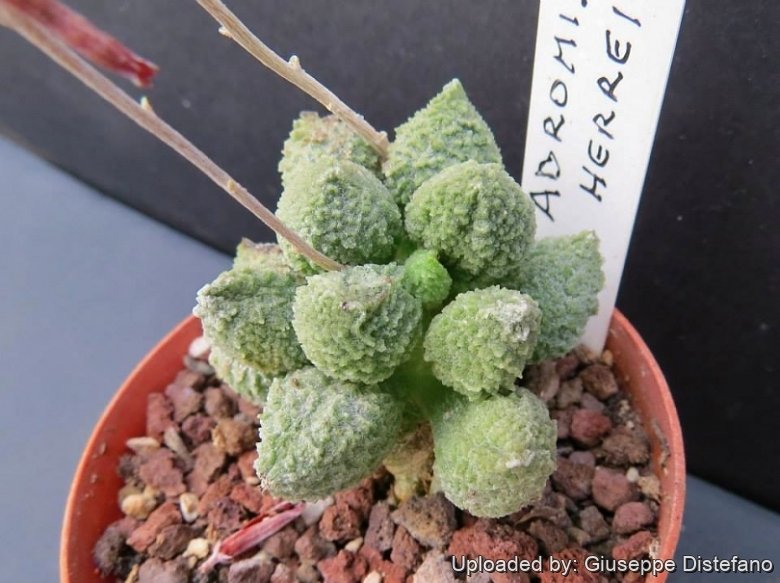
Adromischus marianae f. herrei is a small slow-growing succulent shrub constricted at the base, variable in size up to up to10 cm tall with many thin and very short branches. It is now believed to be merely a red-brown population of Adromischus marianiae with very rough leaves that looks like dried raisins. This species is variable and every clone is distinct and worth to grow more than one sample.
Stem: Short, erect, tapering, basally tuberose.
Roots: Tuberose.
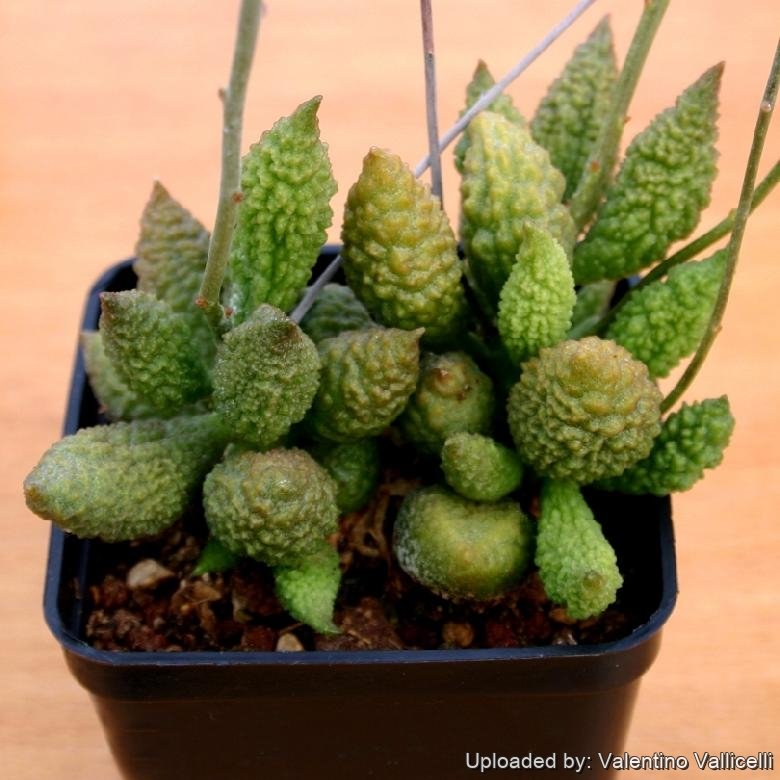
Leaves: Green to reddish-brown or purple (depending on clones, growing conditions and seasons), unspotted, becoming grey and waxy as they ages, petiolate, short, almost spherical to elongate lanceolate or oblanceolate, tapered at both ends and roundish in cross section or slightly concave above, 1,5 to 3,5 cm long, very irregularly warty (tubercled) and slightly caniculate (grooved) in the upper part. Margins absent or brownish or white, raised and more or less horny especially near the tip.
Flowers: Green with pinkish-red tinge about 12 mm long.
Origin and Habitat
South Africa (Little Namaqualand). Grows often filling up cracks on granite hills.
Cultivation and Propagation
Adromischus marianae var. herrei is a most beautiful succulent but rarely seen in cultivation. It is not the easiest species to cultivate, and highly prone to rotting off, both at the height of winter or summer.
Growth rate: It is a relatively fast growing species.
Soil: Use mineral well-permeable substratum with very little organic matter (peat, humus).
It needs perfect drainage to flourish.
Repotting: Repotting every 2-3 years. As it is especially prone to rot under-pot in a smaller container filled with very porous compost. Use pot with good drainage. All species of this genus are happy in small pots.
Exposure: It grows best in a partially shaded position. It got sunburned if exposed to midday sun.
Hardiness: Require a minimum temperature 5°C (But hardy down to -7°C for short periods), with good drainage and dryness in winter to resist the cold.
Watering: It takes more water than cacti, but let the soil dry between soaking, in the wild, it receives rain mostly in spring and fall. Must have very dry atmosphere. Water less in winter but do not allow it to shrivel.
Pest & disease: It is vulnerable to mealybugs and rarely scale. It is prone to rotting from the tuberous base or from dried inflorescences. If the plants are not watered and “aired” correctly, fungicides won’t help all that much.
Maintenance: As the plant matures, the centre becomes bare. When it does, restart it from side cuttings and throw away the central part. Remove flower spikes before winter.
Propagation: Usually propagate from single leaves (leaf cuttings) or stem cuttings seed propagation is rarely used. Leaves easily root and produce new plants. Twist off a leaf and permit it to dry out a couple of days, lay it on the soil and insert the stem end partially into the soil. The original leaf should not be removed until it has dried up. Try to keep the leaf somewhat upright so that the roots are able to grow downward. If grown in a container, bottom watering by immersing the container is recommended.
Bibliography
Major references and further lectures
-
Urs Eggli “Illustrated Handbook of Succulent Plants: Crassulaceae” Springer for Science, 01/gen/2003
-
Werner Rauh “Die großartige Welt der Sukkulenten : Anzucht und Kultur sukkulenter Pflanzen mit Ausnahme der Kakteen” Hamburg ; Berlin : P. Parey, cop. 1967
-
D. J. Court “Succulent Flora of Southern Africa” A.A. Balkema, 1981
-
James Cullen, Sabina G. Knees, H. Suzanne Cubey “The European Garden Flora Flowering Plants: A Manual for the Identification of Plants Cultivated in Europe, Both Out-of-Doors and Under Glass” Cambridge University Press, 11/ago/2011
-
J.P. Roux “Flora of South Africa“ 2003
-
Domitilla Raimondo “Red list of South African plants 2009” South African National Biodiversity Institute, 2009
-
Ernst Van Jaarsveld, Ben-Erik Van Wyk, Gideon Smith “Succulents of South Africa: A Guide to the Regional Diversity” Tafelberg Publishers, Limited, 01/lug/2000
-
Ben P. Barkhuizen “Succulents of Southern Africa: With Specific Reference to the Succulent Families Found in the Republic of South Africa and South West Africa” Purnell, 1978
Source: Adromischus herrei, LLIFLE - Encyclopedia of living forms, CC-BY-SA, retrieved 2026-10-25.
From llifle page Adromischus alveolatus
Description
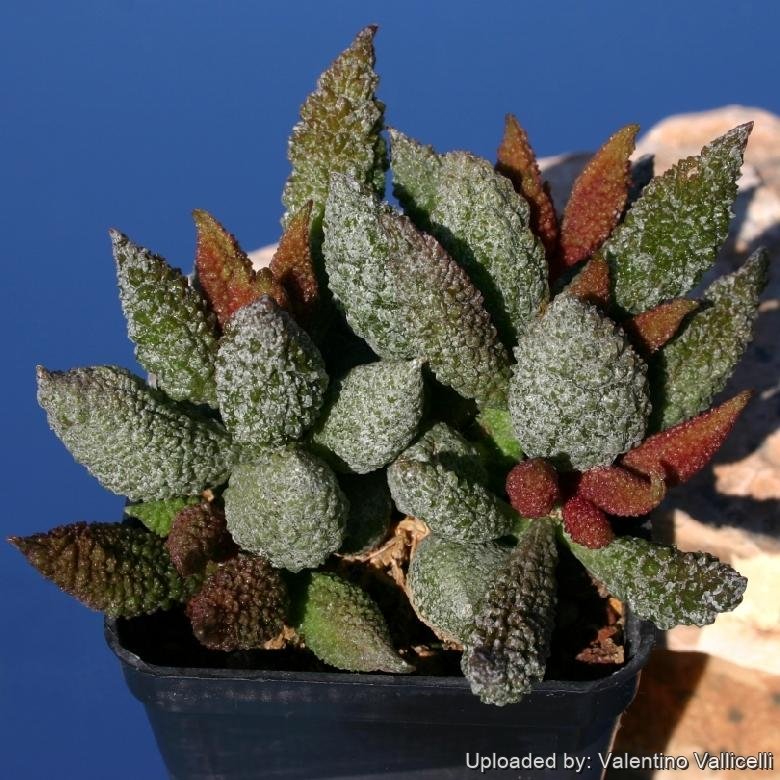
Adromischus marianae f. alveolatus is one of the innumerable morphological and geographical variant of the very variable Adromischus marianae. It is a naturally occurring form similar to Adromischus marianae f. herrei distinguished by peculiar leaves which are shorter less acute, generally more robust, and with a very rough surface. Tubercles are formed occasionally, and very often these run together to form minute and irregularly reticulate, low, rounded ridges. Some of these plants are quite extraordinary in shape.
Habit: It is a much-branched small perennial leaf succulent, with thick stems
Roots: Tuberous, occasionally continued in fat fibrous roots.
Stem: 1-2 cm long, up to 5 mm in diameter, thick ascending often constricted at the base, pale tan-green or yellow green, sometimes whitish, rugose.
Leaves: Up to 3.5 cm long and 20 mm wide, shortly petiolate, subopposite to sub- rosulate, horizontal to erect, usually symmetrical, sub-spherical to obovate or elliptic, longer than broad, often caniculate above, tappered at both ends, verrucose (warty), often alveolate, sometimes with small tubercles, unspotted, grey-green to greyish brown with a with a thick bloom. Base wedge-shaped. Margin only slightly raised and not horny, the apex often subacute.
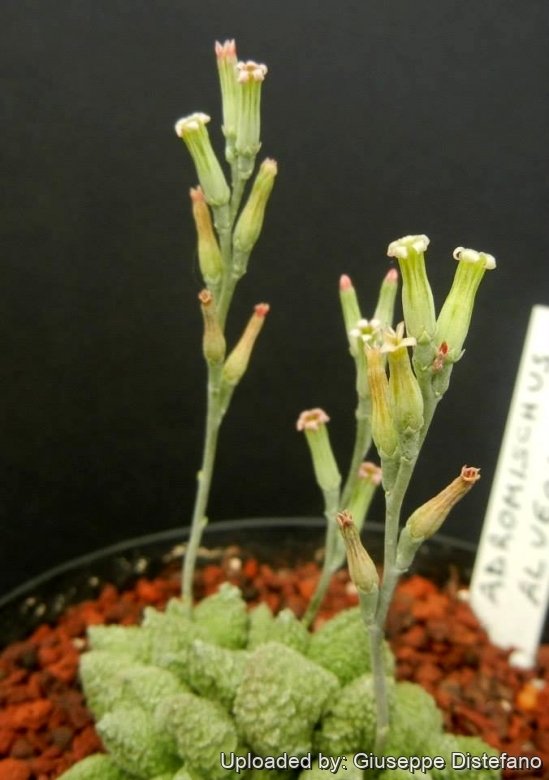
Inflorescence: Simple spike-like thyrse,with 1-flowered cyme 10-25 cm high, peduncle up to 17 cm long, up to 2.5 mm thick, glaucous, sometimes zig-zag, lower 4 cm with about 5 thick, deltoid, pulverulent sterile bracts 1 or more mm wide and 2 mm long; rachis 10 to 15 cm.
Flowers: Buds terete, slightly grooved. Flowers up to 15 erect, single, usually spirally arranged about 1 cm apart, occasionally more crowded to almost opposite. Pedicels pulverulent, white, 4 to 7 mm, long, 2 to 3 mm thick, 1-1,2 cm long pale pink, with 5 petals basally fused to form a greyish-white cylindrical tube gradually tapered towards tip, erect at first, later spreading. Corolla-lobes 2-3 mm long, and 2 mm wide, deltoid, acute, spreading or recurved, pulverulent white with purple margins, rough and with club-shaped hairs mainly in throat. Anthers not protruding from corolla tube. Perianth tube glaucous, yellowish at base, green above, maroon at apex, bright green inside, 15 mm long, 5 mm across, barely inflated, constricted just below mouth, the cross-section at mid-point pentagonal. Filaments in two rows at about mid-tube, about 5 mm long, green.Anthers included, oblong, creamy yellow. Carpels 10 to 11 mm long, green, smooth, subulate, the styles abruptly narrowing, pale yellowish green, the stigmas included. Nectary scales about 1.7 mm long and broad yellow.
Seeds: Very small.
Origin and Habitat
Cape Province, Little Namaqualand, South Africa.
Type locality: 8 miles north of Concordia on the road to Goodhouse.
Habitat: It grows in fissures on exposed sloping granite rock faces, together with a species of fern, Euphorbia dregeana, Ruschia frutescens, Ruschia albiflora, Othonna euphorbioides, Senecio cephalophora and Conophytum pellucidum.
Cultivation and Propagation
Adromischus marianae is a most beautiful succulent but rarely seen in cultivation. It is not the easiest species to cultivate, and highly prone to rotting off, both at the height of winter or summer.
Growth rate: It is a relatively fast growing species.
Soil: Use mineral well-permeable substratum with very little organic matter (peat, humus). It needs perfect drainage to flourish.
Repotting: Repotting every 2-3 years. As it is especially prone to rot under-pot in a smaller container filled with very porous compost. Use pot with good drainage. All species of this genus are happy in small pots.
Exposure: It grows best in a partially shaded position. It got sunburned if exposed to midday sun. I would not advise that any Adromischus be grown in shade, as they soon become atypical in this condition.
Hardiness: Requires a minimum temperature 5°C (But hardy down to -7°C for short periods), with good drainage and dryness in winter to resist the cold.
Watering: It takes more water than cacti, but let the soil dry between soaking, in the wild, it receives rain mostly in spring and fall. Must have very dry atmosphere. Water less in winter but do not allow it to shrivel.
Pest & disease: It is vulnerable to mealybugs and rarely scale. It is prone to rotting from the tuberous base or from dried inflorescences. If the plants are not watered and “aired” correctly, fungicides won’t help all that much.
Maintenance: As the plant matures, the centre becomes bare. When it does, restart it from side cuttings and throw away the central part. Remove flower spikes before winter.
Propagation: Usually propagate from single leaves (leaf cuttings) or stem cuttings seed propagation is rarely used. Leaves easily root and produce new plants. Twist off a leaf and permit it to dry out a couple of days, lay it on the soil and insert the stem end partially into the soil. The original leaf should not be removed until it has dried up. Try to keep the leaf somewhat upright so that the roots are able to grow downward. If grown in a container, bottom watering by immersing the container is recommended.
Source: Adromischus alveolatus, LLIFLE - Encyclopedia of living forms, CC-BY-SA, retrieved 2026-10-25.
Gallery