Publication: Evol. Syst. Crassulaceae 41 1995.
Description
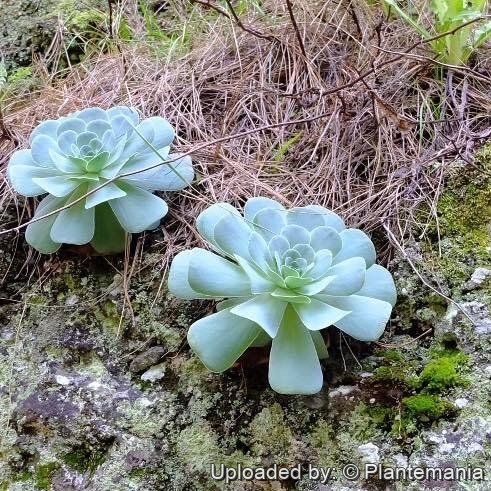
Aeonium aureum (Greenovia aurea) is a monocarpic perennials succulent plant that forms a dwarf prostrate, clump that reacing a height between 30 and 45 centimeters. It bears cup-shaped rosettes of leaves and deep yellow flowers in the spring. Its leaves are rounded and spathulate, with a short point or tip, grey-green-velvet covered with a bluish-green waxy layer. Aeonium aureum also forms a corresponding hibernation stage in summer, with the younger leaves forming a dense, narrow cylinder while the older leaves wilt but are still attached to the rosette, protecting it further against drough. The rosette take a rose-bud shape and resemble closely a bright green rose. It is cultivated by succulent plant enthusiasts and is the most commonly grown Greenovia.
Rosettes: Solitary or occasionally offsetting, 8-15(-25) cm, cup-shaped to deep, funnel-shaped with the inner leaves erect, tightly closed during the dry season.
Leaves: 5-11 long, 3-6 cm wide, fleshy, spatulate, obovate-spatulate or wedge-shaped, apically rounded, truncate or broadly cuneate, minutely apiculate or retuse, basally broadly cuneate, glabrous, grey-green with reddish or blue-green tones, glaucous, margin hyaline and rarely with some minute glandular hairs, pale green.
Inflorescences. The inflorescence are 10-25 cm tall, 20-45 cm across, deep vellow and borne on a densely leafy, hairv stem 15-35(-40) cm long. The inflorescence has dense bracts and branches that give it the shape of a flat-topped head. Pedicel 2-5 mm long, pubescent. After the inflorescence develops, the rosette dies, but it produces a large number of off-shoots at the base of the mother rosette.
Flowers: 25- to 32-merous. Sepals puberulent or pubescent. Petals 7-8 mm long, 1.5-2 mm in diameter, oblanceolate, acuminate, often apiculate, deep yellow. Filaments glabrous.
Origin and Habitat
Canary Islands (Gran Canaria, Tenerife, Gomera, La Palma, Hierro, with the exception of Lanzarote and Fuerteventura).
Altitude range: It occurs at altitudes from 400 to 2000 metres above sea level.
Habitat and ecology: Aeonium aureum forms rather large tufts in habitat. As a location cliffs and rooftops are preferred.
Bibliography
Major references and further lectures
-
Ho-yih Liu “Systematics of Aeonium (Crassulaceae)” National Museum of Natural Science, 1989
-
Urs Eggli “Illustrated Handbook of Succulent Plants: Crassulaceae” Springer Berlin Heidelberg, 05/Nov/2012
-
Miguel A. Cabrera Perez, “Die einheimische Flora der Kanarischen Inseln”. Ed. Everest, Leon 1999
-
Adalbert Hohenester, Walter Welss, “Exkursionsflora fur die Kanarischen Inseln”. Ulmer, Stuttgart 1993
-
Ingrid Schonfelder, Peter Schinfelder, “Kosmos-Atlas Mittelmeer- und Kanarenflora”. Uber 1600 Pflanzenarten. Franckh-Kosmos-Verlag, Stuttgart 2002.
-
Per Sunding, “The Vegetation of Gran Canaria”, Univ.-Forlaget, 1972
-
John A. Burton, Sabina G. Knees, Mike Read, “CITES guide to plants in trade”, Royal Botanic Gardens, Kew, Great Britain. Dept. of the Environment, 1994
-
Werner Rauh, “The Wonderful World of Succulents: Cultivation and Description of Selected Succulent Plants Other Than Cacti”, Smithsonian Institution Press, 1984
-
William Taylor Marshall, “Succulent Plants”, Sawyer’s, 1945
-
Clive Innes, “Complete Handbook of Cacti and Succulents”, Van Nostrand Reinhold Company, 01 December 1981
Gallery