Description
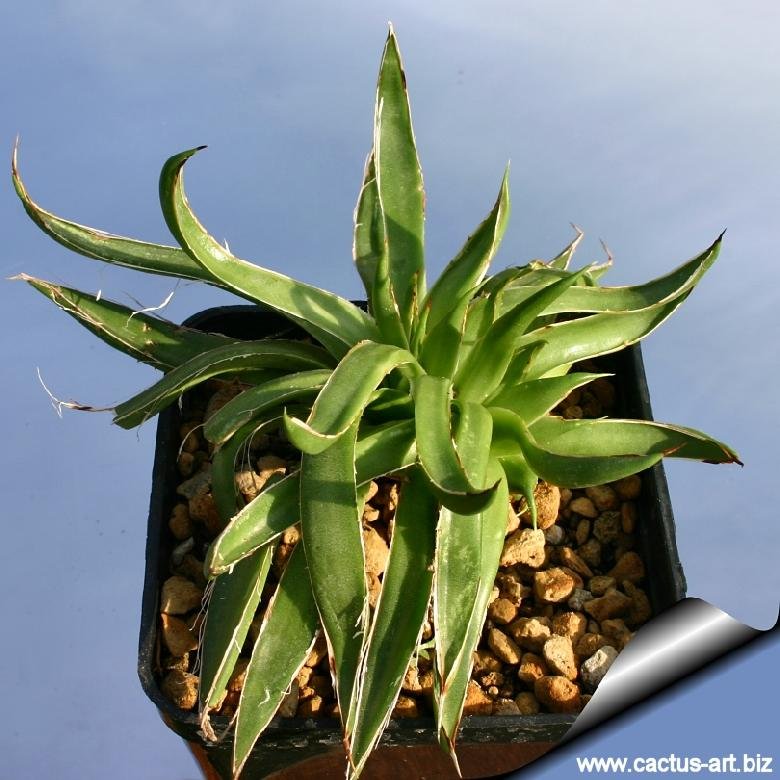
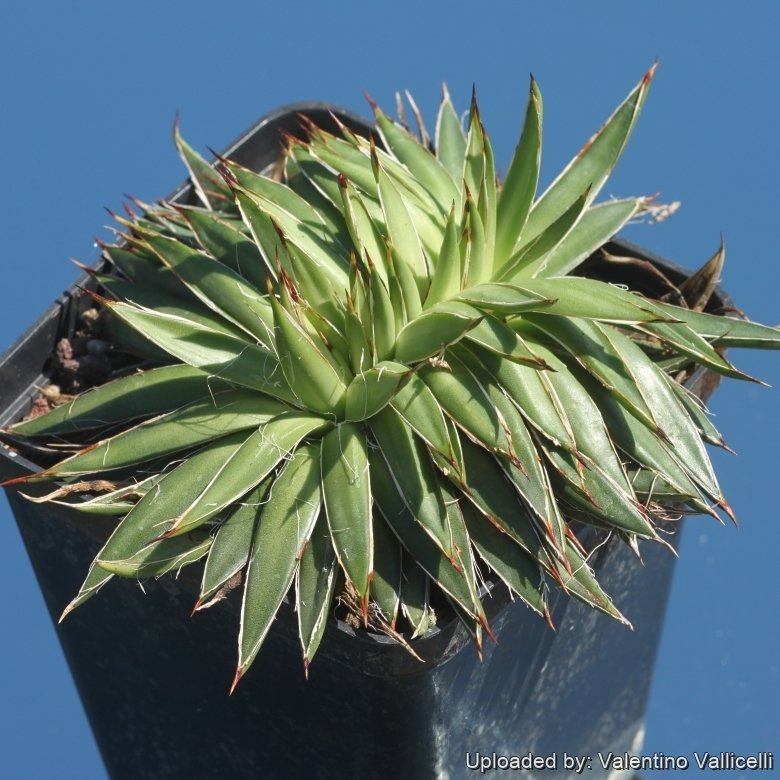
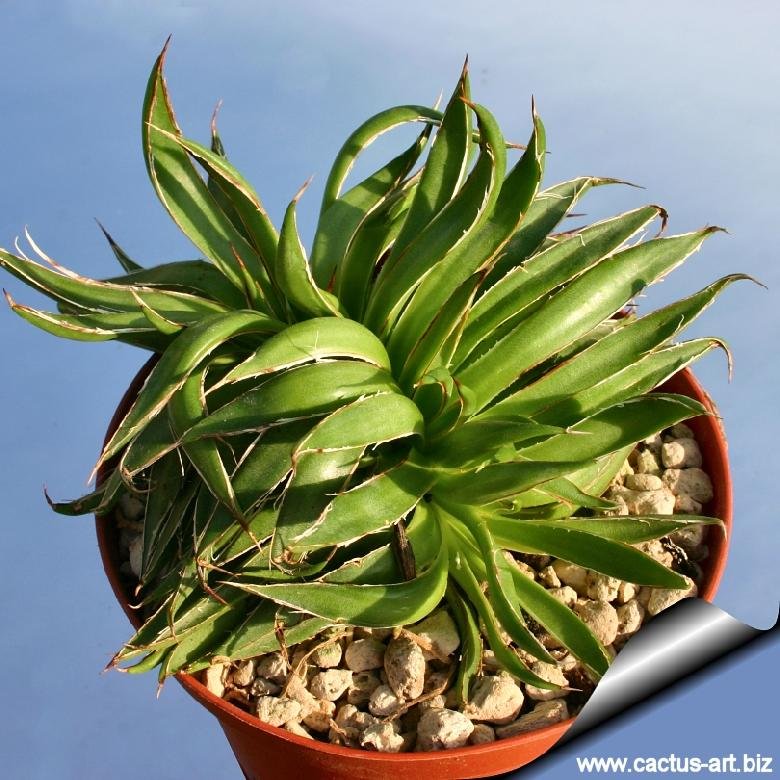
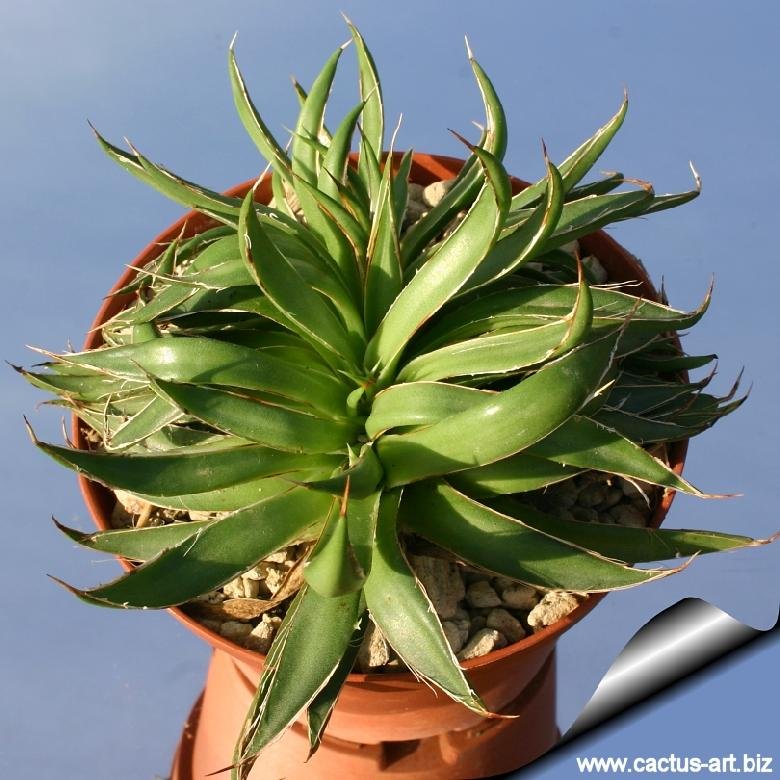
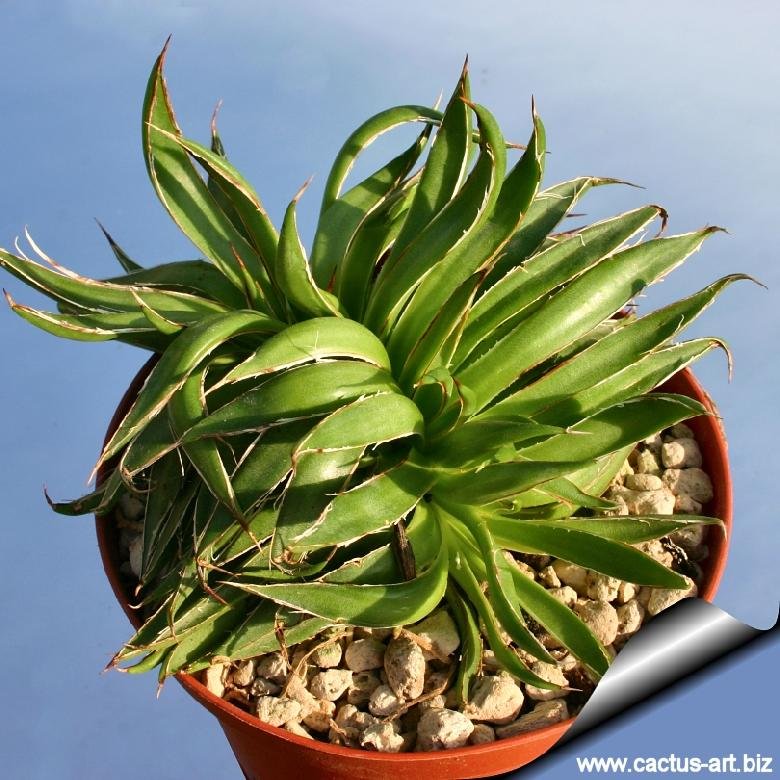
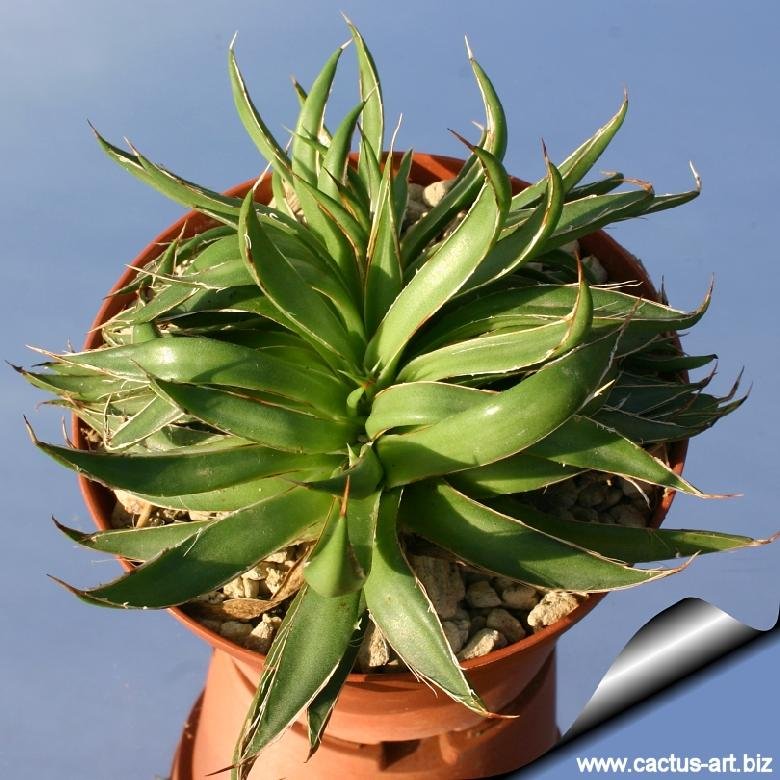
Agave filifera (a.k.a. Thread-leaf Agave) is a small to medium sized agave that forms attractive rosette of leathery leaves each ending in a stout stiff spine. The leaves are dark green in colour with ornamental white threads along the edge.
Crested form: The crested form Agave filifera f. cristata is an attractive dwarf plant and one of the few crested Agave known. Despite to its beauty it is still very rare and sought after by collectors, for its unique features.
Leaves: Usually about 15 cm long and less than 2 cm wide, straight, lanceolate, long-tapering to the apex, narrowed towards the base, broadest in middle, convex above and below from base to mid-blade, stiff, spreading and somewhat upcurved, leathery, smooth, shiny dark green with bud-prints (white lines) on the surface. Margins pale, horny, splitting off as 3 or 5 long, thin threads. Terminal spine 1 cm, brown.
Inflorescence: Not seen.
Origin and Habitat
Known only in cultivation.
Cultivation and Propagation
It is a stunning specimen plant for containers or a well drained spot in the garden. It tend to be slow grower, but worth the effort.
Soil: Grow it in porous soil with adequate drainage.
Sun exposure: It do well in full sun or a lightly shaded area.
Moisture: Water thoroughly when soil is dry to the touch. In winter watering this plant can be done once every 1-2 months, there is no need to mist the leaves.
Hardiness: It is theoretically hardy to -3° C, particularly when dry but it is best to avoid severe freezing temperatures.
Heat Tolerance: Good.
Crested growth: Unlike ‘monstrose’ varieties of plants, where the variation from normal growth is due to genetic mutation, crested growth can occur on normal plants. Sometimes it’s due to variances in light intensity, or damage, but generally the causes are unknown. A crested plant may have some areas growing normally, and a cresting plant that looks like a brain, may revert to normal growth for no apparent reason. If you have any of the crested part left you need to remove the normal growth and leave the crested part behind this will need to be done regularly.
Uses: These striking plants are wonderful when used for accent or simply to provide some all year round foliage colour and often used in a pot as a patio plant, they make an eye-catching statement and along with other evergreen plants in pots, can be moved around to change the scenery or position to give more shelter.Uses: These striking plants are wonderful when used for accent or simply to provide some all year round foliage colour and often used in a pot as a patio plant, they make an eye-catching statement and along with other evergreen plants in pots, can be moved around to change the scenery or position to give more shelter.
Propagation: Relatively easy to propagate by seeds or by suckers (if available) Remove the basal suckers in spring or summer and let the cuttings dry for a few days before inserting in compost.. only problem is the logistics of getting to the suckers - very sharp spines and suckers usually right up against, or underneath the mother plant.
Bibliography
Major references and further lectures
-
Howard Scott Gentry “Agaves of Continental North America” University of Arizona Press, 01/Feb/2004
-
Urs Eggli “Illustrated Handbook of Succulent Plants: Monocotyledons” Springer, 2001
-
Hermann Jacobsen ”A Handbook of Succulent Plants: Abromeitiella to Euphorbia” Blandford Press, 1960
-
Stuart Max Walters “European Garden Flora: A Manual for the Identification of Plants Cultivated in Europe, Both Out-of-Doors and Under Glass” Cambridge University Press, 1984
-
Breitung, A. J. (1962); “Cultivated and native Agaves in the South-western United States” (Part 19; Cact. Succ. J. (USA) 34(2): 42-45.
-
Breitung, A. J(1968): “The Agaves.” Cact. Succ. J. (USA) Yearbook, Abbey Garden Press, Reseda.
-
Terraciano, A. (1885): “Primo contributo ad una monografia delle Agave.” Stabil. Tipogr. Barnaba Cons di Antonio, Napoli.
-
William Davidson “The illustrated directory of house plants: a practical guide to growing over 500 plants for the home” Salamander, 01/Nov/1990
-
Margaret Martin, Peter Chapman “A gardner’s guide to cacti and succulents: how to grow these fascinating plants in the home and greenhouse : featuring 150 species” Salamander Books, Limited, 198