Publication: Wochenschr. Vereines Beford. Gartenbaues Konigl. Preuss. Staaten (1862) 83, 143. Remarks: as “ghiesbrechtii”.
Description
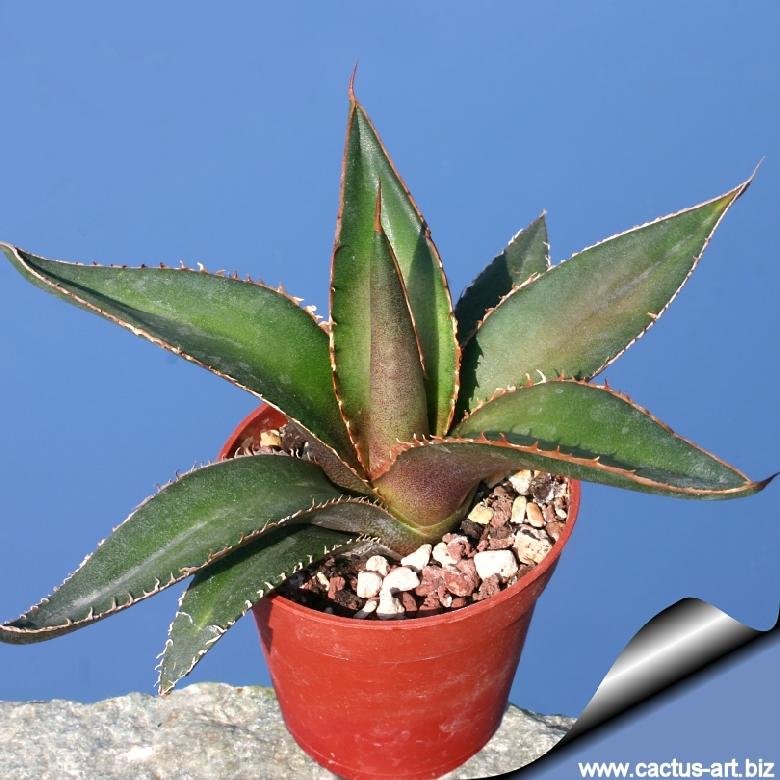
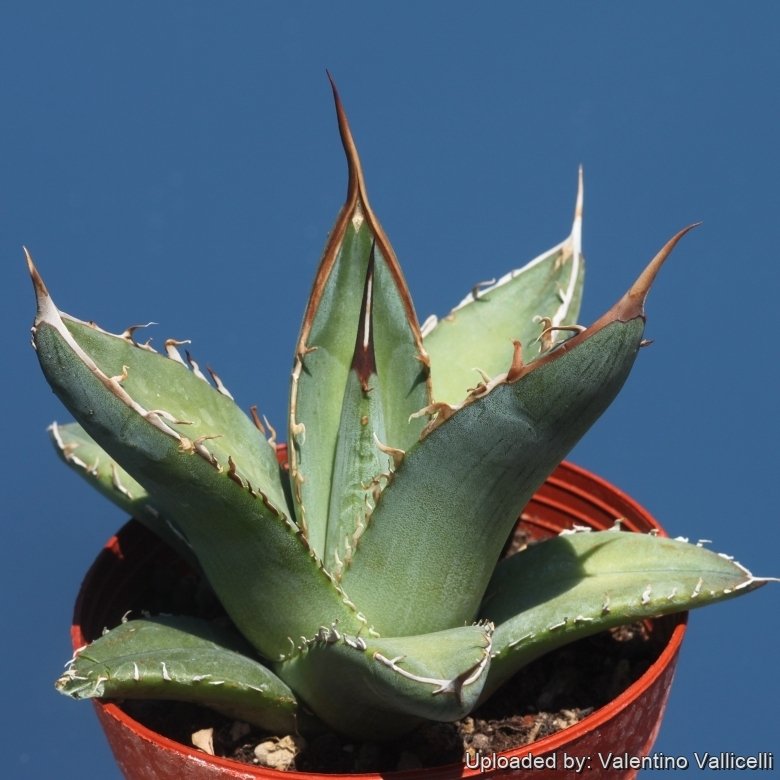
Extensively offsetting medium sized agave, with neat succulent rosettes, up to 75 cm in diameter, 50 cm tall. It suckers profusely and in the garden it can become invasive, slowly forming small compact clumps with several offsets on short rhizomes growing close to the mother plant . Often used for hedge and animal barrier.
Rosette: Open with few short leaves, strongly armed leaves.
Stem: Acaulescent.
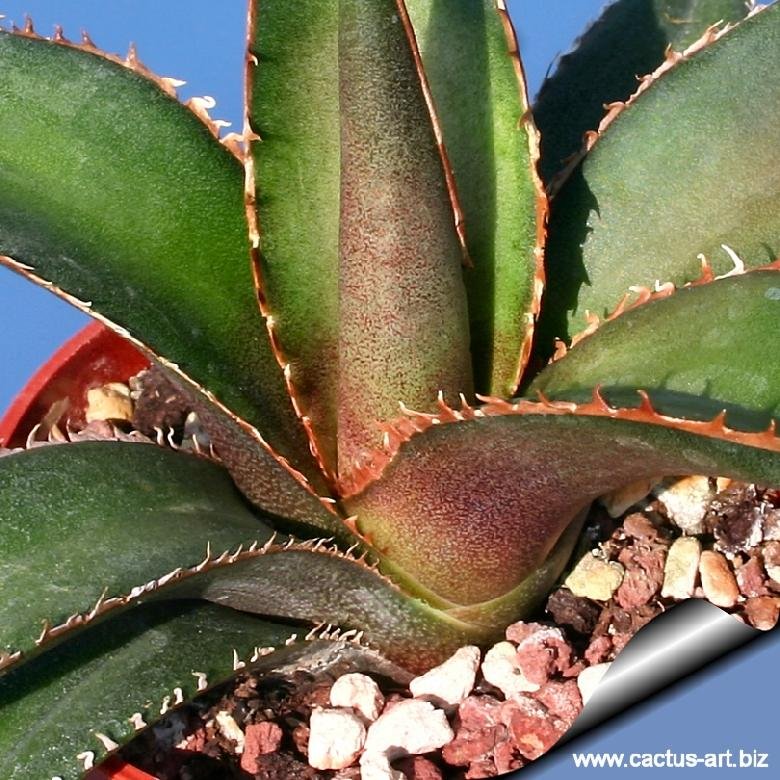
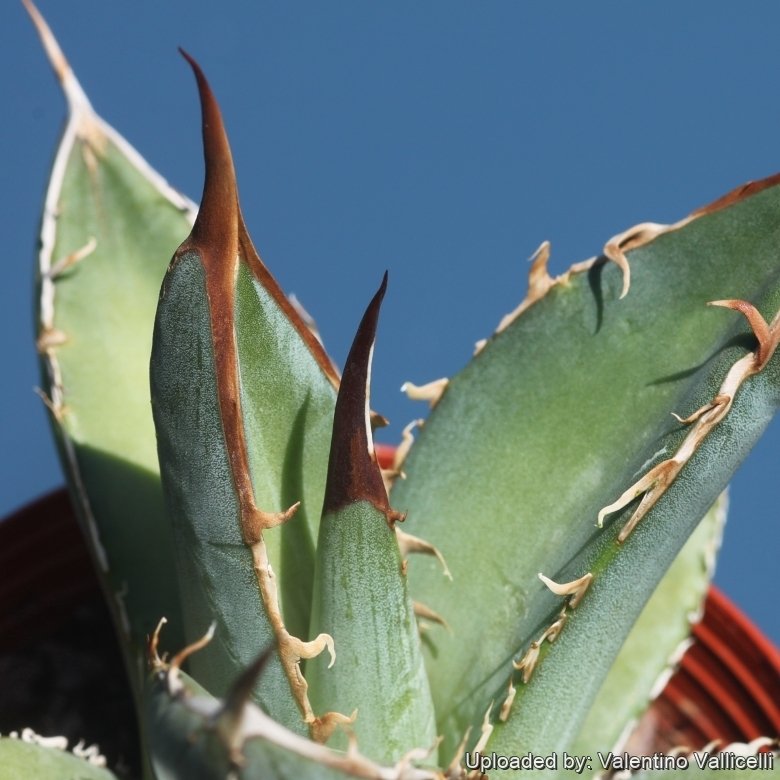
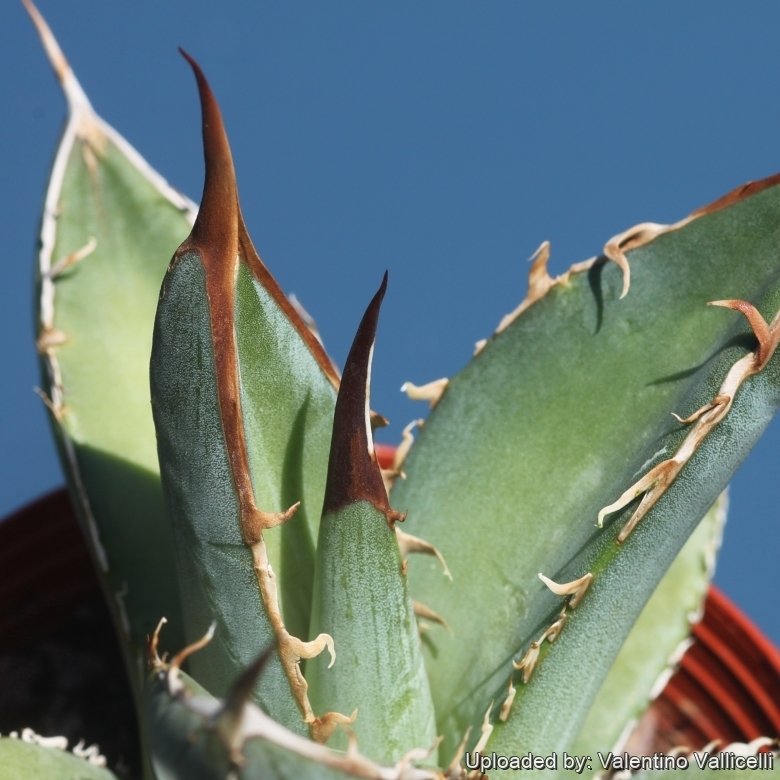
Leaves: 30-40(-65) cm long, 7-10(-12) cm wide, of mature plants generally rigid, broadly lanceolate/deltoide, widest toward the middle, slightly guttered on the upper surface, stiff, flat, convex below and slightly incurved. The leaves are colourful dark green, bluish green or purplish green sometime lighter (usually with a hint of yellow stripe down the middle). The terminal spine is about 1,5-2(-49 cm long, subulate, slightly decurved and scarcely channelled. The margins is attractive, horny, brown-red that age to pale grey as the leaf ages, contrasting well with the dark green leaves and have straight or slightly down turned spines 5-15 mm long (including the margin), 1-4,5 cm apart, typically occurring only on the lower two-third of the leaf.
Inflorescence: (2,5)-3- 4(5) m, unbranched, spicate, with very numerous flowers densely set on the upper half.
Flowers: Greenish-purple or greenish brown 40-50 mm, Pedicel 3-4 mm long; Ovary cylindrical. 16 - 20 mm, neck constricted; tepals greenish-brown to purplish, paler within; tube broadly funnel-shaped. 3 - 5 (-10?) mm. lobes subequal l5 - 21 mm long.
Blooming season: Often in the spring.
Fruits: 2,2 cm x 1,5 cm long capsules.
Seeds: 4 x 3 mm oblong.
Remarks: It is related to Agave kerchovei, but different by its shorter and broader leaves with more and smaller teeth on narrower and darker horny margins. It can be distinghuished by Agave lophantha and Agave lechugulla by its leaves that are wider in the centre of the blade and a little curved and for the small straight teeth and the uniform , not striated leaf surface. It differs from Agave schidigera by its lack of filaments, and wider and fewer leaves.
Origin and Habitat
Mexico (Mexico, Guerrero. Puebla. Oaxaca. Chiapas) and Guatemala.
Habitat: Grassy slopes of oak-Pinion woodland and in the mattoral xerofilo. The climate is an open one below the Tropic of Cancer with a protracted dry season from January to May.
Cultivation and Propagation
A. ghiesbreghtii is a stunning specimen plant for containers or a well drained spot in the garden abd noted as rare in cultivation. It tend to be slow grower, but worth the effort. Grow them in porous soil with adequate drainage. They do well in full sun or a lightly shaded area. Water thoroughly when soil is dry to the touch. In winter watering this plant can be done once every 1-2 months, there is no need to mist the leaves. It is theoretically hardy to -3° C, particularly when dry but it is best to avoid severe freezing temperatures.
Heat Tolerance: Excellent.
Propagation: Relatively easy to propagate by seeds or by suckers (if available) Remove the basal suckers in spring or summer and let the cuttings dry for a few days before inserting in compost. only problem is the logistics of getting to the suckers - very sharp spines and suckers usually right up against, or underneath the mother plant.
Use: These striking plants are wonderful when used for accent or simply to provide some all year round foliage colour and often used in a pot as a patio plant, they make an eye-catching statement and along with other evergreen plants in pots, can be moved around to change the scenery or position to give more shelter.
From llifle page Agave purpusorum
Description
Agave purpusorum is an offsetting medium sized agave perhaps only a local form of Agave ghiesbreghtii, the “purpusorum form”has more open, few-leaved rosettes with shorter green leaves. It suckers profusely slowly forming small compact clumps with several offsets on short rhizomes growing close to the mother plant .
Rosette: Open with few short, strongly armed leaves, usually 35-70 cm in diameter and 25-40 cm high.
Stem: Trunk-less .
Leaves. Leaves broadly lanceolate ovate, deltoid or (rarely) broadly linear, straight or up-curving, thick, rigid, narrowed above the base and widest in the middle, apex acuminate, convex or more or less triangular below, plane to deeply grooved on the upper surface, 17-25(-35) long and (5-)6- 7(-12) cm wide, smooth, dark to light green. Sometime broadly pale stripped with paler green in the centre of the leaves. Margins horny. relatively narrow, brown; marginal teeth frequently straight, sometimes curved upwards or downwards, larger teeth 5 - 8 (-10) mm. Brown to greyish 1-3 cm apart, reduced at the Leaves apex; Terminal Spine subulate. 2-4 cm horny, brown to grey.
Flowers: Greenish-purple or greenish brown 40-50 mm, Pedicel 3-4 mm long; Ovary cylindrical. 16 - 20 mm, neck constricted; tepals greenish-brown to purplish, paler within; tube broadly funnel-shaped. 3 - 5 (-10?) mm. lobes subequal l5 - 21 mm long.
Blooming season:** Often in the spring.
Fruits: 2,2 cm x 1,5 cm long capsules.
Seeds:*** 4 x 3 mm oblong.
Origin and Habitat
Mexico, state Puebla, near Tehacan
Cultivation and Propagation
Often used for hedge and animal barrier. It is a stunning specimen plant for containers or a well drained spot in the garden. Grow it in porous soil with adequate drainage. It do well in full sun or a lightly shaded area. Water thoroughly when soil is dry to the touch. In winter watering this plant can be done once every 1-2 months, there is no need to mist the leaves.
It holds up well in drought situations and can take light freezes.
Propagation: Relatively easy to propagate by seeds or by suckers. Remove the basal suckers in spring or summer and let the cuttings dry for a few days before inserting in compost. only problem is the logistics of getting to the suckers - very sharp spines and suckers usually right up against, or underneath the mother plant.
Uses: These striking plants are wonderful when used for accent or simply to provide some all year round foliage colour and often used in a pot as a patio plant, they make an eye-catching statement and along with other evergreen plants in pots, can be moved around to change the scenery or position to give more shelter.
Source: Agave purpusorum, LLIFLE - Encyclopedia of living forms, CC-BY-SA, retrieved 2026-10-25.