Publication: Gartenflora 23: 76 (1874). et in Belg. Hortic. (1883) 238.
Description
Agave marmorata is an unusual, mid-sized species generally non-suckering with large, broad leaves. It is named “marmorata” (marbled) for the greyish marble-like hue and transverse zones that bar sometimes the leaves especially on specimens grown in full sun.
Stem: stemless or short stemmed.
Rosettes: 1,2-1,3 m wide and up to 2 m in diameter, large with about 30-50 leaves, often prostrate, openly spreading, more or less irregular in shape with contorted leaves flattened on the ground.
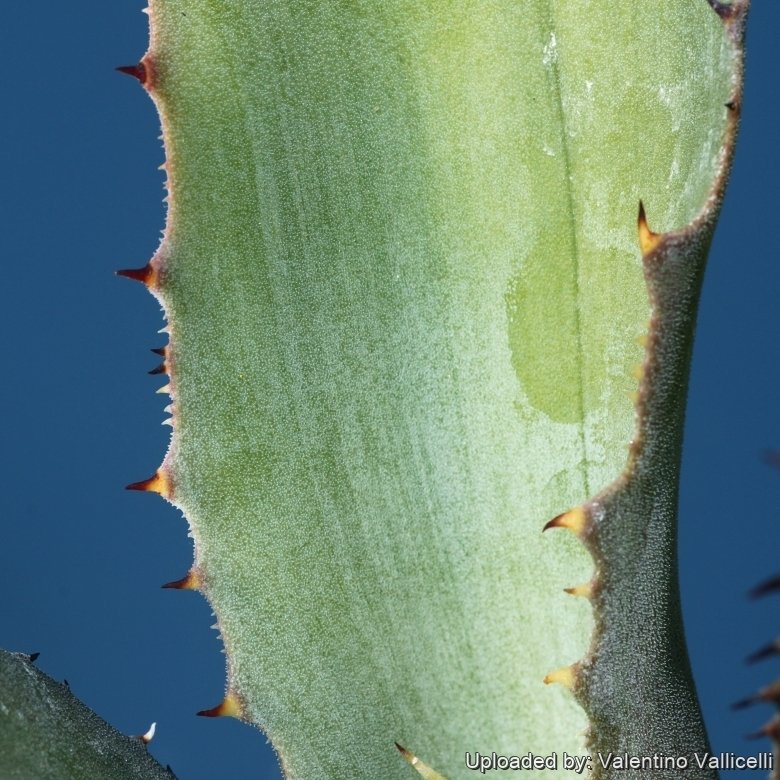
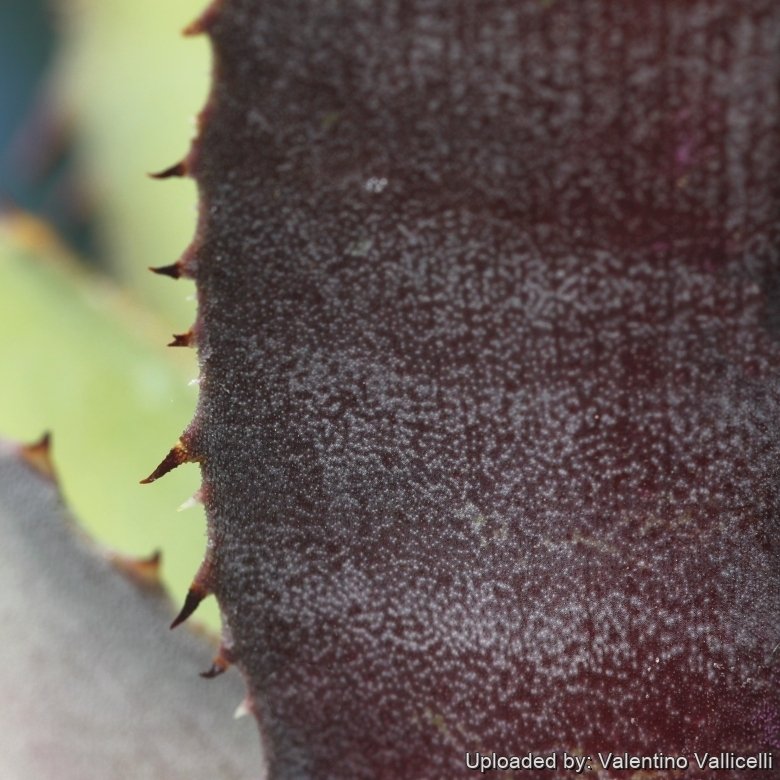
Leaves: 100-135 cm long 20-30 cm wide, soft-fleshy, convoluted, recurved from the centre, broadly lanceoate, frequently undulate, thick at base, flat above, convex below, generally characteristically sandpaper-surfaced, dusky green to slightly glaucous, often zonate (distinctly striped) in pale blue and greyish green, but quite variable in differed populations and clones. The shape and patterns of leaves also depends on cultivation conditions. The back of leaves are often purple in young specimens. Margins deeply serrated, teeth more or less numerous, mostly 6-12 mm long, 2-5 cm apart, irregularly arranged on nipples, flattened, mostly straight, castaneous to dark brown, interstitial teeth few or none; apical spine usually short conic, 1.5-3 cm long and horny.
Inflorescence: The inflorescence is a 5-6.5 m tall panicle with stout peduncle and
20-25 large diffuse decompound umbels in upper half of stalk; usually with no bulbils.
Flowers: Small yellow, 40-48 mm long; ovary 20-25 mm long, light green, cylindric, the neck unconstricted and scarcely grooved; tube 5-6 mm deep, 12 mm wide, shallowly funnelfonn, grooved, the sinuses soon spreading; tepals equal, 14- 16 mm long, 4 mm broad, linear, fleshy, erect, involute, the apex galeate, dark colored; filaments 34-37 mm long, inserted in orifice of tube or near base of tube, slender, yellow; anthers 18 mm long yellow.
Fruit: Capsules oblong, 4 it 1.6-1.8 cm slender stipitate, short-beaked, thin-walled
Remarks: Several other agaves species have very contrasting areas: Agave colorata, Agave murpheyi, Agave sobria, and some selected clones of Agave zebra and Agave americana.
Agave marmorata belongs to the Marmoratae tribe along with Agave gypsophila, Agave nayaritensis, Agave valenciana and Agave zebra.
Origin and Habitat
Oaxaca, Mexico
Cultivation and Propagation
It is a stunning specimen plant for containers or a well drained spot in the garden. It tend to be slow grower, but worth the effort. Grow it in porous soil with adequate drainage. It do well in full sun or a lightly shaded area. Water thoroughly when soil is dry to the touch. In winter watering this plant can be done once every 1-2 months, there is no need to mist the leaves.
It holds up well in drought situations and can take light freezes.
Propagation: Relatively easy to propagate by seeds or by suckers (if available) Remove the basal suckers in spring or summer and let the cuttings dry for a few days before inserting in compost, only problem is the logistics of getting to the suckers - very sharp spines and suckers usually right up against, or underneath the mother plant.
Uses: These striking plants are wonderful when used for accent or simply to provide some all year round foliage colour and often used in a pot as a patio plant, they make an eye-catching statement and along with other evergreen plants in pots, can be moved around to change the scenery or position to give more shelter.