Publication: Trans. Acad. Sci. St. Louis 23: 135, pl. 7. 1915
Description
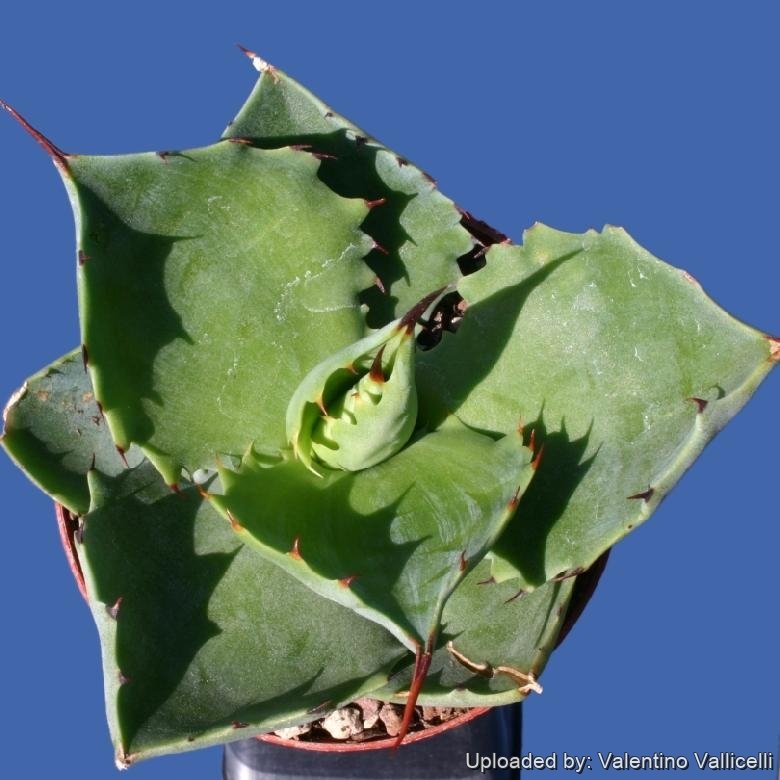
Agave pachycentra is a magnificent, large Agave with broad light green leaves. It is highly variable in leaf size, form, armature, and coloring.
Rosette: Stemless rather open medium-sized to rather large up to 2 m in diameter.
Leaves: Broadly lanceolate 15 to 20 cm. wide, 35 to 60 cm long, very light green, pale blue or nearly white, with heavy recurved blackish thorns along their margins. However the leaves are quite variable on different variants of the species and can bear different coloured teeth and spines; the red brown ones look particularly attractive on the fresh green of the leaf-lamina. The apical spine is large dark reddish-brown to grey 8 mm wide and 50 to 60 mm long.
Inflorescences: Flowering stalk, crooked with loosely flowered, open panicles with small yellow umbels.
Origin and Habitat
Mexico (Oaxaca, Chiapas), Guatemala, Honduras, El Salvador.
Type locality: La Cruz, railroad station in the valley of Rio Motagua at 310-375 metres above sae level, Guatemala.
Altitude: It grows below 1200.
Habitat: Agave pachycentra grows on open, often rocky or brushy steep hillsides, especially on volcanic rock outcrops among bunch-grass sometimes in extensive pine and oak thorn forest. The climate is semi-arid with a long dry hot spring.
Cultivation and Propagation
Agave pachycentra is a more tropical species that tolerate both drier conditions and an occasional very light freeze, but likely it will depend on from where this wide ranging plant was collected.
Growth rate: It is a relatively rapidly growing species given the best conditions.
Exposure: They do well in full sun or a lightly shaded area with afternoon shade.
Soil: They do best in very well-drained, sandy or gravely soil. As ornamental they are also grown in containers where they stay much smaller than their outdoor brethren. In pots they need a very porous mix soil (e.g. 2 parts peat moss to 1 part loam to 1 part of pumice).
Repotting: Use pot with good drainage.
Fertilization: They grows quickly if kept well nourished with a slow release fertilizer specifically formulated for cactus and succulents applied once or twice a year (poor in nitrogen), including all micro nutrients and trace elements.
Hardiness: Keep it in a cool, frost-free area in winter and put it out on the balcony or patio in summer. It grows fairly fast in summer if provided with copious water but allows to dry thoroughly before watering again. During the winter months, one should only water enough to keep the leaves from shrivelling.
Scenography: They are usually cultivated outdoors in tropical rock gardens, in cactus and succulent gardens, in borders, or as a specimen. These striking plants are wonderful when used for accent or simply to provide some all year round foliage and often used in a pot as a patio plant, can be moved around to change the scenery or position to give more shelter.
Warning: It is armed with sharp spines.
Propagation: Seeds
Notes
The Central American agaves are dominated by the subgenus Hiemiflorae, especially Agave pachycentra, Agave wercklei, Agave seemanniana. This group generally has broader, shorter, more open panicles than other species common to the north.
Bibliography
Major references and further lectures
-
Timothy E. Scheffler “The El Gigante Rock Shelter, Honduras” ProQuest, 2008
-
Howard Scott Gentry “Agaves of Continental North America” University of Arizona Press, 01/Feb/2004
-
Urs Eggli “Illustrated Handbook of Succulent Plants: Monocotyledons” Springer, 2001
-
Hermann Jacobsen ”A Handbook of Succulent Plants: Abromeitiella to Euphorbia” Blandford Press, 1960
-
Yvonne Cave “Succulents for the contemporary garden” Timber Press, 01/Jan/2003
-
August J. Breitung “The Agaves” Abbey Garden Press
-
Paul C. Standley, Smithsonian Institution “Trees and shrubs of Mexico, Volume 1” Smithsonian Institution, 1967
From llifle page Agave eichlamii var. interjecta
Origin and Habitat
Guatemala (Central America)
Source: Agave eichlamii var. interjecta, LLIFLE - Encyclopedia of living forms, CC-BY-SA, retrieved 2026-10-25.
Gallery