Publication: Trans. Acad. Sci. St. Louis iii. (1875) 311.
Description
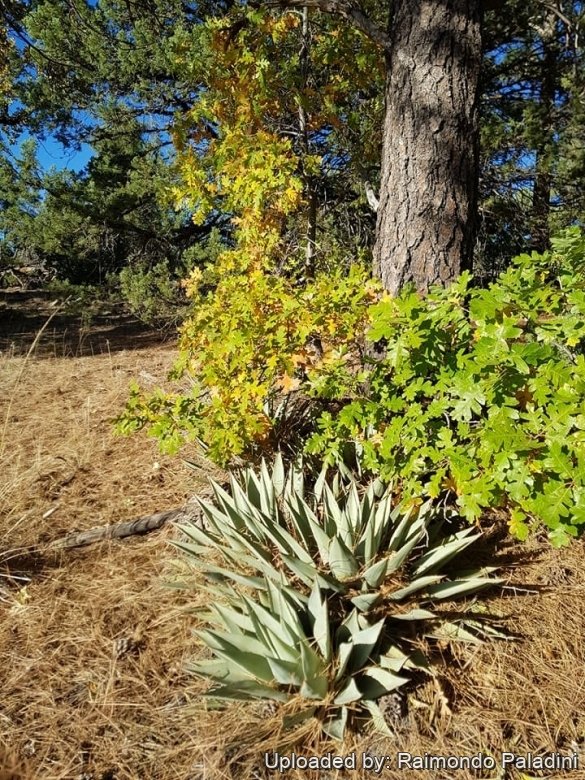
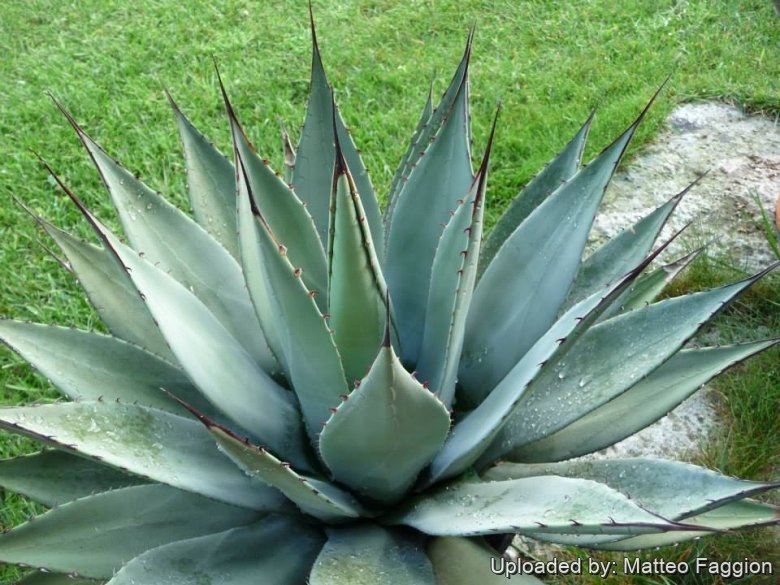
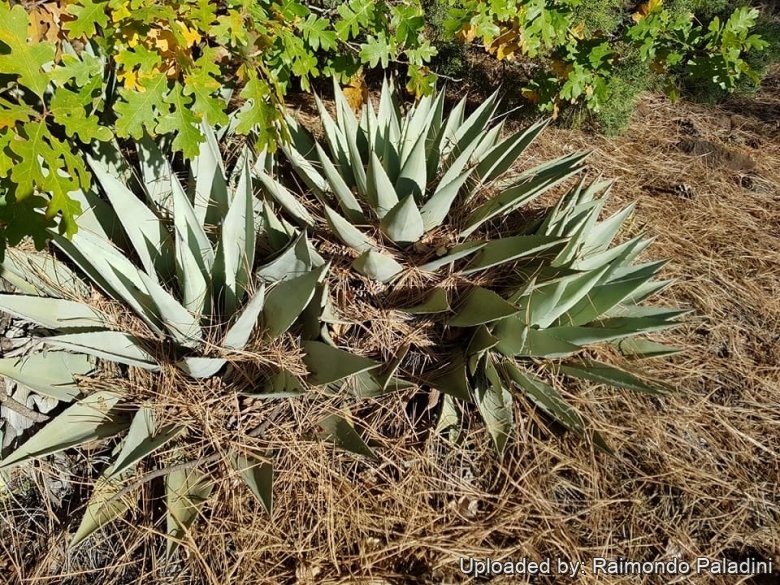
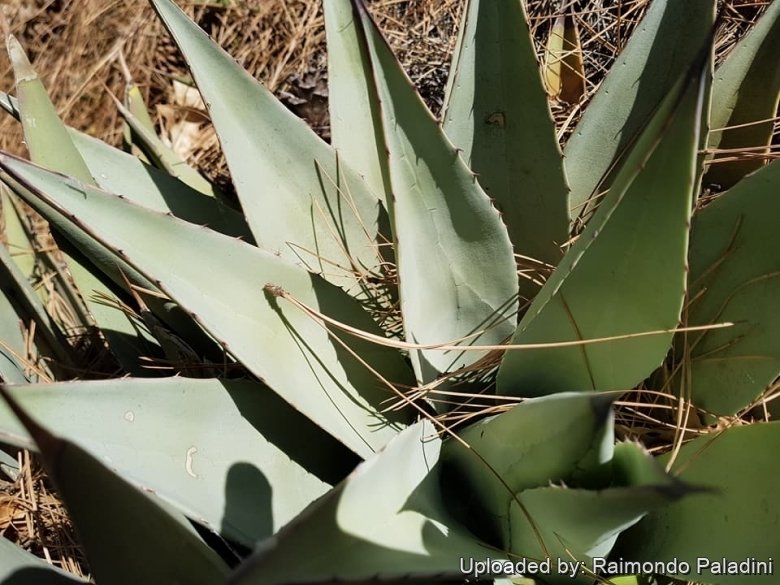
Agave parryi, also known as Parry’s agave or mescal agave, is a slow-growing, compact, small to medium-sized agave with grey-green leaves with a dark tan or black terminal spine and with very ornamental imprints of previous leaves on the back. After approximately 25 years plant sends up a 4 metres tall flowering stalk with bright yellow blooms, facing skyward, in large, flattened, terminal clusters; after blooming, it dies, as all leaf and root resources are put into the stalk, flowers, and seeds. New plants already formed on root system take over. It is very variable and all varieties form beautiful, tight rosettes and is one of the more ornamental specie.
Rosettes: Compact, globose, “artichoke-like” (35-)40-60 cm tall, 60-75 cm wide, freely suckering, many-leaved.
Stem: Stemless.
Leaves: 100-160 per rosette, light green, glaucous-grey or greyish linear-ovate, spatula-shaped, concave on upper surface, closely imbricate, rigid, thick, short-acuminate, mostly (18-)25-50 cm long and (4.5-)8-12 cm wide. Marginal teeth mostly rather straight on a nearly straight margin, small, largest above the middle of the lamina, 3-7 mm long, dark brown to greyish, mostly 1-2 cm apart. Terminal spine nearly flat above, 1.5-3 cm long, dark brown to grey with age, decurrent to the 1st or 2nd teeth.
Inflorescence: 4-6 m tall, paniculate, stout, part-inflorescences stout, 20 - 36 in the upper half of the inflorescence.
Flowers: 60-77 mm long. Buds reddish orange, after opening turn bright yellow. Ovary (27-)30-47 mm long, neck long 6 - 9 mm, mildly constricted and grooved. Tepals yellow, tube 9-12 mm long, lobes subequal, 1824 mm long.
Blooming season: Summer (in habitat June—August).
Fruits: Pedicels stout 3.5-5 cm long, 1.5-2 cm in diameter, shortly stipitate, beaked, strong-walled.
Seeds: 7-8 mm long, 5-6 mm broad, semicircular in outline.
Chromosome number 2n = 60, 120.
Origin and Habitat
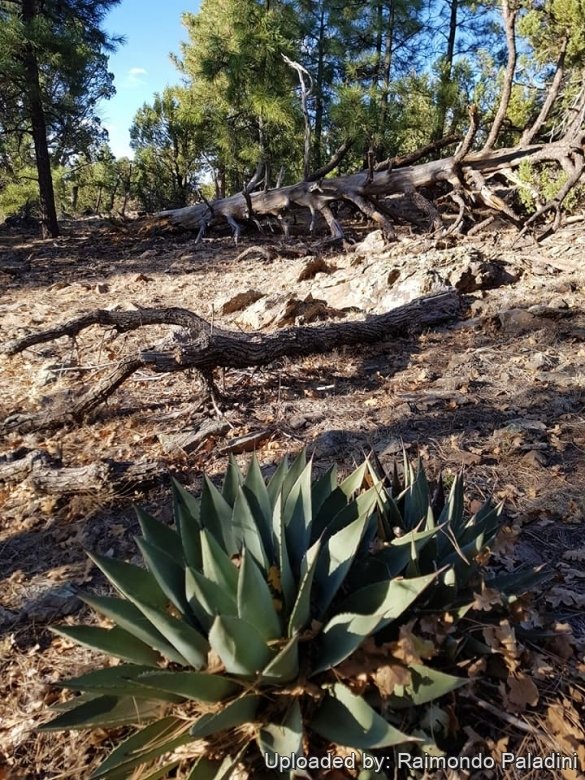
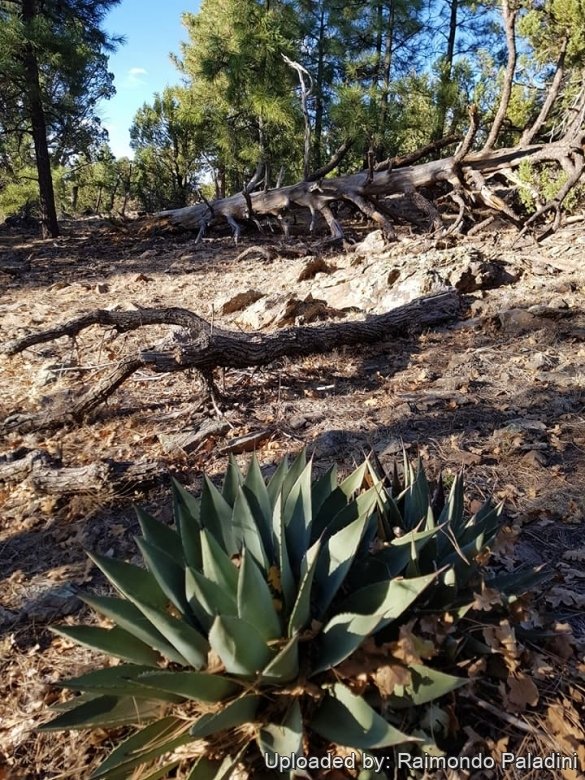
Agave parryi has a widespread distribution, with plants found as far north as north-central Arizona, spreading southeast to southeastern Arizona, the mountains of western Chihuahua, and western Durango, and extending into southeastern New Mexico and extreme western Texas.
Type locality: Graham County, Arizona
Altitude range: Mostly around 1200-2800 metres above sea level.
Habitat and ecology: Agave parryi grows in dry rocky slopes in the upper Sonoran region and lower transition zone in grama grasslands, open oak woodland, pine-oak-forest, and chaparral. Its habitat is a relatively cold climate where temperatures frequently drop below 0°C and the ground is often snow. Like most agave species, this plant is monocarpic, meaning that it will only bloom and bear fruit once during its life before dying. As agaves approach maturity at 10 to 30 years of age, they accumulate a large amount of carbohydrates in their tissues that provide the energy that fuels the rapid development of the large flower spike. This species is pollinated by insects and hummingbirds.
Cultivation and Propagation
Agave parryi is usually cultivated outdoors in rock gardens, in cactus and succulent gardens, in Mediterranean-style landscapes, in borders, or as a specimen. It suckers, but tends to be slow to sucker, so easy to keep control of. Some varieties, like truncata, hardly sucker at all. It is very frost hardy. Because of its compact size, plus its low water use and low maintenance, it is considered a good landscaping plant for desert residential landscaping.
Growth rate: Slow to medium growing, but speeds up considerably given the best conditions.
Exposure: They do well in full sun or a lightly shaded area with afternoon shade.
Soil: They do best in very well-drained, sandy or gravely soil. As an ornamental it is also grown in containers where it stays smaller than its outdoor brethren. In pots they need a very porous mix soil (e.g. 2 parts peat moss to 1 part loam to 1 part of pumice).
Repotting: Use pot with good drainage.
Fertilization: They grows quickly if kept well nourished with a slow release fertilizer specifically formulated for cactus and succulents applied once or twice a year (poor in nitrogen), including all micro nutrients and trace elements.
Hardiness: Agave parryi is one of the most cold hardy of the agaves, (hardy to -9/-18°C dependin by clones (USDA zones: 9b-11). However some variety (e.g. Agave parryi var. couesii) has proven to grown without particular damages in wet, cold and harsh winters with temperatures down to -20°C or less at least with good drainage).
Scenography: These striking plants are wonderful when used for accent or simply to provide some all year round foliage and often used in a pot as a patio plant, can be moved around to change the scenery or position to give more shelter.
Traditional uses: Used to manufacture mescal and tequila. Native Americans also use plant for food, fiber, soap and medicines.
Warning: It is armed with needle-sharp spines. The juice of this species can be irritating to the skin.
Propagation: Seeds or suckers which often are found growing around the base of the plant, Remove the basal suckers (if available) in spring or summer and let the cuttings dry for a few days before inserting in compost.
Notes
Mescal (Agave neomexicana, Agave havardiana, Agave gracilipes and Agave parryi).
The significance of the mescal in the life of the Apaches of the South-west cannot be exaggerated. The Spanish named the Mescalero Apaches for the food on which they depended so heavily for survival. Mescal was such an important source of food, fiber, and drink that for nearly six hundred years the home ranges of the Apaches coincided with those of various species of agave. The Lipan Apaches relied on Agave havardiana in the mountains of the Big Bend region, and the Mescaleros depended on Agave neomexicana and Agave gracilipes from the Guadalupe Mountains and on Agave parryi into southern New Mexico.
Bibliography
Major references and further lectures
-
Urs Eggli “Illustrated Handbook of Suculent Plants: Monocotyledons” Springer, 2001
-
Howard Scott Gentry “Agaves of Continental North America” University of Arizona Press, 01/Feb/2004
-
August J. Breitung: “Agave parryi” In: “The Agaves.” The Cactus & Succulent Journal Yearbook, 1968
-
Howard Scott Gentry: “Agave parryi.” In: “Agaves of Continental North America.” The University of Arizona Press, 1982
-
J.Thiede: “Agave parryi.” In: Urs Eggli (Hrsg.): “Sukkulenten-Lexikon. Einkeimblättrige Pflanzen (Monocotyledonen).” Eugen Ulmer, Stuttgart 2001
-
James L. Reveal & Wendy C. Hodgson: “Flora of North America Agavaceae.” 2002
-
Chihuahuan desert plants. “Parry Agave (Agave parryi)”.
-
Wikipedia contributors. “Agave parryi.” Wikipedia, The Free Encyclopedia. Wikipedia, The Free Encyclopedia, 18 Oct. 2014. Web. 2 Nov. 2014.
-
“Vascular Plants of the Gila Wilderness” Presented in Association with the Western New Mexico University Department of Natural Sciences. “Agave parryi Engelmann”.
-
Mary Irish “Gardening in the Desert: A Guide to Plant Selection & Care” University of Arizona Press, 01/Sept./2000
-
Greg Starr “Agaves: Living Sculptures for Landscapes and Containers” Timber Press, 27/Jun/2013
-
Mary Irish “Gardening in the Desert: A Guide to Plant Selection & Care” University of Arizona Press, 2000
-
Delena Tull “Edible and Useful Plants of Texas and the Southwest: A Practical Guide” University of Texas Press, 1999
From llifle page Agave americana var. latifolia
Origin and Habitat
New Mexico ( U.S.A )
Source: Agave americana var. latifolia, LLIFLE - Encyclopedia of living forms, CC-BY-SA, retrieved 2026-10-25.
Cultivars and forms (6)
Subspecies (1)
Varieties (4)
Cultivars (1)
Gallery