Publication: Proc. Calif. Acad. Sci. ser. 2, 2: 207. 1889
Description
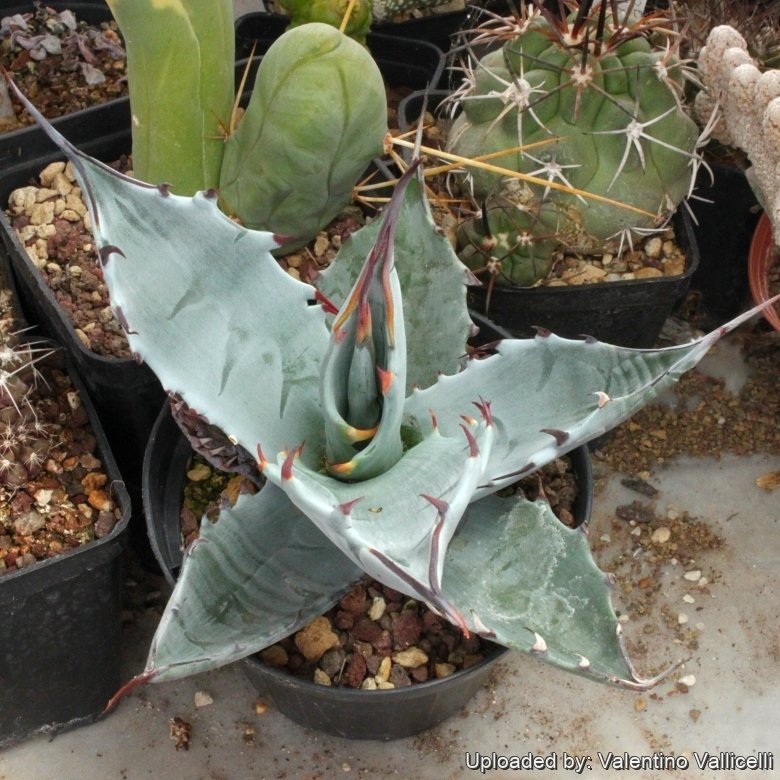
It is a small to medium stemless Agave that occasionally from a short stem.
Rosettes: Open, few-leaved, compact 1 to 1.8 m in diameter.
Leaves: Broad, openly spreading to ascending, linear, lanceolate to oblanceolate in shape with thick and fleshy bases, smooth, pale glancous-grey, bluish or yellowih-green, 20 to 80 cm long 6-10 cm wide, often attractively cross-banded and sometimes twisted.
Theet: Heavy, flexible, long and spaced 3-4 cm apart, chestnut, later grey, rather dull and glaucous.
Inflorescence: Formed by 2-20 nearly globose, compact short lateral umbels on a slender stalk 2.5-4 m tall.
Flowers: Pale yellow.
Blooming season: March through November.
Remarks: Leaves from northern populations of A. sobria are similar in size (30-60 cm long) to Agave capensis. The island forms Agave cerulata var. dentiens and Agave sobria ssp. roseana differ from peninsular counterparts in similar ways, with long. narrow, and thin leaves in a more open rosette, and with marginal teeth reduced or absent.
Origin and Habitat
Mexico (East side of Central Lower Califonia) Altitude from sea level to up to 1050 m. It has a wide range along the southern gulf coast broadly distributed in the Sierra de la Giganta and reaching Carmen and Danzante.
Type locality: Mesas about Comondu.
Habitat: It is most frequently found in dry, rocky, north-facing slopes. Plants from more exposed positions are typically small and often damaged.
From llifle page Agave affinis
Origin and Habitat
Lower California
Source: Agave affinis, LLIFLE - Encyclopedia of living forms, CC-BY-SA, retrieved 2026-10-25.
Cultivars and forms (1)
Subspecies (1)
Gallery