Publication: Cact. Succ. J. (Los Angeles) 32: 81, fig. 41. 1960
Description
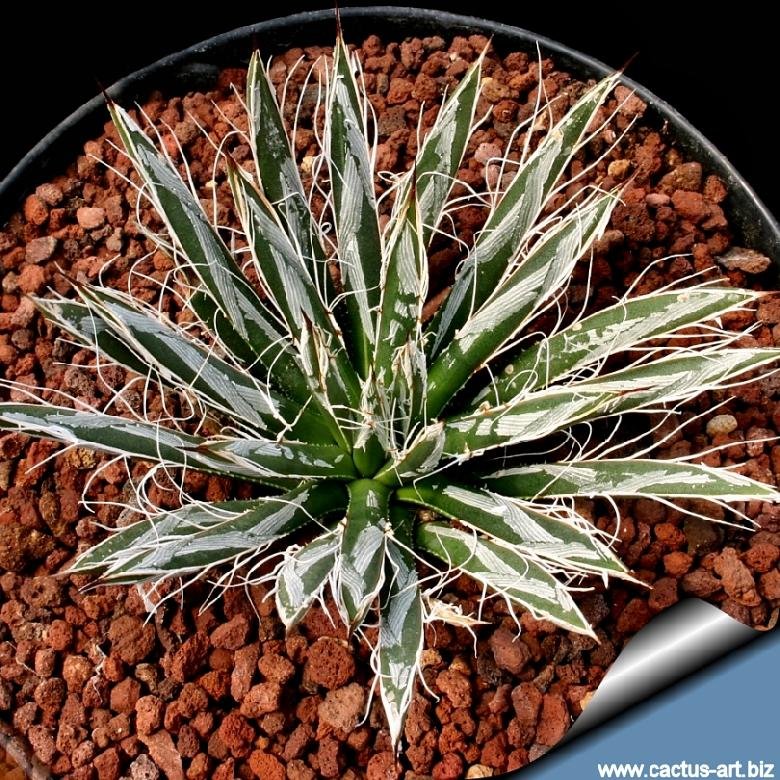
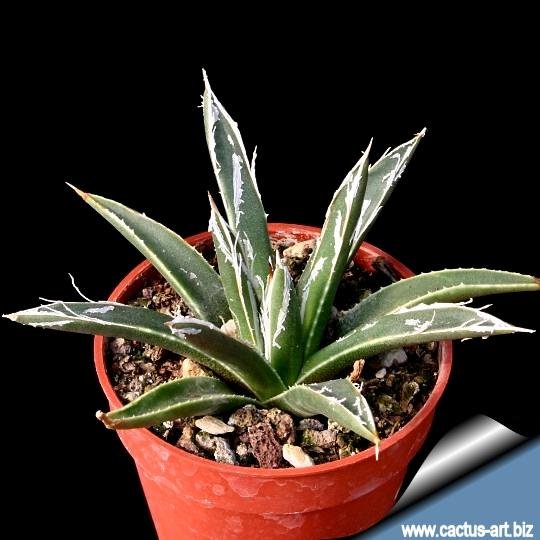
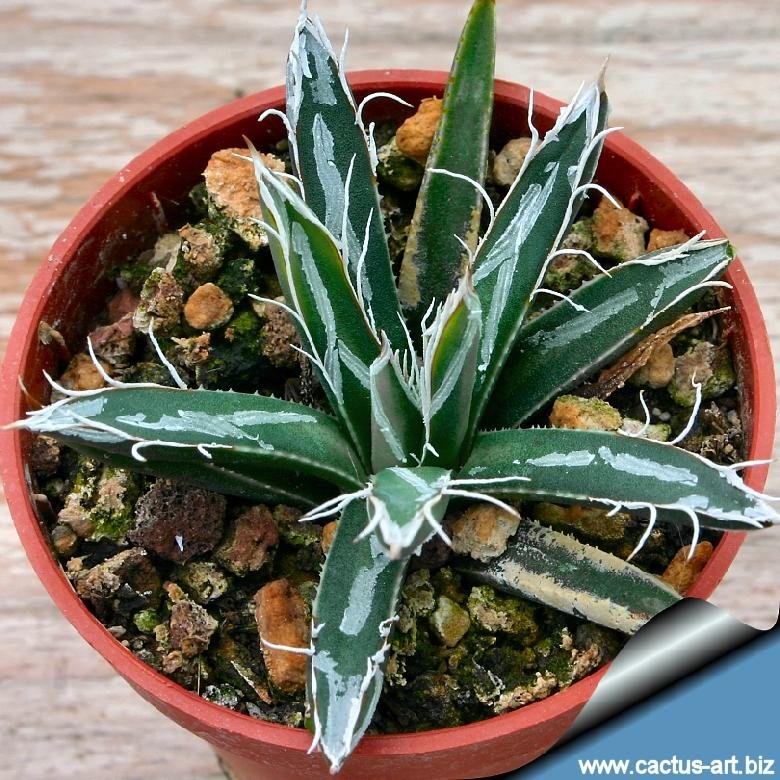
Small rosettes, up to 20 cm in diameter, 25 cm tall, each with 100–200 leaves at maturity. Individual rosettes are small and compact, but plants sucker readily forming large clumps.
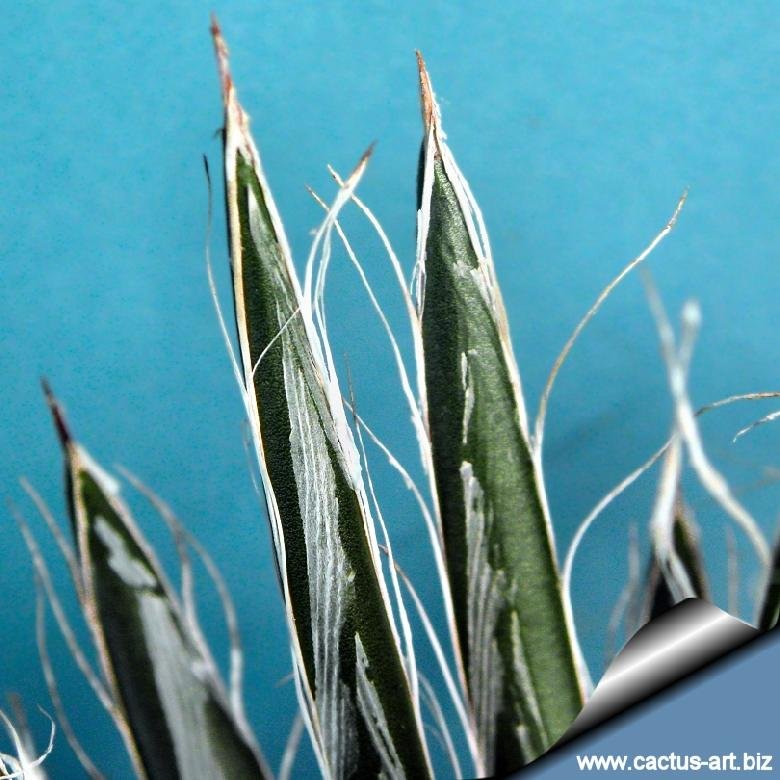
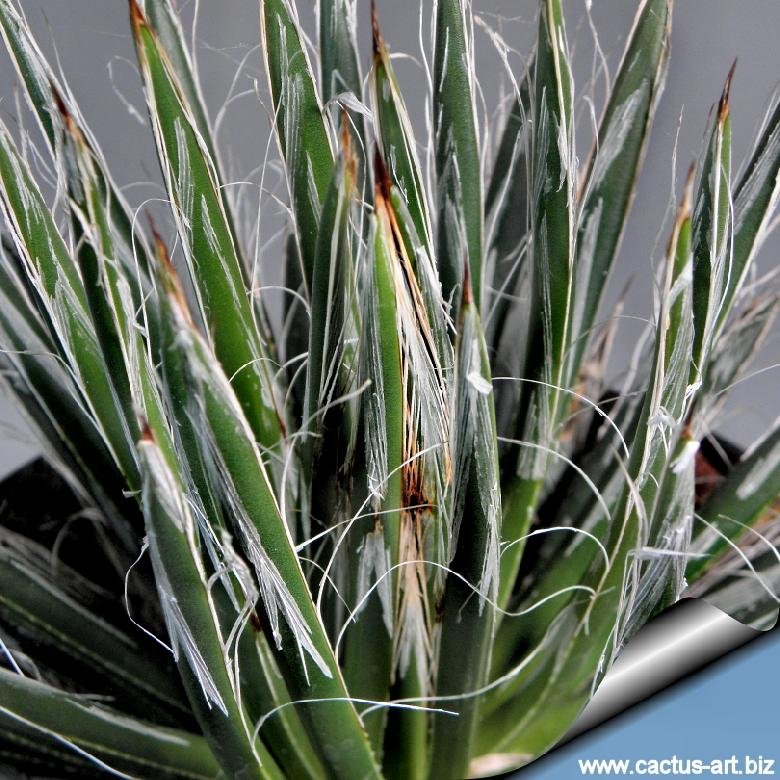
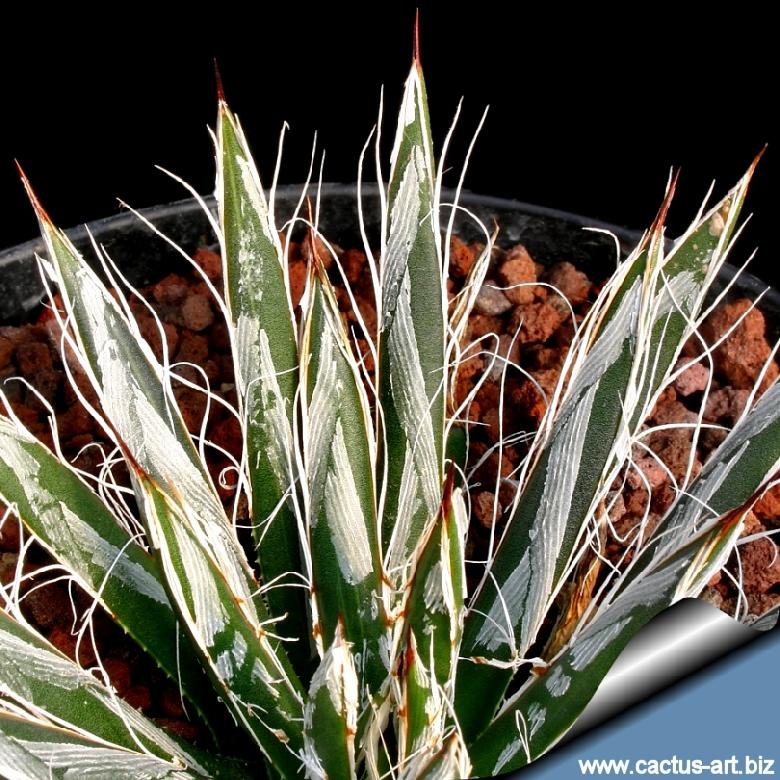
Leave: 9 to 20 cm long, 0,6 to 2 cm wide of equal length giving the rosette a flat-topped appearance, light to dark green, flat-topped, with striking white markings. Leaf margins are smooth with a brown border and white threadlike curling white threads, replaced by denticulate margins below 1/3 of leaf. The white filaments on the leaf edges curl to resemble tight ringlets. When it gets watered on, the filaments immediately partly uncurl, but as they dry out they slowly re-curl again. Apical spine subulate, with a short narrow groove above, 1(-2)cm long, brown to greyish.
Flowers: The slender flower stalk (spike) is smaller (1,5 m tall) than in the typical variety with densely or laxly flowers in the upper ½-¼ part, pale greenish yellow flowers 1,6–2,1 cm. limb lobes 6,5–7 mm. Filaments 1,1-1,3 cm.
Blooming season: Late spring to early summer.
Remarks: The ‘bella” variety is much smaller and compact than the Agave toumeyana (up to 20 cm tall). It has shorter, more equal, leaves with margins replaced by denticles in the lower ½ of the leaf and makes a denser rosette. It also make smaller inflorescence.
Origin and Habitat
Central Arizona (USA) restricted to the eastern slope of the Bradshaw Mountains, eastern Yavapai to northwestern and central to southern Gila County, northeastern Maricopa to northern Pinal County.
Habitat: Occurs in rocky hillsides, highland desert mesas, chapparal, or lower pine forest on open gravelly to rocky limestone or basalt slopes, mostly with desert scrub, chaparral, and pinyon juniper woodlands; 800 1700 m;
Cultivation and Propagation
Agave toumeyana subsp. bella is a very cold hardy form of the species. It is theoretically hardy to -12°C (or more) particularly when dry. It is a relative easy-to-grow species. Need a very well-drained, soil. It grows fairly fast in summer if provided with copious water but allows to dry thoroughly before watering again. During the winter months, one should only water enough to keep the leaves from shrivelling. They do well in full sun or a lightly shaded area. Plants cultivated outdoors are drought tolerant and takes blasting heat and full sun. It is a wonderful companion plant for Echinocereus and Escobaria cacti species.
Propagation: It is propagated vegetatively by suckers which often are found growing around the base of the plant. Remove the basal suckers (if available) in spring or summer and let the cuttings dry for a few days before inserting in compost or by seed.
Notes
The species suggest a larger version of A. parviflora with more acuminate leaves, larger flowers with filaments inserted higher up in the tube.
Bibliography
Major references and further lectures
-
Howard Scott Gentry “Agaves of Continental North America” University of Arizona Press, 01/Feb/2004
-
Urs Eggli “Illustrated Handbook of Succulent Plants: Monocotyledons” Springer, 2001
-
Hermann Jacobsen ”A Handbook of Succulent Plants: Abromeitiella to Euphorbia” Blandford Press, 1960
Gallery