Publication: Ann. Missouri Bot. Gard. 16: 390, tab. 32. 1929
Description
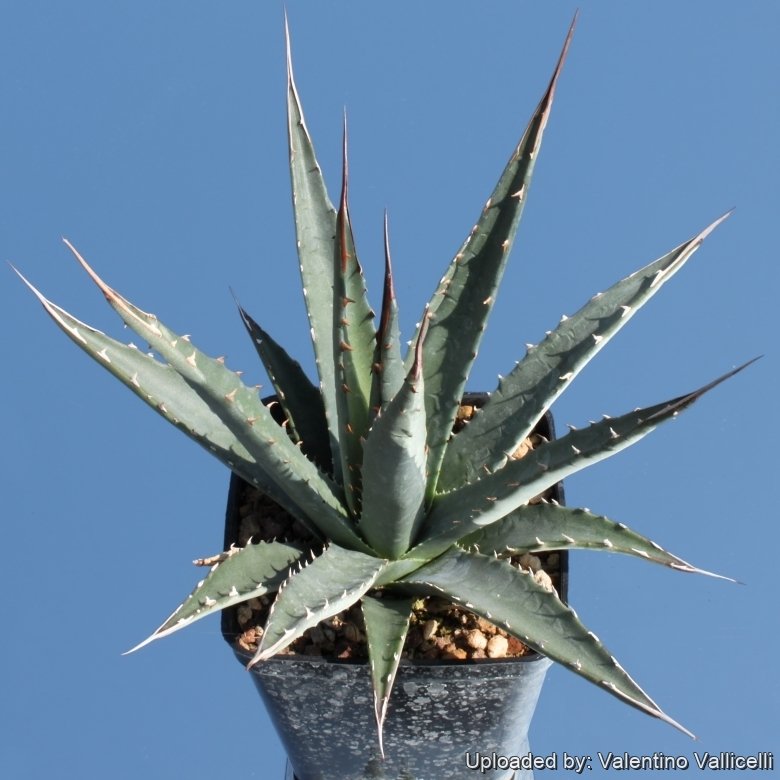
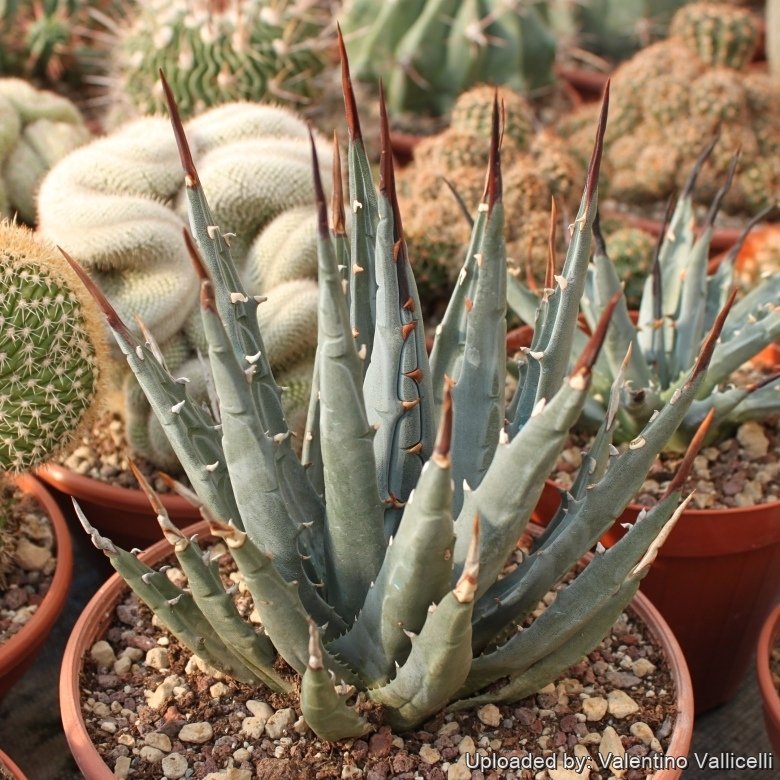
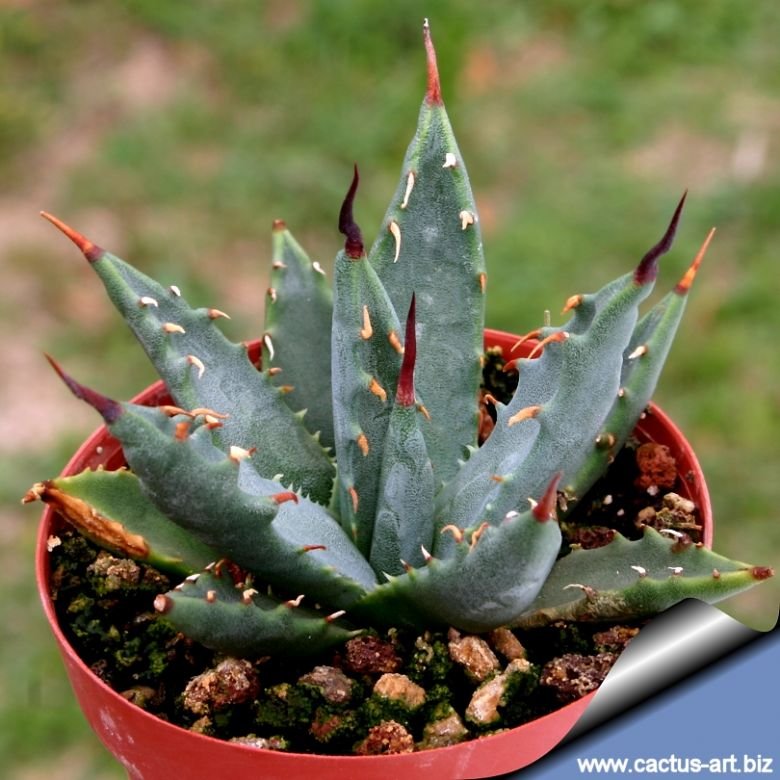
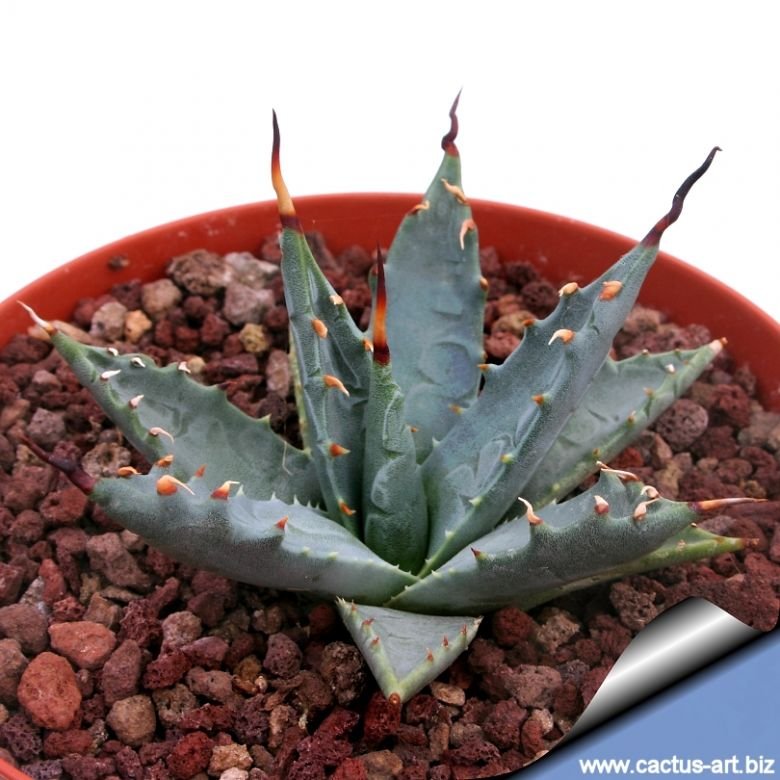
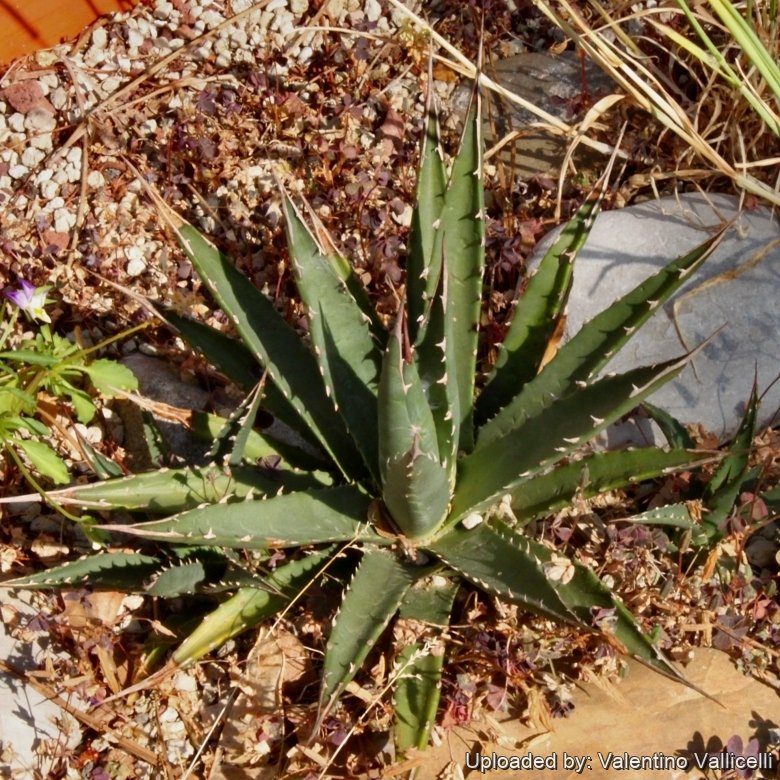
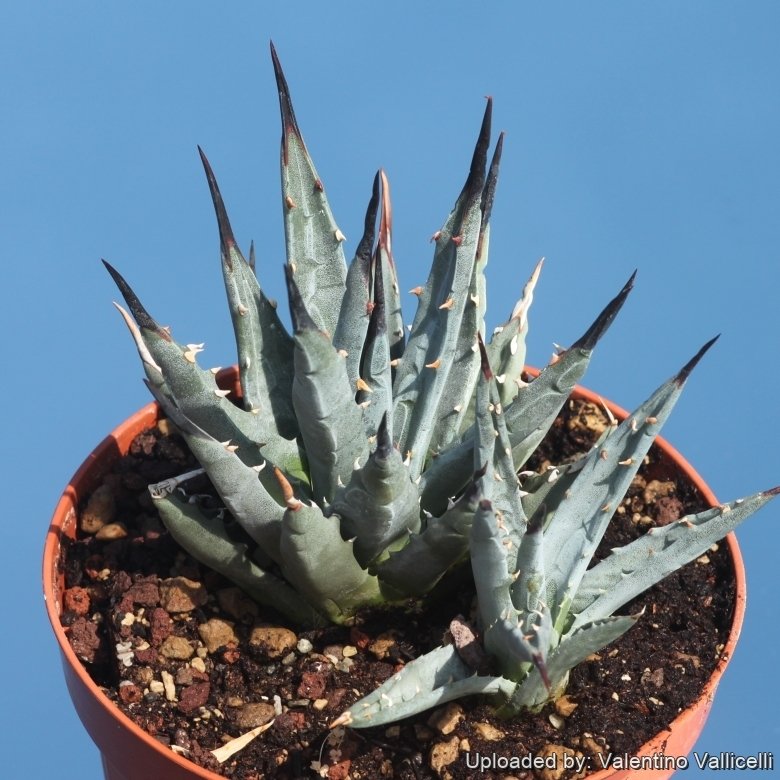
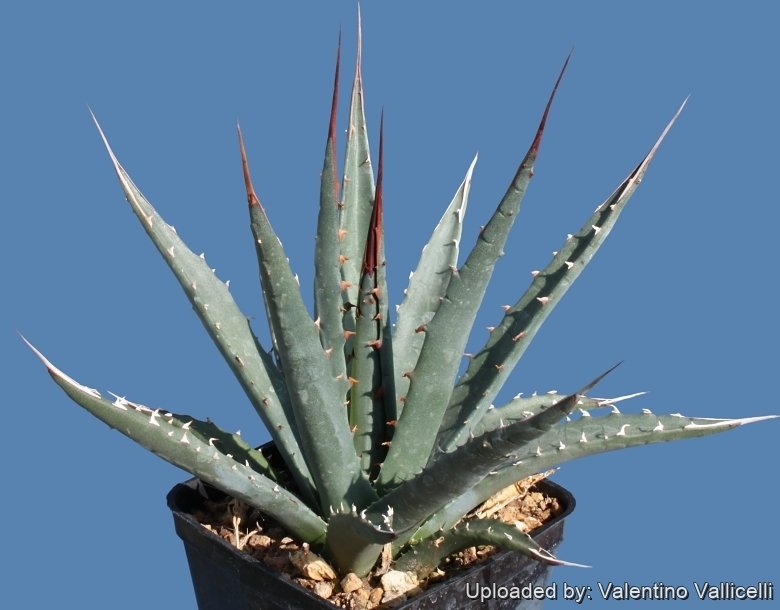
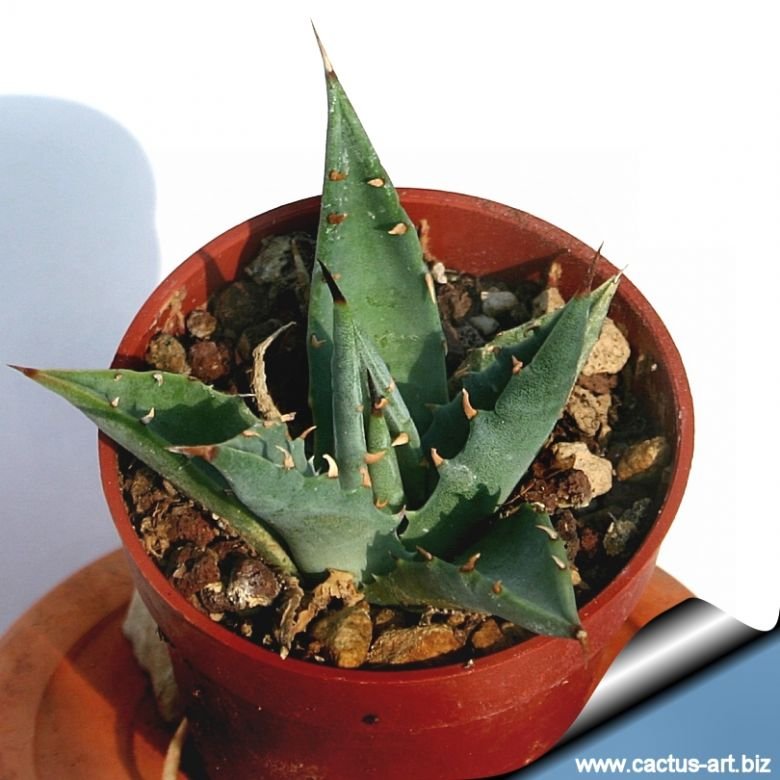
Agave utahensis var. nevadensis is one of the smallest species of Agave. It is extremely ornamental with small blue-green, symmetrical rosettes and long, harmless terminal grass-like spines. Slowly growing up to 15-30 cm tall, 25-30(-60) cm spread. This is the smallest and most cold hardy variety of A. hutaensis. In contrast to other subspecies it has broader, bluish green leaves with strong marginal teeth, It suckers slowly and the suckers tend to be adhered to the mother plant, eventually forming a large matt of spines where you can’t tell which leaf belongs to which plant.
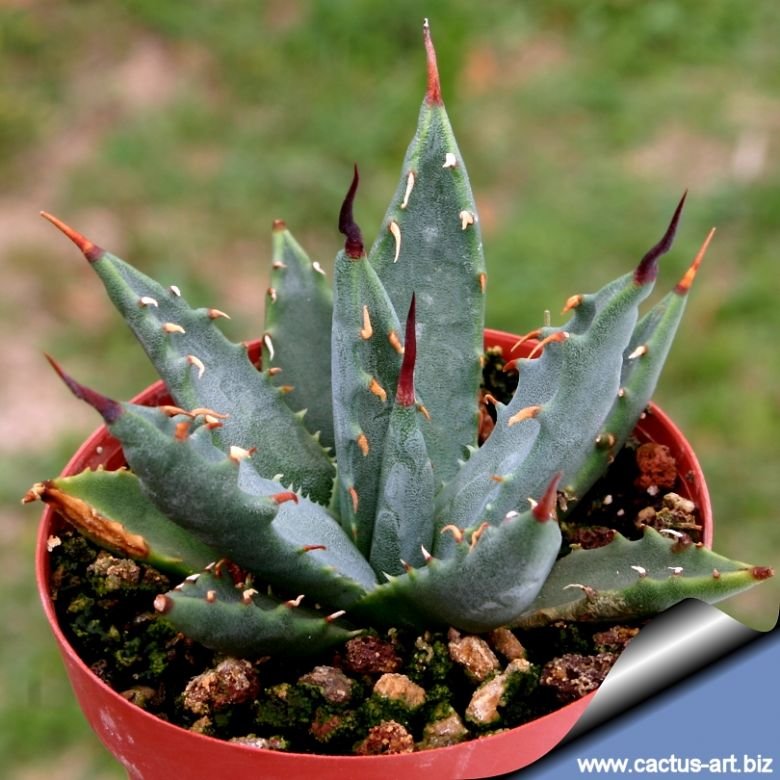
Leaves: 15–25 long and 1,5–3 cm wide, pale blue-green, linear-laceolate, straight or falcate, spiked, stiff, convex below, plane or concave above, ending in a soft, grass-like spine whitish to brown, slender, 4–8 cm long (split usually). The leaves have heavily toothed margins, the teeth are prominent 4–6 mm long (not very sharp, though).
Flowers: Light yellow, bulbous flower clusters arise along the stem on short 2-2,5 stalks. The rosette dies after flowering. The inflorescence varies in style from plant to pant. It may be a spike, a raceme, or a panicle 2–4 metres.
Blooming season: Late winter early summer.
Fruit: Capsules 2-3cm long.
Seeds: Black
Remarks: 2n = 60.
Origin and Habitat
USA (California, Nevada)
Altitude: 1200-1900 metres above sea level.
Habitat: It is native of dryish, stony calcareous outcrops, slopes and ridges in mountainous areas and canyons, to the east of the Mojave Desert with desert scrubs.
Cultivation and Propagation
It is a very cold hardy form of the species. It is theoretically hardy to -18°C (or more) particularly when dry. It is a relative easy-to-grow species. Need a very well-drained, soil. It grows fairly fast in summer if provided with copious water but allows to dry thoroughly before watering again. During the winter months, one should only water enough to keep the leaves from shrivelling. They do well in full sun or a lightly shaded area. Plants cultivated outdoors are drought tolerant and takes blasting heat and full sun. It is a wonderful companion plant for Echinocereus and Escobaria cacti species. During the beautiful season it’s good to enrich the soil using a fertilizer rich in potassium and phosphorous, but poor in nitrogen, because this chemical element doesn’t help the development of succulent plants, making them too soft and full of water.
This stylish succulent has long been highlighted in gardening magazines and television shows. They are great used as feature plants in Mediterranean and modern style landscapes, pots and containers, rockeries, embankments and tropical style gardens.
Propagation: Suckers or seed.
SUCKERS: Remove the basal suckers (if available) in spring or summer and let the cuttings dry for a few days before inserting in compost.
SEEDS: Sow at any time of year in a well-aerated compost at a temperatures of 22-24°C . Stand the pots in water, moisten thoroughly and drain. Scatter and press lightly the seed onto the top of the compost. But do not cover the small seeds with compost. Secure a polythene bag around the pot or cover the container with glass or and place in a warm shaded place. If possible, germinate in a propagator.
Some seedlings may appear within a week or 10 days others will take longer. At lower temperatures, germination usually takes considerably longer. Once germination has taken place, remove gradually the glass or plastic and move into a good light but not in direct sun. If the young plants are exposed to too much sun, or the compost dries out, they may stop growing and often turn red; once they stop, it is often difficult to persuade them to start growing again. Never let the pots dry out-but don’t saturate them either. A sodden compost is as harmful as a dry one.
Uses:
-
The plant was used for food by local Native American peoples. Seed may be ground into flour. Flower stalk, roasted, & the Root cooked. The heart of the plant, which is partly below ground, is very rich in saccharine matter and can be eaten when baked. It is sweet and delicious and can be dried for future use or soaked in water to produce a flavourful beverage. Sap from the cut flowering stems is used as syrup. The sap can also be tapped by boring a hole into the middle of the plant at the base of the flowering stem. It can also be fermented into ‘Mescal’, a very potent alcoholic drink!
-
It has very good fibres which withstand hard wear and are water-resistant, that are used mainly in brush making, but they are occasionally used for textiles (can be spun, or made into rope)
Bibliography
Major references and further lectures
-
Joachim Thiede: “Agave utahensis.” In: Urs Eggli “Illustrated Handbook of Suculent Plants: Monocotyledons” Springer, 2001
-
Howard Scott Gentry “Agaves of Continental North America” University of Arizona Press, 01/Feb/2004
-
Gentry, H. S. 1972. “The agave family in Sonora.” U.S.D.A. Agric. Handb. 399. (Agave Sonora)
-
Wikipedia contributors. “Agave utahensis.” Wikipedia, The Free Encyclopedia. Wikipedia, The Free Encyclopedia, 16 Jun. 2014. Web. 3 Nov. 2014.
-
August J. Breitung: “Agave utahensis” In: “The Agaves.” The Cactus & Succulent Journal Yearbook, page 21.1968
-
Zlatko Janeba: “Komplex Agave utahensis.” In: Kaktusy Special 2. Page 5–14 2010
-
James L. Reveal, Wendy C. Hodgson: “Agave utahensis.” In: “Flora of North America.” page 450–451 2002
-
Urs Eggli (Hrsg.): “Sukkulenten-Lexikon. Einkeimblättrige Pflanzen (Monocotyledonen).” Eugen Ulmer, Stuttgart 2001, ISBN 3-8001-3662-7, S. 69.
-
James L. Reveal & Wendy C. Hodgson: “Flora of North America Agavaceae.” 2002
-
Urs Eggli, Leonard E. Newton: “Etymological Dictionary of Succulent Plant Names.” Springer, Berlin/Heidelberg 2010
-
George Engelmann: “Yucca, Agave, Hesperaloe” In: Sereno Watson u.a: “Botany. United States Geological Exploration of the fortieth parallel”. Volume 5, United States Government Printing Office, Washington 1871
-
Abrams, L. 1923. “Ferns to Birthworts.” 1: 1–557. In L. Abrams (ed.) “Ill. Fl. Pacific States.” Stanford University Press, Stanford.
-
Bailey, L.H. & E.Z. Bailey. 1976. “Hortus Third” i–xiv, 1–1290. MacMillan, New York.
-
Flora of North America Editorial Committee, e. 2002. “Magnoliophyta: Liliidae: Liliales and Orchidales.” Fl. N. Amer. 26: i–xxvi, 1–723.
-
Hickman, J. C. 1993. “The Jepson Manual: Higher Plants of California” 1–1400. University of California Press, Berkeley.
-
Shreve, F. & I. L. Wiggins. 1964. “Veg. Fl. Sonoran Des.” 2 vols. Stanford University Press, Stanford.
-
Albano, P.-O. (2003). “La Conaissance des Plantes Exotiques” 1-324. Édisud, Aix-en-Provence.
-
Encke, F. et al. 1984. ”Zander: Handwörterbuch der Pflanzennamen,” 13. Auflage. (Zander ed13)
-
Albano, P.-O. (2003). “La Conaissance des Plantes Exotiques:” 1-324. Édisud, Aix-en-Provence.
-
Govaerts, R. (1995). “World Checklist of Seed Plants” 1(1, 2): 1-483, 1-529. MIM, Deurne.
Gallery