Publication: Mem. Acad. Malgache 17: 30 60 1934
Description
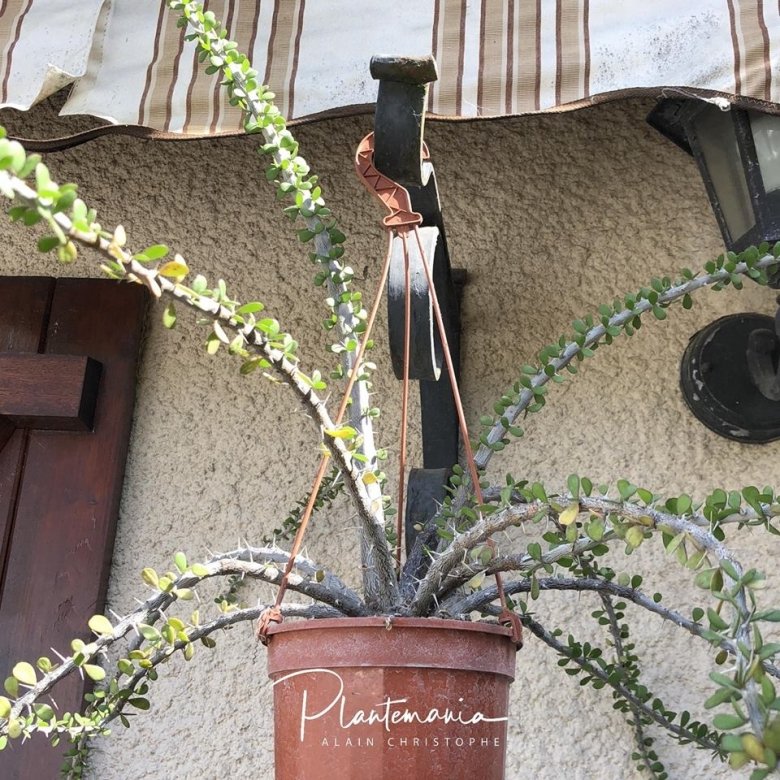
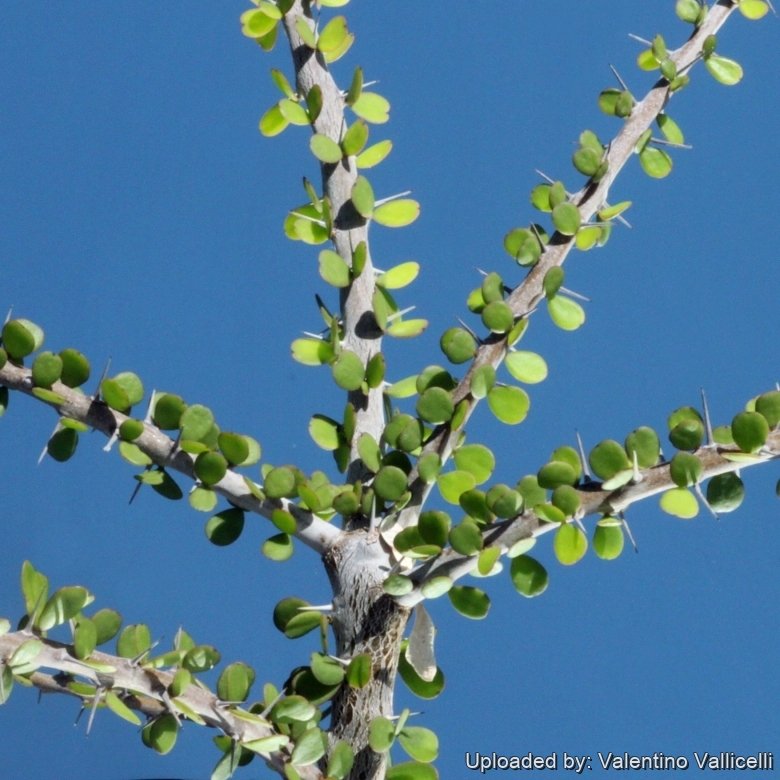
Alluaudia humbertii is an inconspicuous, freely branching, woody stemmed, succulent shrubs or small tree up to 5(-7) m high when it is mature, whose branches grow both horizontally and vertically. A. humbertii has slender stems less than half the diameter of the more common Alluaudia procera but lined with similar slightly fleshy obovate vertically oriented bright green leaves.
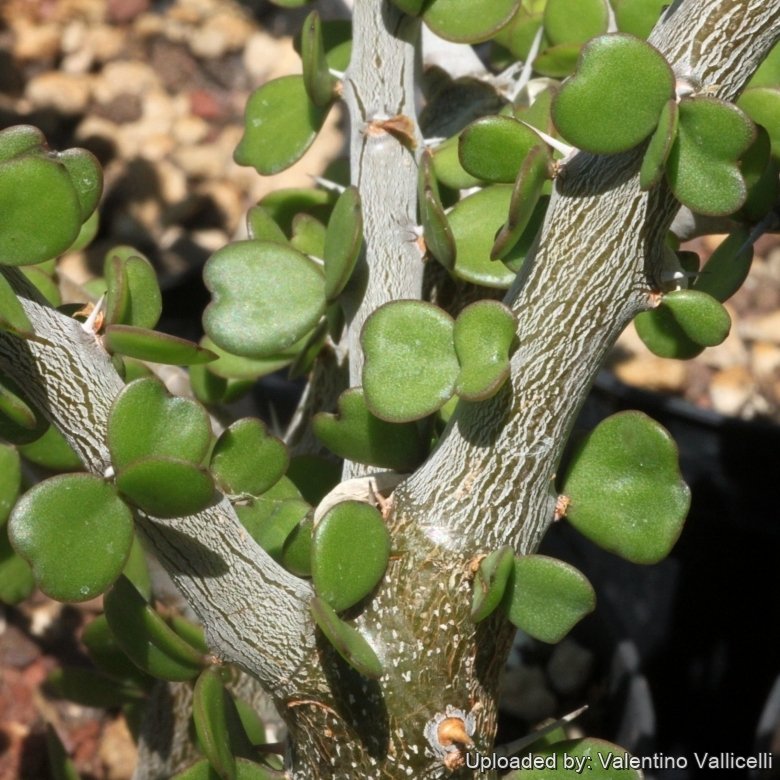
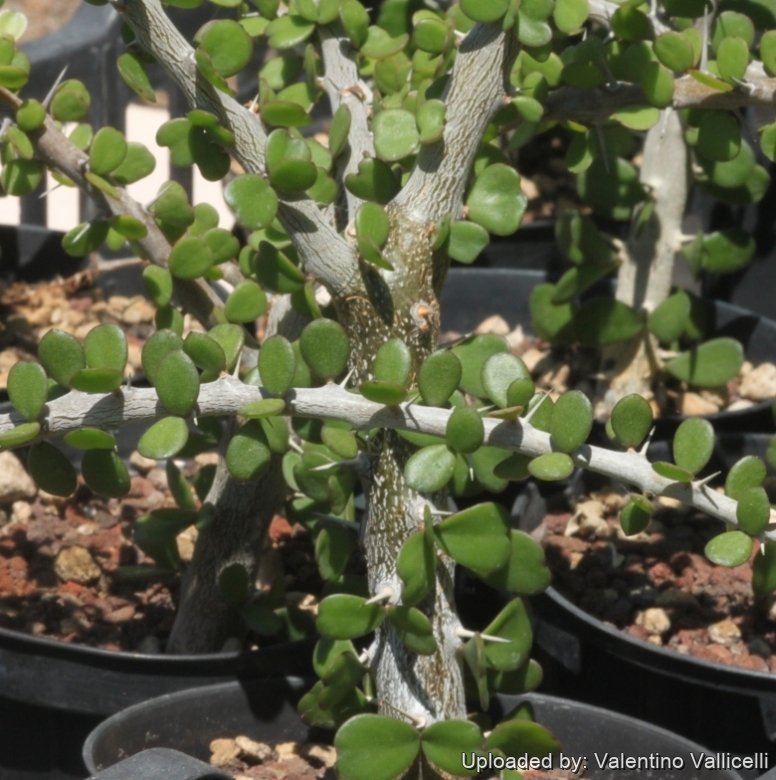
Trunk: It has a short woody trunk with branches from near the base, the branches grow both horizontally and vertically.
Branches: Either smooth or spiny, thin, rod-like, upright that soon arch graciously to form a thick tangle of horizontal branches. In mature plants the branches are erect. Photosynthesis is carried on both by the leaves and by the stems.
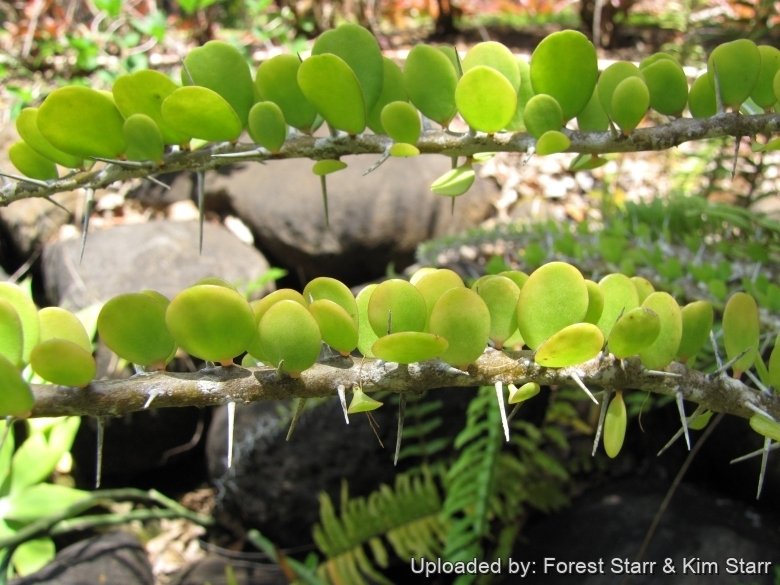
Spines: Absent or isolated in the axil of each pair of leaves, sharp, fine, needle-shaped 5-23 mm long.
Leaves: In pairs, sessile or short petiolate, usually beneath the spines, fleshy, obovate to orbicular or revese-heart-shaped in shape with scolloped margins 4,5-15 mm long an 4,5-10 mm wide. The leaves are deciduous and produced secondarily, and repeatedly with recurring wet seasons. Short-lived primary leaves are produced only on new growth and are more slender, acute and oriented horizontally.
Flowers: Male flowers 8-10 mm in diameter, female flowers 4-6 mm in diameter.
Bloom Time (northern hemisphere): August to October
Origin and Habitat
Southern coastal plain and western highlands of Madagascar.
Habitat: This grows in the spine forest in semi-arid regions often with Alluaudia procera and Pachypodium spp. on acid soils over crystalline bedrock, mainly on sandy loams and red sands, (“sables rouges”) It grows in areas that may receive no rain for more than a year. It can withstand extended periods of drought, yet lacks the water storage tissues associated with most true succulents. All are deciduous in the dry season but leaf out virtually over night when the rains come.
Cultivation and Propagation
It needs full sun or high interior lighting with a very well drained soil mix and freely circulating air.
It prefers acidic substrate without limestone. Plants are watered and allowed to dry thoroughly before watering again. If fertilizer is used, it should be diluted to ¼ (one-quarter) the recommended rate on the label. It is a frost tender species that must be protected in the greenhouse over the winter but established plants should tolerate temperatures as low as 0° C (Avoid any frost!). If grown in the home environment, the ideal temperatures should run between 20° to 30° C with winter time temperatures around 10°C. During the winter months, the plant will drop all of its leaves and no water should be given during this period. Once this plant is established in its new pot, it should be cut back to 7-10 cm in height to encourage branching, to maintain an attractive shape and to ensure pachycaul habit. The cutting removed can be rooted easily, and the process repeated. If pruned and kept somewhat pot bound, it can be maintained at a manageable size, depending on what ”manageable size” means to you. If planted in the landscape however, it will often drop all its leaves when it decides to take a rest. When this happens, cut down on the watering until the leaves start to appear again.
Propagation: It is propagated from cuttings taken in the spring or from seed when available.
Bibliography
Major references and further lectures
-
Forest & Kim Starr Alluaudia humbertii (Alluaudia). Plants of Hawaii. <http://www.starrenvironmental.com\>. Downloaded on 21 August 2014.
-
Wikipedia contributors. “Alluaudia.” Wikipedia, The Free Encyclopedia. Wikipedia, The Free Encyclopedia, 9 Sep. 2013. Web. 15 Sep. 2014.
-
“The Flowering Plants of Africa” Volumes 52-53 Copertina anteriore
Botanical Research Institute, Department of Agricultural Technical Services, Republic of South Africa., 1992
-
Werner Rauh, Herman Schwartz “Succulent and xerophytic plants of Madagascar” Volume 2 Strawberry Press, 1998
-
Sean Hogan “Flora: A Gardener’s Encyclopedia” Volume 1 Timber Press, 2003
-
Urs Eggli “Illustrated Handbook of Succulent Plants: Dicotyledons” Springer Science & Business Media, 2002
-
James Cullen, Sabina G. Knees, H. Suzanne Cubey “The European Garden Flora Flowering Plants: A Manual for the Identification of Plants Cultivated in Europe, Both Out-of-Doors and Under Glass” Cambridge University Press, 11/Aug/2011
-
A. Jolly, P. Oberle, R. Albignac, “Key Environments: Madagascar” Elsevier, 22 gen 2016
Gallery