Publication: J. Bot. 22: 52 (1884)
Description
Aloe cryptopoda is one of the most beautiful and showy of the South African species of Aloe with bicoloured flowers. Flower buds are very showy red, and open yellow flowers in winter. It is usually simple but sometimes suckers to form small groups. Due to its wide distribution it is extremely variable and in different populations you can find plants with different sizes, colour of epidermis, colour of flowers, etc. It can happen that two individuals of two different populations can look very similar and also, two plants of the same population can look very different. Also known as Geelalwyn, this plant puts on a spectacular floral display and is a popular addition to many gardens as it is very attractive to sunbirds.
Stem: Stemless or very shortly decumbent.
Rosettes: Dense, compact with 40-50 leaves.
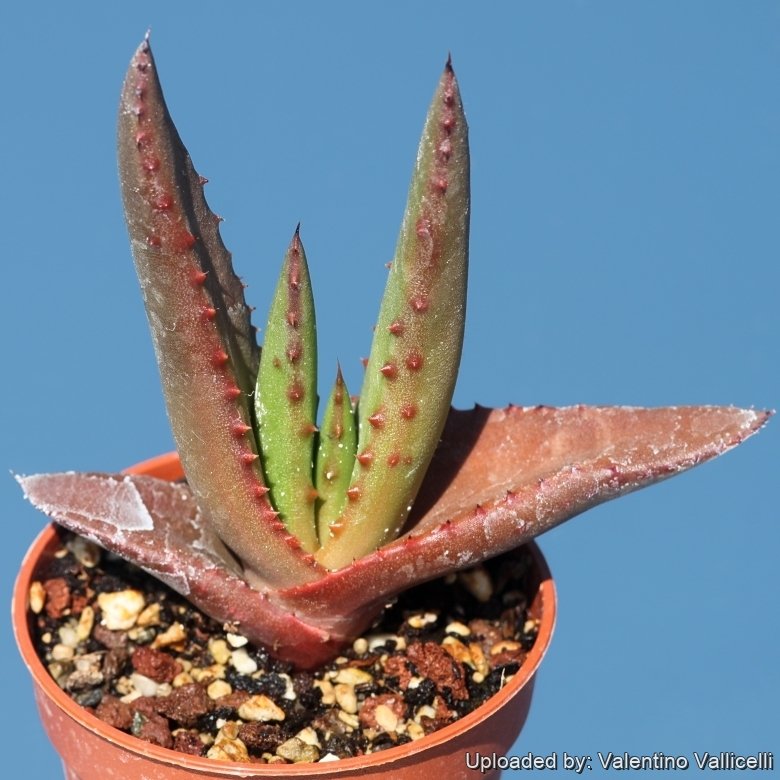
Leaves: 60-90 long and 7 -15 cm wide toward the base, stout but slender, lanceolate-ensiform or gradually attenuate from base, stiffly erect and curving slightly inwards: Leaf colour varying from uniform (without spots) grey-green to dark olive green or turquoise-grey with a pronounced velvety or rough leaf texture, often tinged purplish in dry conditions. Margin with reddish-brown to dark brown deltoid teeth, approx. 1-3 mm tall, pungent, 5-7 mm apart. Like many aloes, leaf tip browning can occur if conditions are too dry. Sap bright yellow, drying purplish.
Inflorescences: 1 to 3 at a time, 1-1,75 m tall, with 5 - 8 branches. Racemes, densely flowered, cylindrical-conical to cylindrical-acuminate, 25-35 cm long and 6-7 cm broad. Branches erect. Peduncle 1–4-branched; Bracts ovate-acuminate, scarious, brownish, approx. 10-15 long and 8-12 mm wide. Aloe cryptopoda was aptly named as the meaning is “hidden foot” describing the conspicuous character of the large bracts which clasp the pedicels and hide them from view.
Flowers: 35-40 (-45) mm approx. 9 mm in diameter across the ovary long scarlet, greenish-tipped in buds, upper half becoming yellowish at anthesis, corolla 28–35 mm long with tepals free to base, tips scarcely spreading. Stamens and stigma exserted approx. 3 mm. However flowers colour can range from dark red to yellow.
Blooming season: Flowers bloom in mid winter.
Fruit: The fruits are yellowish-brown ovoid, capsule 20–30 long and 13 mm broad.
Seeds: 4-5 mm, blackish-brown with narrow very dark yellowish-brown wings.
Chromosome number: 2n = 14
Origin and Habitat
Mozambique, Botswana, Malawi, Zambia, Zimbabwe, Republic of South Africa (Northern Prov., North-West Prov. Mpumalanga), Swaziland and southern Tanzania on the Mozambique border.
Habitat: It grows mainly on very thin soil in rocky slopes, usually steep and exposed with little or no grass.
Altitude: 600- 1600 m a.s.l.
Cultivation and Propagation
It is one of the more attractive stemless aloes easy to grow and adaptable, usually single it may suckers and can form dense groups. It can be grown in large containers. Many hybrids are available, with beautiful flowers. All are drought-tolerant.
Soil: Always use a good quality, loamy sandy soil with plenty of drainage with chips at the bottom of containers.
Repotting: Use pot with good drainage.
Watering: Needs moderate to copious waterings in summer, but do not overwater, or not at all in the colder months of winter. Outdoors it can withstand long periods of drought, but they will thrive and flower more profusely if watered in the correct season. This aloe is very tolerant of drought, although the tips of the leaves may wither and curl during hot, dry periods. Supplemental watering will help keeping the leaves plump and juicy.
Fertilization: Feed it once or twice during the growing season with a fertilizer specifically formulated for cactus and succulents (poor in nitrogen), including all micro nutrients and trace elements diluted to ½ the strength recommended on the label.
Exposure: It need full sun to partial shade, but plants grown in partial shade usually look healthier and more succulent. It is however very hardy when grown in full sun with the minimum water.
Hardiness: When dry it can stand light frost but it is damaged in hard freezes, but recovers quickly. The leaf tips and blooms get damaged below -2°C (USDA zones 9b-10 ).
During the winter months, the plants should be grown cool to initiate flower development (about 5-10°C )
Pests & diseases: Incorrect watering, poor drainage or too much shade can lead to attack by pests and diseases.
Maintenance: Removal of old flower stalks; Divide the crowded clumps periodically. It grows much better outdoors in spring and summer.
Gardening: In mild climates it can be cultivated outdoors for use in landscaping, it can be grown in large, rocky, well-drained soil in gardens in drier areas. It adapts well to a variety of soils and climates, but will grow best in regions with a climate close to that of its native deserts not too cold, and not too wet. It makes an excellent ground cover, grows best in a sunny position and makes a long lasting cut flower. They grow slowly, but not agonizingly so being able to increase their width by 10- 20 cm per year under favourable conditions.
Traditional uses: This plant is suitable as a source of dye, the roots dye wool red-brown to purplish-red, depending on the mordant.
Propagation: By division of offshoots that develop around the outside of the main rosette in spring, the cuttings must be dried out for at least 1 week before planting in river sand. It is easily rooted in potting soil with warmth. It can also be propagated or by seed planted in autumn, in trays of coarse river sand, compost and soil. Sprinkle the seeds evenly on the surface and cover with a layer of small pebbles. The pebbles help the seedlings to stay upright and prevent damping off. Fresh seeds germinate quickly at 18° C. Keep seed tray in a dry corner and do not allow to dry out, but may damp off if overwatered. Transplant the seedlings after one year.
Bibliography
Major references and further lectures
-
S. Kativu “Flora Zambesiaca” FZ, Vol 12 Part 3, page 48 (2001)
-
Urs Eggli “Illustrated Handbook of Suculent Plants: Monocotyledons” Springer, 2001
-
Keith Kirsten “Gardening with Keith Kirsten” Struik, 01/set/2001
-
Hans Bornman, David S. Hardy “Aloes of the South African veld” Voortrekkerpers, 1971
-
The Flowering Plants of Africa:
-
Botanical Research Institute (South Africa), South Africa. Dept. of Agricultural Technical Services “A Magazine Containing Coloured Figures with Descriptions of the Flowering Plants Indigenous in Africa …” Volume 2. 1922. Page 41
-
Barbara Jeppe “South African aloes” Purnell, 1974. Page 61
-
Paulos Cornelis Maria Jansen, D. Cardon “Dyes and Tannins” PROTA, 2005
-
Ben-Erik Van Wyk, Gideon Smith “Guide to the Aloes of South Africa” Briza Publ., 1996
From llifle page Aloe pienaarii
Description
Aloe pienaarii is one of the most beautiful and showy of the South African species of Aloe, it is very closely allied to Aloe cryptopoda, but is more robust with oblong, red raceme.
Stem: Aloe pienaarii ( = Aloe cryptopoda) has very short stems (almost stemless) which can become decumbent with time.
Rosettes: Dense, compact with 40-50 leaves.
Leaves: 60-90 long and 7 -15 cm wide toward the base, stout but slender, lanceolate-ensiform or gradually attenuate from base, stiffly erect and curving slightly inwards: Leaf colour varying from uniform (without spots) grey-green to dark olive green or turquoisey-grey with a pronounced velvety or rough leaf texture, often tinged purplish in dry conditions. Margin with reddish-brown to dark brown deltoid teeth, approx. 1-3 mm tall, pungent, 5-7 mm apart. Like many aloes, leaf tip browning can occur if conditions are too dry. Sap bright yellow, drying purplish.
Inflorescences: 1 to 3 at a time, 1-1,75 m tall, with 5 - 8 branches. Racemes, densely flowered, cylindrical-conical to cylindrical-acuminate, 25-35 cm long and 6-7 cm broad. Branches erect. Peduncle 1–4-branched; Bracts ovate-acuminate, scarious, brownish, approx. 10-15 long and 8-12 mm wide. Aloe cryptopoda was aptly named as the meaning is “hidden foot” describing the conspicuous character of the large bracts which clasp the pedicels and hide them from view.
Flowers: 35-40 (-45) mm approx. 9 mm in diameter across the ovary long scarlet, greenish-tipped in buds, upper half becoming yellowish at anthesis, corolla 28–35 mm long with tepals free to base, tips scarcely spreading. Stamens and stigma exserted approx. 3 mm. Aloe pienaarii has oblong, red raceme.
Blooming season: Flowers bloom in mid winter.
Fruit: The fruits are yellowish-brown ovoid, capsule 20–30 long and 13 mm broad.
Seeds: 4-5 mm, blackish-brown with narrow very dark yellowish-brown wings.
Chromosome number: 2n = 14
Source: Aloe pienaarii, LLIFLE - Encyclopedia of living forms, CC-BY-SA, retrieved 2026-10-25.
From llifle page Aloe wickensii
Description
Aloe wickensii is one of the most beautiful and showy of the South African species of Aloe. It is very closely allied to Aloe cryptopoda, but is a slightly smaller plant with paler more incurved leaves and more yellow bi-colour flowers.
Stem: Aloe wickensii has very short stems (almost stemless) which can become decumbent with time.
Rosettes: Dense, compact with 40-50 leaves.
Leaves: 60-90 long and 7-15 cm wide toward the base, stout but slender, lanceolate-ensiform or gradually attenuate from base, stiffly erect and curving slightly inwards. Leaf colour varying from uniform (without spots) grey-green to dark olive green or turquoisey-grey with a pronounced velvety or rough leaf texture, often tinged purplish in dry conditions. Margin with reddish-brown to dark brown deltoid teeth, approx. 1-3 mm tall, pungent, 5-7 mm apart. Like many aloes, leaf tip browning can occur if conditions are too dry. Sap bright yellow, drying purplish.
Inflorescences: 1 to 3 at a time, 1-1,75 m tall, with 5-8 branches. Racemes, densely flowered, cylindrical-conical to cylindrical-acuminate, 25-35 cm long and 6-7 cm broad. Branches erect. Peduncle 1–4-branched; Bracts ovate-acuminate, scarious, brownish, approx. 10-15 long and 8-12 mm wide.
Flowers: 35-40(-45) mm approx. 9 mm in diameter across the ovary long scarlet, greenish-tipped in buds, upper half becoming yellowish at anthesis, corolla 28–35 mm long with tepals free to base, tips scarcely spreading. Stamens and stigma exserted approx. 3 mm. In Aloe wickensii the flowers are bi-colour red and yellow.
Blooming season: Flowers bloom in mid winter.
Fruit: The fruits are yellowish-brown ovoid, capsule 20–30 long and 13 mm broad.
Seeds: 4-5 mm, blackish-brown with narrow very dark yellowish-brown wings.
Chromosome number: 2n = 14
Origin and Habitat
South Africa, Mozambique.
Habitat: It grows mainly on very thin soil in rocky slopes, usually steep and exposed with little or no grass.
Altitude range: 600- 1600 metres above sea level.
Bibliography
Major references and further lectures
-
S. Kativu “Flora Zambesiaca” FZ, Vol 12 Part 3, page 48 (2001)
-
Urs Eggli “Illustrated Handbook of Suculent Plants: Monocotyledons” Springer, 2001
-
Keith Kirsten “Gardening with Keith Kirsten” Struik, 01/September/2001
-
Hans Bornman, David S. Hardy “Aloes of the South African veld” Voortrekkerpers, 1971
-
The Flowering Plants of Africa:
-
Botanical Research Institute (South Africa), South Africa. Dept. of Agricultural Technical Services “A Magazine Containing Coloured Figures with Descriptions of the Flowering Plants Indigenous in Africa …” Volume 2. 1922. Page 41
-
Barbara Jeppe “South African aloes” Purnell, 1974. Page 61
-
Paulos Cornelis Maria Jansen, D. Cardon “Dyes and Tannins” PROTA, 2005
-
Ben-Erik Van Wyk, Gideon Smith “Guide to the Aloes of South Africa” Briza Publ., 1996
Source: Aloe wickensii, LLIFLE - Encyclopedia of living forms, CC-BY-SA, retrieved 2026-10-25.
Gallery