Publication: Gard. Dict., ed. 8. n. 22. 1768 [16 Apr 1768]
Description
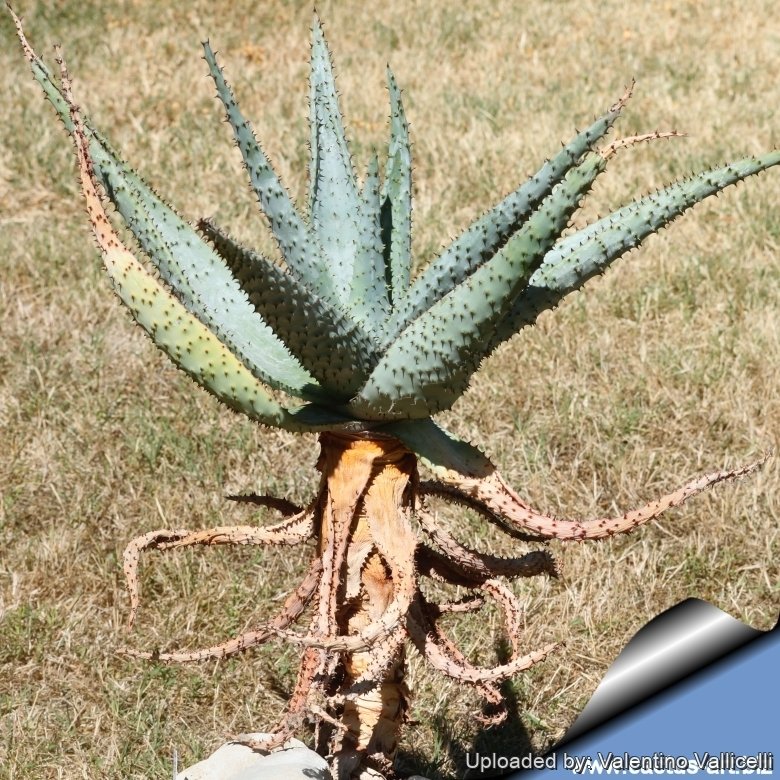
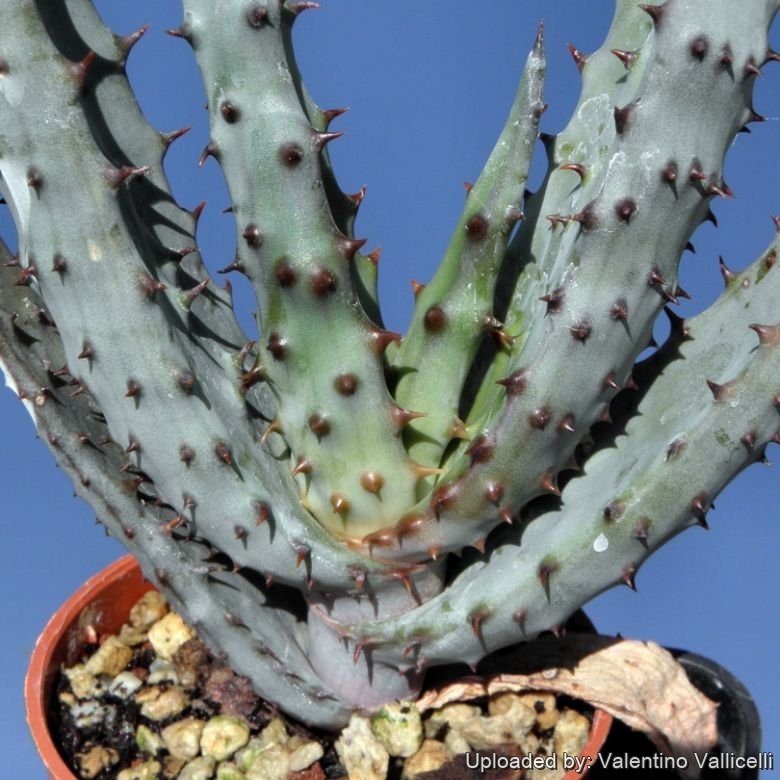
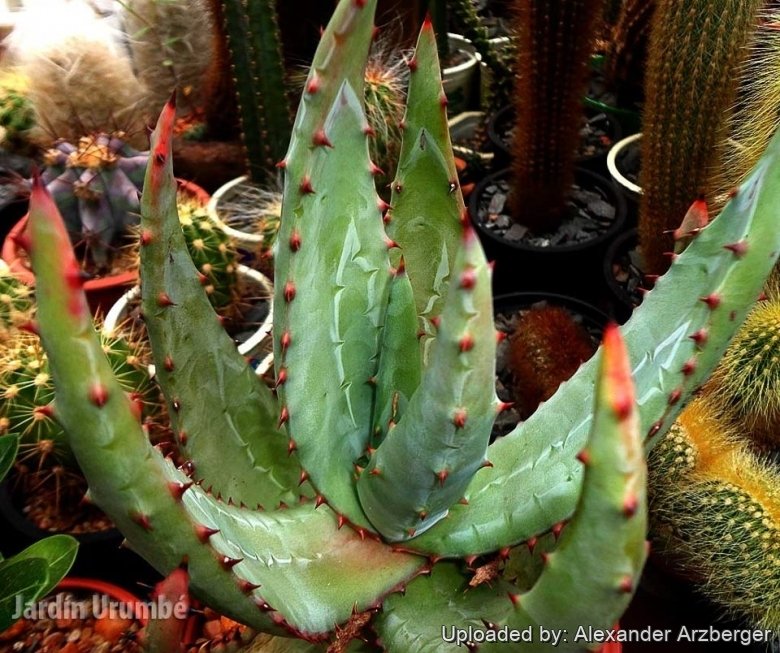
Aloe ferox is a single stemmed, caulescent, aloe about 2-3 m or taller with the leaves arranged in an apical rosette with dead leaf remains. The leaves can be up to 1 metres long and to 15 cm broad, green, sometimes with reddish tinge and are covered by reddish-to brownish teeth. Young plants tend to be very spiny. Aloe ferox is a very variable species, but Reynolds (1950) did not accept the varieties that have been described. Aloe horrida possibly belong here. Aloe ferox is easily confused with Aloe marlorii, bur the flowers of the later are produced on horizontal branches. This species will also hybridise with any other aloe flowering at the same time and many “Aloe ferox” in cultivation are hybrid.
Stem: Simple or ralely branched above the base, 3-3 metres tall, occasionally reaching a length of 5 m and a diameter of 10-15 cm.
Rosette: with 30–60 leaves, densely aggregated at stems tip. The old leaves remain after they have dried, forming a persistent “petticoat” on the stem which give it a ragged untidy appearance if not removed.
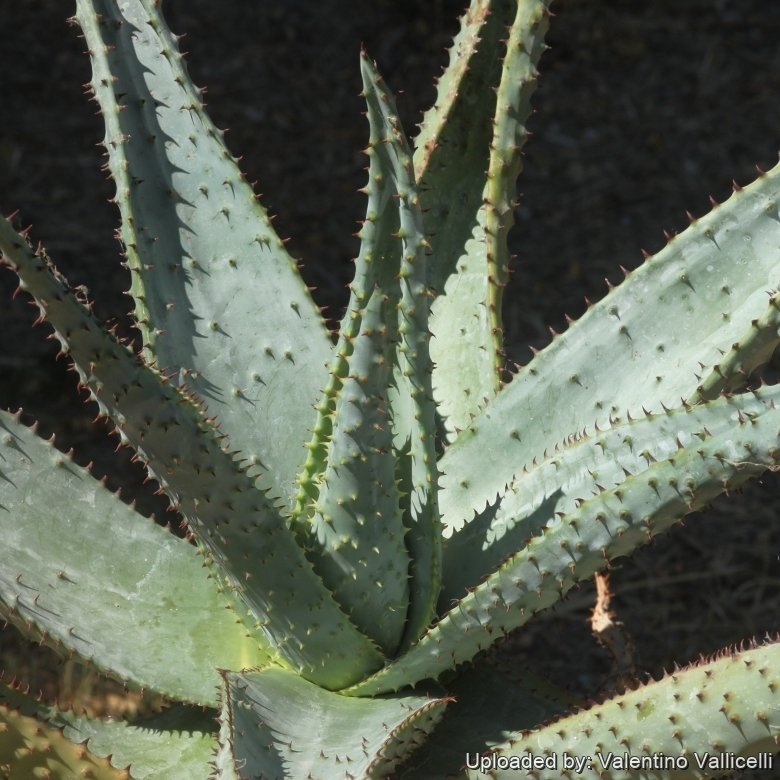
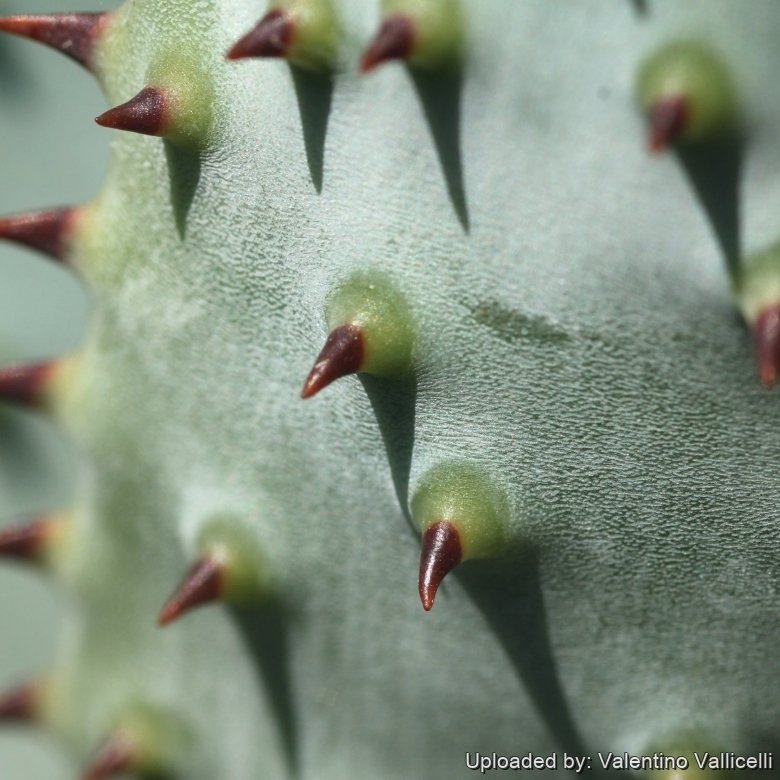
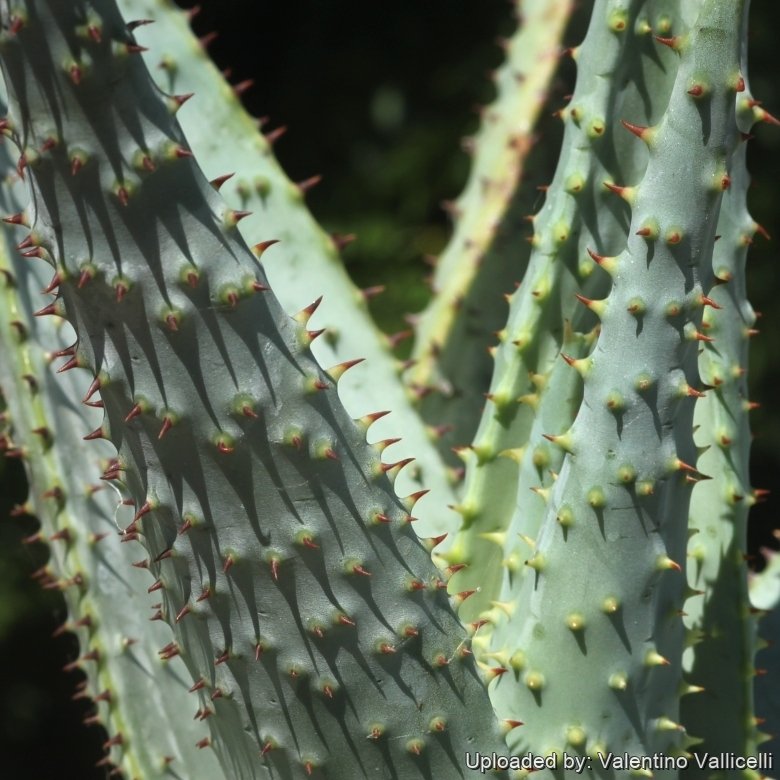
Leaves: Lanceolate, very rigid in texture, the upper face shallowly channelled and the lower convex, pungent at the apex, arcuate-erect to spreading with the leaf tips curving slightly downwards, dull green or grey green, sometimes with a slightly blue look to them and often with a reddish-brown tinge under stress condition. Each leaf can be 50-100 cm long, x 65-150 mm wide. Leaves are furnished with copious reddish to dark brown deltoid-cuspidate prickles 3-6 mm long and 10-20 mm apart along the margins. Surface glabrous or with few to many irregular prickles scattered on the leaf surfaces, especially on the lower surface. Young plants tend to be very spiny. The presence of a thick cuticle, makes leaves well adapted to dry conditions.
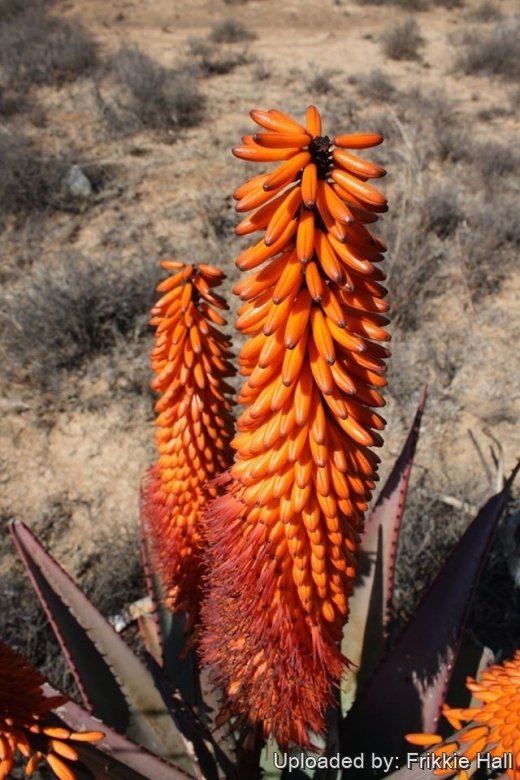
Inflorescences: The inflorescence is a single tall candelabra-like branched panicle, with 5-8(-12) branche each bearing an erect cylindrical or narrowly conical dense racemes, carrying a large spike-like head of many flowers 50-80(-100) cm tall, 9-12 cm in diameter narrowing to about 6 cm at tip, very dense bud horizontal. Bracts ovate-acute, 8-10 cm long, 3-6 mm wide, 3-many-nerved.
Flowers: Pedicels 3-8 mm long. Flows are showy, yellow-orange to bright red (rarely yellow or white) with inner petals tipped with white tubular, subclavate or ventricose and about 3 cm long, base rounded, enlarging above. Ovary slightly narrowed at mouth. Tepals free for 22 mm. Stamens and style dark orange to bright red, anthers, protruding from the mouth 9-25 mm. Outer segments connate in lower third, inner segments free but dorsally adnate to outer in lower third. Aloe ferox are pollinated by birds but honey bees also play a role in the pollination. Blooms are self-sterile and only a few flowers per raceme mature simultaneously. The stamens produce pollen in the morning and wither in the afternoon, whereas the style is exerted on the second day of anthesis.
Blooming season: Winter (May to November according to the area), but in colder country this may be delayed until spring.
Fruit: 20-23 x 10-12 mm, yellowish grey-brown, many seeded.
Seeds: Almost black, about 5.0 x 3.0 x 0.6 mm, broadly winged.
Chromosome number: 2n = 14
Origin and Habitat
South Africa (Eastern Cape, Free State, KwaZulu-Natal), and extending inland as far as Lesotho. Aloe ferox is widespread and common throughout its range.
Altitude range: Up to 1000 metres above sea level.
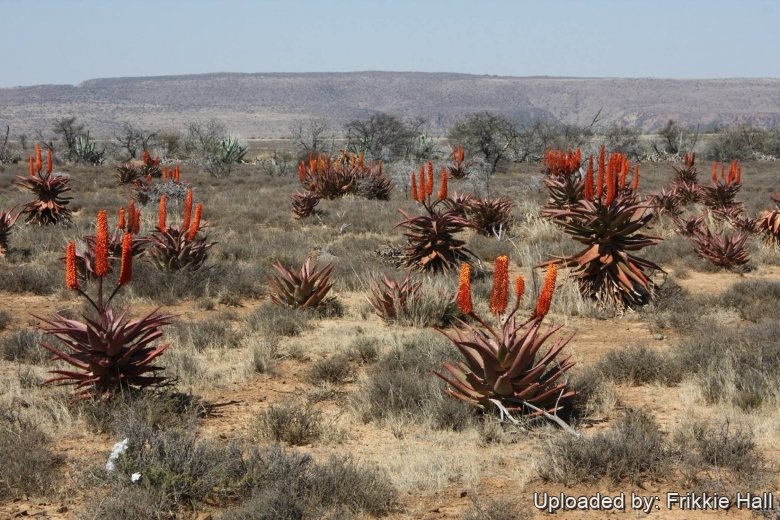
Habitat and ecology: Albany Thicket, Fynbos, Grassland, Indian Ocean Coastal Belt. Aloe ferox is one of the dominant species in the ‘succulent bushland’ vegetation in South Africa. It grows in a wide range of climatic conditions. It is especially abundant on coastal river valley and further inland on rocky outcrops to flat, open areas, arid rocky hillsides and mountain slopes, where mean temperatures range from 27-31°C. Capable of thriving in the arid climate of the western part of the range as well as relatively wet conditions in the eastern part of the range. Annual rainfall ranges from 50-300 mm. Though the root system is shallow, the plant can grow under such dry conditions. Aloe ferox has a stem surrounded with a persistent layer of dead leaves that insulate the stem in the case of bush fires. This species is pollination by birds. However, honey bees also play a role in the pollination. The leaves of this commercially important medicinal plant is extensively harvested and products derived from harvested material are exported. Large volumes have been exported since the 1980s, with an increase in trade over the past 15 years. Despite heavy exploitation in some areas this species is still extremely common and not suspected to be in any danger of extinction. Aloe ferox has a weed-like ecology and is a pioneer species in disturbed vegetation, and therefore land degradation in many areas is suspected to have led to an increase in the population size over the past 30 years.
Cultivation and Propagation
Aloe ferox is cultivated widely as an ornamental. It is not a demanding species and usually does not give many problems in cultivation. It can be grown in a cool-warm glasshouse and put outside for the summer. In warm climates it is also an excellent garden specimen plant and is adaptable to many conditions. It grows much better outdoors in spring and summer, it is also perfect for the bright windowsill.
Soil: It is adaptable but prefers rich leaf mould with a slightly acidic pH (5-6). It has large root system and need big pots. Out-of-Doors grow it in light, fertile, well-drained soils.
Light requirements: It needs full sun to filtered sun.
Waterings: It should be soaked and allowed to dry out between waterings in summer. It should be given very light watering in winter too, still allowing the compost to dry out in between. Watorlogging should be always avoided.
Temperature requirements: Avoid any frost (but tolerates -2 degrees C if very dry).
Maintenance: Removal of old flower stalks. During the winter months, the plants should be grown cool to initiate flower development (about 5-10°C )
Propagation: Aloe ferox does not produce suckers but can be propagated by seed and planting of the tops of old plants. Sow seed in a well drained medium in shallow trays and cover lightly with sand or the seed will blow away. Once the seeds begin to germinate, keep moist but watch out for overwatering as the seedlings could rot. Transplant into small pots once they are about 3-4cm high (approximately 6 months). Plant regeneration (micropropagation) from root and embryo tissue is successful as well.
Bibliography
Major references and further lectures
-
Walters, S.M. “The European Garden Flora, Vol. 1. Pteridophyta; Gymnospermae; Angiospermae — Alismataceae to Iridaceae.” 1986
-
Susan Carter, John J. Lavranos, Leonard E. Newton, Colin C. Walker “Aloes. The definitive guide.” Kew Publishing, Royal Botanic Gardens, Kew 2011
-
Urs Eggli “Illustrated Handbook of Succulent Plants: Monocotyledons: Monocotyledons” Springer Science & Business Media, 17 July 2001
-
Gilbert Westacott Reynolds “The Aloes of Tropical Africa and Madagascar” Aloes Book Fund, 1966
-
Hermann Jacobsen “Abromeitiella to Euphorbia” Blandford Press, 1960
-
Reynolds, G.W. 1950. “The aloes of South Africa” The Aloes of South Africa Book Fund, Johannesburg.
-
Van Wyk, B.-E. and Smith, G. “Guide to the aloes of South Africa.” Briza Publications, Pretoria. 1996.
-
Boon, R. “Pooley’s Trees of eastern South Africa”. Flora and Fauna Publications Trust, Durban.2010.
-
Pooley, E. “Mountain flowers: a field guide to the flora of the Drakensberg and Lesotho.” Natal Flora Publications Trust, Durban.2003.
-
Vlok, J. and Schutte-Vlok, A.L. “Plants of the Klein Karoo”. Umdaus Press, Hatfield.
-
Raimondo, D., Vlok, J.H., van Wyk, B.E., van Jaarsveld, E. & Victor, J.E. 2012. Aloe ferox Mill. National Assessment: Red List of South African Plants version 2015.1. Accessed on 2016/05/03
-
“Medicinal Plants”, Volume 1 PROTA, 2008
-
Raewyn Adams “Aloes A to Z” Lulu.com, 2015
From llifle page Aloe candelabrum
Cultivation and Propagation
It is an easy plant that usually does not give many problems in cultivation. Needs light shade to filtered sun, but will redden with more light exposure. Regular water in summer, keep dryer in winter, needs good drainage It grows much better outdoors in spring and summer, it is also perfect for the bright windowsill. Grow it in light, fertile, well-drained, moderate soils, with a slightly acidic pH (5-6). Avoid any frost.
Maintenance: Removal of old flower stalks; It is a suckering species, and one plant can eventually cover a large area. Divide the crowded clumps periodically. During the winter months, the plants should be grown cool to initiate flower development (about 5-10°C )
Propagation: Suckers, division of older plants.
Source: Aloe candelabrum, LLIFLE - Encyclopedia of living forms, CC-BY-SA, retrieved 2026-10-25.
From llifle page Aloe subferox
Description
It is a single stemmed aloe about 2-3 m or taller with the leaves arranged in an apical rosette. The old leaves remain after they have dried, forming a persistent “petticoat” on the stem which give it a ragged untidy appearance if not removed. Aloe ferox is easily confused with Aloe marlorii, bur the flowers of the latter are produced on horizontal branches. This species will also hybridise with any other aloe flowering at the same time and many “Aloe ferox” in cultivation are hybrid.
Leaves: Dull green or grey green, sometimes with a slightly blue look to them and often with a reddish-brown tinge under stress condition. Each leaf can be up to 1 m long with the leaf tips curving slightly downwards. Leaves have dark brown spines along the margins and often scattered on the leaf surfaces, especially on the lower surface. Young plants tend to be very spiny.
Inflorescences: The inflorescence is a tall candelabra-like branched panicle, with 5-10 erect cylindrical racemes, each carrying a large spike-like head of many flowers.
Flowers: Showy, tubular and about 3 cm long, yellow-orange to bright red with inner petals tipped with white. The stamens, protruding from the mouth, are dark orange. There are also pure white or pure yellow forms. Aloe ferox are pollinated by birds but honey bees also play a role in the pollination. Blooms are self-sterile and only a few flowers per raceme mature simultaneously. The stamens produce pollen in the morning and wither in the afternoon, whereas the style is exerted on the second day of anthesis.
Blooming season: Winter, but in colder country this may be delayed until spring.
Cultivation and Propagation
It is not a demanding species and usually does not give many problems in cultivation. It can be grown in a cool-warm glasshouse and put outside for the summer. In warm climates it is also an excellent garden specimen plant and is adaptable to many conditions. It needs full sun to filtered sun. It should be soaked and allowed to dry out between waterings in summer. It should be given very light watering in winter too, still allowing the compost to dry out in between. Watorlogging should be always avoided. It grows much better outdoors in spring and summer, it is also perfect for the bright windowsill. Grow it in light, fertile, well-drained soils, with a slightly acidic pH (5-6). Avoid any frost.
Maintenance: Removal of old flower stalks. During the winter months, the plants should be grown cool to initiate flower development (about 5-10°C )
Propagation: Aloe ferox does not produce suckers but can be propagated by seed and planting of the tops of old plants. Sow seed in a well drained medium in shallow trays and cover lightly with sand or the seed will blow away. Once the seeds begin to germinate, keep moist but watch out for overwatering as the seedlings could rot. Transplant into small pots once they are about 3-4cm high (approximately 6 months). Plant regeneration (micropropagation) from root and embryo tissue is successful as well.
Source: Aloe subferox, LLIFLE - Encyclopedia of living forms, CC-BY-SA, retrieved 2026-10-25.
From llifle page Aloe perfoliata var. e
Description
It is a single stemmed aloe about 2-3 m or taller with the leaves arranged in an apical rosette. Aloe ferox is easily confused with Aloe marlorii. bur the flowers of the later are produced on horizontal branches. This species will also hybridise with any other aloe flowering at the same time and many “Aloe ferox” in cultivation are hybrid.
Stem: Simple or ralelybranched above the base, occasionally reaching a length of 5 m and a diameter of 10-15 cm.
Rosette: with 30–60 leaves, densely aggregated at stems tip. The old leaves remain after they have dried, forming a persistent “petticoat” on the stem which give it a ragged untidy appearance if not removed.
Leaves: 50-60 per rosette, lanceolate, very rigid in texture, shallowly channelled,, pungent at the apex, arcuate-erect to spreading with the leaf tips curving slightly downwards, dull green or grey green, sometimes with a slightly blue look to them and often with a reddish-brown tinge under stress condition. Each leaf can be 50-100 cm long, x 65-150 mm wide. Leaves are furnished with copious dark brown deltoid-cuspidate prickles 3-6 mm long along the margins and often scattered on the leaf surfaces, especially on the lower surface. Young plants tend to be very spiny.
Inflorescences: The inflorescence is a tall candelabra-like branched panicle, with 5-12 erect cylindrical or narrowly conical dense racemes, each carrying a large spike-like head of many flowers up to 1 m tall..
Flowers: Showy, tubular, subclavate or ventricose and about 3 cm long, yellow-orange to bright red with inner petals tipped with white. The stamens, protruding from the mouth, are dark orange. There are also pure white or pure yellow forms, bracts ovate-acute, 7-11 x 3-6 mm, 3-many-nerved.; outer segments connate in lower third, inner segments free but dorsally adnate to outer in lower third; pedicels 3-8 mm long. Stamens and style bright red, anthers exserted 9-25 mm. Aloe ferox are pollinated by birds but honey bees also play a role in the pollination. Blooms are self-sterile and only a few flowers per raceme mature simultaneously. The stamens produce pollen in the morning and wither in the afternoon, whereas the style is exerted on the second day of anthesis.
Blooming season: Winter, but in colder country this may be delayed until spring.
Fruit: 20-23 x 10-12 mm, yellowish grey-brown, many seeded.
Seeds: Almost black, about 5.0 x 3.0 x 0.6 mm, broadly winged.
Chromosome number: 2n = 14
Source: Aloe perfoliata var. e, LLIFLE - Encyclopedia of living forms, CC-BY-SA, retrieved 2026-10-25.
Cultivars and forms (3)
Gallery