Publication: 1926
Description
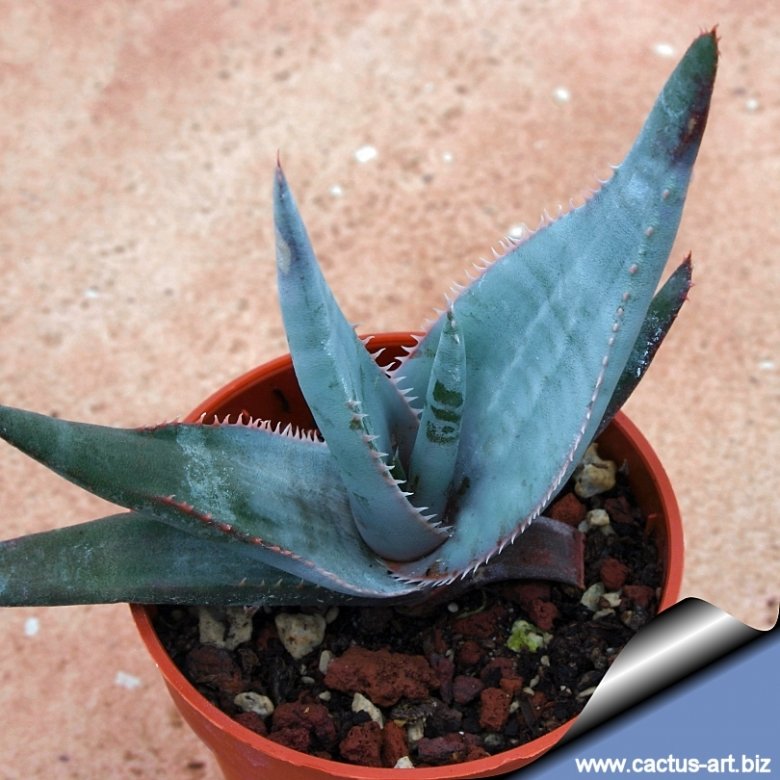
Aloe laeta is a rare but extremely attractive slow growing stemless, or nearly so aloe. It forms rosettes maximally up to 20 cm in diameter, whose blue-grey-green, waxy leaves have dense red teeth on the margin. Its flowers appear in a head-like raceme and are pendulous, cylindrical, and carmine red.
Derivation of specific name: “laeta” For the bright crimson flowers, from. Latin ‘laetus’ (bright).
Rosette: Stout, usually simple, compact 20 to 40 cm large.
Leaves: 15-23 cm long, 7-9 cm wide, upright rounded at the base and apex, flatly spreading, waxy, glaucous bluish-green to blackish-red, both sides papillose,. Leaf teeth red adpressed, horny, 2 mm long.
Infloerscence: Usually simple or branched that rises from the centre of the crown 30 to 45 cm high
Flowers: 15 to 30, coral-red.
Blooming area: In habitat the plant flowers mostly in May, at the start of the southern winter (dry season).
Remarks: Aloe laeta is one of the few self-fertile species in the genus; viable seed can therefore be obtined without crossed pollination. Perrier (1926) described a var. maniaensis from an area a short distance to the south-east of the main population of this species. It is said to differ in having smaller leaves (about 80 x 20 mm) and hence a smaller rosette, and in that the perianth is funnel shaped, but most authors have dismissed var. maniaensis as perhaps not worthy of even varietal status, but it still has a value for a collector because they identify plants with particular characters.
Origin and Habitat
Ibity massif in the Antananarivo and Fianarantsoa provinces central Madagascar.
Altitude range: 1600 to 2200 metres above sea level.
Habitat: This species grows on decomposed sandstone as plaques of plants attached to bare rocks by their roots. These plants perform an important function in impeding run-off during the frequent rains. In addition to its high rainfall, this area is frequently shrouded in mist.
Cultivation and Propagation
It is not easy in cultivation.
Bibliography
Major references and further lectures
-
Werner Rauh, Herman Schwartz “Succulent and xerophytic plants of Madagascar”, Volume 2 Strawberry Press, 1998
-
“The Flowering Plants of Africa”, Botanical Research Institute, Department of Agricultural Technical Services, Republic of South Africa., 1992
-
Hermann Jacobsen “Abromeitiella to Euphorbia” Blandford Press, 1960
-
Werner Rauh “The Wonderful World of Succulents: Cultivation and Description of Selected Succulent Plants Other Than Cacti” Smithsonian Institution Press, 1984
-
Gilbert Westacott Reynolds “The Aloes of Tropical Africa and Madagascar” Aloes Book Fund, 1966
-
O.M. Grace, R.R. Klopper, E. Figueiro & G.F. Smith “The aloe names book” in Strelitzia 28 Pretoria 2011
-
Urs Eggli “Illustrated Handbook of Succulent Plants: Monocotyledons” Springer Science & Business Media, 06 December 2012
Gallery