Publication: Rec. Albany Mus. 2: 139 (1907)
Description
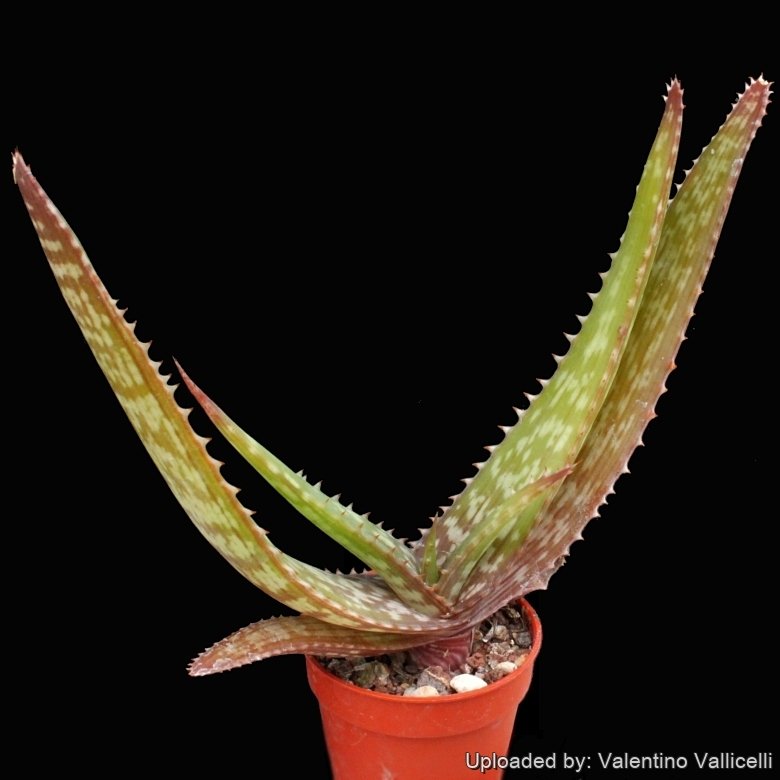
Aloe parvibracteata is a a typical maculate aloe, solitary or in small groups or, usually suckering, freely to form large, dense groups that grows up to 20-40 cm tall excluding inflorescence. It is extremely variable in habit, leaf arrangement and shape.
Stem: Plants are generally stemless, but may in time develop a short, erect or creeping stem.
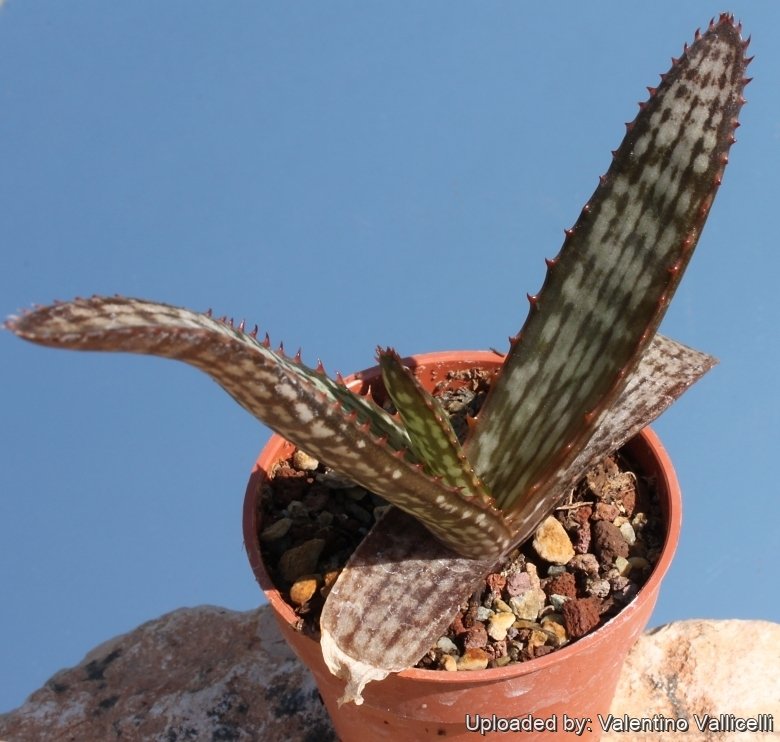
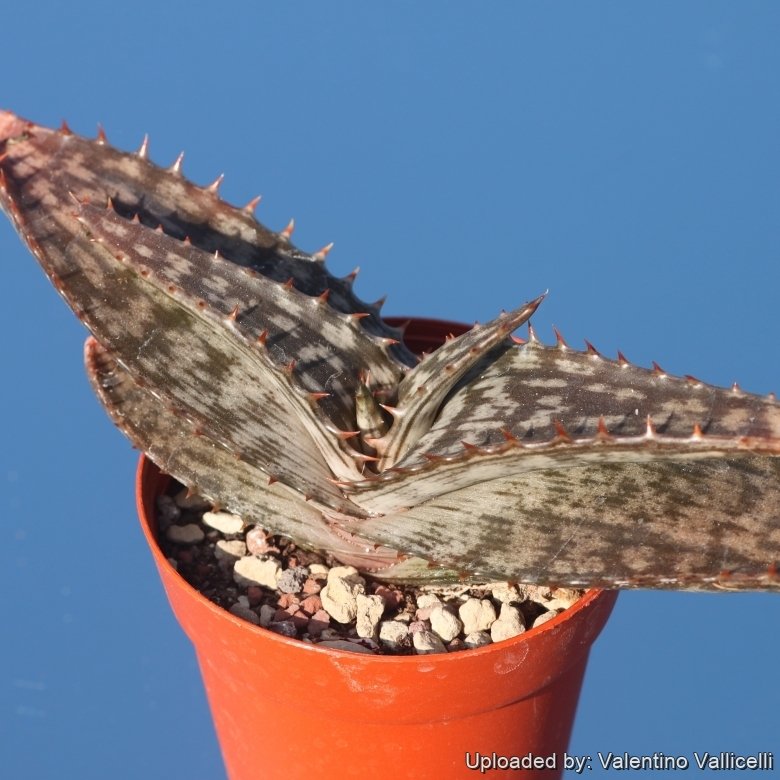
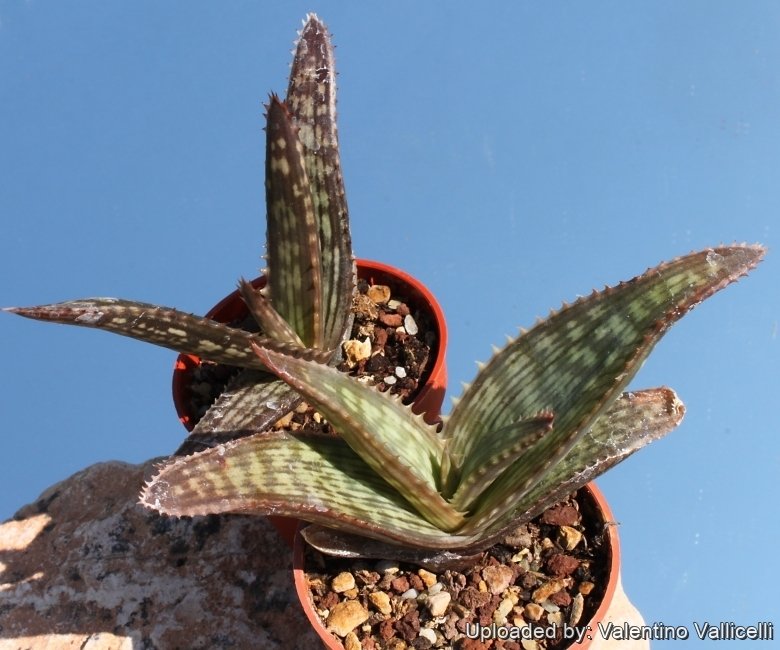
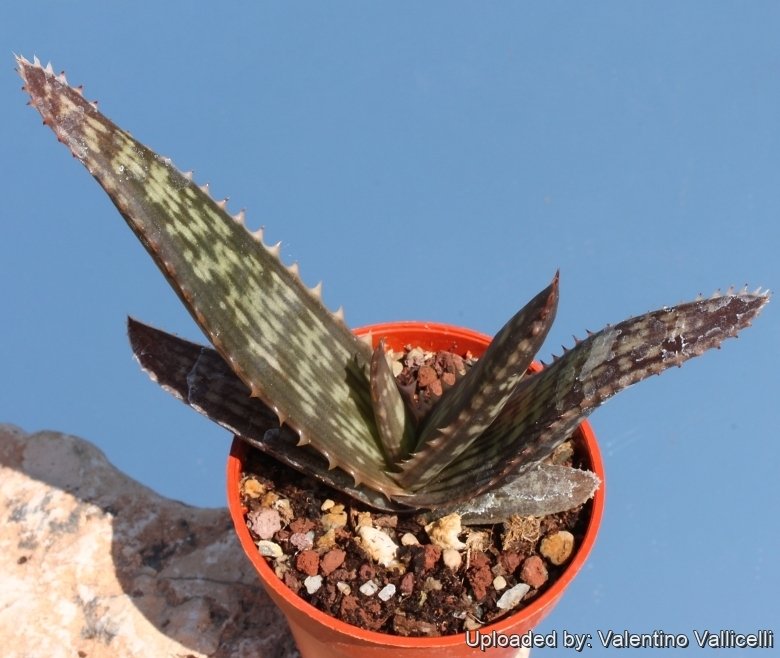
Rosettes: Tends to be distichous as a seedling, but forms a perfect rosette as it grows. The rosette is more or less compact with approximatively 10-15 decurved to spreading widely leaves giving the rosette a flattened appearance.
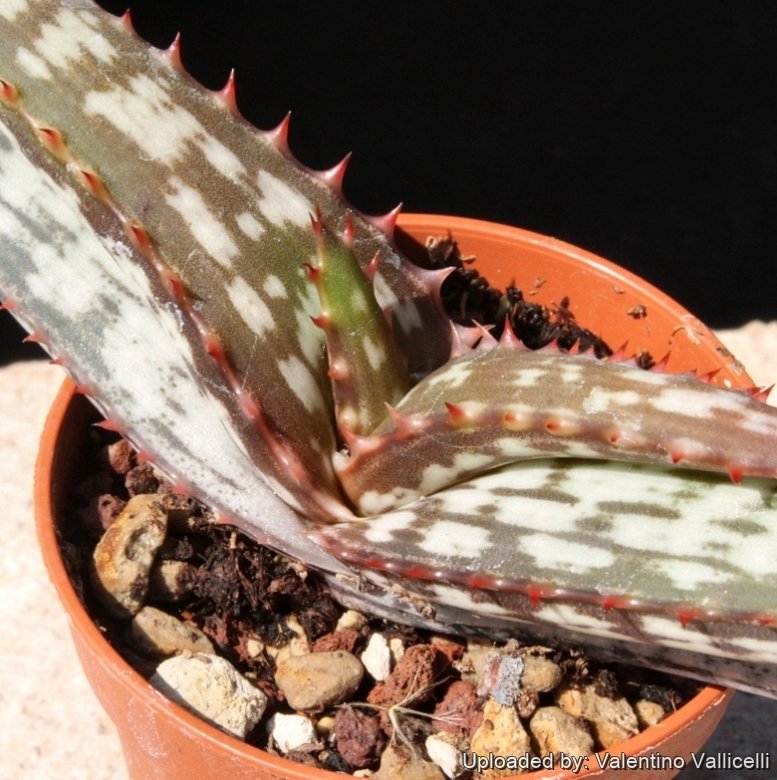
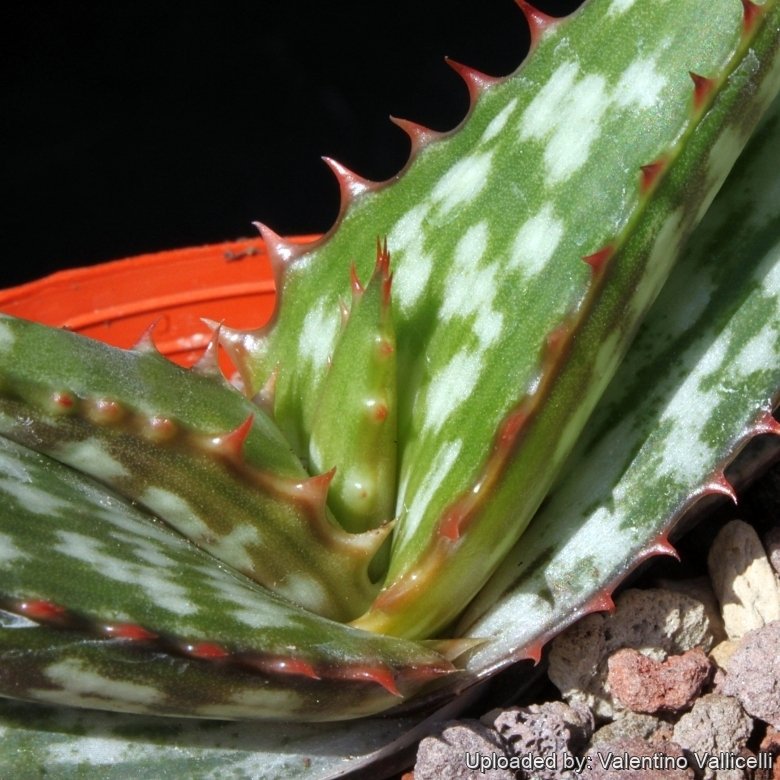
Leaves: 30-50 cm long, 3-8 cm broad toward the base, lanceolate-attenuate, but variable in shape and ranging from comparatively short, erect and triangular to fairly long and twisted, slightly channelled, upper surface dark brownish-green with many whitish spots in irregular transverse bands, sometimes obscurely lineate, lower surface spotted or unspotted. Marginal teeth 3 -5 mm long, sharp, deltoid, brown tipped, 0,8-1,5 cm apart. In this species the leaf sap usually dries deep purple to violet, but exceptional specimens with sap drying golden yellow are known.
Inflorescence: 0,5-1,5(-2) m tall with 4-9 ultimate branches sometimes rebranched; racemes cylindric, sub-lax, slightly acuminate, 15-20(-40) long, 6-7 cm in diameter with 40-50 florets.
Bracts deltoid-cirrhous or lanceolate-acuminate, 12 mm long, 3 mm broad, 5-7-nerved. Pedicels 6-17 mm long.
Flowers: Coral-red or dull red, somewhat pruinose, 24-33(-40) mm long, 7-9 mm in diameter mouth down-turned; outer segments free for 8-10 mm with pale margins, inner segments dorsally adnate to outer; Anthers exserted 1-2 mm. Ovary 7-10 mm loong, 2,5-3,5 mm in diameter, green abruptly narrowed to 5 - 6 mm above; Stamens and style protruding beyond the margin 1-2 mm.
Blooming season: Winter.
Chromosome number: 2n = 14
Fruit: Capsule, oblong-ovoid 20-23 long, 11-13 mm brod, greyish to purplish brown.
Seeds: 2,5 × 6 mm, black with pale brown wings.
Note: Aloe parvibracteata is most usefully separated from Aloe zebrina by the flowering season (winter, not autumn) and the leaf sap drying purple not yellow, but both of these characters are known to break down.
Origin and Habitat
This aloe has a wide distribution area. Found in South Africa , from the Lebombo Mountains to the sea. (Northern Province, Mpumalanga, Swaziland, and KwaZulu-Natal); also in Mozambique and Zimbabwe.
Type locality: Mozambique, Maputo.
Habitat: It grows mostly on rock outcrops in hot flat grasslands and thorny woodlands with scattered trees and shrubs, often in seasonally swampy areas or near water-courses. It has no specific requirements for soil, being found to grow equally well on heavy clay and in cracks in rock.
Altitude: 0-230 meters above sea level.
Cultivation and Propagation
This is one of the most attractive foliage aloes and also bears attractive flowers. It is easy to grow and adaptable, it suckers and can form dense groups. It can be grown in large containers. Sometimes used as stock for hybrids because of the reliable red colour to the leaves. Many hybrids are available. All are drought-tolerant.
Growth: It grows slowly, but not agonizingly so being able to increase its width by 10- 20 cm per year under favourable conditions.
Soil: Always use a good quality, loamy sandy soil with plenty of drainage with chips at the bottom of containers.
Repotting: Use pot with good drainage.
Watering: Needs moderate to copious waterings in summer, but do not overwater, or not at all in the colder months of winter. Outdoors it can withstand long periods of drought, but they will thrive and flower more profusely if watered in the correct season. This aloe is very tolerant of drought, although the tips of the leaves may wither and curl during hot, dry periods. Plant in full sun in a well-drained soil and irrigate only occasionally to enhance the red coloration of the foliage. Supplemental watering will help keeping the leaves plump, green and juicy.
Fertilization: Feed it once or twice during the growing season with a fertilizer specifically formulated for cactus and succulents (poor in nitrogen), including all micro nutrients and trace elements diluted to ½ the strength recommended on the label.
Exposure: It need full sun to partial shade, but plants grown in partial shade usually look healthier and more succulent. It is however very hardy when grown in full sun with the minimum water.
Hardiness: When dry it can stand light frost but it is damaged in hard freezes, but recovers quickly. The leaf tips and blooms get damaged below -2°C (USDA zones 9b-10 ). The clumps melted in the freeze, often return from underground suckers. During the winter months, the plants should be grown cool to initiate flower development (about 5-10°C )
Pests & diseases: Incorrect watering, poor drainage or too much shade can lead to attack by pests and diseases.
Maintenance: Removal of old flower stalks; Divide the crowded clumps periodically. It grows much better outdoors in spring and summer.
Warning: It’s teeth are not too sharp, but they can hurt your fingers if you are pruning off some dead leaves (get stiffer once they dry).
Gardening: This is a great plant for color, if you have a bright, sunny spot in an area that doesn’t get too much water. It is one of the redder aloes available. In mild climates it can be cultivated outdoors for use in landscaping, it can be grown in large, rocky, well-drained soil in gardens in drier areas. It adapts well to a variety of soils and climates, but will grow best in regions with a climate close to that of its native deserts not too cold, and not too wet. It makes an excellent ground cover, grows best in a sunny position and makes a long lasting cut flower.
Traditional uses: This plant is suitable as a source of dye, the roots dye wool yellow.
Propagation: By division of offshoots that develop around the outside of the main rosette in spring, the cuttings must be dried out for at least 1 week before planting in river sand. It is easily rooted in potting soil with warmth. It can also be propagated or by seed planted in autumn, in trays of coarse river sand, compost and soil. Sprinkle the seeds evenly on the surface and cover with a layer of small pebbles. The pebbles help the seedlings to stay upright and prevent damping off. Fresh seeds germinate quickly at 18° C. Keep seed tray in a dry corner and do not allow to dry out, but may damp off if overwatered. Transplant the seedlings after one year.
Bibliography
Major references and further lectures
-
Dr J.P. Roux “Flora of South Africa” (2003)
-
Urs Eggli “Illustrated Handbook of Suculent Plants: Monocotyledons” Springer, 2001
-
Barbara Jeppe “South African aloes” Purnell, 1974
-
“Aloe parvibracteata Schonland” in Records of the Albany Museum 2: 139 (1907)
-
B-E. van Wyk & G.F. Smith, “Guide to the Aloes of South Africa” 62 (1996).
-
Reynolds, “Aloe parvibracteata” Aloes S. Africa: page 276 (1950)
-
Hans Bornman, David S. Hardy “Aloes of the South African veld” Voortrekkerpers, 1971
-
S. Kativu “Flora Zambesiaca” Vol 12 Part 3, page 48 (2001)
-
Paulos Cornelis Maria Jansen, D. Cardon “Dyes and Tannins” PROTA, 2005
From llifle page Aloe burgersfortensis
Description
Aloe burgersfortensis (=Aloe parvibracteata) is a typical maculate aloe usually solitary, but some specimens will occasionally form two or three heads from basal suckers. that grows up to 20-40 cm tall excluding inflorescence. Aloe burgersfortensishas brownish leaves with dry twisted tips, branched inflorescence of dull red flowera with whitish bloom. This is yet another species of spotted aloe that has hardly any distinguishing characters, apart from its geographical distribution range and its immense variability.
Stem: Plants are generally stemless, but may in time develop a short, erect or creeping stem.
Rosettes: Tends to be distichous as a seedling, but forms a perfect rosette as it grows. The rosette is more or less compact with approximatively 10-15 decurved to spreading widely leaves giving the rosette a flattened appearance.
Leaves: 30-50 cm long, 3-8 cm broad toward the base, lanceolate-attenuate, but variable in shape and ranging from comparatively short, erect and triangular to fairly long and twisted, slightly channelled. Leaf colour is very variable and ranges from dull brownish green to bright green, upper surface with many whitish spots in irregular transverse bands, sometimes obscurely lineate, lower surface spotted or unspotted. Marginal teeth 3 -5 mm long, sharp, deltoid, brown tipped, 0,8-1,5 cm apart. In this species the leaf sap usually dries deep purple to violet, but exceptional specimens with sap drying golden yellow are known.
Inflorescence: 0,5-1,5(-2) m tall with 4-9 ultimate branches sometimes rebranched with flowers not unlike those of Aloe zebrina; racemes cylindric, sub-lax, slightly acuminate, 15-20(-40) long, 6-7 cm in diameter with 40-50 florets.
Bracts deltoid-cirrhous or lanceolate-acuminate, 12 mm long, 3 mm broad, 5-7-nerved. Pedicels 6-17 mm long.
Flowers: Coral-red or dull red, somewhat pruinose, 24-33(-40) mm long, 7-9 mm in diameter mouth down-turned; outer segments free for 8-10 mm with pale margins, inner segments dorsally adnate to outer; Anthers exserted 1-2 mm. Ovary 7-10 mm loong, 2,5-3,5 mm in diameter, green abruptly narrowed to 5 - 6 mm above; Stamens and style protruding beyond the margin 1-2 mm.
Blooming season: Winter.
Chromosome number: 2n = 14
Fruit: Capsule, oblong-ovoid 20-23 long, 11-13 mm brod, greyish to purplish brown.
Seeds: 2,5 × 6 mm, black with pale brown wings.
Note: Aloe parvibracteata is most usefully separated from Aloe zebrina by the flowering season (winter, not autumn) and the leaf sap drying purple not yellow, but both of these characters are known to break down.
Origin and Habitat
It is endemic to Burgersfort, Mpumalanga, South Africa.
Habitat: It is a typical component of bushveld vegetation around Burgersfort and Steelpoort, and also occurs further to the south near Barberton. It grows mostly on sandy soil in the open or in the shade of trees in hot flat grasslands with scattered trees and shrubs.
Altitude: Its altitudinal range varies from 1000 to 1400m.
Bibliography
Major references and further lectures
-
Ben-Erik van Wyk & Gideon Smith “Guide to the Aloes of South Africa”, 2nd edition, 2003
-
Urs Eggli “Illustrated Handbook of Suculent Plants: Monocotyledons” Springer, 2001
-
Barbara Jeppe “South African aloes” Purnell, 1974
-
“Aloe parvibracteata Schonland” in Records of the Albany Museum 2: 139 (1907)
-
B-E. van Wyk & G.F. Smith, “Guide to the Aloes of South Africa” 62 (1996).
-
Reynolds, “Aloe parvibracteata” Aloes S. Africa: page 276 (1950)
-
Hans Bornman, David S. Hardy “Aloes of the South African veld” Voortrekkerpers, 1971
-
S. Kativu “Flora Zambesiaca” Vol 12 Part 3, page 48 (2001)
-
Paulos Cornelis Maria Jansen, D. Cardon “Dyes and Tannins” PROTA, 2005
-
Dr J.P. Roux “Flora of South Africa” (2003)
Source: Aloe burgersfortensis, LLIFLE - Encyclopedia of living forms, CC-BY-SA, retrieved 2026-10-25.
From llifle page Aloe decurvidens
Origin and Habitat
Transvaal
Source: Aloe decurvidens, LLIFLE - Encyclopedia of living forms, CC-BY-SA, retrieved 2026-10-25.
Gallery