Publication: Bothalia 28(1): 81 (1998)
Description
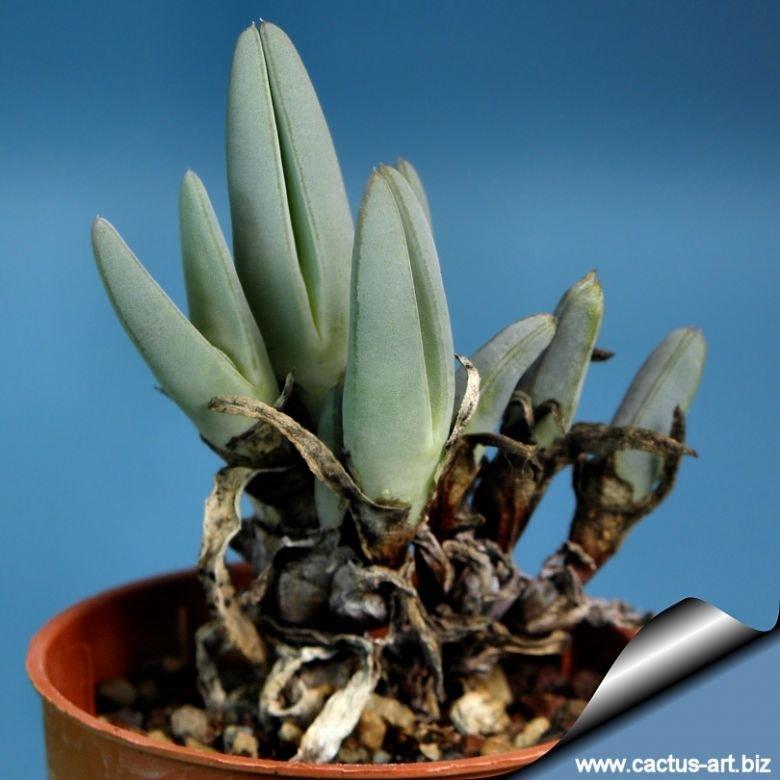
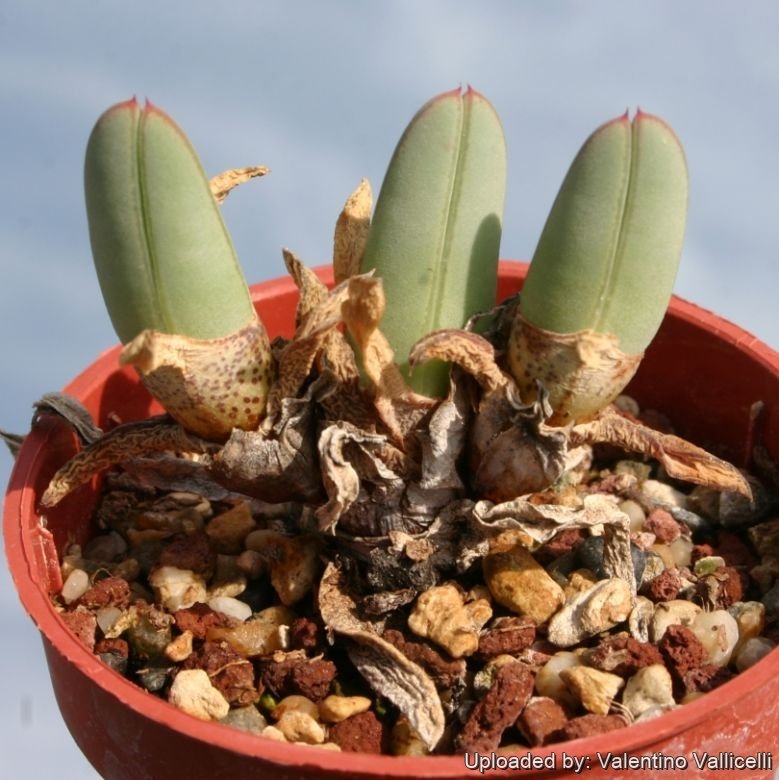
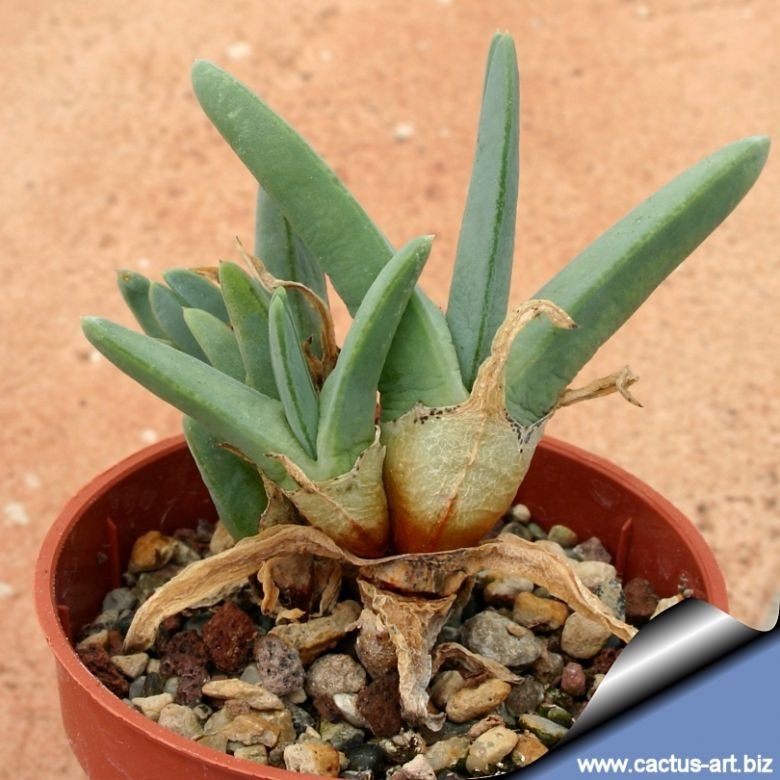
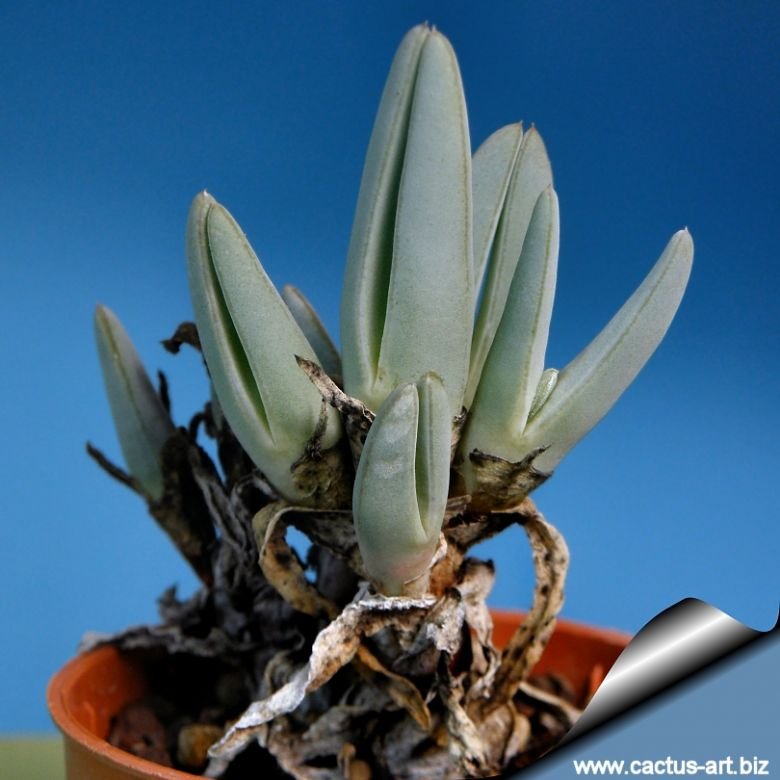
Antimima ventricosa is a small succulent shrub forming a compact cushion and bearing large flowers.
Stem: Basally branched with very short internodes.
Leaves: These peculiar plants are heterophyllous, that is to say that they produce leaves of two kinds on a branch: the first pair of the season (for the summer dormant period) connate for almost half its length, sheathing over in summer and enclosing subsequent leaves; other leaf pair (during the winter) up to 4-8(-12) cm long, 13-17 mm broad, 10-13 mm thick, opposite, joined at the base, with a longer free part, keeled near the tip, mucronate, silvery green, waxed and joined with the shorter drier outside pair framing the larger younger inner pair. Free parts trigonous and papillate in both types, but more densely so in younger.
Flowers: Showy, daisy-like, mauve with pink staminodes centrally collected.
Fruits (capsules): The fruit is a 5-locular capsule with persistent bracteoles, without
valve wings, expanding keels distant. 4-6-loeuled, incompletely known. The low number of locules excludes the species from Cheiridopsis where it might otherwise belong.
Origin and Habitat
Western Cape, South Africa.
Habitat and ecology: This species grows in shrubby associations on slopes with quartzite stones. The climate in this area is very dry with 100-500 mm/annum rainfall in winter. The species is stable and not threatened.
Cultivation and Propagation
The Antimima ventricosa is a “winter” grower which is most active from late winter until later spring and heading for summer dormancy. It is relatively easy to grow.
Soil: Requires good drainage as it it is prone to root rot. It can grows outdoor in sunny, dry, rock crevices (protection against winter wet is required) It can also be cultivated in alpine house, in poor, drained soil.
Fertilization: It thrives in poor soils and seems sensitive to an excess of potassium.
Watering: Water minimally in summer, only when the plant starts shrivelling, water more abundantly when they are growing in the autumn and spring. Requires little water otherwise its epidermis breaks (resulting in unsightly scars).
Light: It needs a bright sunny or light shade exposure in winter, but keep cool and shaded in summer.
Hardiness: It prefer a very bright situation and will take a light frost (Hardy to -5°C) if it is in dry soil. USDA zones 9A – 11.
Uses: Container, rock garden.
Propagation: Seed in spring or (or rarely) cuttings. It is easily propagated by seed.
Bibliography
Major references and further lectures
-
Burgoyne, P.M. 2006. “Antimima ventricosa (L.Bolus) H.E.K.Hartmann”. National Assessment: Red List of South African Plants version 2015.1. Accessed on 2015/11/15
-
Heidrun E.K. Hartmann “Illustrated Handbook of Succulent Plants: Aizoaceae A-E” Springer Science & Business Media, 2002
-
Heidrun E.K. Hartmann “New combinations in Antimima (Ruschioideae, Aizoaceae) from southern Africa” Bothalia 28.1: 67-82 (1998)
-
Antimima. In: Gideon Smith “Mesembs of the World. Illustrated Guide to a Remarkable Succulent Group.” Briza Publications 1998
-
E.J. Jaarsveld & U. De Pienaar “Aizoaceae” Ulmer 2000
-
S.A. Hammer « Mastering the art of growing mesembs», in Cact. Succ. Journ. (USA), 67(4). 1995