Publication: Natl. Cact. Succ. J. 28 (2): 50 (1973).
Description
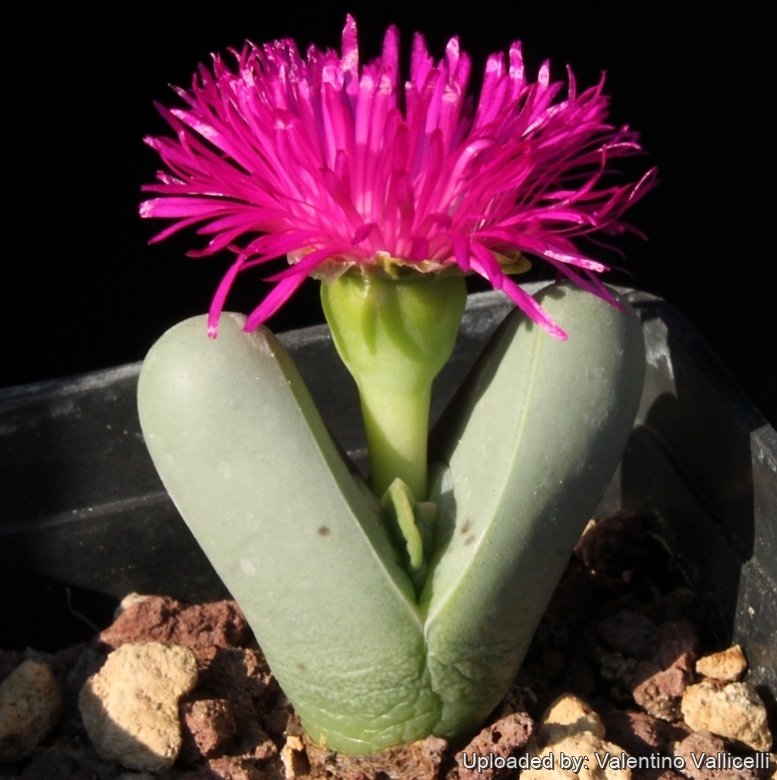
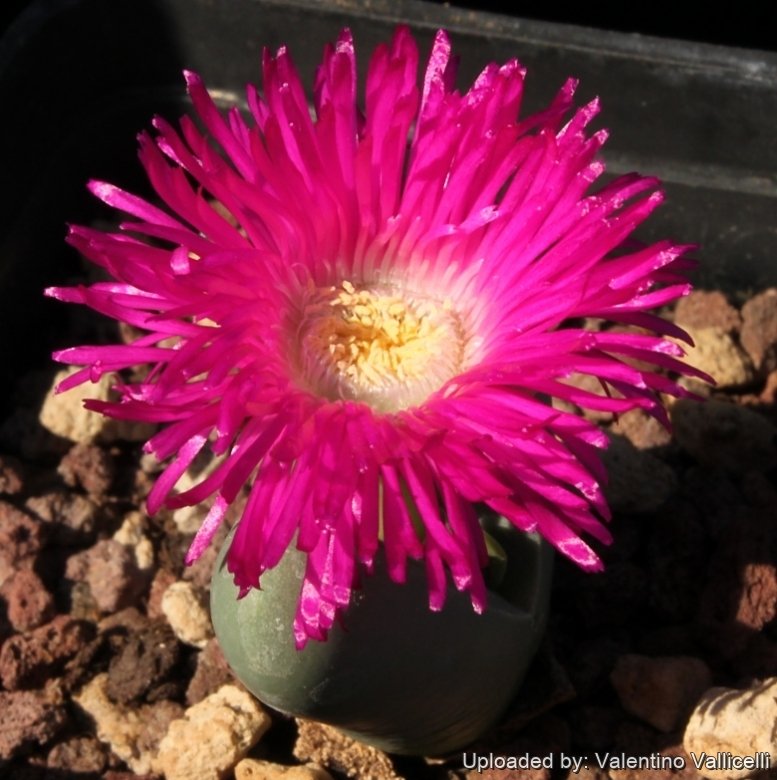
Argyroderma framesii subsp. hallii is a tufted succulent with tiny purple flowers. It is comparatively larger and stouter than the type.
Habit: It is a compact, leaf succulent forming small rounded mounds of 10 to 20 plant bodies. It is one of the more branched Argyroderma species.
Bodies (Paired leaves): 12-20 mm long, up to 12 mm wide, half-ovoid, hood-shaped, keeled, 5-10 mm apart at the apex, spreading, old ones rusty-brown, persisting over many years, often distinctly trigonous. The subsp. hallii has leaves 10-15 mm broad, bracteoles homogeneously reddish and the the gap between them more than 5 mm broad.
Blooming Habits: Flowers 25-30(-40) mm in diameter, purple or yellow. Flower-stalks 3-4 mm long.
Blooming season: Summer.
Fruits: Round 10-12 chambered; homogeneously reddish, with brownish bracteoles that touch the base of capsule.
Origin and Habitat
It has a restricted distribution on the northern Knersvlakte in the Western Cape, South Africa.
Habitat: It grows on quartz fields among rougher rocks, like Argyroderma congregatum.
Ecology: The mechanism of seed dispersal is through a higrochastic fruit and the seed is only dispersed in the immediate environment, which results in local small communities.
Cultivation and Propagation
Argyroderma are easy to grow. Argyroderma are more forgiving than Lithops of excess water (though it should be rarely given in summer) and thrive in light winter rains in temperate climates and were heading for summer dormancy.
Soil requirements: It needs a very draining mineral, rather acidic, substrate. A mixture comprising 20 % pumice grit, 20% lava grit, 20% quartz grit, 20% coarse river sand and 20 % garden soil seems well suited.
Water needs: Requires little water otherwise its epidermis breaks (resulting in unsightly scars). Water minimally in summer, only when the plant starts shrivelling. But be careful with watering (rot sensitive).
Fertilization: Fertilize moderately during the growing season with diluted high potassium fertilizer.
Hardiness: It is fairly cold resistant and hardy to -5°C (or less if dry) depending on the clone.
Exposure: Need full sun, (with insufficient illumination bodies get thinner as a result of the lack of sun) but keep cool and shaded in summer.
Propagation: Seeds or division of larger clumps. Argyroderma is very easy to start from seed. Seeds germinate in 7-14 days at 21°C. Although they will start from cuttings, it is quite difficult to get them to root. If they start to rot there is usually part of the plant that can be removed and possibly rooted.
Bibliography
Major references and further lectures
-
Heidrun E. K. Hartmann“Aizoaceae A – E” Springer (2001)
-
James Cullen, Sabina G. Knees, H. Suzanne Cubey “The European Garden Flora Flowering Plants: A Manual for the Identification of Plants Cultivated in Europe, Both Out-of-Doors” Cambridge University Press, 11/Aug./2011
-
Raimondo, D., von Staden, L., Foden, W., Victor, J.E., Helme, N.A., Turner, R.C., Kamundi, D.A. and Manyama, P.A. 2009. “Red List of South African Plants.” Strelitzia 25. South African National Biodiversity Institute, Pretoria.
-
Ernst Van Jaarsveld, Ben-Erik Van Wyk, Gideon Smith “Succulents of South Africa: a guide to the regional diversity” Tafelberg, 01/Jul/2000
-
Kakteen und andere Sukkulenten 32: 1311981). 33: 172-3 (1982).
-
AFPD. 2008. African Flowering Plants Database - Base de Donnees des Plantes a Fleurs D’Afrique.
-
Bailey, L. H. & E. Z. Bailey. 1976. “Hortus Third” i–xiv, 1–1290. MacMillan, New York.
-
Gibbs Russell, G. E., W. G. Welman, E. Reitief, K. L. Immelman, G. Germishuizen, B. J. Pienaar, M. v. Wyk & A. Nicholas. 1987. “2List of species of southern African plants.” 2 Mem. Bot. Surv. S. Africa 2(1–2): 1–152(pt. 1), 1–270(pt. 2).