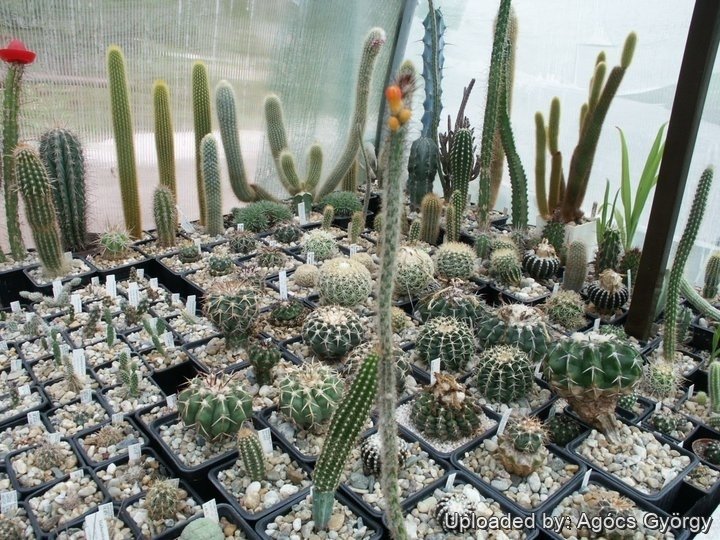
Publication: Cactaceae Consensus Init. 3: 7. 1997
Description
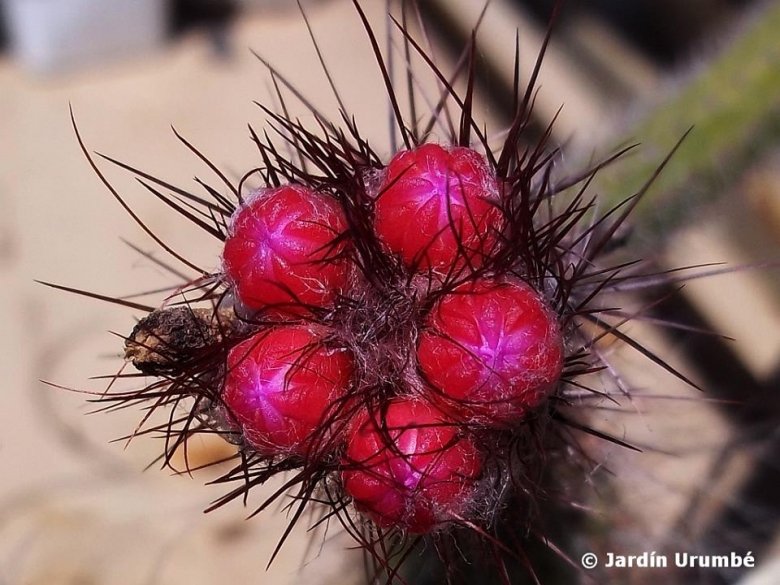
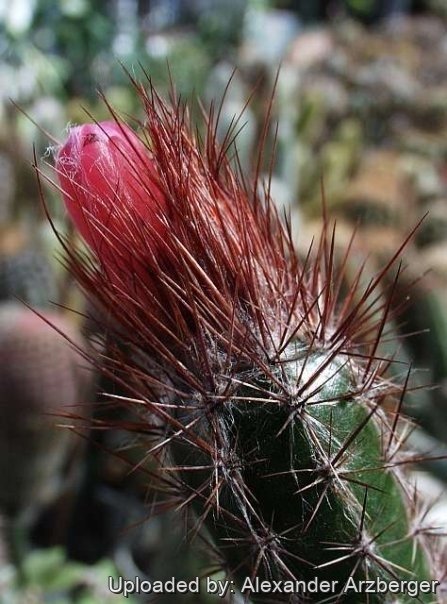
Arrojadoa dinae is a low succulent shrub with slender stems, basally branching with subterranean tubers. The ssp. eriocaulis (firstly described as Arrojadoa eriocaulis by Buining & Bredero in 1973) is distinctive in having a covering of white wool, typically with only 8-9 ribs, yellowish brown spines, and light violet-pink flowers. Arrojadoa dinae and A. eriocaulis are often understood as different species. In fact in some places like the area northeast of Mato Verde, A. eriocaulis and A. dinae grow together without hybridizing, this would confirm the thesis of two distinct, indipendent species.
Stems: Slender, cylindrical, very fine, up to about 30 cm tall,
Ribs: 8-9.
Areoles: Round, closely set, at first very woolly, later almost bare. Flowering areoles different from non flowering, tufted with bristles and hairs.
Spines: Yellowish brown.
Cephalia: With cm long.
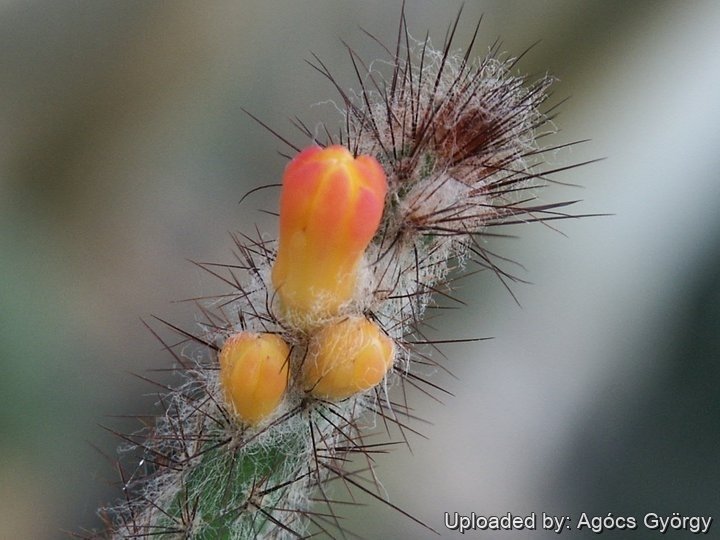
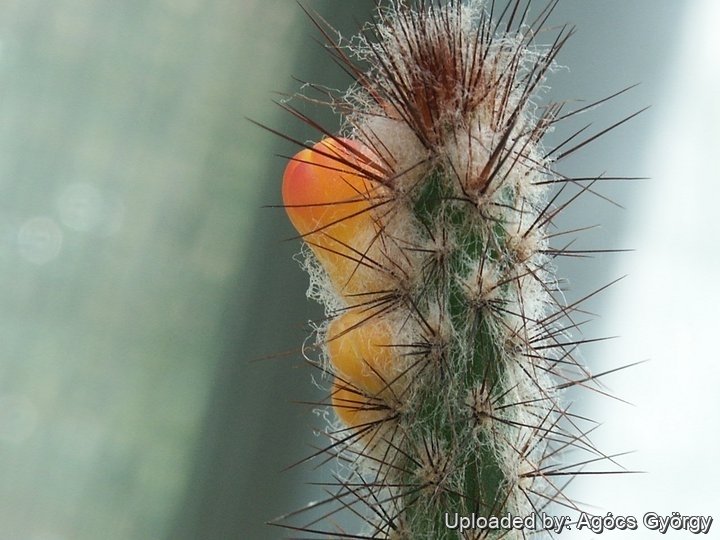
Flowers. The tubular flowers appear near the apex, among thick white wool and brownish bristles, that form a pseudocephalium, creating a kind of ring around the stem, through which the cactus continue its growth. The flower-tube is often, brownish red to violet-pink, to 30 mm long and 9 mm in diameter, the pericarpel and tube naked, the limb very short pale violet-pink or white, stamen and style not projecting. This species start blooming when about 20 cm tall.
Origin and Habitat
Arrojadoa dinae ssp. eriocaulis is endemic to Brazil, where it is found in the eastern drainage of Serra do Espinhaço in northern Minas Gerais up to the border area of Bahia (The extent of occurrence is quite large, approximately 4,700 km2, but the area of occupancy is estimated to be below 500 km2). It occurs in two disjunct areas, at elevations of 700 to 1,100 m asl: the northern subpopulation grows in the mountains east of the towns of Monte Azul and Mato Verde, while the southern subpopulation is found in Grao Mogol. The subpopulations are small and fragmented. Each subpopulation has less than 500 individuals, and there are no more than 5,000 mature individuals in total.
Habitat and Ecology:A species of the campo rupestre element, it is found in sandy cerrado. The generation length is around 10 years. The population is declining in the northern part due to fires, deforestation, and sand quarrying. Arrojadoa eriocaulis is also threatened by illegal collection. The entire plant as well as its seeds are collected for ornamental use.
Cultivation and Propagation
Arrojadoa dinae subs. eriocaulis is not particularly difficult on own roots providing it is given a little extra heat during the winter, but this and all its relatives do best when grafted. Arrojadoas bloom on the forest floor all year-round and are accustomed to receiving lots of summer rain and winter dew, so they never dry out for long in the wild. They most definitely are not desert plants and don’t survive if treated as such. In arid climates they fare best in containers, where the roots remain moist longer.
Growth rate: It is a relatively rapidly growing and easily flowering species that will make clumps given the best conditions.
Soils: It likes very porous standard cactus mix soil and can also be grown in orchid bark, or on cork sheets or a tree branch like for epiphytes.
Repotting: Use pot with good drainage.
Watering: It should be watered generously during the growing season, keep drier in winter. Water them less than average if in bigger pots.
Fertilization: Feed with a high potassium fertilizer in summer.
Hardiness: Reputedly sensitive to frost (in his biotope the temperature never drops below 15 ° C), but less so if kept on the dry side prior to, and during, cold weather. However warmth throughout the year will increase the grower’s success (not less than 8-12°C during rest season).
Exposition: Outside bright, hot conditions or afternoon shade, inside it needs bright light, and some direct sun. Strong light encourages flowering and heavy wool and spine production.
Uses: It is an excellent plant for container growing. It always looks good and stays small.
Pests & diseases: It may be attractive to a variety of insects, but plants in good condition should be nearly pest-free, particularly if they are grown in a mineral potting-mix, with good exposure and ventilation. Nonetheless, there are several pests to watch for:
- Red spiders: Red spiders may be effectively rubbed up by watering the plants from above.
- Mealy bugs: Mealy bugs occasionally develop aerial into the new growth among the wool with disfiguring results, but the worst types develop underground on the roots and are invisible except by their effects.
- Scales: Scales are rarely a problem.
- Rot: Rot is only a minor problem with cacti if the plants are watered and “aired” correctly. If they are not, fungicides won’t help all that much.
Propagation: The Arrojadoas are quite easy to grow from cuttings, seed or (often) graft. Seeds germinate in 7-14 days at 21-27° C in spring, remove the glass cover gradually as the plants develops and keep ventilated, no full sun for young plants! To make a cutting twist off a branch and permit it to dry out a couple of weeks, lay it on the soil and insert the stem end partially into the soil. Try to keep the cutting upright so that the roots are able to grow downward.
Bibliography
Major references and further lectures
-
Machado, M., Braun, P., Taylor, N.P. & Zappi, D. 2013. Arrojadoa eriocaulis. The IUCN Red List of Threatened Species. Version 2015.1. <www.iucnredlist.org>. Downloaded on 14 June 2015.
-
Edward Anderson “The Cactus family” Timber Press, Incorporated, 2001
-
Nigel P. Taylor, Daniela C. Zappi “Cacti of Eastern Brazil” Royal Botanic Gardens, Kew, 2004
-
Urs Eggli, Leonard E. Newton “Etymological Dictionary of Succulent Plant Names.” Birkhäuser 2004
-
Kakteen und andere Sukkulenten. 24(5): 99–101, 1973
-
Keith Grantham, Paul Klaassen “The plantfinder’s guide to cacti & other succulents” Timber Press, 18 May 1999
-
Stuart Max Walters “European Garden Flora: A Manual for the Identification of Plants Cultivated in Europe, Both Out-of-Doors and Under Glass” Cambridge University Press, 27 lug 1989
From llifle page Arrojadoa eriocaulis var. rosenbergeriana
Description
Arrojadoa eriocaulis var. rosenbergeriana (ayn: Arrojadoa rosenbergeriana), is generally included within (as a synonym of) Arrojadoa dinae subs. eriocaulis, suggesting that there is not really a fundamental difference between the two, and hard to name accurately without knowing where they come from. In particular the var. rosenbergeriana distinguish for the darker and stronger spines. However the distinguishing characteristics of var. rosenbergeriana, appear to fall within the natural variation of Arrojadoa dinae subs. eriocaulis and it should be synonymized with the latter, but it still has a value for a collector because they identify plants with particular characters.
Origin and Habitat
East of Mato Verde, Minas Gerais, Brazil.
Altitude range: 1067 metres.
Cultivation and Propagation
This species is not particularly difficult on own roots providing it is given a little extra heat during the winter, but this and all its relatives do best when grafted. Arrojadoas bloom on the forest floor all year-round and are accustomed to receiving lots of summer rain and winter dew, so they never dry out for long in the wild. They most definitely are not desert plants and don’t survive if treated as such. In arid climates they fare best in containers, where the roots remain moist longer.
Growth rate: It is a relatively rapidly growing and easily flowering species that will make clumps given the best conditions.
Soils: It likes very porous standard cactus mix soil and can also be grown in orchid bark, or on cork sheets or a tree branch like for epiphytes.
Repotting: Use pot with good drainage.
Watering: It should be watered generously during the growing season, keep drier in winter. Water them less than average if in bigger pots.
Fertilization: Feed with a high potassium fertilizer in summer.
Hardiness: Reputedly sensitive to frost (in his biotope the temperature never drops below 15 ° C), but less so if kept on the dry side prior to, and during, cold weather. However warmth throughout the year will increase the grower’s success (not less than 8-12°C during rest season).
Exposition: Outside bright, hot conditions or afternoon shade, inside it needs bright light, and some direct sun. Strong light encourages flowering and heavy wool and spine production.
Uses: It is an excellent plant for container growing. It always looks good and stays small.
Pests & diseases: It may be attractive to a variety of insects, but plants in good condition should be nearly pest-free, particularly if they are grown in a mineral potting-mix, with good exposure and ventilation. Nonetheless, there are several pests to watch for:
- Red spiders: Red spiders may be effectively rubbed up by watering the plants from above.
- Mealy bugs: Mealy bugs occasionally develop aerial into the new growth among the wool with disfiguring results, but the worst types develop underground on the roots and are invisible except by their effects.
- Scales: Scales are rarely a problem.
- Rot: Rot is only a minor problem with cacti if the plants are watered and “aired” correctly. If they are not, fungicides won’t help all that much.
Propagation: The Arrojadoas are quite easy to grow from cuttings, seed or (often) graft. Seeds germinate in 7-14 days at 21-27° C in spring, remove the glass cover gradually as the plants develops and keep ventilated, no full sun for young plants! To make a cutting twist off a branch and permit it to dry out a couple of weeks, lay it on the soil and insert the stem end partially into the soil. Try to keep the cutting upright so that the roots are able to grow downward.
Source: Arrojadoa eriocaulis var. rosenbergeriana, LLIFLE - Encyclopedia of living forms, CC-BY-SA, retrieved 2026-10-25.
From llifle page Arrojadoa multiflora
Description
Arrojadoa multiflora is a columnar cactus with slender stems, up to 80 cm tall. The stems, usually single, are covered with yellowish brown spines and greyish-white wool. Towards the apex appears a pseudocephalium (area where the flower buds and fruit are produced) composed of long, thin red bristles. The bicolored tubular flowers are pinkish-red or carmine-red with many petals. Flowers bloom at night. Hunt et al. (2006) indicated that this taxon was best assigned to either Arrojadoa dinae or Arrojadoa eriocaulis, but thought the latter to be the most likely. Other authors consider Arrojadoa multiflora a good species.
Derivation of specific name: The species name multiflorus = multiflorum describes the numerous flowers that appear on plants.
Stem: About 80 cm long, erect, 10-20 mm thick, glossy dark green.
Root: Tuberous.
Ribs: 7-8, 2-3 mm high, dull.
Areoles: 4-7 mm apart, 1-2 mm wide, circular, white, with downwardly facing white hairs, 5-10 mm long.
Radial spines: 12-15 needle-like, brown or rusty-red to white pointing sideways 5-10 mm long.
Central spines: 1 to 3.
Cephalia: Towards the apex, lateral on a somewhat thickened part of the stem, with enlarged areoles, densely filled with white wool and many soft rust-red bristles 15-30 mm long.
Flowers: About 3 cm long; tube 11 mm long, 4 mm wide, pale inside, outside somewhat ruby, with very little scales; filaments of the same colour of petals 4-8 mm long; anthers small golden yellow; pistil of the same colour of petals 22 mm long, stigma lobes 5,2-3 mm long; petals straight, pointed, outer ones about 7 mm long, 3-4 mm wide, pale yellow with a crimson mid-stripe; inner ones 5 mm long, 2.5 mm wide, very pale yellow. The species is self-fertile.
Blooming season: Flowers appear in flushes during the growing season.
Fruits: 12-15 mm long, 8 mm wide, brownish-red, club-shaped. The fruits remain long on the plant.
Seeds: 1.5 mm long, 1.2 mm wide, 1 mm thick, blackish.
Origin and Habitat
Arrojadoa multiflora is found in southern Bahia (Brazil) from the south of Caetite to northwest of Riacho de Santana and east of Tanque Novo. It is only known from four fragmented sites (extent of occurrence less than 5,000 km2). The subpopulations have a small number of plants (less than 250 per subpopulation) and are declining due to habitat loss. The total number of mature individuals is less than 5,000.
Altitude range: It grows at altitudes between 550 and 1,400 metres above sea level.
Habitat and Ecology: This cactus is found in campo rupestre and cerrado. It also grows among crystalline rocks and in sand. The generation length of this succulent shrub is ten years or less. The main threats are deforestation for agro-industry farming and urbanization. The decline has probably exceeded 30 percent in the last 30 years and is suspected to continue at the same or an even higher rate.
Cultivation and Propagation
Arrojadoa multiflora is not particularly difficult on own roots providing it is given a little extra heat during the winter, but this and all its relatives do best when grafted.
Growth rate: It is a relatively rapidly growing and easily flowering species that will make clumps given the best conditions.
Soils: It likes very porous standard cactus mix soil.
Repotting: Use pot with good drainage.
Watering: It should be watered generously during the growing season, keep dry in winter. Water them less than average if in bigger pots, small pots preferred.
Fertilization: Feed with a high potassium fertilizer in summer.
Hardiness: Reputedly sensitive to frost, but less so if kept on the dry side prior to, and during, cold weather. However warmth throughout the year will increase the grower’s success (8-12°C during rest season).
Exposition: Outside bright, hot conditions or afternoon shade, inside it needs bright light, and some direct sun. Strong light encourages flowering and heavy wool and spine production.
Uses: It is an excellent plant for container growing. It always looks good and stays small.
Pests & diseases: It may be attractive to a variety of insects, but plants in good condition should be nearly pest-free, particularly if they are grown in a mineral potting-mix, with good exposure and ventilation. Nonetheless, there are several pests to watch for:
- Red spiders: Red spiders may be effectively rubbed up by watering the plants from above.
- Mealy bugs: Mealy bugs occasionally develop aerial into the new growth among the wool with disfiguring results, but the worst types develop underground on the roots and are invisible except by their effects.
- Scales: Scales are rarely a problem.
- Rot: Rot is only a minor problem with cacti if the plants are watered and “aired” correctly. If they are not, fungicides won’t help all that much.
Propagation: Division, direct sow after last frost or (often) graft. Seeds germinate in 7-14 days at 21-27° C in spring, remove the glass cover gradually as the plants develops and keep ventilated, no full sun for young plants! To make a cutting twist off a branch and permit it to dry out a couple of weeks, lay it on the soil and insert the stem end partially into the soil. Try to keep the cutting upright so that the roots are able to grow downward.
Bibliography
Major references and further lectures
-
Braun P., “A.dinae Buining et Brederoo var. nana Braun et Esteves - Eine neue Arrojadoa-Sippe aus Minas Gerais (Brasilien)”, Kakt. und and. Sukk., 42: 190-195, 1991
-
Říha J., “Arrojadoa multiflora Ritter”, Kaktusy, 19: 95-96, 1983
-
Ritter, “Kakteen in Südamerika” 1: 89-90, 1979
-
Machado, M. 2013. Arrojadoa multiflora. The IUCN Red List of Threatened Species. Version 2015.1. <www.iucnredlist.org>. Downloaded on 09 June 2015.
-
Edward Anderson “The Cactus family” Timber Press, Incorporated, 2001
-
Nigel P. Taylor, Daniela C. Zappi “Cacti of Eastern Brazil” Royal Botanic Gardens, Kew, 2004
-
Urs Eggli, Leonard E. Newton “Etymological Dictionary of Succulent Plant Names”. Birkhäuser 2004
-
Stuart Max Walters “European Garden Flora: A Manual for the Identification of Plants Cultivated in Europe, Both Out-of-Doors and Under Glass” Cambridge University Press, 27 lug 1989
Source: Arrojadoa multiflora, LLIFLE - Encyclopedia of living forms, CC-BY-SA, retrieved 2026-10-25.
Gallery