Description
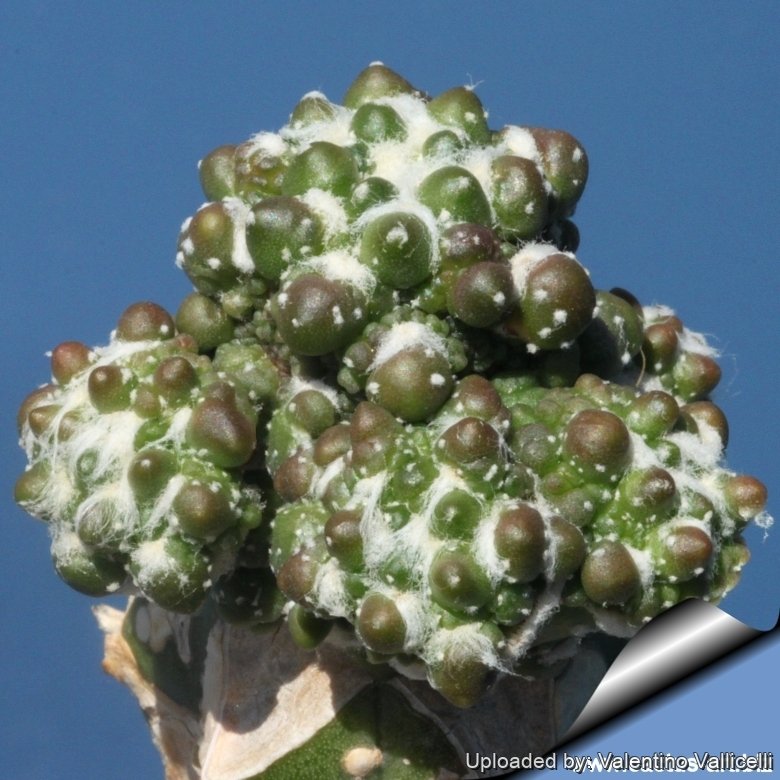
Astrophytum asterias (a.k.a. Sea-Urchin Cactus or Sand Dollar) is an extremely flat barrel cactus with unique and remarkably beautiful form and no typical covering of spines, but with tiny speckled tuft of hairs less than pinhead-sized. Many different odd forms and cultivars of A. asterias have been selected by Asian growers, are now available. Astrophytum asterias cv. Ikaryoko is a odd Japanes cultivars characterized by a lumpy-bumpy monstrous, tubercled, reptile-like skin. This cultivar branches profusely from the side areoles forming large tangled mound. It is very rare and sought after by collectors, for its unique features. There are several forms mainly selected by Asian growers.
Roots: The underground body is fleshy, turnip-like, with fine diffuse roots.
Stem: Multi-branched, roundish, grey-green to dull green, but often reddish in the new growing parts, mature plants up to 7 cm tall, 16 cm broad.
Ribs: Completely broken in round tubercles, and reptile-like wharts.
Areoles: Round, small, felted to hairy, white.
Spines: Not any.
Flowers: Not seen.
Fruits: Not seen.
Origin and Habitat
Garden origin (Nursery produced cultivar). There are several forms mainly selected by Asian growers, particularly in Japan.
Cultivation and Propagation
Astrophytum asterias cv. Ikaryoko is not too difficult in a greenhouse, although grows quite slowly. It is usually seen as a grafted plant but can grow on its own roots too.
Soil: Use a mineral well permeable soil with little organic matter (peat, humus).
Exposure: They need a good amount of light shade to full sun this help to keep the plants healthy, although slow growth. Keep well ventilated, as it is prone to root rot.
Watering: Water sparingly from March till October (weekly during summertime, if the weather is sunny enough), with a little fertilizer added. Less or no water during cold winter months, or when night temperatures remain below 10° to prevent root loss. It is sensitive to overwatering (rot prone).
Fertilization: Feeding may not be necessary at all if the compost is fresh then, feed in summer only if the plant hasn’t been repotted recently. Do not feed the plants from September onwards as this can cause lush growth which can be fatal during the darker cold months.
Hardiness: Keep perfectly dry in winter at temperatures from 5 to 15 degrees centigrade. In the rest period no high atmospheric humidity!!
Monstrous growth: Monstrous varieties of plants, where the variation from normal growth is due to genetic mutation, can occur randomly on normal plants. Sometimes it’s due to damage, but generally the causes are unknown. A monstrous plant may may revert to normal growth for no apparent reason.
Propagation: Grafting (usually) or by cuttings that are hard to root. Plants are usually grafted onto column-shaped cacti but proved to be able to produce their own roots if degrafted. Cuttings will take root in a minimum temperature of 20° C (but better in hot weather).
Gallery