Description
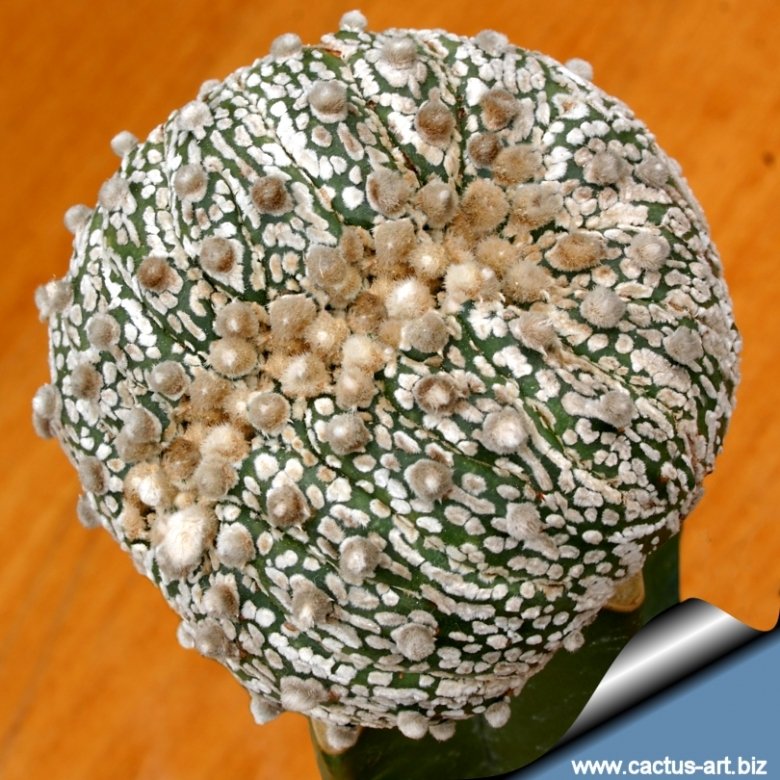
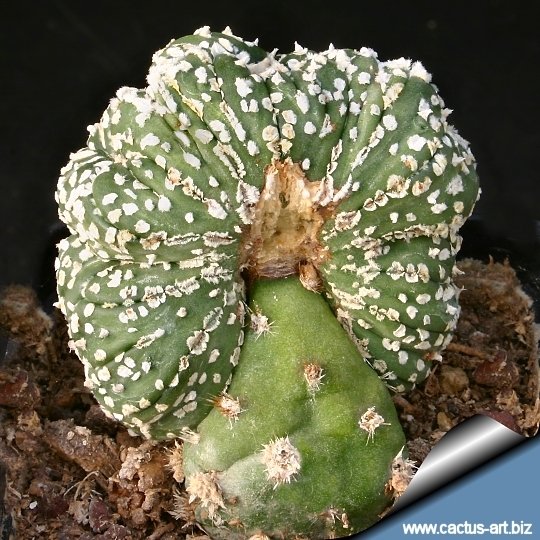
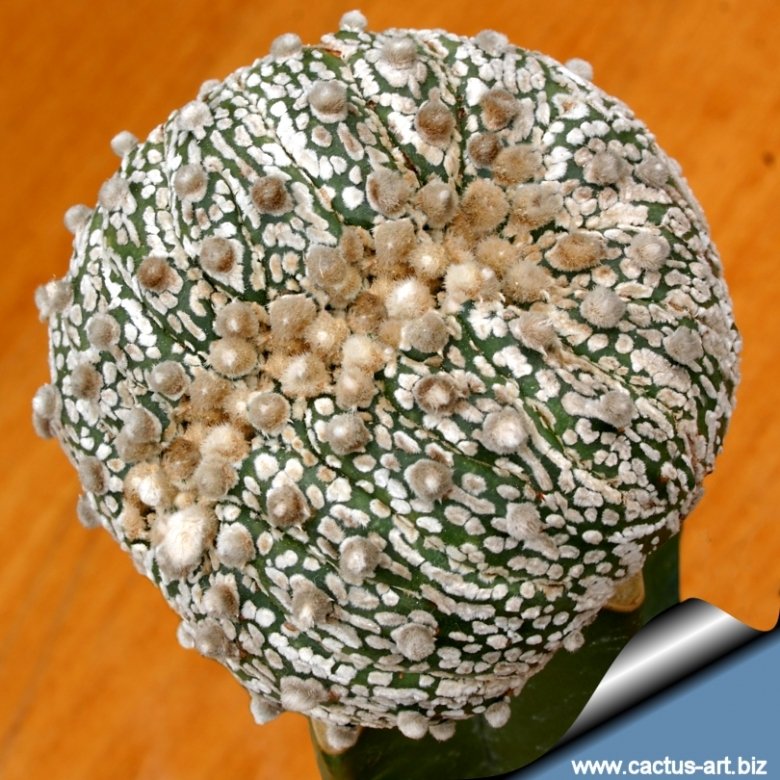
The crested form of the A. “SUPERKABUTO”, only deviate from the typical form for the stem which is fan shaped up to 30 cm (or more ) in diameter with age. There are several crested forms mainly selected by Asian growers.
Spines: None.
Flowers: The flowers are unusual and eventually produced only by some clones.
Origin and Habitat
Garden origin (Nursery produced cultivar). There are several forms mainly selected by Asian growers, particularly in Japan.
Cultivation and Propagation
Although regarded as a choice and difficult plant is not too difficult in a greenhouse, although grows quite slowly. It is sometime seen as a grafted plant but grows very well on its own roots too. Use mineral well permeable mineral soil with little organic matter (peat, humus). Water sparingly from March till October (weekly during summertime, if the weather is sunny enoughand) , with a little fertilizer added. keep perfectly dry in winter at temperatures from 5 to 15 degrees centigrade. (but it is relatively cold resistant and hardy to -7° (-10°)C for short periods) In the rest period no high atmospheric humidity!! They need a good amount of light shade to full sun this help to keep the plants healthy, although slow growth.
Be careful: The epidermis of Superkabuto is harder than in the normal asterias and cracks easily if plants are overwatered.
Propagation: Grafting.or cuttings. Plants are usually grafted onto column-shaped cacti but proved to be able to produce their own roots if degrafted.
Bibliography
Major reference and further lectures
-
Hadley Nation “Super Kabuto and Rare Astrophytum: Limited Edition Collector’s Guide” Little Quin Publishing, 2007
-
Sato, T., “J.C.P Color Hand Book Series No. 2, Volume 1, Hand Book Asterias Family” page 1-65, Japan Cactus Planning Co. Press. 03/25/1973
-
Benadom, D., “Cacti & Succulents for the Amateur” in: Cact. Succ. Journ. (US), volume: 70 No. (6), page 314-315, 1998
-
Kleszewski, K. P., “Verein der Kakteenfreunde Mainz/Wiesb. u. Umgebung, OG, Astrophytum asterias (ZUCC.) LEM. Am Standort in Mexiko…und in Kultur” in: Kaktusblüte, volume: No., page 25-28, 1998
-
Kibayashi, A., “Cacti and succulents in Japan, part 1” in: Cact. Succ. Journ. (US), volume: 65 No. (3), page 126-127, 1993
-
Kobayashi, A., “Cacti and succulents in Japan, part 3” in: Cact. Succ. Journ. (US), volume: 68 No. (5), page 245-249, 1996
-
Sato, T., “Astrophytum asterias varieties” In : A Quarterly Cactus & Succulent Journal of Japan, volume: 1 No. (1), page 22-34, 1978
-
Sato, T., “Astrophytum asterias” in: Cactus & Succulent Journal of Japan, volume: 9 No. 7, page 10-14, 1995
10 ) Sato, T., “Astrophytum asterias” in: Cactus & Succulent Journal of Japan, No. 3, page 10-14, Japan Cactus Planning Co. Press, 1995
-
Sato, T., “Contest of Cactus & Succulent plant in Kyoto 1998” in: Cactus & Succulent Journal of Japan, No. 11, page 2-7, Japan Cactus Planning Co. Press, 1998
-
Sato, T., “Contest of Cactus & Succulent plant in Saitama 1998” in: Cactus & Succulent Journal of Japan, No. 12, page 2-4, Japan Cactus Planning Co. Press, 1998
-
Sato, T., Cactus & Succulent Journal of Japan, No. 6, page 2, 7, Japan Cactus Planning Co. Press, (unknown) 1999
-
Sato, T., Cactus & Succulent Journal of Japan, No. 7, page 9, 10, 15, Japan Cactus Planning Co. Press, (unknown) 1999
-
Sato, T., 1999 “The report of the grand meeting to celbrate the 20th anniversary of ‘KYOSENKAI’” in Cactus & Succulent Journal of Japan, No. 9, page 2-11, Japan Cactus Planning Co. Press,
-
Anderson, M., “Grafting succulents” in: Cact. Succ. Journ. (US), volume: 69 No. (1), page 17-25, 1997