Publication: Život v Přír. 2911: 9. 1925 Kakt. a Succ. 37
Description
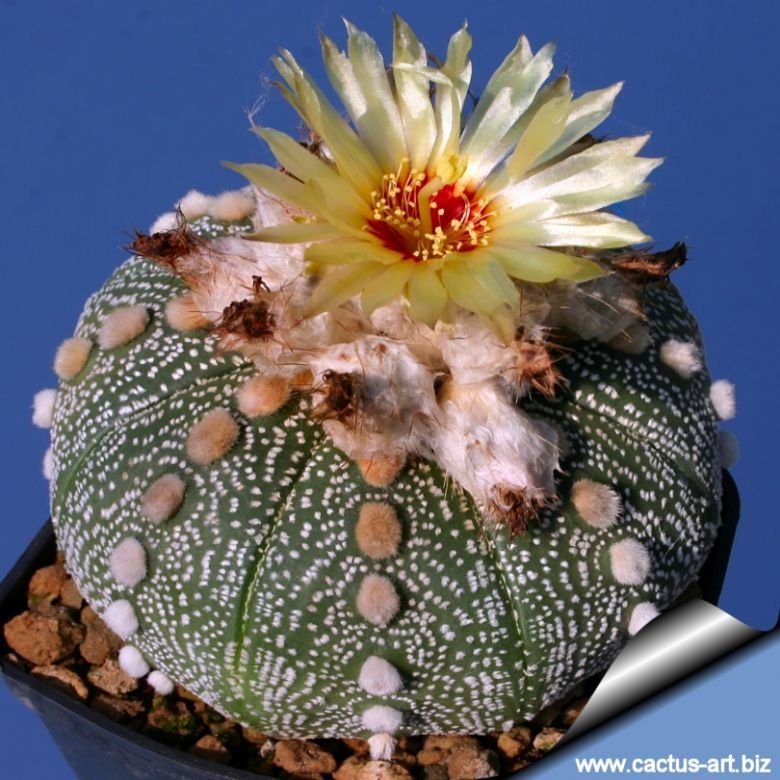
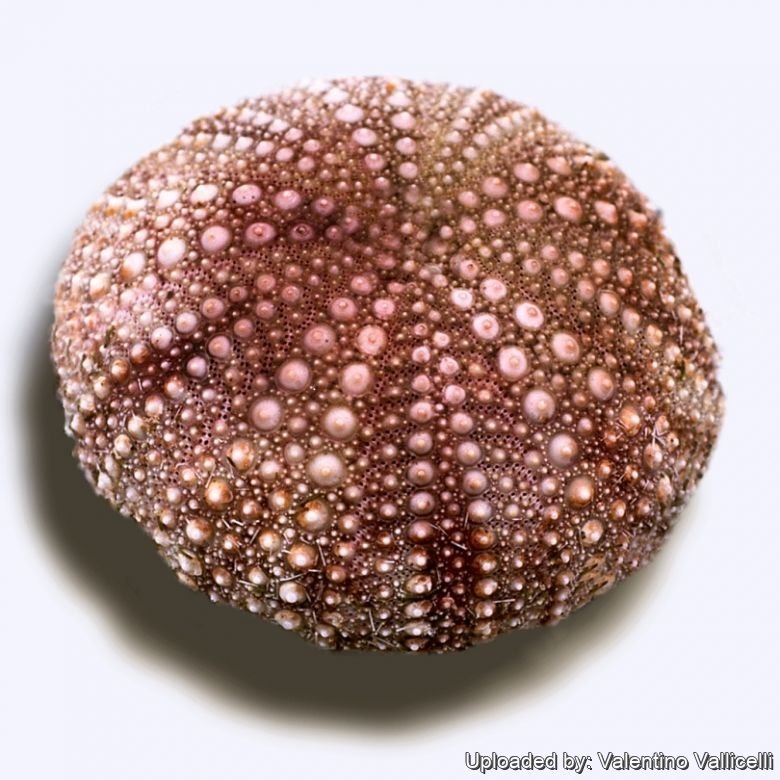
Astrophytum asterias (a.k.a. Sea-Urchin Cactus or Sand Dollar) is an extremely flat barrel cactus with unique and remarkably beautiful form and no typical covering of spines, but with tiny speckled tuft of hairs less than pinhead-sized. It produces large yellow flowers with orange throats often larger than the plant itself. The common name comes from resemblance to sea urchin without spines.
Habit: It is a solitary (unless damaged) perennial stem succulent growing deep seated just flat to the ground surface. Only in cultivation plants may have a spherical till columnar shape.
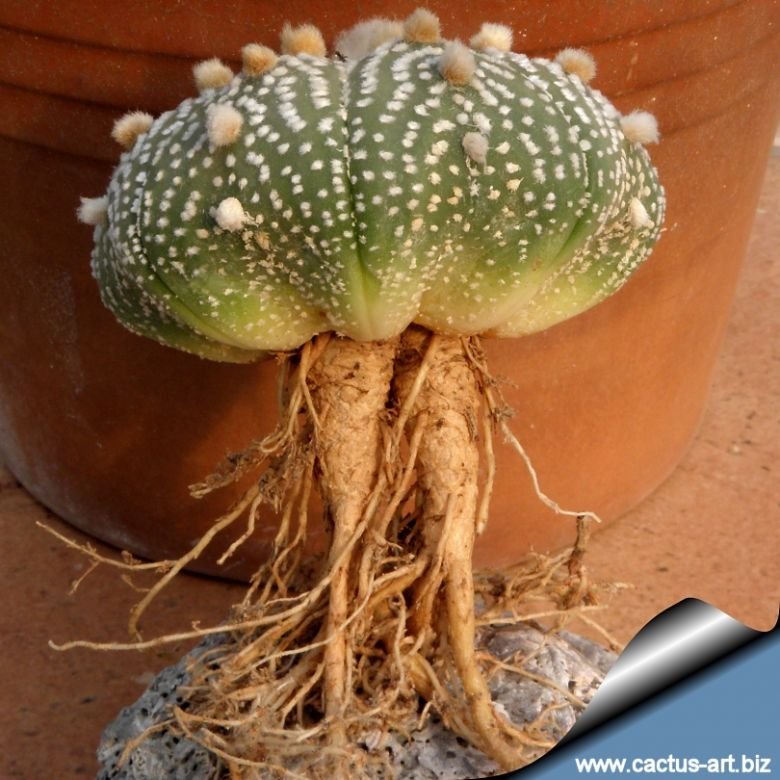
Roots: The underground body is fleshy, turnip-like, with fine diffuse roots.
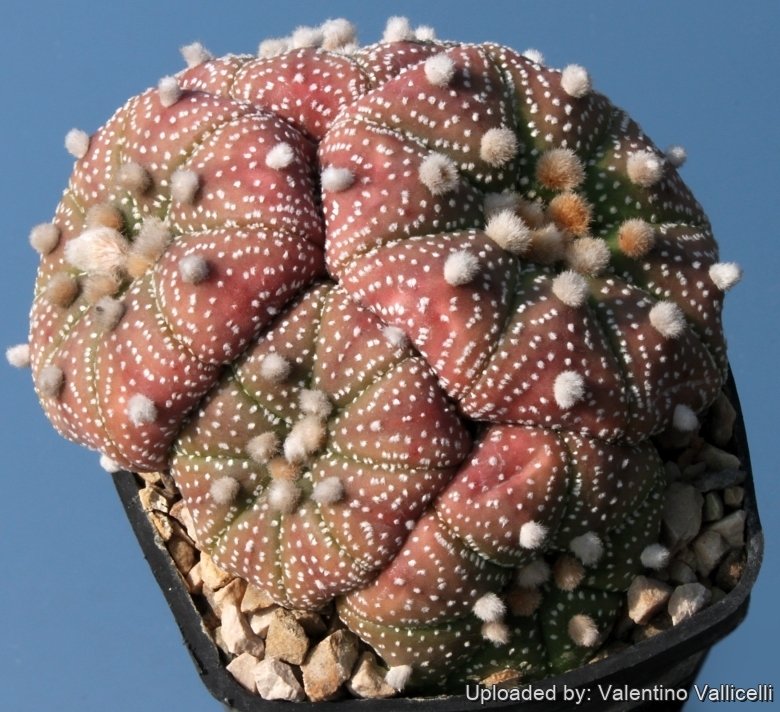
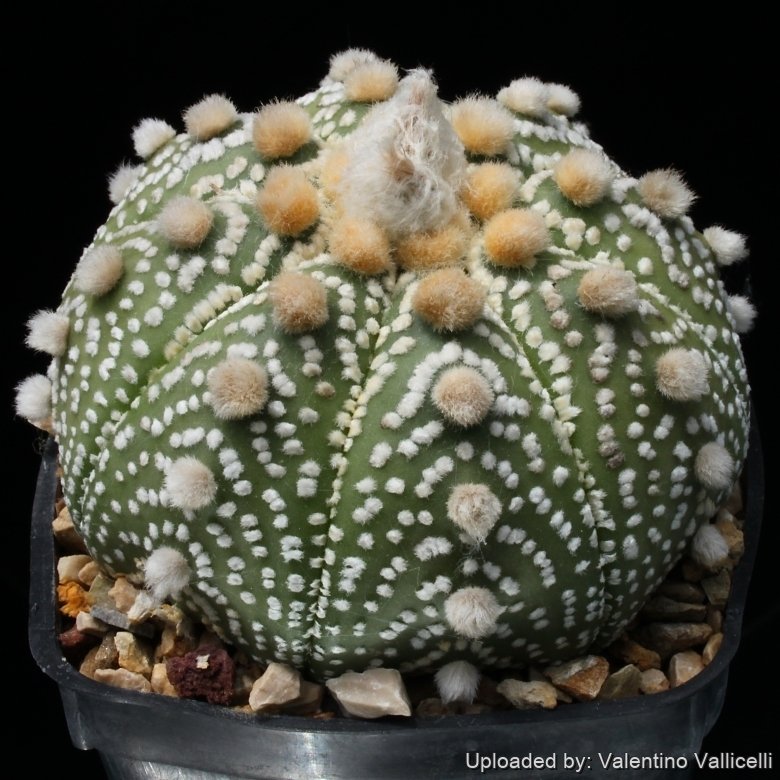
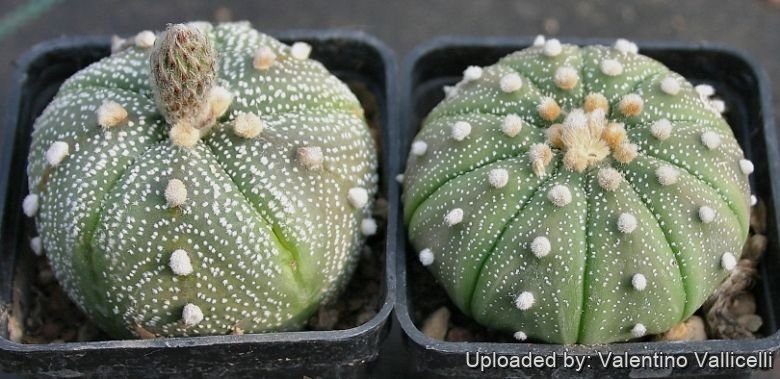
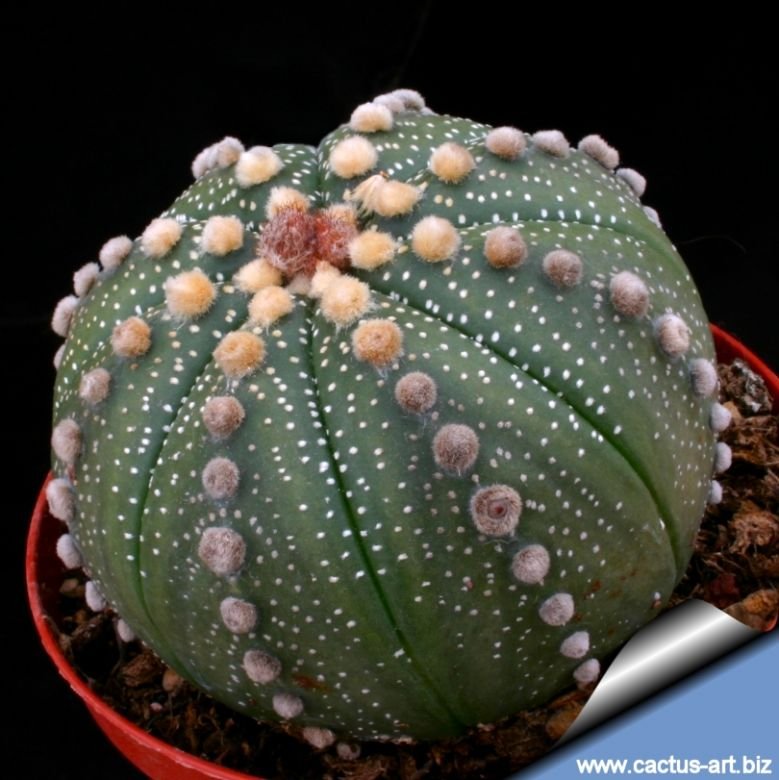
Stem: Non-branched, much depressed, disc-shaped to low dome-shaped, grey-green to dull green (unless stressed), mature plants 2-7 cm tall, 5-16 cm broad, dotted with numerous minuscule tufts of bright white wool (hairy scales). These hairy scales are usually loose, sprinkled over the stem in irregular patterns, sometimes arched around the areoles or on line. Cultivated plants possess sometimes very dense and big hairy scales. The short white wool on surface, said to substitute for lack of shade from spines. There are also completely flake free pure green specimens.
Ribs: The stem is typically divided by very narrow but distinct vertical grooves into 8 broad ribs. The ribs are very low, almost flat on top, forming triangular sections with no cross-grooves. The normal rib number eight is very stable in wild specimens, independent of the age of the plant, but in cultivation selected cultivars and hybrids can have from 4 to 13 ribs.
Areoles: Round, prominent, 3-12 mm in diameters, forming a line up to the centre of each rib, felted to hairy, white, creamy, dirty-yellow till straw-coloured, then grey. Normally 3 to 10 mm apart, but sometime very close one to each other in cultivated plants.
Spines: Not any. Only seedlings show some rudimentary spines within the first weeks and months.
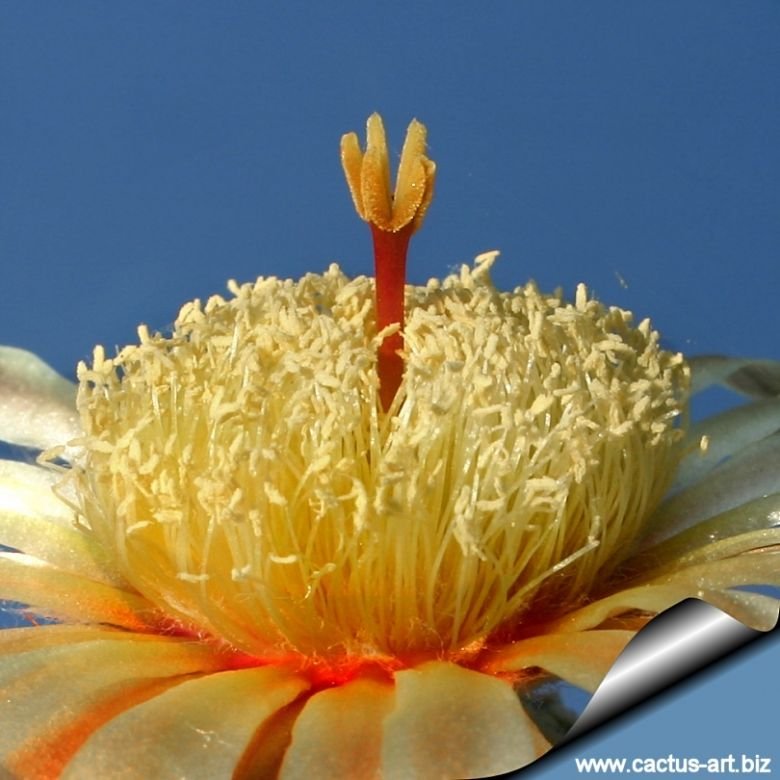
Flowers: Apical, diurnal, radial, 3-5 cm long, 5-7(-9) cm in diameter opening widely, yellow with orange/red throats. Ovary and tube very short, densely covered with thin, bristle-like, black tipped scales and with cobwebby wool in axils. Outer tepals short, narrow, pointed, greenish, covered with short fuzz on outer surfaces; inner tepals long, slightly spatulate, from narrow orange-red bases; upper parts clear yellow, edges entire, tips entire and slightly pointed to erose and irregular. Filaments orange at bases, yellow above, anthers and pollen yellow. Style yellowish with 10-12 yellowish-green stigma lobes.
Blooming season: In habitat the flowering period is spring and each flower lasts for one or two days only, but the plant may flower at any time during the warmer months of the year if adequate water is provided.
Fruits: Oval to round, about 1,5-2 cm long, green, pinkish or greyish-red densely covered with spines and dull-white wool, becoming dry and finally breaking off at or near base (not opening above the base).
Seeds: Black or dark brown, glossy, bowl to helmet shaped about 2 mm long, 3 mm broad.
Similar species: Astrophytum asterias is sometimes confused with peyote (Lophophora williamsii). Both species are spine-less, and peyote often has 8 ribs. However, peyote is bluish-green but has irregularly shaped ribs and lacks the tiny whitish scales.
Remarks: The stem is said to be suffused with chemical compounds distasteful to herbivores.
Origin and Habitat
It was once found throughout Texas and Mexico in an area of occupancy of less than 2,000 km² at the Mexico-USA border to the east of the Sierra Madre Oriental mountain in the states of Tamaulipas (Gonzales, El Hundido, Estancion Calles, Fortin Agrero, Llera, Ejido 21. Marzo, Rancho San Antonio, South of San Carlos and south of Cd. Victoria), Nuevo Leon (Lucio Blanco) and the lower Rio Grande Valley, of Texas in the United States (Starr and Hidalgo County).
Altitude: 50-200 metres above sea-level.
Habitat: It grow on hills, hollows and along the sides of dry river beds, on gravelly alluvial loams and saline or calcareous clays in thorn shrub vegetation and grasslands in warm-temperate, subtropical steppe climate (semi-desert). Astrophytum asterias is mainly found in the shade of other plants or rock in the grass up to the edge of the bushes almost completely buried underground, often covered by sand. It is very cryptic. Its colours matches that of the surrounding soil and is difficult to spot if not in flower. Associates succulents include Opuntia leptocaulis, Mammillaria heyderi, Thelocactus schwarzii, Echinocereus reichenbachii var. fitchii, Homalocephala texensis, Pilosocereus palmeri, Coryphantha macromeris var. runyonii and Stenocereus pruinosus. Precipitation less than 500 mm per annum. Much of its original habitat has been destroyed by habitat destruction, agricultur, collecting and foraging by cottontail-rabbits in Texas and in Tamaulipas. Once fairly widely distributed in south Texas, the species is now known from only one locality near Rio Grande City. Several localities are known in Mexico, both north and south of Ciudad Victoria. The species may also have occurred in the State of Nuevo León and is hence Regionally Extinct there. The total population numbers more than 5,000 plants from known localities in both countries.
Cultivation and Propagation
Astrophytum asterias is a summer grower species relatively easy to grow. It is sometime seen as a grafted plant but grows very well on its own roots too. It is not too difficult in a greenhouse, although grows quite slowly.
Soil: Use mineral well permeable substratum with little organic matter (peat, humus), plants may become too elongated if compost is too rich.
Repotting: Re-pot every 2 years. Use pot with good drainage.
Fertilization: It grows much faster with a low nitrogen content fertilizer in spring and summer. Potassium helps maintaining the plants compact and healthy.
Watering: Requires careful watering to keep plant compact. Water sparingly from March till October, the thin, fibrous roots suffer if there is humidity, therefore the plant should be watered only when the surrounding terrain is dry. Keep dry as soon as the temperature starts dropping in October and keep it perfectly dry in winter at temperatures from 5 to 15 degrees centigrade.
Hardiness: They need to be kept in a cool place during winter rest and are somewhat resistant to frost if kept on the dry side prior to, and during, cold weather (due to the altitude they are hardy to -5 C ° C, or less for short periods).It tends to rot in winter during the resting phase, if kept wet. In the rest period no high atmospheric humidity!!
Sun Exposure: Light shade to full sun, its colour tends to richer and darker when grown in light shade.
Uses: It is an excellent plant for container growing. It always looks good and stays small.
Pests & diseases: It may be attractive to a variety of insects, but plants in good condition should be nearly pest-free, particularly if they are grown in a mineral potting-mix, with good exposure and ventilation. Nonetheless, there are several pests to watch for:
- Red spiders: Red spiders may be effectively rubbed up by watering the infested plants from above.
- Mealy bugs: Mealy bugs occasionally develop aerial into the new growth among the wool with disfiguring results, but the worst types develop underground on the roots and are invisible except by their effects.
- Scales: Scales are rarely a problem.
- Rot: Rot is only a minor problem with cacti if the plants are watered and “aired” correctly. If they are not, fungicides won’t help all that much. To prevent rottenness it is also advisable to surround its root neck by very rough sand or grit, this help a fast water drainage.
Propagation: By seeds, remembering that seedlings dislike strong light and dry conditions and need to be repotted frequently. Eventually, as they become mature, they attain a maximum size of 8-10 cm (20) cm. However, old plants become senile and have a tendency to succumb to disease and a weak root system. At this stage, as is well known, they die suddenly. So, after they reach 10 cm in diameter grow them slowly, and adopt a new repotting period, using intervals of every 2-3 years. Additionally grow them under drier conditions or with stronger sunlight. But plants are often grafted to accelerate growth as they would generally take at least a five years to reach maturity on their own, but the grafted plants are typical rather tall growing, compared with plants on their own roots that are usually more flat to the ground.
Remarks: This quite variable plant has been widely grown for years and is now available in several cultivated variety and several breeds do exist. The famous “Superkabuto” is only one of these and though maybe the most beautiful, but a lot of other forms are represented in many collections.
Notes
The name “Peyote” used by the natives comes presumably by the external similarity to Lophophora williamsii, however there is no closer botanic relationship. Till now, there is no found of hallucinogenic in the plants despite multiple contrary assertions.
Bibliography
Major references and further lectures
-
Edward Anderson “The Cactus family” Timber Press, Incorporated, 2001
-
Tony Sato “Astrophytum Handbook VOL.1 ASTERIAS FAMILY” Japan Cactus Planning Co Press 1973
-
James Cullen, Sabina G. Knees, H. Suzanne Cubey “The European Garden Flora Flowering Plants: A Manual for the Identification of Plants Cultivated in Europe, Both Out-of-Doors and Under Glass” Cambridge University Press, 11/Aug/2011
-
David R Hunt; Nigel P Taylor; Graham Charles; International Cactaceae Systematics Group. “The New Cactus Lexicon” dh books, 2006
-
N. L. Britton, J. N. Rose: “The Cactaceae. Descriptions and Illustrations of Plants of the Cactus Family.” Volume III, The Carnegie Institution of Washington, Washington 1922
-
Brian Loflin, Shirley Loflin “Texas Cacti: A Field Guide” Texas A&M University Press, 26/Oct/2009
-
Albert Michael Powell, James F. Weedin “Cacti of the Trans-Pecos and Adjacent Areas” Texas Tech University Press, 2004
-
Del Weniger “Cacti of Texas and Neighboring States: A Field Guide” University of Texas Press, 1984
-
Alfred Richardson “Plants of Deep South Texas: A Field Guide to the Woody and Flowering Species” Texas A&M University Press, 2010
-
Jackie M. Poole, William R. Carr, Dana M. Price “Rare Plants of Texas: A Field Guide” Texas A&M University Press, 2007
Gallery