Description
A. capricorne v. niveum is bigger than var. senilis and var. aureum, and its dimension are similar to the standard species.
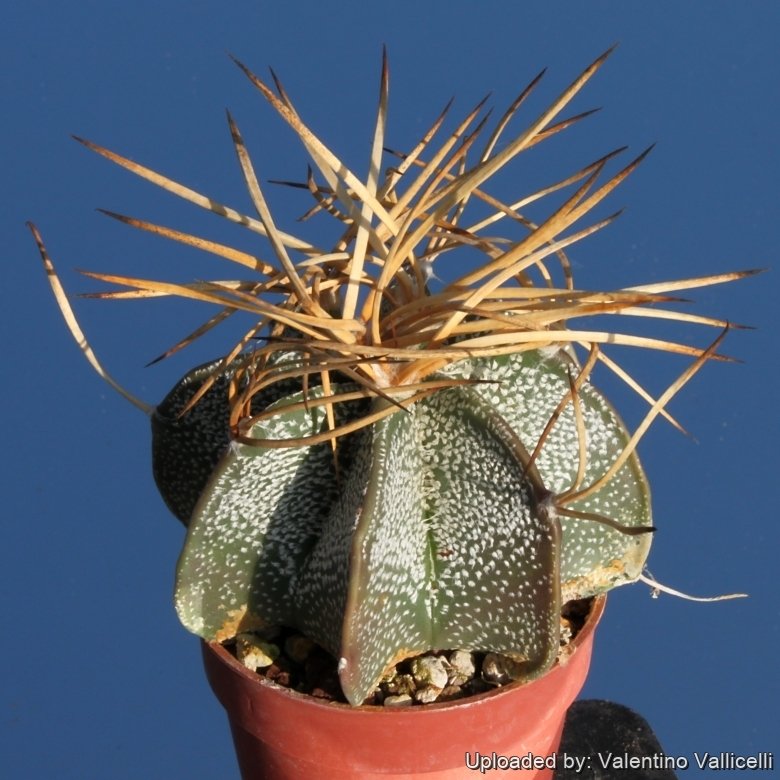
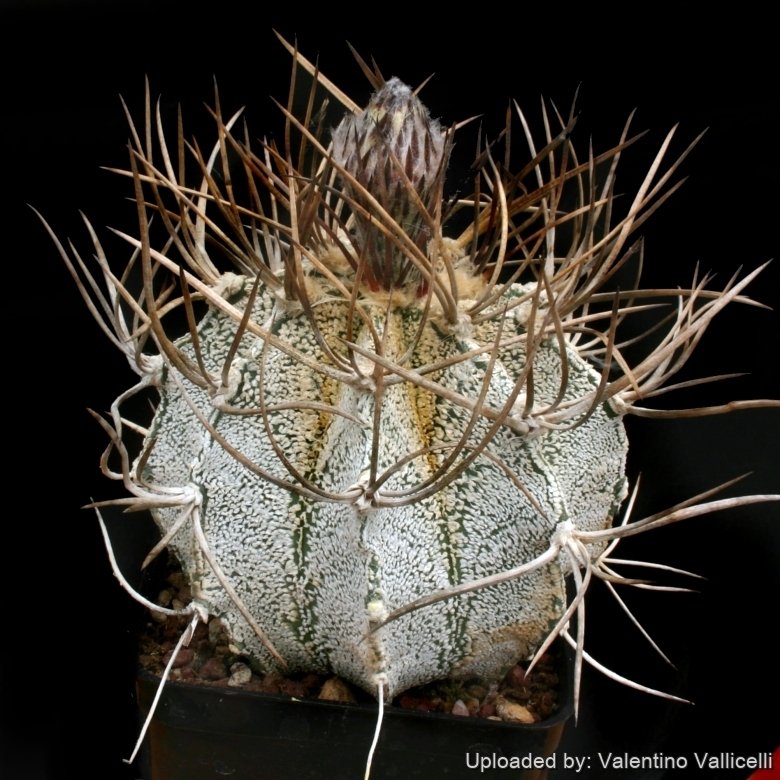
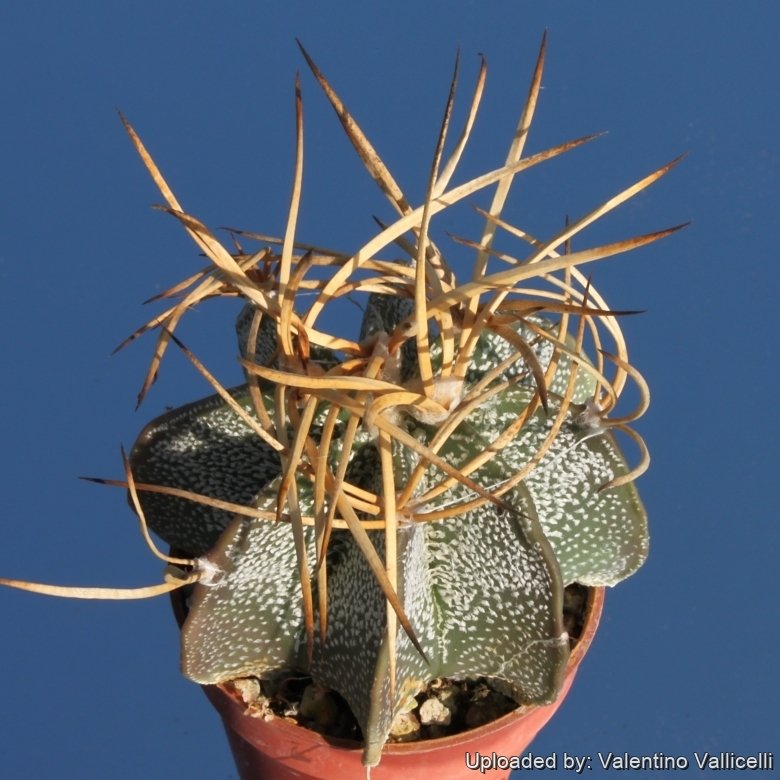
Stem: Robust, at first globular then cylindrical up to 50 cm tall, diameter up to 20 cm (this size correspond in habitat to a 50 years old plant). The epidermis is densely covered with white flecks that give the plant a furry look. The hairy scales are pure white also in the new growth, while in the type species the new flecks are initially brownish and turn into white only lately.
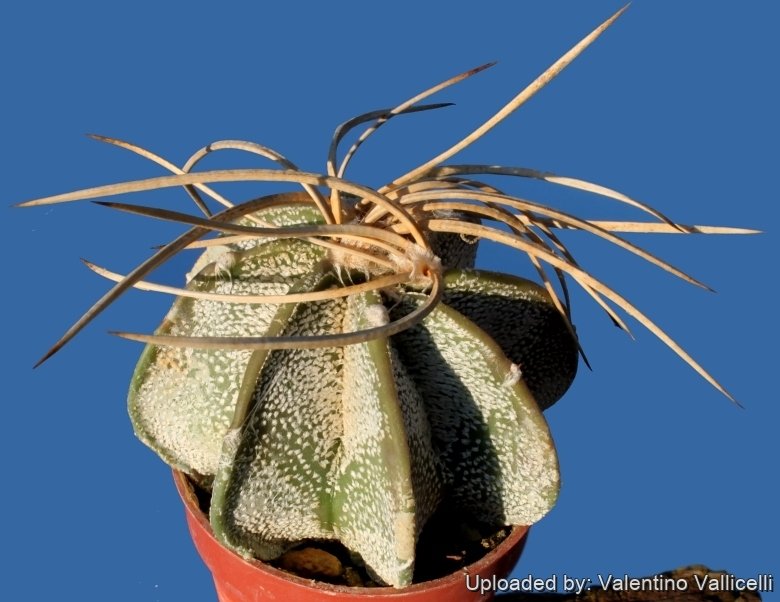
Spines: 6-8 per areole, striking strong of variable size (max. 7-9 cm long) flat, bent upward and not very wavy. Brownish-blackish that turn grey-chalky as they age. Nice yellow and white spined forms are also common in cultivation.
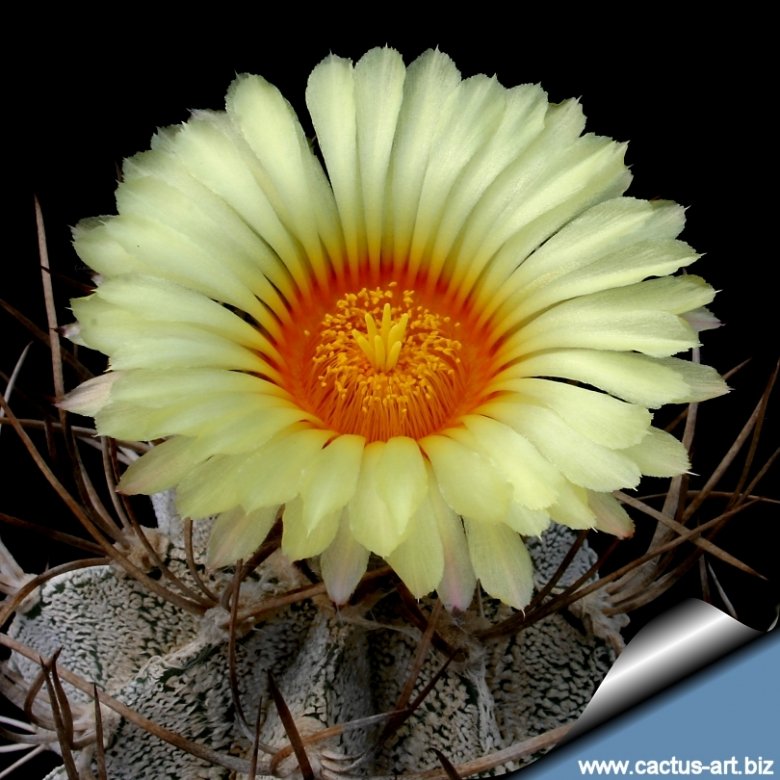
Flower: Medium sized, 7 cm (max. 9 cm) yellow with a red or orange throat.
Fruit: Fruit and seeds are identical to the standard species.
Remarks: A. capricorne v. niveum form nudum (Syn: Astrophytum capricorne var. crassispinum)
Recently (1985-1986) a curious A. niveum without the typical white flecks covering was fuond at about 10 kilometers on the west of Cuatro Cinegas. This ‘nudumum’m’ form grows in association with normal white flecked specimens. This plant caused many confusions among botanists and collectors because it has been also indicated with a different name Astrophytum capricorne var. crassispinum. Astrophytum capricorne and its varieties are very variable in their habit even in small areas. And it is understandable that today we often have problems to decide to which population plants belong
Origin and Habitat
Region of Cuatro Cinegas in the centre of the state of Coahuila (Mexico) The variety ’niveum’ is the more northern of the capricornes (Latitude 27° North)
Habitat: Desert of Chihuahua at an altitude of about 600 m among the impenetrable “Mesquite” woodland (spiny bushes) along with Lophophora williamsii, Ariocarpus fissuratus and Echinocactus horizonthalonius.
It grows in gravely soil among limestone rocks in a very dry area (±180 mm rain/year mainly from May to September).
The temperature is very variable either seasonally and daily. Freezing temperatures in the winter are quite frequent. The insulation and luminosity are also very strong. The seed dispersion in habitat is pursued by ants.
Cultivation and Propagation
It is a popular summer-growing species of relatively easy cultivation.
Growth rate: Slow-growing.
Soil: Grow it in an open standard, sandy-gritty cactus compost and provide a very good drainage.
Exposure: It is suited for sunny-brightly exposure, but can tolerate light shade. However it will do its best with lots of sun and become stressed with inadequate light which could result in poor growth and unnatural shape. It has a good heat tolerance.
Watering: Water regularly (about once a week) during the growing season and keep it completely dry during winter or when night temperatures remain below 10° C. Water it less than average if in bigger pots.
Fertilization: Feed them once during the growing season with a fertilizer specifically formulated for cactus and succulents (high potash fertilizer with a dilute low nitrogen), including all micro nutrients and trace elements diluted to ½ the strength recommended on the label. They thrive in poor soils and need a limited supplies of fertilizer to avoid the plants developing excess vegetation, which is easily attacked by fungal diseases.
Special need: It is suited for airy exposures. Provide very good ventilation. Nearly all problems occur as a result of overwatering and poor ventilation, especially when weather conditions are dull and cool or very humid. ere.
Hardiness: It likes warmth (recommended minimum winter temperature 5° C) But plants kept perfectly dry can easily survive to light frost (it is reported hardy to -7° C for brief periods).
Pests & diseases: These cacti may be attractive to a variety of insects, but plants in good condition should be nearly pest-free, particularly if they are grown in a mineral potting-mix, with good exposure and ventilation. Nonetheless, there are several pests to watch for:
- Red spiders: Red spiders may be effectively rubbed up by misting the plants from above.
- Mealy bugs: Mealy bugs occasionally develop aerial into the new leaves and flowers with disfiguring results, but the worst types develop underground on the roots and are invisible except by their effects.
- Scales, thrips and aphids: These insects are rarely a problem.
- Rot: Rot is only a minor problem if the plants are watered and “aired” correctly. If they are not, fungicides won’t help all that much.
Propagation: It can be propagated easily from seed (seldom produces offsets). The seeds can be sown in pots of fine, well-drained sandy soil, any time during the spring when temperatures are warm. Cover the seeds with a fine layer of grit and water from below with a fungicide to prevent damping off. For the 1-2 weeks cover the pots with a sheet of glass/clear perspex to keep the humidity levels high. Remove the glass and replace it with light shade-cloth and mist once or twice a day for the next two weeks after which most seeds should have germinated. From then on mistings can be reduced to every second and then every third day as the little plants grow. The seedlings should not be disturbed until they are well rooted after which they can be planted separately in small pots. Sometimes it is grafted to avoid root rot problems as plants grafted on an hardy stock are easy to grow and no special skill is required.
Notes
This variety has been discovered only on 1930 by Viereck on the North the town of Cuatro Cinegas, Kaiser made the first desription in 1933 with the name Echinocactus capricornis v. niveus, the same year Okomura renamed it with its actual name.
Bibliography
Major references and further lectures
-
Edward Anderson “The Cactus family” Timber Press, Incorporated, 2001
-
James Cullen, Sabina G. Knees, H. Suzanne Cubey “The European Garden Flora Flowering Plants: A Manual for the Identification of Plants Cultivated in Europe, Both Out-of-Doors and Under Glass” Cambridge University Press, 11/Aug/2011
-
David R Hunt; Nigel P Taylor; Graham Charles; International Cactaceae Systematics Group. “The New Cactus Lexicon” dh books, 2006Jackie M. Poole, William R. Carr, Dana M. Price, Jason R. Singhurst “Rare plants of Texas: a field guide” Texas A&M University Press, 30/Dec/2007
-
Hiroshi Hirao “Colour encyclopaedia of cacti” Seibundo Shinkosha, 1979
-
Hans Hecht “BLV-Handbuch der Kakteen” BLV-Verlagsgesellschaft, 1982
-
Willy Cullmann, Erich Götz (Dozent Dr.), Gerhard Gröner “The encyclopedia of cacti” Timber Press, 1987
Gallery