Publication: Cactaceae (Berlin) 1939(2): 12, in obs. [Oct 1939]
Description
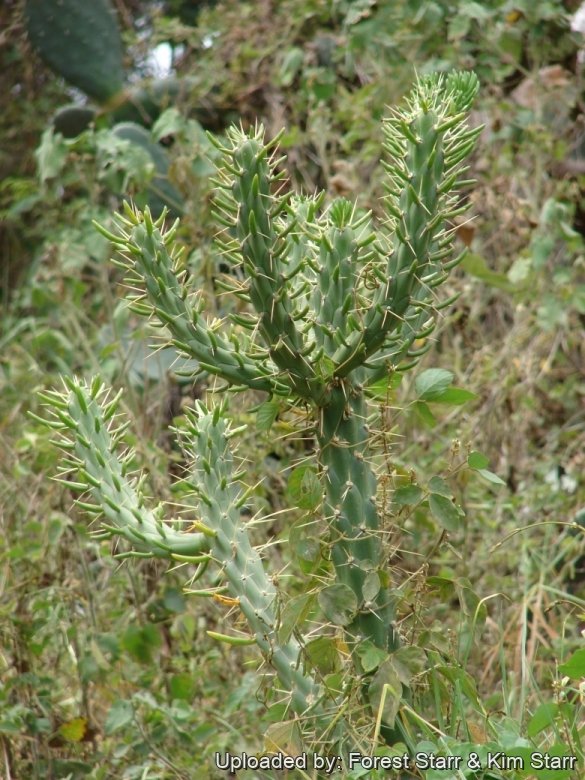
Austrocylindropuntia subulata is a popular well-known shrubby cactus with several main branches from the base or a small tree with a simple erect trunk and a large almost hemispherical top often 3 to 4(-5) meters high. The leaves are relatively large and persistent. Two subspecies are recognized, the nominate and subsp. exaltata (A.Berger) D.R.Hunt.
Stem: Trunk 6 to 10 cm in diameter, the old bark smooth and brown, its areoles bearing clusters of 8 spines or more, branches numerous, elongate, unsegmented, 30- 50 cm long, 4-7 cm in diameter, more or less clustered but not whorled, at first almost at right angles to main stem but soon erect, somewhat
fragile, bright green.
Tubercles: Large, depressed, becoming obliterated on old branches, arranged in a few longitudinal or spiral lines, more or less diamond-shaped, but retuse at apex and pointed or attentuate below, 2 to 4 cm long.
Areoles: Shortly wooly, sitting in the retuse grooves on upper parts of the tubercles.
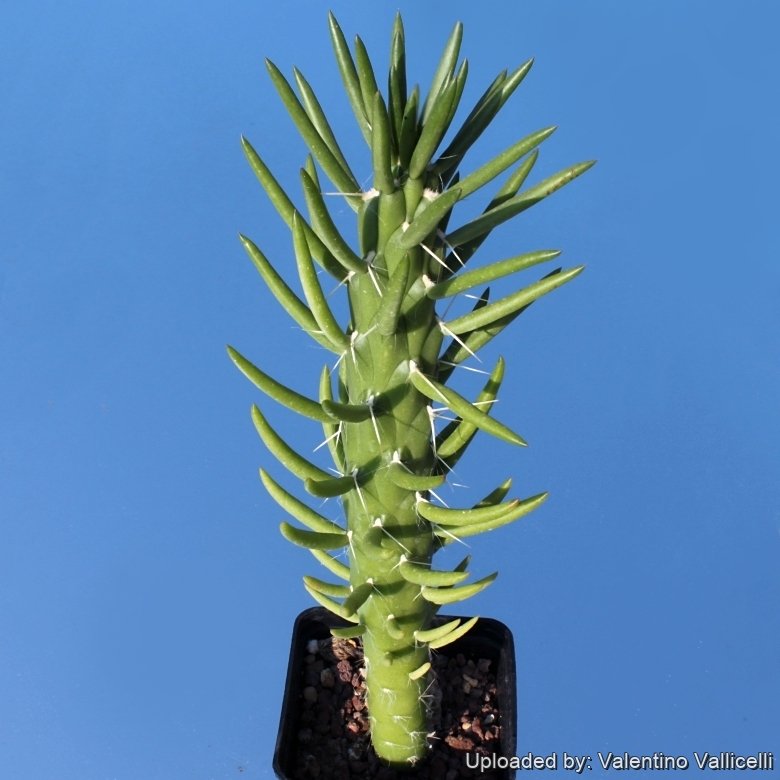
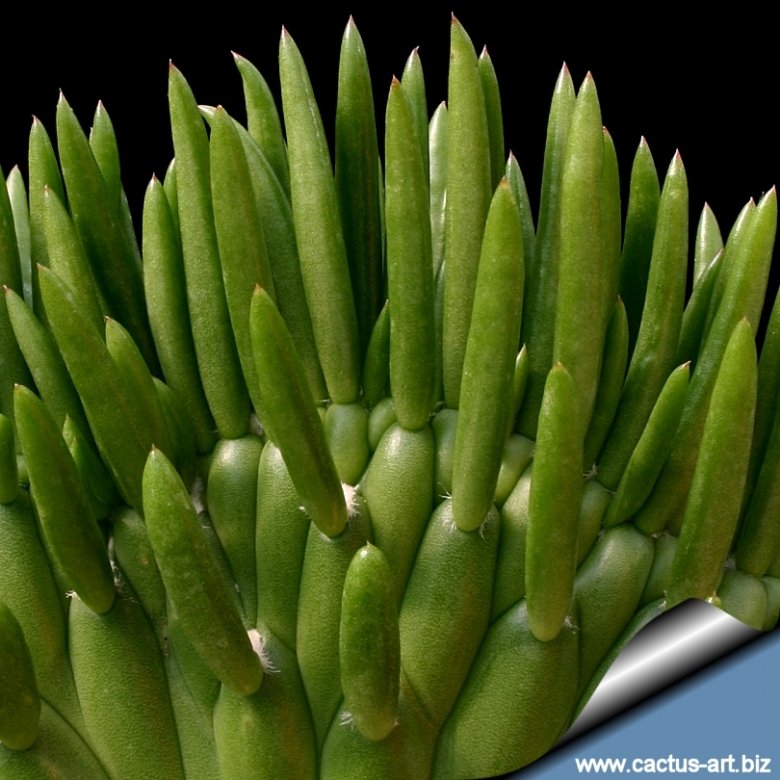
Leaves: Persistent more than a year, green, more succulent than on other species, awl-like, nearly at right angles to branch, straight or somewhat bowed above, nearly terete, pointed, 5 to 12 cm long, grooved on the under side.
Spines: Usually 1 or 2 or sometimes spineless (more numerous in older stems), slender , erect, strong, straight, pale yellow to greyish white, to 8 cm long.
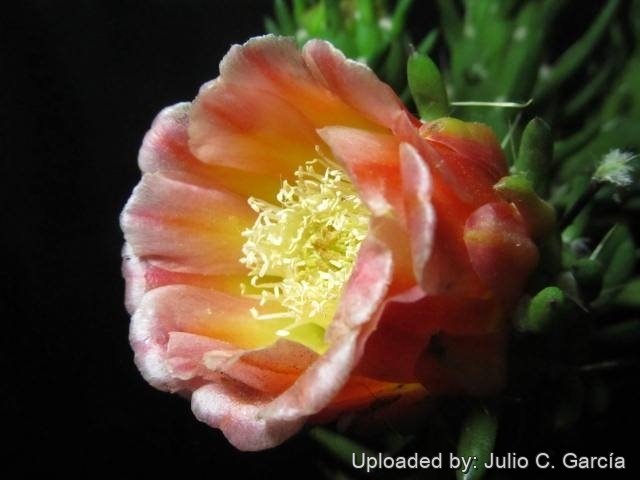
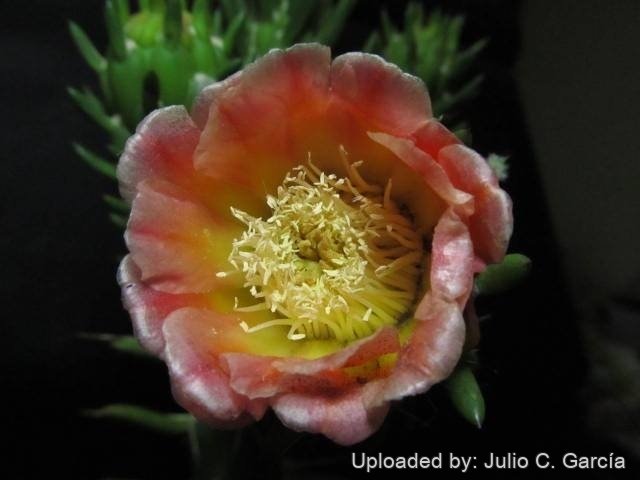
Flowers: Borne toward the ends of the branches red, not opening widely to 6 cm long. Pericarpels long, tuberculate, awl-like, with erect scales to 2 cm long. Sepals reddish, minute, 4 to 8 mm long or less. Petals broader than the sepals, orange-red or greenish yellow. Style rose-red except the whitish base, including the stigma-lobes about 3 cm long, about as long as the longest stamens. Stigma-lobes 5 or 6, slender, orange-yellow.
Fruits: Ovoid to oblong to club shaped, more or less persistent, sometimes spiny, 6 to 10 cm long, leafy, with a deep umbilicus, sometimes proliferous.
Seeds: Few, large, 10 to 12 mm long.
Origin and Habitat
Probably native only to the Andes of Peru Austrocylindropuntia subulata is now one the most widely distributed Opuntia of South America particularly in Argentina and Bolivia and widely cultivated as natural fencing. It has been widely naturalized in parts of southern Europe and elsewhere in the tropics as ornamental.
Type locality: Valparaiso, Chile, but doubtless described from cultivated plants.
Habitat and Ecology: It occurs in inter-Andean valleys and matorrales. This cactus is abundant where it occurs. The populations are stable and there are no threats to this species due to its wide distribution, its presence in several protected areas and because it is not exposed to any major threat.
Cultivation and Propagation
Austrocylindropuntia subulata is a semi-hardy cactus easily found in cultivation. Make sure your A. subulata is not exposed to temperatures below -4°C or it may die. Nevertheless it is a good advice never let the night-time temperature fall below 5°C. It is a summer grower species that offers no cultivation difficulties.
Soil: Use a very a particularly draining substratum, as it is sensitive to rottenness when in presence of humidity and low temperatures and let the soil dry out between waterings, since it’s natural habitat is in sandy or gravelly, well draining soils.
Repotting: Repot in the spring, when their roots become cramped. Generally, they should be repotted every other year in order to provide fresh soil. After repotting, do not water for a week or more.
Water: In summer, during the vegetative period, it must be regularly watered, but allowing the substratum to completely dry up before irrigating again (but do not overwater ); in winter, it’s to be kept dry. Preferable not to water on overcast days, humid days or cold winter days.
Hardiness: It is dslightly frost resistant cactus, hardy to -4° C if very dry. However in cultivation it is better not to expose it to temperatures lower than -5° C, even if in an aerated and protected location, in order to avoid the formation of anti-aesthetic spots on the epidermis. In presence of high atmospheric humidity avoid any frost as it is sensitive to root rot. USDA Zone 9-10. It can handle extremely high temperatures in summer.
Exposure: Outside full sun or afternoon shade, inside needs bright light, and some direct sun.
Use: It is suitable for “desert” gardens, in association with other xerophytes. Where the open air cultivation is not possible due to the climate, it is to be cultivated in pot in order to shelter it in winter.
Traditional uses: Leaves of A. subulata are comestible and can be purchased as vegetables in south America. The spines were used as needles in ancient Peru.
Propagation: Stem division. Prickly pear pads root easily and grow rapidly when placed in loose, well-draining soil.
Bibliography
Major references and further lectures
-
Forest & Kim Starr Austrocylindropuntia subulata (Eve’s pin cactus, can cholla). Plants of Hawaii. <http://www.starrenvironmental.com\>. Downloaded on 21 August 2014.
-
Edward F. Anderson “The Cactus Family” Timber Press, 2001
-
James Cullen, Sabina G. Knees, H. Suzanne Cubey “The European Garden Flora Flowering Plants: A Manual for the Identification of Plants Cultivated in Europe, Both Out-of-Doors and Under Glass”Cambridge University Press, 11/Aug/2011
-
Curt Backeberg, Frederic Marcus Knuth: “Kaktus-ABC.” 1936
-
Curt Backeberg: “Die Cactaceae: Handbuch der Kakteenkunde.” 2. Auflage. Band I, Gustav Fischer Verlag, Stuttgart New York 1982
-
N. L. Britton, J. N. Rose: “The Cactaceae. Descriptions and Illustrations of Plants of the Cactus Family.” Vol I, The Carnegie Institution of Washington, Washington 1919
-
Urs Eggli, Leonard E. Newton: “Etymological Dictionary of Succulent Plant Names.” Springer, Berlin/Heidelberg 2010
-
Friedrich Ritter “Kakteen in Südamerika: Ergebnisse meiner 20jährigen Feldforschung” Band 4, 1981, S. 1244.
-
Peter Hanelt, Institute of Plant Genetics and Crop Plant Research, W. Kilian “Mansfeld’s Encyclopedia of Agricultural and Horticultural Crops: (Except Ornamentals)” Springer Science & Business Media, 10/Apr/2001
-
Park S. Nobel “Environmental Biology of Agaves and Cacti” Cambridge University Press, 16/Oct/2003
-
Hans Hecht “Cacti & Succulents” Sterling Publishing Company Incorporated, 1994
-
E Haustein “Der Kosmos Kakteenfuehrer (the Kosmos Cactus Guide)” Balogh Scientific Books 01 December 1998
-
Aragón, G. A. “Cactaceas de los alrededores de la ciudad de Arequipa” [prim.]. Bol. Lima 20(4): 59–69.1982.
-
Véliz Pérez, M. E. “Cactáceas Guatemala” 1–129. Univ. de San Carlos de Guatemala, Guatemala. 2008.
-
David Hunt, Nigel Taylor “The New Cactus Lexicon” DH Books, 2006
From llifle page Opuntia subulata f. cristata
Description
Austrocylindropuntia subulata is native to high elevations in Ecuador and Peru and forms an tree-like, branching specimen with time.
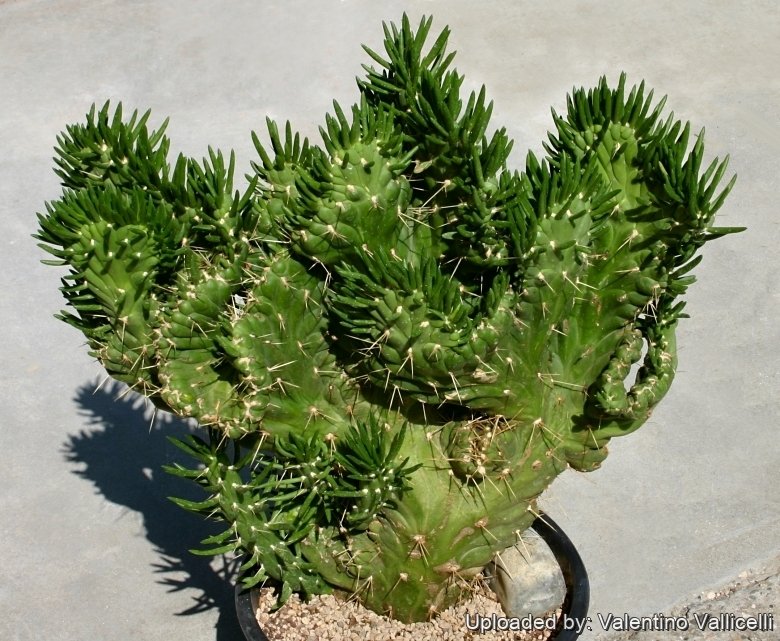
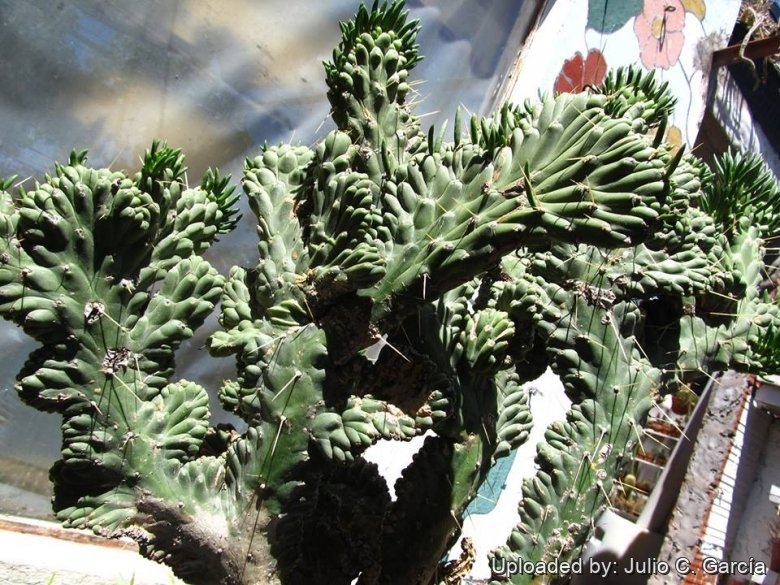
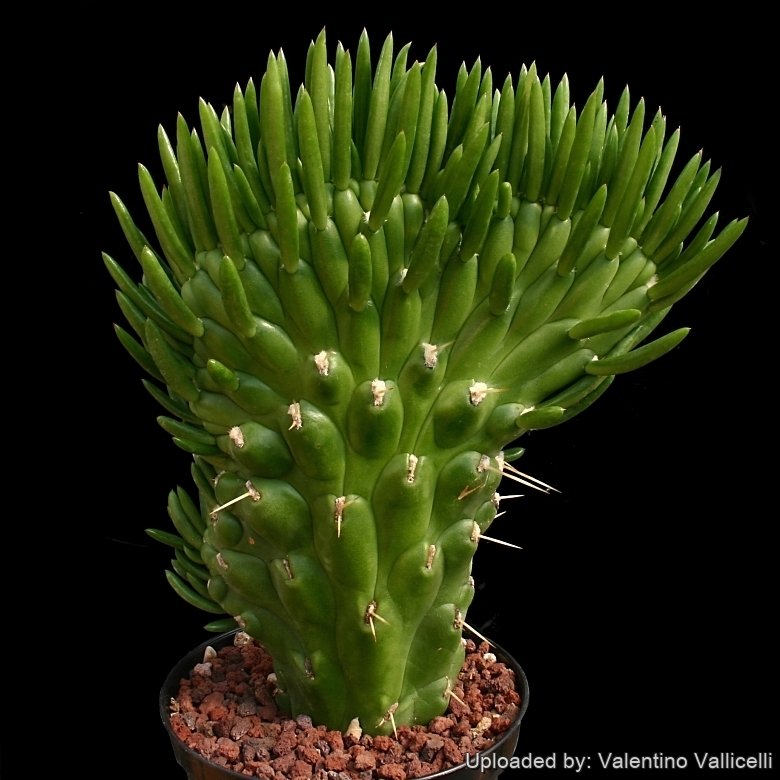
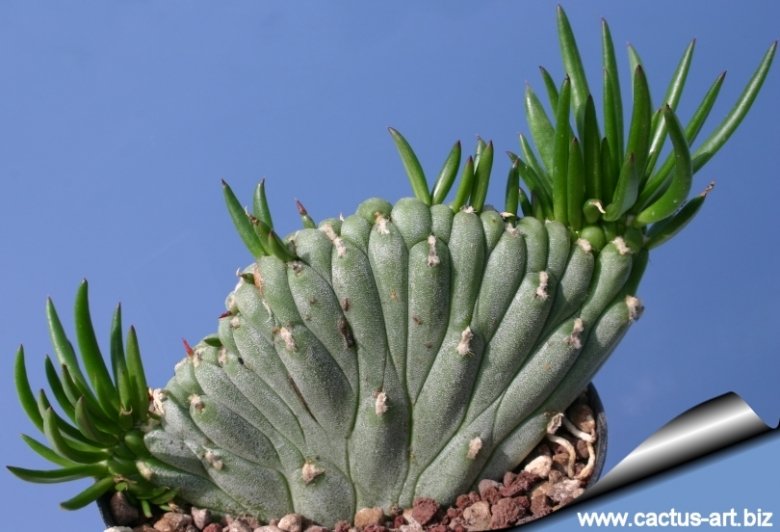
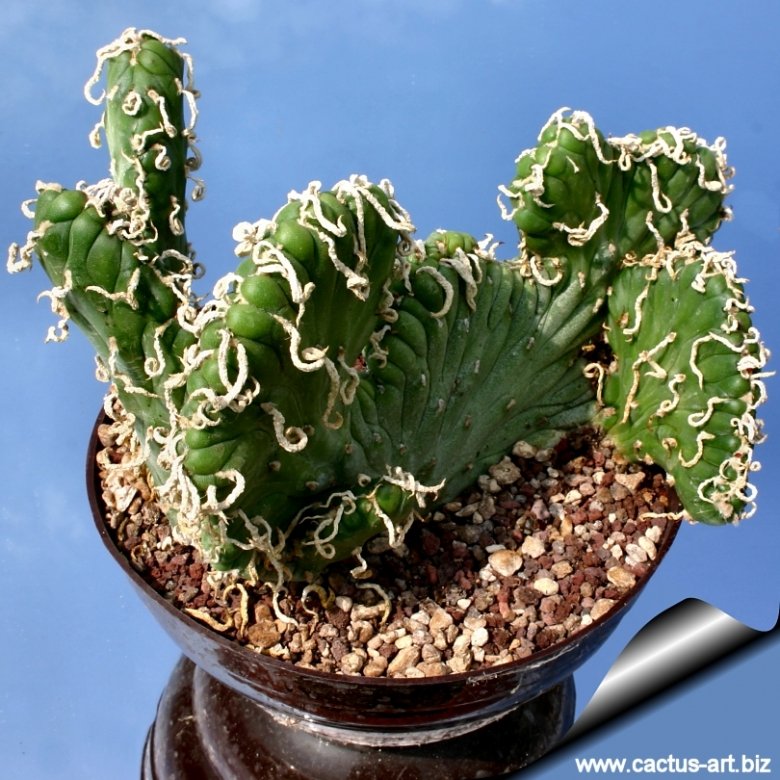
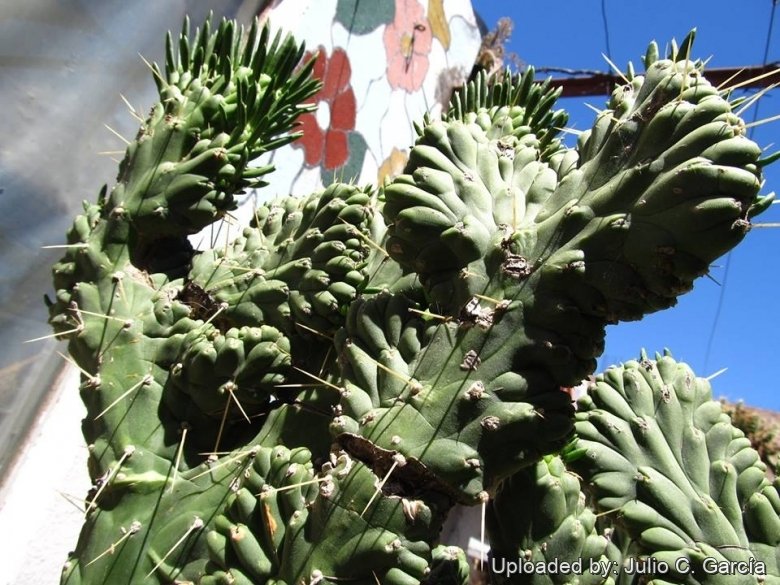
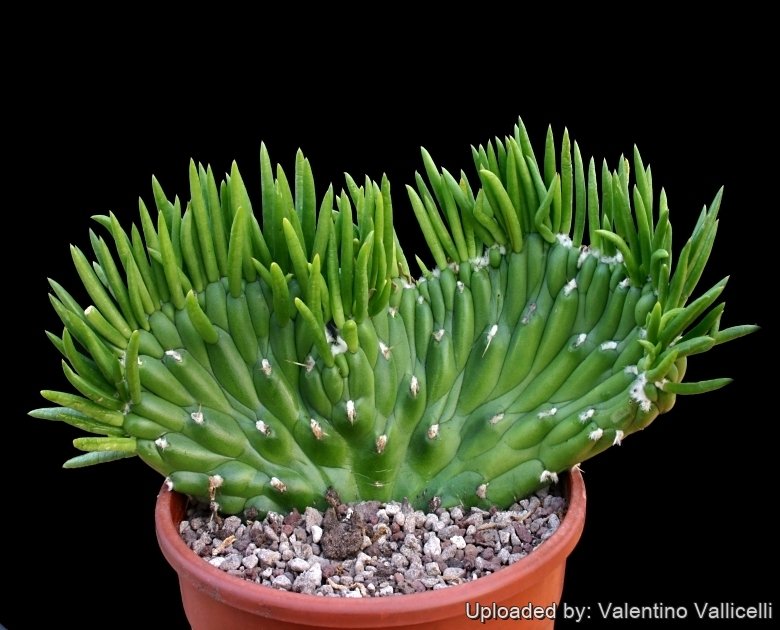
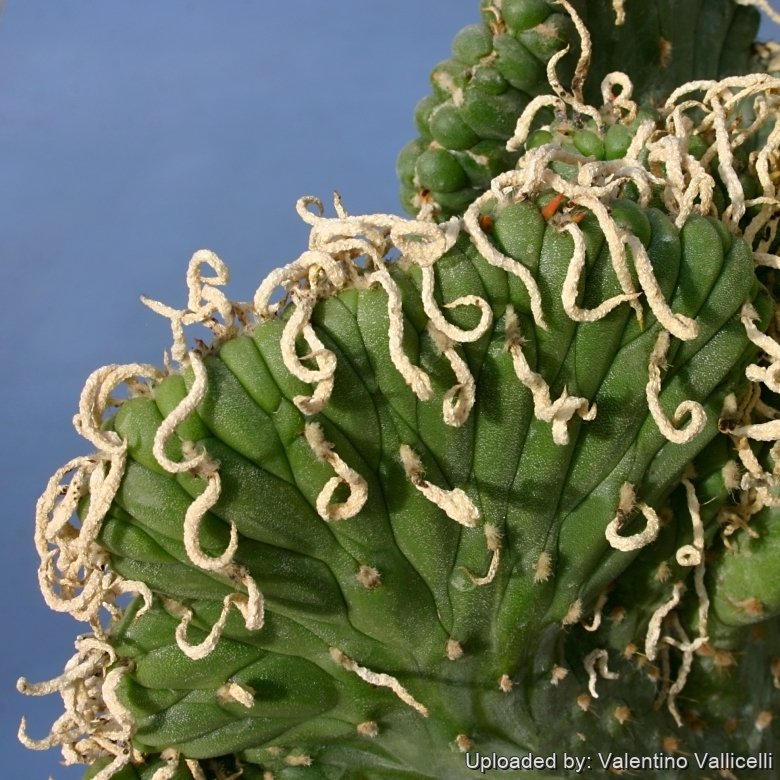
Crested form: The crested form (Austrocylindropuntia subulata f. cristata) creates very wide undulant fans topped shapes with combs of long emerald green succulent leaves with white areoles, and few (but fierce) white spines. In the crested form the cells at the tip of the branch where growth occurs begin to multiply at a much faster rate and the normal growing tip “goes crazy”, creating fantastic whorls and fans with pronounced sculpture effects. The crested branches slowly form delightful, snaky, ridged or crowded hemispherical clusters. The plant often grows a fast growing cylindrical stem to reveal its origins.
Origin and Habitat
Garden origin (Nursery produced cultivar)
Cultivation and Propagation
They are semi-hardy. Make sure your Opuntia subulata is not exposed to temperatures below -4°C or it may die. Nevertheless it is a good advice never let the night-time temperature fall below 5°C. Water regularly in summer, but allow to dry fully before watering again. It needs a well-drained soil mix, with small gravel added to ensure drainage. During the winter months it should be rather kept dry, and water is restricted to only enough to keep the stems and branches from shrivelling. Since these are big sized plants, and they need plenty of space for their roots, repotting should be done every other year, or when the plant has outgrown its pot.
Propagation: Cuttings in summer (Cuttings will root only in hot weather)
Bibliography
Major references and further lectures
-
David Hunt, Nigel Taylor “The New Cactus Lexicon” DH Books, 2006
-
Edward F. Anderson “The Cactus Family” Timber Press, 2001
-
James Cullen, Sabina G. Knees, H. Suzanne Cubey “The European Garden Flora Flowering Plants: A Manual for the Identification of Plants Cultivated in Europe, Both Out-of-Doors and Under Glass”Cambridge University Press, 11/Aug/2011
-
Curt Backeberg, Frederic Marcus Knuth: “Kaktus-ABC.” 1936
-
Curt Backeberg: “Die Cactaceae: Handbuch der Kakteenkunde.” 2. Auflage. Band I, Gustav Fischer Verlag, Stuttgart New York 1982
-
N. L. Britton, J. N. Rose: “The Cactaceae. Descriptions and Illustrations of Plants of the Cactus Family.” Vol I, The Carnegie Institution of Washington, Washington 1919
-
Urs Eggli, Leonard E. Newton: “Etymological Dictionary of Succulent Plant Names.” Springer, Berlin/Heidelberg 2010
-
Friedrich Ritter “Kakteen in Südamerika: Ergebnisse meiner 20jährigen Feldforschung” Band 4, 1981, S. 1244.
-
Peter Hanelt, Institute of Plant Genetics and Crop Plant Research, W. Kilian “Mansfeld’s Encyclopedia of Agricultural and Horticultural Crops: (Except Ornamentals)” Springer Science & Business Media, 10/Apr/2001
-
Park S. Nobel “Environmental Biology of Agaves and Cacti” Cambridge University Press, 16/Oct/2003
-
Hans Hecht “Cacti & Succulents” Sterling Publishing Company Incorporated, 1994
-
E Haustein “Der Kosmos Kakteenfuehrer (the Kosmos Cactus Guide)” Balogh Scientific Books 01 December 1998
-
Aragón, G. A. “Cactaceas de los alrededores de la ciudad de Arequipa” [prim.]. Bol. Lima 20(4): 59–69.1982.
-
Véliz Pérez, M. E. “Cactáceas Guatemala” 1–129. Univ. de San Carlos de Guatemala, Guatemala. 2008.
Source: Opuntia subulata f. cristata, LLIFLE - Encyclopedia of living forms, CC-BY-SA, retrieved 2026-10-25.
Cultivars and forms (1)
Gallery