Publication: Comm. Pl. Afr. Austr. (Meyer) 196 1838.
Description
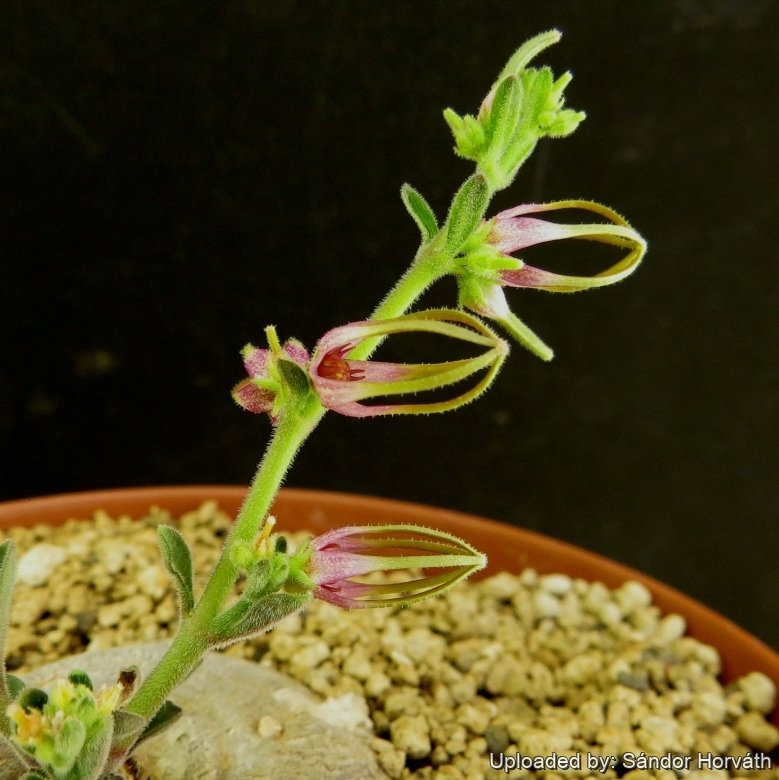
Brachystelma circinatum is a dwarf perennial herb producing one or more stems that branch from the base 2 – 40 cm high, with a small flattish underground tuber (caudex), with its little lantern or cage-like flowers with no apparent corolla tube and long, narrow lobes remaining joined at their tips, it cannot be confused with any other species in south-west Africa. The leaves are sessile, opposite, oblong, soft and covered in whitish hairs. Leaves are ovate in shape with entire margins curled inwards and tapering apices. The flowers show a considerable variation in shape, size and colour with lobes from white to red-brown and from 5-25 mm in length. The vast amount of phenotypic variation has led N. E. Brov/n I.e. (1908) to the creation of several species, but it is very difficult to distinguish clearly between them, and a number of species originally in the genus Dichaelia are now part of the very broad, multiform Brachystelma circinatum.
Tuber (caudex): Roundish, up to 100 mm diameter, flattish to depressed and often with slightly bowl-shaped central area.
Stems: Branches erect, solitary to several, umbranched to richly horizontally branched, densely puberulous with minute recurved hairs.
Leaves: (1) 2 (-few) at nodes, ascending or suberect from a spreading base, (2-)6-20(-40) mm long, linear or linear-subterete from being longitudinally folded or having incurved margins, acute or subobtuse, 8-12 mm broad when folded, puberulous like the stems or sometimes glabrous on upper surface, with the upper (infolded) surface glabrous.
Flowers: mostly in pairs at the nodes. Pedicels 2 (in fruit 4-5) mm long. Sepals about 1.5 mm long, lanceolate, acuminate, and like the pedicels minutely puberulous. Corolla from white to maroon, with cylindric beak in bud , 5-25 mm long, cage-like, lobed nearly to the base, with the lobes connate at the tips, minutely spreading-puberulous all over outside, glabrous within; united part flattish or saucer-shaped, scarcely 1.5 mm deep. Lobes 8-10 mm long, linear-filiform from a 1.5 -broad base. Outer corona-lobes shorter than the staminal column, about 0.5 mm long, deeply divided into 2 subulate slightly divergent teeth, glabrous, apparently whitish. Inner corona-lobes 0.25-05 mm long, half as long as the anthers and resting in a concave channel on their backs, with a small linear or subulate acute or obtuse point, and a rather thick dark-coloured fleshy dorsal gibbosity at their base.
Origin and Habitat
Southern Africa - Namibia, Botswana, S. Africa (Eastern Cape, Free State, Gauteng, KwaZulu-Natal, Limpopo, Mpumalanga, Western Cape).
Altitude range: 500-1800 meters above sea level.
Habitat and ecology: Brachystelma circinatum grows in various stony places and has adapted to different environmental factors.
Cultivation and Propagation
In cultivation the plants are usually grown in semi shade, with the tubers wholly or (preferably) partially exposed to prevent scorching and rotting of the roots. This plant can take a good deal of water during active growth and should be watered only when not dormant. Keep dryish in winter. It should be overwintered in the greenhouse at temperatures over 12°C (avoid letting temperatures drop lower than 5° C). Use a very draining but rich soil. An error in cultivation may produce unsightly holes in the tuber.
Traditional uses: The plant is harvested from the wild for local use of its edible root by South Sothos that call this plant “Bohobe-ba-setsomi” the bread (bohobe) of the hunter tubers
Reproduction: This species can be reproduced by seeds. Sow seeds in summer in a well drained medium.
Bibliography
Major references and further lectures
-
Christian Puff “Zur Biologie von Myrothamnus flabellifolius Welw., Myrothamnaceae” Verlag der S.W.A. Wiss. Ges., 1978
-
N. E. Brown “Flora Capensis”, Vol 4, 1909
-
Hyde, M.A., Wursten, B.T., Ballings, P. & Coates Palgrave, M. (2016). Flora of Zimbabwe: Species information: Brachystelma circinatum.
http://www.zimbabweflora.co.zw/speciesdata/species.php?species\_id=146160, retrieved 10 January 2016
-
Leffers A. “Gemsbok Bean and Kalahari Truffle” Gamsberg MacMillan; Namibia. 2003
-
Useful Tropical Plants Database 2014 by Ken Fern, web interface by Ajna Fern with help from Richard Morris. “Brachystelma circinatum” <http://tropical.theferns.info/viewtropical.php?id=Brachystelma+circinatum\> web 08 January 2016
-
Foden, W. & Potter, L. 2005. “Brachystelma circinatum E.Mey.” National Assessment: Red List of South African Plants version 2015.1. Accessed on 2016/01/10
-
Ralf Peckover “The cultivation of Brachystelma from seeds” ALOE 35 No.1, 1998
-
<http://www.flora-africa.com/The%20cultivation%20of%20Brachystelmas%20from%20seed.pdf\> web 08 January 2016
-
R. A. Dyer “Notes on the Genus Brachystelma” Bothalia 10, 2 : 373-378
-
J.P. Roux “Flora of South Africa”, 2003
From llifle page Brachystelma pallidum
Description
It is a monoecious caudiciform plant, commonly known as “Baboon’s Cucumber” with lots and lots of herbaceous climbing or creeping vines growing rapidly from the swollen base and looking like an English ivy with a tuber. The shoots emerge from a massive underground tuberous rootstock (or caudex). This tuber is a water-storage organ so it is very resistant to drought. In cultivation the tuber is raised over the ground so that it can be seen and is especially cultivated for its looks. Architecturally it is a real stunner. When the “caudex” shape is adequately in evidence this plant is incomparable. The plant is quite variable and in cultivation a number of very different plants are, all referred to as Kedrostis africana creating some confusion.
Caudex: Large, up to 50 cm across, simple or branched, woody, somewhat flattened, stone-like of variable shape, with a distinctive fissured, pale grey-green to pale-brown rind covered in small warts
Vines: Annual, 1-6 metres in length, thin, green glabrous or nearly so, with filiform simple (unforked) tendrils.
Leaves: Alternate, 6-10 cm long, triangula in outline and more or less deeply palmately divided into 3 or 5 lobes, segments pinnatifid, lobes lanceolate or linear-lanceolate, mucronate, entire or dentate, the terminal longer. Petiole 4-12 mm long. Surface slightly rough. Upper leaves much smaller.
Male flowers: Minute, 1 to 12 in short racemes on 2-8 cm long peduncle, petals bristly green-yellow to whitish or cream.
Female flowers: Solitary or few in fascicles. Petals green-yellow to whitish or cream
Blooming seson: Flowers unfailingly every year in summer.
Fruit: 8-15 mm in diameter, roundish, orange/yellow to reddish.
Origin and Habitat
Namibia and South Africa (Eastern Cape, Free State, Gauteng, KwaZulu-Natal, Limpopo, Mpumalanga, Northern Cape, North West, Western Cape)
Cultivation and Propagation
It grows well, though very slowly, but it possible to increase the speed of growth to some extent by providing adequate amount of water, warmth, and fertilizer during the active growing season, but it’s susceptible to rotting if too wet. It likes a sunny position, but avoid direct blasting sun in summer. It should be watered regularly in Summer and kept drier in Winter. It like pots with generous drain holes, need a very porous, slightly acidic potting medium (add pumice, vulcanite, and perlite). It can be grown outdoors in frost-free climates, need anyway to kept above 0°C and dry in winter.
Manteinance: Repot every two years.
Propagation: Seeds or cuttings.
Bibliography
Major references and further lectures.
-
Urs Eggli “Illustrated Handbook of Succulent Plants: Dicotyledons” Springer Science & Business Media, 2002
-
Klaus Kubitzki “Flowering Plants. Eudicots: Sapindales, Cucurbitales, Myrtaceae” Springer Science & Business Media, 10/Dec/2010
-
C. Jeffrey “Flora of Tropical East Africa” 1967
-
C. Jeffrey “Cucurbitaceae” in: Flora Zambesica. 1978
-
Meeuse, A.D.J. “The Cucurbitaceae of southern Africa.” in: Bothalia 8: 1-111.1962
Source: Brachystelma pallidum, LLIFLE - Encyclopedia of living forms, CC-BY-SA, retrieved 2026-10-25.
From llifle page Dichaelia macra
Description
Gymnocalycium saglionis subsp. tilarense differs from subspecies saglionis in having flowers with shorter floral tubes and occurring only in an area near Tilcara.
The typical Gymnocalycium saglionis (commonly known as the “Giant Chin Cactus”) is a solitary barrel cactus, rather flattened, often very large, with long spreading and sometimes recurved spines.
Stem: Flattened globose to shortly cylindrical more or less flattened up to 30 (40) cm in diameter, 15-30 cm tall occasionally up to 90 cm tall, dull-green or blue-green.
Ribs: 10-32 according to the size of the plant, low, very broad, sometimes 4 cm. long, separated by wavy intervals, divided into large, low, rounded tubercles.
Areoles: About 2 to 4 cm apart, large, felted when young.
Spines: 8 to 10 on small plants but on old plants often 15 or more, 3-4 cm long, yellowish-brown, reddish or black becoming grey with time which contrast well against the green body at first ascending, afterwards more or less curved outward.
Central spines: 1-3 almost straight.
Radial spines: 10-15 bent against the stem.
Flowers: Broadly funnelform, white or pale pinkish, with reddish throat up to 3-4 cm long, 2-3 cm in diameter, with a very short flower’s tube.; inner perianth-segments spatulate, acute; scales of the ovary nearly orbicular, rounded, with a scarious margin. The flowers forms a crown on the plant apex and have a hard time coming through the dense mass of spines.
Blooming season: Appearing repetitively during the growing season.
Fruit: Red, globular.
Origin and Habitat
Argentina only in an area near Tilcara.
Cultivation and Propagation
Gymnocalycium bruchii is a summer grower species that is easy to cultivate. It is one of the most cold-tolerant South American species. It can grow outdoors and is hardy to -15° C or even less.
Growth rate: It is a relatively rapidly growing and easily flowering species that will make clumps given the best conditions.
Soils: It likes very porous standard cactus mix soil. Prefer a low pH compost, avoid substrata rich in limestone; otherwise growth will stop altogether.
Repotting: Use pot with good drainage.
Watering: Needs moderate to copious waterings in summer, but do not overwater (Rot prone), keep dry in winter.
Fertilization: Feed with a high potassium fertilizer in summer.
Hardiness: Reputedly very resistant to frost if kept on the dry side prior to, and during, cold weather (hardy to -15 C ° C, or less for short periods).
Exposition: The plant tolerates extremely bright situations but enjoys filtered sunlight or afternoon shade, inside it needs bright light, and some direct sun. Tends to bronze in strong light, which encourages flowering and heavy spine production.
Uses: It is an excellent plant for container growing. It always looks good and stays small. It look fine in a cold greenhouse and frame or outdoor in a rockery.
Pests & diseases: It may be attractive to a variety of insects, but plants in good condition should be nearly pest-free, particularly if they are grown in a mineral potting-mix, with good exposure and ventilation. Nonetheless, there are several pests to watch for:
- Red spiders: Red spiders may be effectively rubbed up by watering the plants from above.
- Mealy bugs: Mealy bugs occasionally develop aerial into the new growth among the wool with disfiguring results, but the worst types develop underground on the roots and are invisible except by their effects.
- Scales: Scales are rarely a problem.
- Rot: Rot it is only a minor problem with cacti if the plants are watered and “aired” correctly. If they are not, fungicides won’t help all that much.
Propagation: Division, direct sow after last frost. Seeds germinate in 7-14 days at 21-27° C in spring, remove gradually the glass cover as soon the plants will be well rooted (ca 1-2 weeks) and keep ventilated, no full sun for young plants! To make a cutting twist off a branch and permit it to dry out a couple of weeks, lay it on the soil and insert the stem end partially into the soil. Try to keep the cutting somewhat upright so that the roots are able to grow downward.
Bibliography
Major references and further lectures
-
Edward Anderson “The Cactus family” Timber Press, Incorporated, 2001
-
James Cullen, Sabina G. Knees, H. Suzanne Cubey “The European Garden Flora Flowering Plants: A Manual for the Identification of Plants Cultivated in Europe, Both Out-of-Doors and Under Glass” Cambridge University Press, 11/Aug/2011
-
David R Hunt; Nigel P Taylor; Graham Charles; International Cactaceae Systematics Group. “The New Cactus Lexicon” dh books, 2006
-
N. L. Britton, J. N. Rose “The Cactaceae. Descriptions and Illustrations of Plants of the Cactus Family.” Volume 4, The Carnegie Institution of Washington, Washington 1923
-
Curt Backeberg “Die Cactaceae: Handbuch der Kakteenkunde” Gustav Fischer Verlag, Stuttgart New York 1982–1985
Source: Dichaelia macra, LLIFLE - Encyclopedia of living forms, CC-BY-SA, retrieved 2026-10-25.
Gallery