Publication: Syst. Veg. (ed. 16) [Sprengel] 2: 86. 1825 [Jan-May 1825]
From llifle page Bulbine brunsvigiaefolia
Description
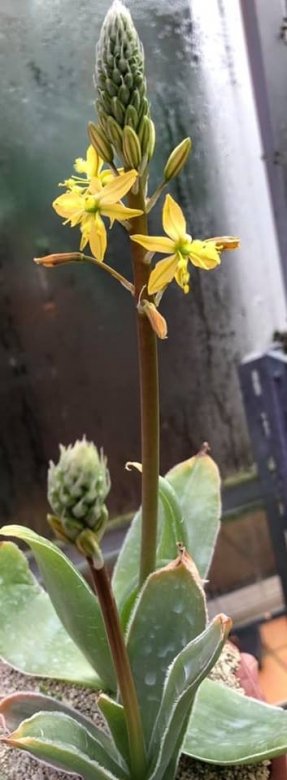
Bulbine brunsvigiifolia (previously known as B. brunsvigiæfolia or B. brunsvigiaefolia) was first named in 1987 by J. G. Baker. It is generally included within (as a synonym of) Bulbine latifolia |, suggesting that there is not really a fundamental difference between the two, and hard to name accurately without knowing where they come from. The name brunsvigiifolia, meaning “Brunsvigia-like leaves”, refers to the leaves that lie flat on the ground at the manner of Brunsvigia. The leaves distinguish this species from the other low growing species.
The original description included the following information:
Leaves: Thin, lorate-oblong (tongue shaped), 15-20 cm long, 5 cm broad, subobtuse, minutely cuspidate, glabrous on the surface, densely persistent, shortly ciliated on the edge.
Inflorescence: Peduncle stout, a foot long; flowers many in a lax raceme 7.5-10 cm long; pedicels ascending or spreading, 12-18 mm long; bracts membranous, ovate-lanceolate, 8-12 mm long; perianth 12 mm long; segments oblanceolate, obtuse, distinctly keeled with green; stamens 3 mm long; filaments densely stuppose in the upper half; anthers small, oblong; style filiform, 4 mm long; stigma capitate.
Origin and Habitat
Modderfontein, Little Namaqualand, North-West Cape Province, South Africa, South Africa.
Altitude range: Around 450-600 metres above sea level.
Bibliography
Major references and further lectures
- J. G. Baker “Flora Capensis” 1897
Source: Bulbine brunsvigiaefolia, LLIFLE - Encyclopedia of living forms, CC-BY-SA, retrieved 2026-10-25.
Gallery