Publication: Proc. Amer. Philos. Soc. 50: 426. 1911
Description
Calibanus hookerii is an interesting looking plant that is related to the agaves, it looks like a trunk-less Nolina topped by perennial grasslike, silver-blue, raspy-surfaced leaves that expand from a woody caudex (Swollen succulent rootstock) that over several years, can reach one or more metres in diameter. Young plants of this species resemble little more than a confused tangle of thick grass, as the dense foliage can tend to conceal the presence of the tuberous caudex. The flowers are inconspicuous creamy-white, pink or purplish. It is usually considered to be a member of the Dracenaceae (C. hookeri is sometimes placed in the Agavaceae or in the Liliaceae too).
Derivation of specific name: hookeri For Sir William J. Hooker (1785– 1865), British botanist, first director of the Royal Botanic Gardens Kew 1841–1865.
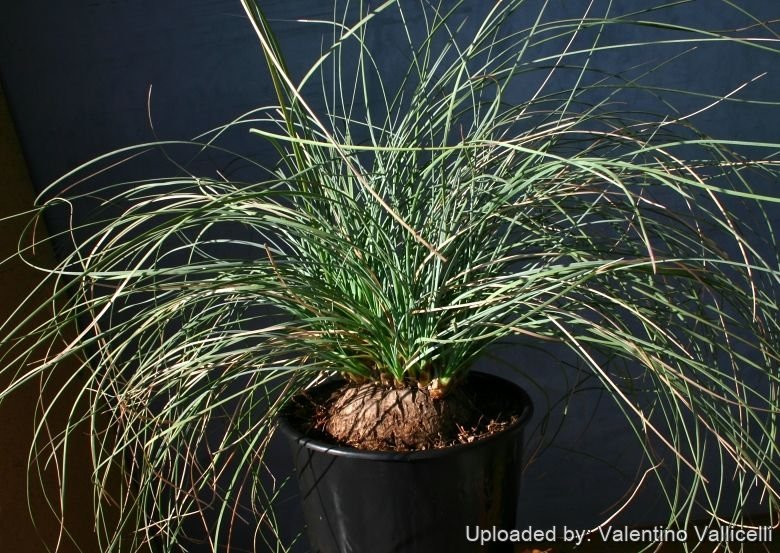
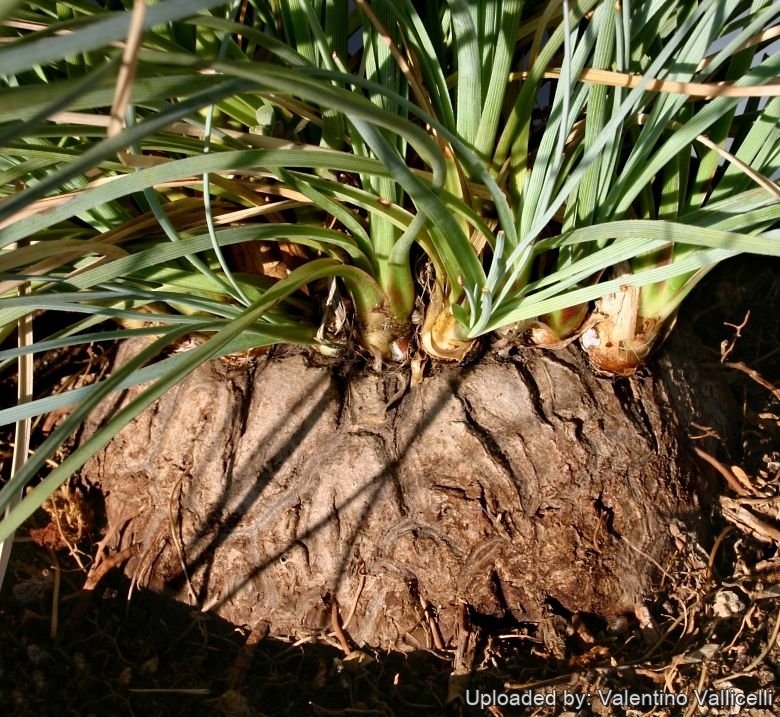
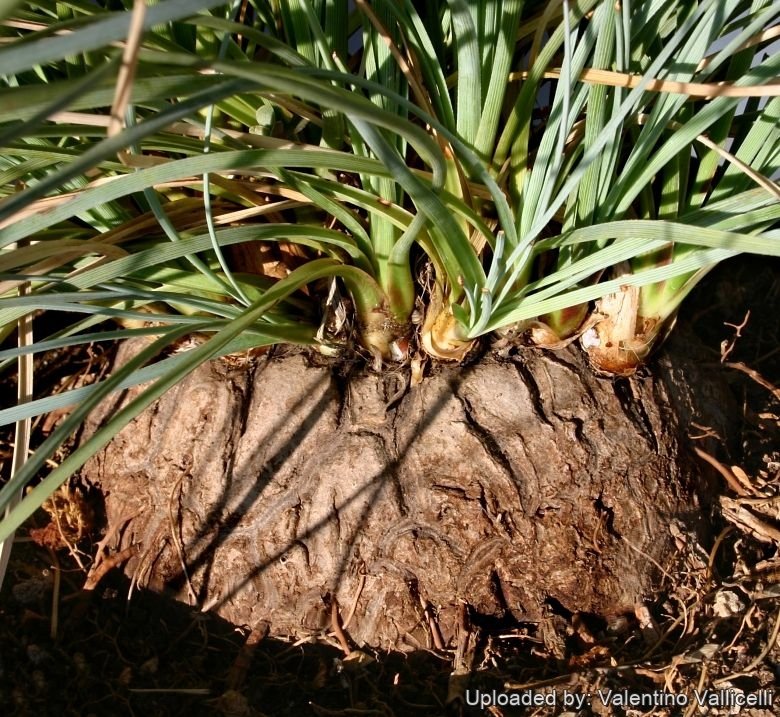
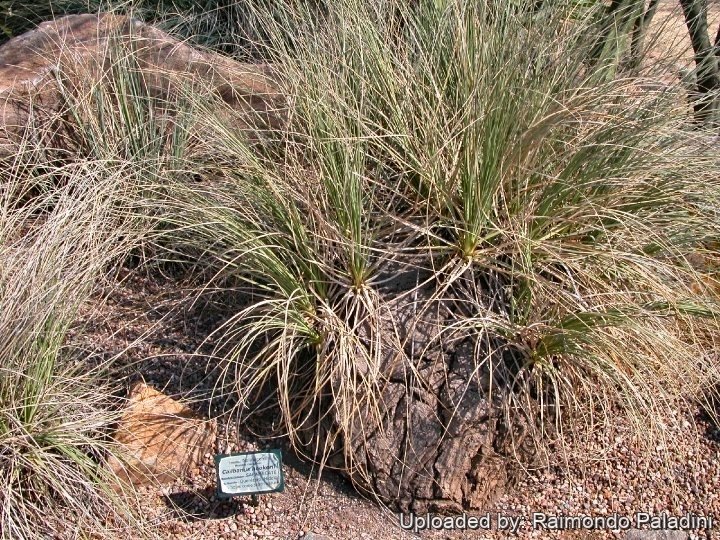
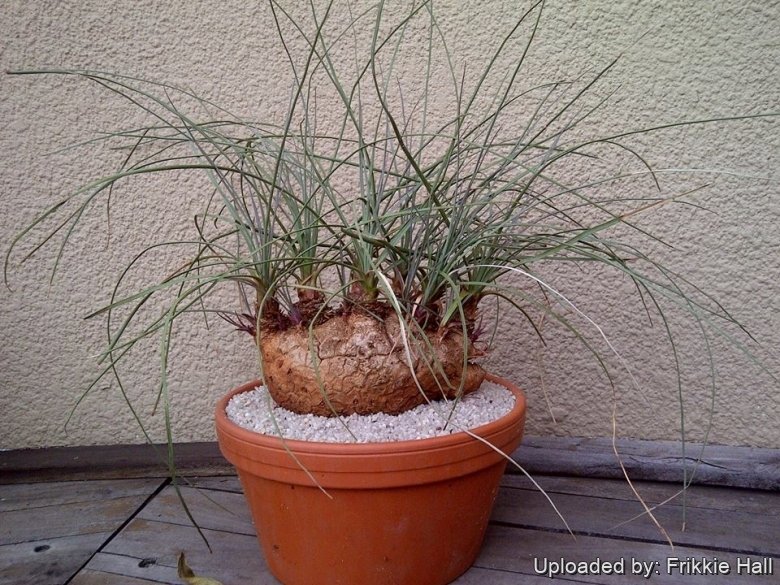
Caudex: The caudiciform base is depressed globose with numerous crowns of leaves and sits halfway out of the soil It is woody, gnarled and bearing deep furrows and scars, with a fissured or plate-like brownish-grey bark, its surface marked with a pattern of shallow tubercles. It is very slow growing, generally it is 0,30 to 1 m in diameter and 0, 25 cm high, but in the wild desert habitat, the caudices may attain the size and appearance of large boulders to 5 meters in diameter. The caudex often producing laterally other hemispherical stems, with several branches above each with a few long, thin, thread-like, rather tenacious leaves.
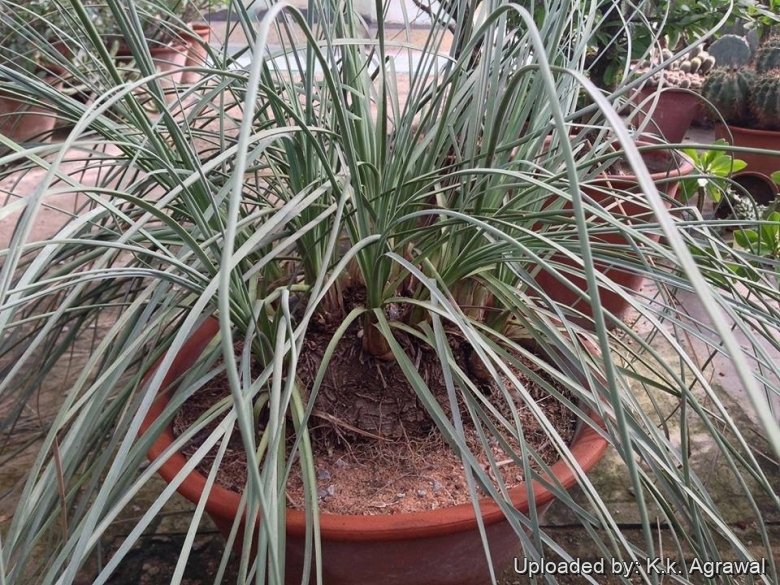
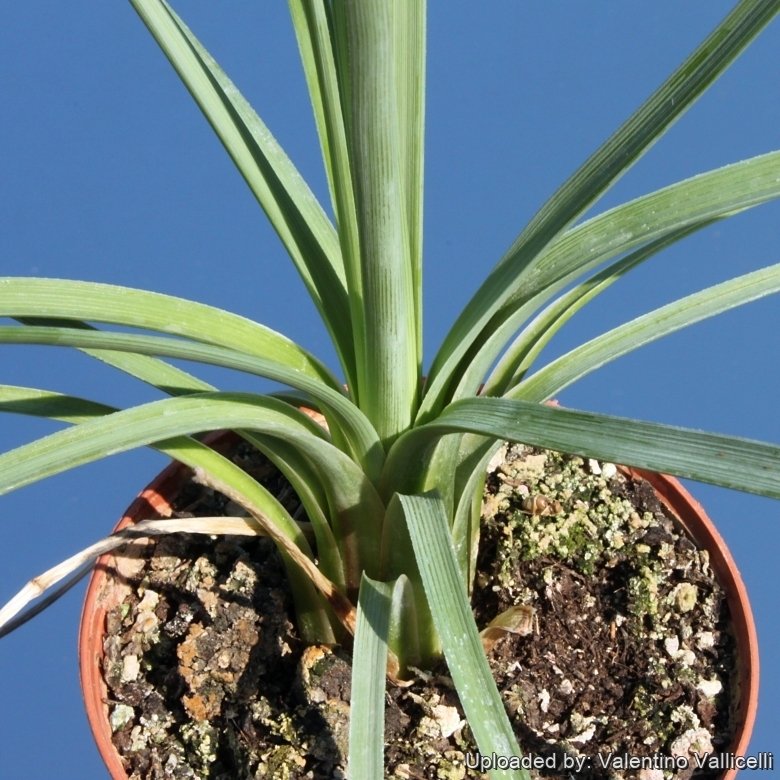
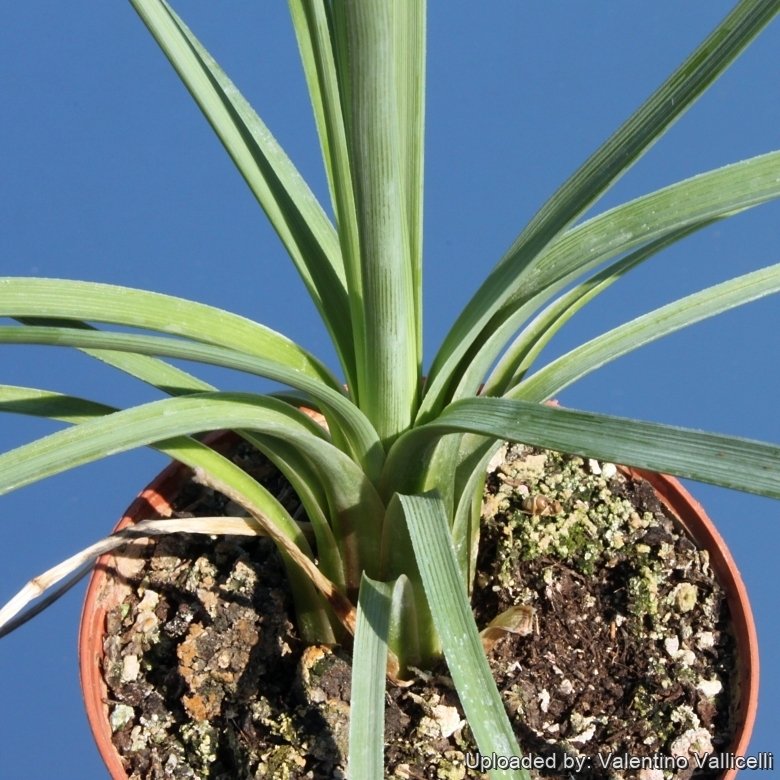
Leaves: Thin, wiry, flexible, grass-like, raspy surfaced that grows upright in the centre of the plant and then arch down as they mature. They are somewhat concave and keeled, the margins are rounded. The leaves will get 30 to 90 cm long and are only 2-3 mm wide. They are blue green in colour. They appear on the plant as a crown formed by numerous bundles arising from the top of the caudex. The number of the bundles increase as the plant increase in size. Each leaf rosette grown from the caudex is believed to be a vegetatively produced independent plant which dies after fruiting to be replaced by a new one.
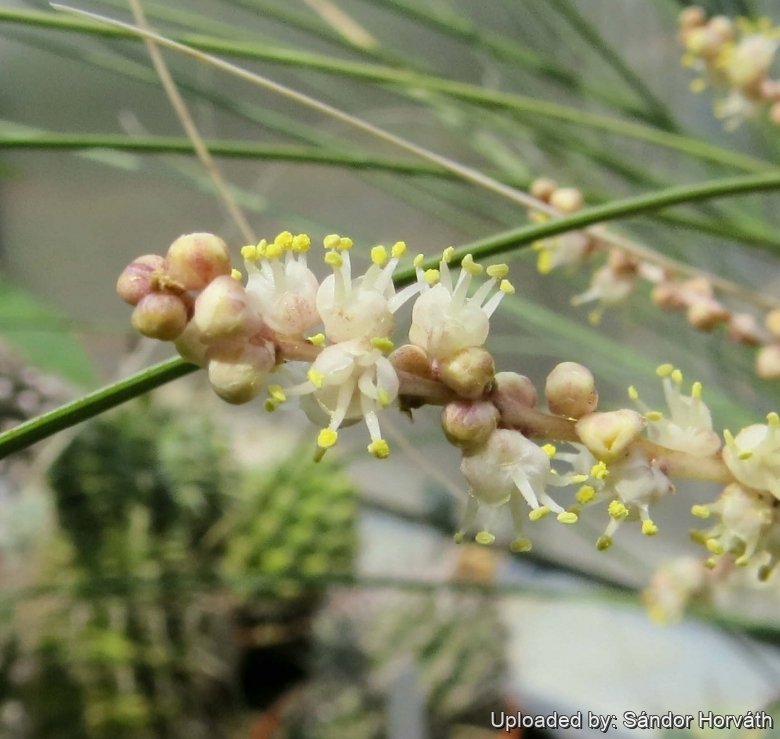
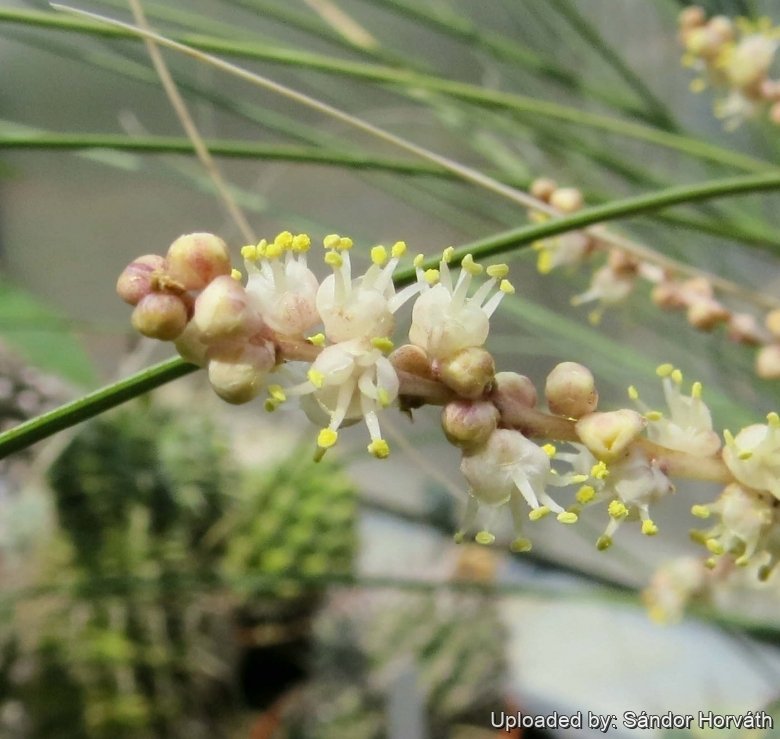
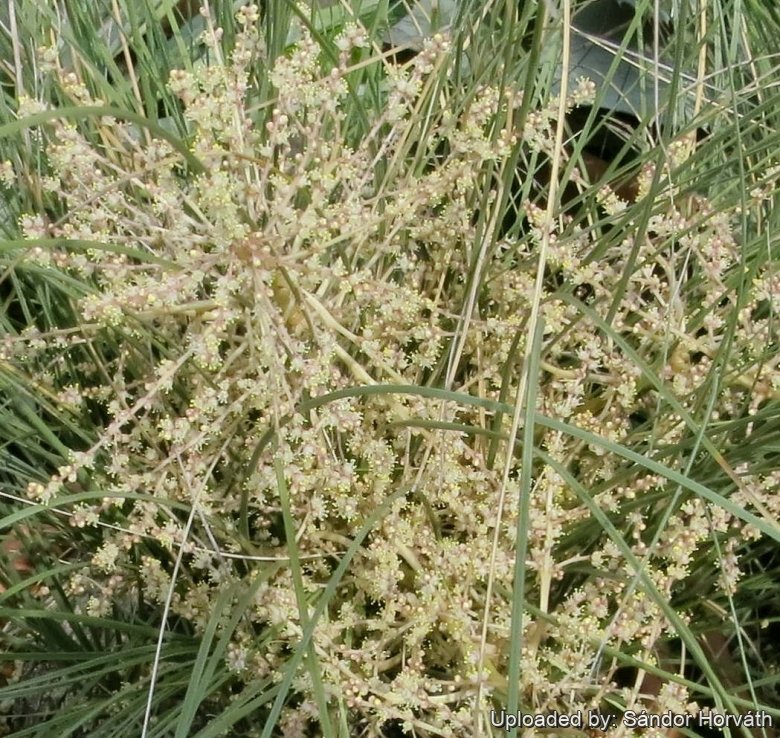
Flowers: The Calibanus is dioecious (there are male and female plants) or rarely some plants are hermaphrodite. The clusters of flowers (panicles) are rigid 10 to 100 cm long ( mostly about 25 cm long and shorter than the leaves) with many branchings, 6-8 cm long and partially hidden in the foliage or with exceptional very short and few basal branchlets. Peduncled, simple very short. Bracts scarious, much shorter than the subtended branches, the floriferous ones and the bractlets inconspicuous, ovate or lanceolate, little-toothed. The flowers are greenish white, creamy-white, pink or purplish and very tiny. Perianth segments about 1 mm long.
Fruit: Female plants bear subglobose, ovoid, three angled berries, (4-)8-9 mm long, 85-)6-7 mm in diameter. The fruits are straw-brownish to reddish and indehiscent.
Seeds: Mellon shaped, 3 x 3-4 mm wide.
Origin and Habitat
North central Mexico (Hidalgo, Tamaulipas and San Luis Potosi).
Habitat and ecology: It grows in grit, in a dry mountainous habitat, where it receives quite copious water in the short growing-period. These plants are very drought tolerant, and have developed a caudex (water storage organ) at and below ground level, a common survival strategy in dry climates.
Cultivation and Propagation
Calibanus hookeri is a very tolerant plant that can withstand temperatures of -15 Celsius degrees, but its exact hardiness is unknown. Because of its extreme drought tolerance, it makes a great container plant for light shade to full sun, or is an excellent foliage accent in a dry garden in warm regions. Might look its best in a vase shaped terra cotta pot to allow the leaves to drape downwards.
Soil: In pots it needs a porous and fertilized potting medium (add pumice, vulcanite, and perlite). It does better in a rather acidic soil. It is a tough plant. Having been bred to endure dry air and drought, it will survive for years in less than ideal conditions. Should be grown in a large and shallow container and should be kept outside in summer. It can stay in the same pot for a number of years since it prefers to be a bit rootbound.Outdoor it needs heavy soil with excellent drainage and circulating dry air.
Water requirements: It needs moderate water when actively growing, little water the rest of the time, if established.
Light requirements: C. hookeri likes full sunlight.
Manteinance: It should be noted that in cultivation, the tips of the leaves of Calibanus hookeri tend to shrivel up and become brown, creating a somewhat unsightly effect. For the sake of general greenhouse hygiene, the dead tips may be trimmed away.
Propagation: Seeds; it cannot be reproduced by cuttings of the caudex (or leaves).
Bibliography
Major references and further lectures
-
Urs Eggli “Illustrated Handbook of Succulent Plants: Monocotyledons” Springer Science & Business Media, 06 December 2012
-
Urs Eggli, Leonard E. Newton “Etymological Dictionary of Succulent Plant Names” Springer Science & Business Media, 29 June 2013
-
“The New Plantsman” Royal Horticultural Society, 1998
-
Hermann Jacobsen “Abromeitiella to Euphorbia” Blandford Press, 1960
-
Wikipedia contributors. “Calibanus hookeri.” Wikipedia, The Free Encyclopedia. Wikipedia, The Free Encyclopedia, 11 May. 2015. Web. 5 Jan. 2016.
-
Zdenek Jezek, Libor Kunte “Encyclopedia of Succulents” Rebo Productions December 22nd 2009
-
Mary Irish, Gary Irish “Agaves, Yuccas and related Plants” Timber Press, Portland, Oregon 2000
-
William Trelease “The desert group Nolineae. Calibanus” In: Proceedings, American Philosophical Society. 50: 426–427, 1911 <http://biodiversitylibrary.org/page/26867753#page/436/mode/1up\> Web. 5 Jan. 2016.
-
Dasylirion hartwegianum. In: Bot. Mag. 3(15): pl.5099 1859.
-
Dasylirion caespitosum. In: Wochenschr. Verein Beförd. Gartenbau 4: 286, 1861
-
San Marcos Growers “Calibanus hookeri.” <http://www.smgrowers.com/products/plants/plantdisplay.asp?plant\_id=289\>. Web. 5 Jan. 2016.
From llifle page Calibanus caespitosus
Description
Calibanus hookerii is an interesting looking plant that is related to the agaves, it looks like a trunk-less Nolina, topped by perennial grasslike silver-blue leaves that expand from a woody caudex (Swollen succulent root).
Caudex: The caudiciform base is hemispherical and woody with a fissured or plate-like brownish-grey bark and sits halfway out of the soil. It is very slow growing, generally it is 0,30 to 1 m in diameter but can eventually grow to 5 meters in diameter,
Leaves: Thin, wiry, flexible, grass-like, raspy surfaced that grows upright in the center of the plant and then arch down as they mature. They are somewhat concave and keeled, the margins are rounded. The leaves will get 30 to 90 cm long and are only 2-3 mm wide. They are blue green in colour. They appear on the plant as a crown formed by numerous bundles arising from the top of the caudex. The number of the bundles increase as the plant increase in size.
Flowers: The Calibanus is dioecious (there are male and female plants) or rarely some plants are hermaphrodite.. The clusters of flowers (panicles) are rigid about 10-20 cm long and partially hidden in the foliage. The flowers are pink or purplish and very tiny.
Fruit: Female plants bear globose, ovoid, three angled berries, 8-9 mm long, 6-7 mm in diameter. The fruits are straw-brownish to reddish and indehiscent.
Seeds: Mellon shaped, 3-4 x 3 mm wide.
Cultivation and Propagation
Calibanus hookeri is a very tolerant plant that can withstand temperatures of -15 Celsius degrees, but its exact hardiness is unknown. Because of its extreme drought tolerance, it makes a great container plant for light shade to full sun, or is an excellent foliage accent in a dry garden in warm regions. Might look its best in a vase shaped terra cotta pot to allow the leaves to drape downwards. It needs moderate water when actively growing, little water the rest of the time, if established. Outdoor it needs heavy soil with excellent drainage and circulating dry air. It is a tough plant. Having been bred to endure dry air and drought, it will survive for years in less than ideal conditions. It can stay in the same pot for a number of years since it prefers to be a bit rootbound.
Propagation: Seeds; it cannot be reproduced by cuttings of the caudex (or leaves).
Source: Calibanus caespitosus, LLIFLE - Encyclopedia of living forms, CC-BY-SA, retrieved 2026-10-25.
Gallery