Publication: Ind. Sp. Gen. Car. 13 1931.
Description
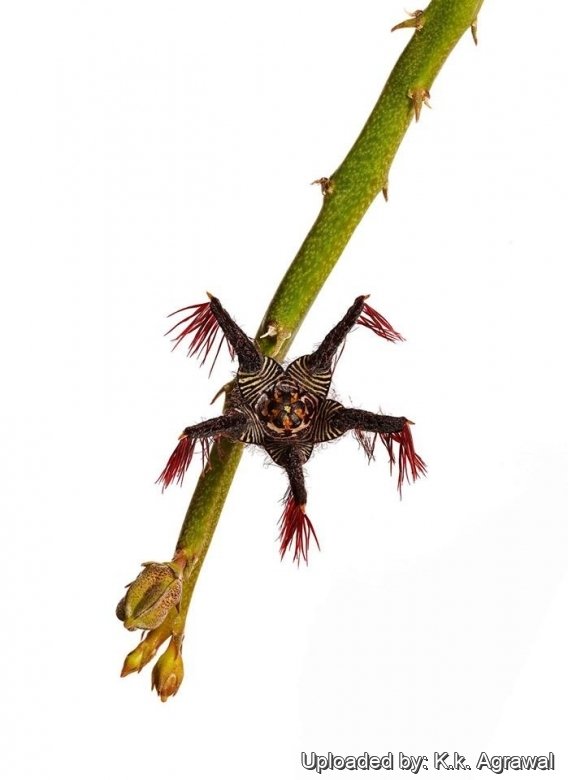
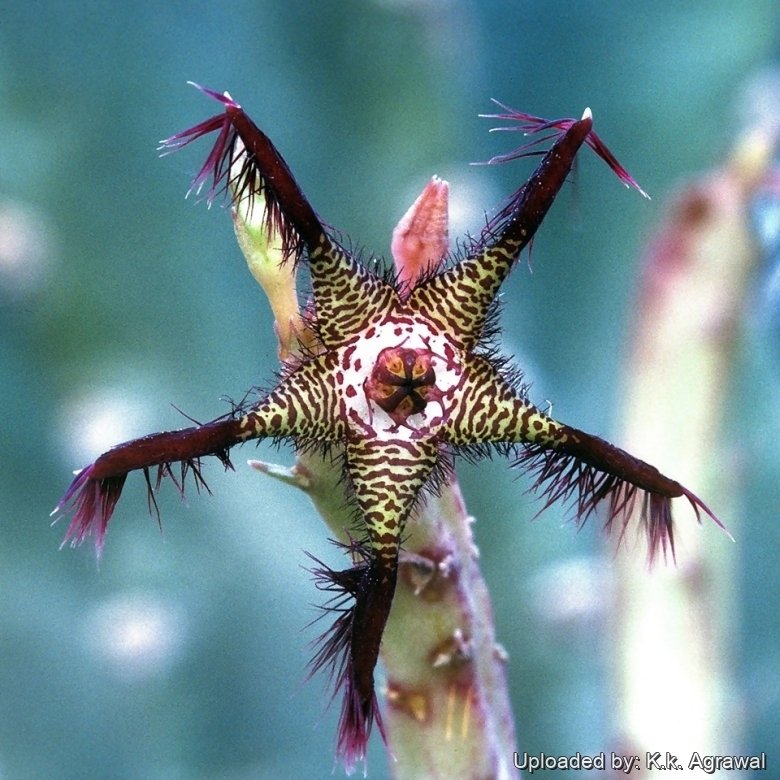
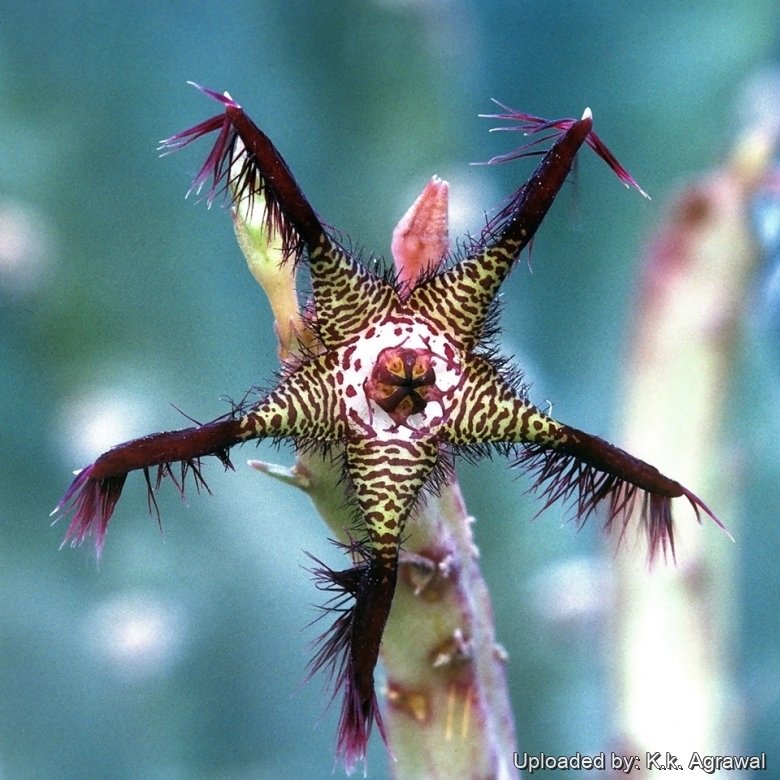
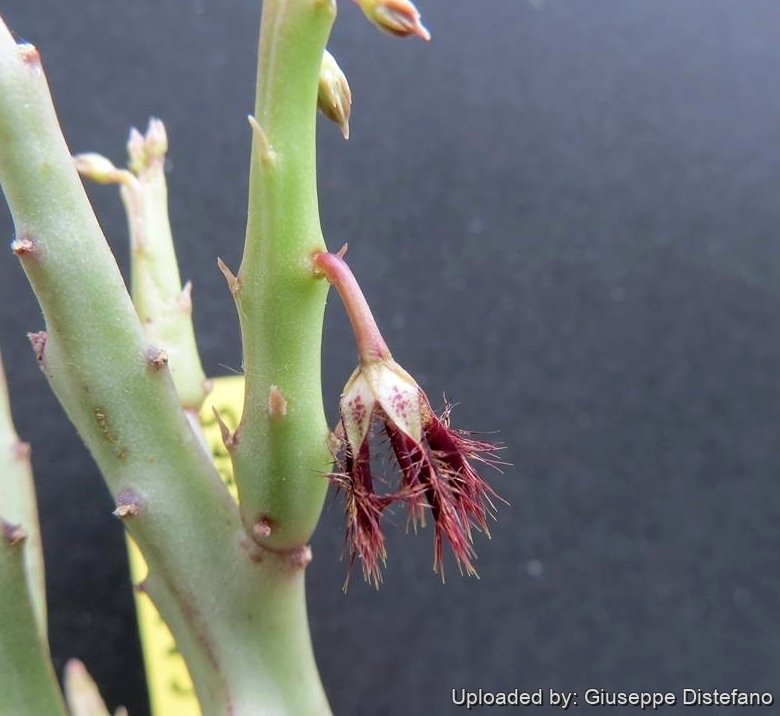
Caralluma adscendens var. fimbriata (Caralluma fimbriata) differs from var. adscendens for its stems (at least close to the base) with rounded edges. The flowers are rather small, drooping frilly with hairs similar to Caralluma adscendens var. attenuata.
Derivation of specific name: Latin ‘fimbria’, thread, fringe; and Latin ‘-fer, -fera, -ferum’, -carrying; for the hairs on the corolla lobes.
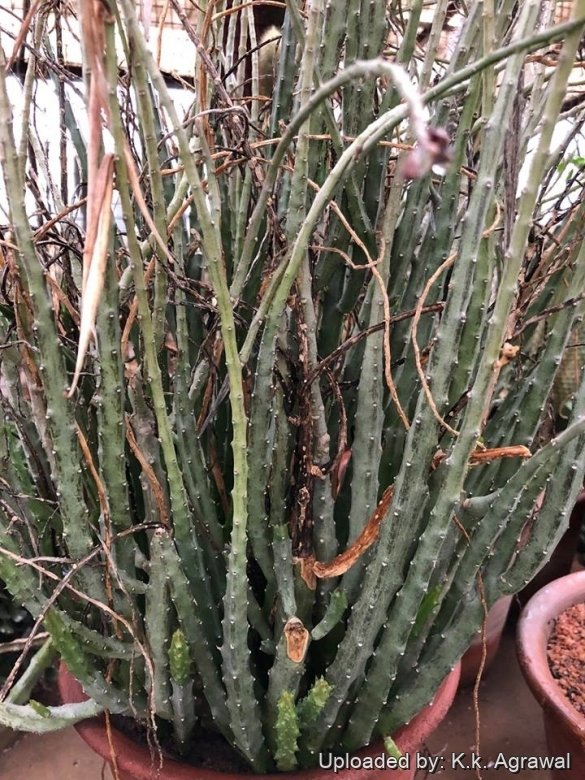
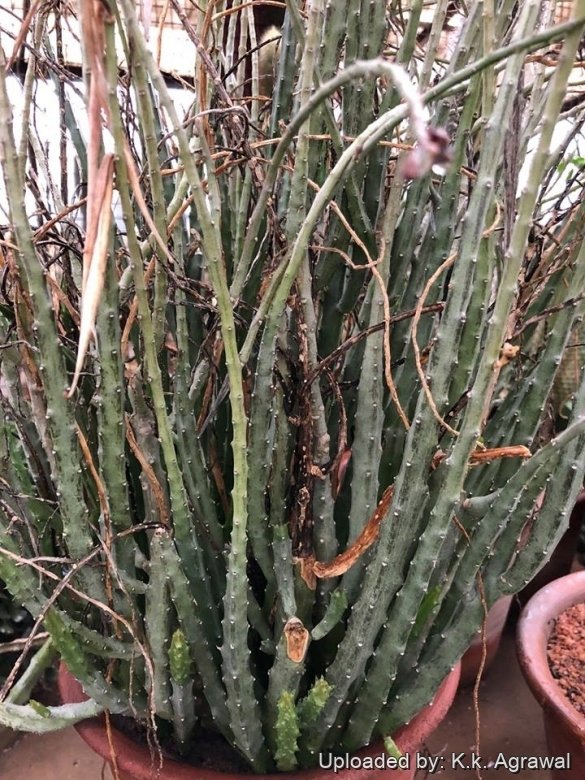
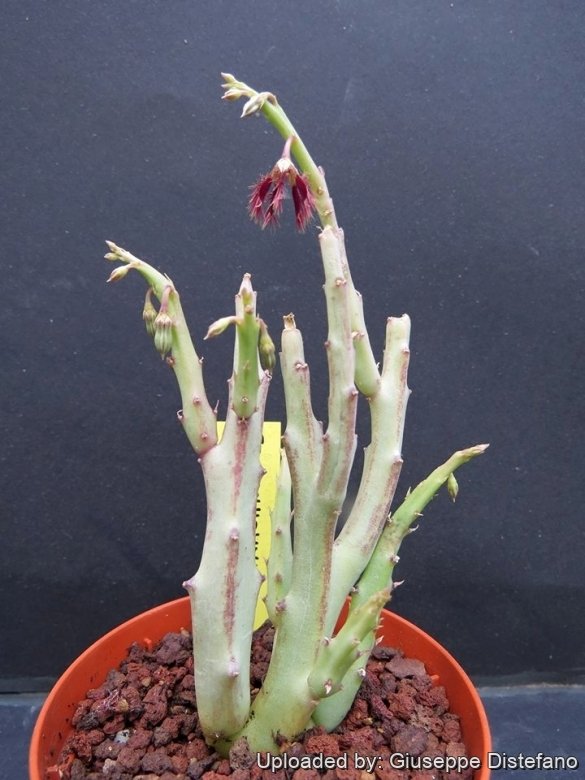
Habit: It is an erect shrubby perennial herb, 12-20 cm tall, usually dichotomously branched, with xerophytic features and cactus-like appearance. The stems are fleshy almost leafless, green, often with brownish streak.
Stems: Stemlets leafless, creeping at first, then upright, tapering towards the apex and only, green, often striped brownish, four-angled, edges rounded slightly sinuate-dentate. Tubercles blunt, protruding, horizontally spreading. Sap watery.
Leaves: Rudimentary, minute tooth-like, present only on young branches, soon falling off, leaving a tooth-like projection on the angles.
Inflorescences: Borne at the end of branches, 1- to 3-flowered in the leaf-axils, loosely scattered.
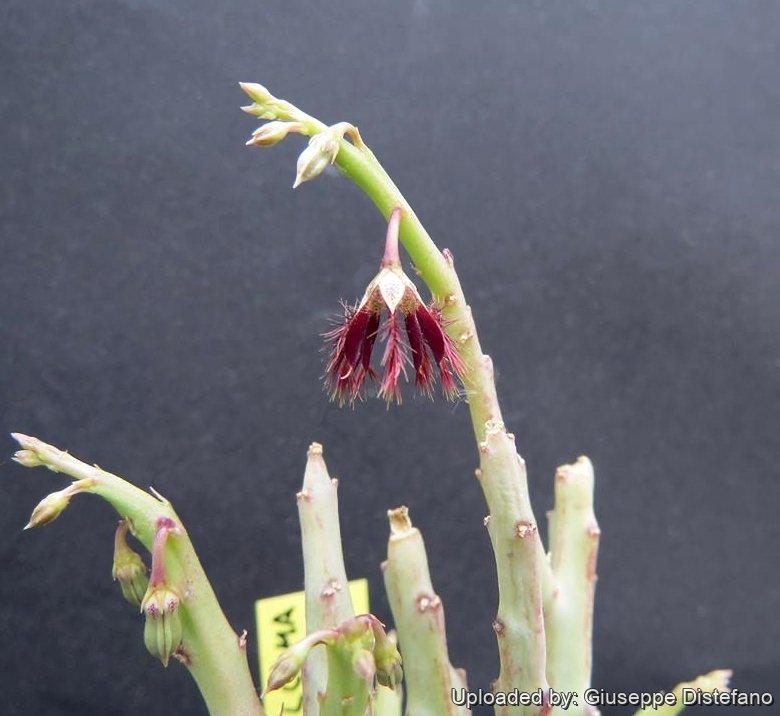
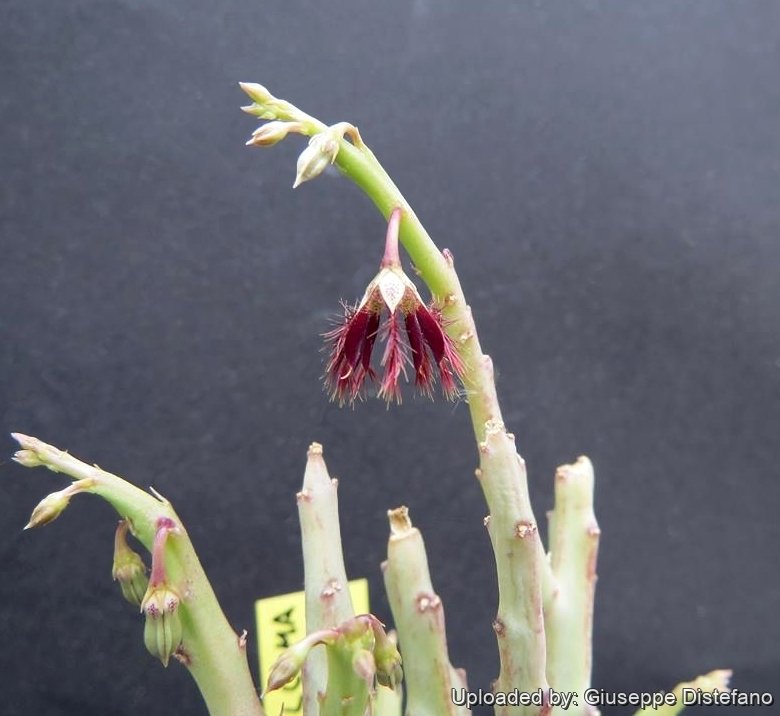
Flowers: About 20 mm across, drooping on short stalks bent downwards. Corolla rotate, lobes narrow, purple with yellow marking, and margins frilly with hairs.
Blooming season (in habitat): July-August.
Fruits (follicles): Paired, slender, 10-12 cm long, cylindric with one of the pairs often suppressed, round in cross section, green with purple streaks, tapering towards apex.
Seeds: Comose.
Origin and Habitat
Caralluma adscendens var. fimbriata is found in peninsular India (Dekkan Peninsula, from the Konkan southwards), and also Sri Lanka and in the Ava district of Burma.
Habitat and ecology: Arid rocky places.
Cultivation and Propagation
Caralluma adscendens var. fimbriata is a relatively quick-growing species and not as difficult to cultivate as was originally thought. It can stand drought for quite a period, which is the only time when it loose its leaves. Keep dry in Winter. Water a little more than other succulents in Summer.
Traditional uses: This species has been in use for centuries in India. It is commonly used as a vegetable in semiarid regions of India. It is eaten raw or cooked with spices, or preserved in chutneys and pickles, and is often found as a roadside shrub or boundary marker. It is also classified as famine food. In arid and semiarid regions, when no food is available, this is consumed as a substitute for food. Indians are known to chew chunks of Caralluma adscendens var. fimbriata) to suppress hunger when on a day’s hunt. The cactus is used by the South Indians to suppress appetite and enhance endurance. They make their living as hunters, wood collectors, plant collectors, foragers, etc. They do not eat or carry cooked food with them while they go into the forests for hunting. To ensure that they are not hungry and that they have enough endurance to last them on their forays into the forest, they chop off the stems of this succulent and chew a handful of them. By doing so, they do not feel hungry and thirsty. They can hunt and stay out for hours together without food or water. The tribesmen also state that their energy levels are maintained without food and water and that they do not feel any fatigue or tiredness. In a day, the consumption of C. adscendens var. fimbriata as a vegetable in the manner used by the tribesmen was about 100 g. C. adscendens var. fimbriata and Hoodia gordonii received a growing interest in the past 20 years because it was claimed that they presented appetite-suppressant and weight loss properties. The bioactive compounds that were isolated from C. adscendens var. fimbriata and H. gordonii were glycosteroids, specifically 14b-hydroxypregnane derivatives.
Medical uses: Anti inflammatory, antipyretic, antinociceptive, antifungal, antidote and anthelmintic, used in treatment of rheumatism, diabetes, leprosy, tumour, fungal diseases, snake, scorpion bite. Young stem ground with onion and tamarind and made into a paste used to cure digestive problems.
Bibliography
Major references and further lectures
-
Debasis Bagchi, Harry G. Preuss “Obesity: Epidemiology, Pathophysiology, and Prevention” Second Edition CRC Press, 06 July 2012
-
Focke Albers, Ulrich Meve “Illustrated Handbook of Succulent Plants: Asclepiadaceae: Asclepiadaceae” Volume 4 Springer, 2002
-
Hermann Jacobsen “A Handbook of Succulent Plants: Descriptions, Synonyms, and Cultural Details for Succulents Other Than Cactaceae” Volume 1 Blandford Press, 1960
-
George Watt “A Dictionary of the Economic Products of India” Volume 2 Cambridge University Press, 23 january 2014
-
T. M. Ramakrishna, S. N. Ramaswamy, Govindappa D. Arekal “The Asclepiadaceae and Periplocaceae of Karnataka” Prasaranga, University of Mysore, 1995
-
Umberto Quattrocchi “CRC World Dictionary of Medicinal and Poisonous Plants: Common Names, Scientific Names, Eponyms, Synonyms, and Etymology” CRC Press, 03 May 2012
-
R. P. Sharma, Business Manager, Indian Forester. “The Indian Forester” Volume 125 1999
-
“Plants of the Coast of Coromandel” 1: 28-29, t. 30. 1795
-
“Memoirs of the Wernerian Natural History Society” 1: 25. 1810
-
“Synopsis plantarum succulentarum” 47. 1812
-
“Taxon” 30: 696. 1981
-
“Journal of Pharmacy Research” 2(7): 1228-1229. 2009
-
“Studies in Natural Products Chemistry” Volume 40 Newnes, 25 June 2013
-
“Bradleya: Yearbook of the British Cactus and Succulent Society” Volune 10: 95 The Society, 1992
-
“Journal of Non-timber Forest Products”, Volumi 7-9 Bishen Singh Mahendra Pal Singh, 2000
-
Wikipedia contributors. “Caralluma adscendens.” Wikipedia, The Free Encyclopedia. Wikipedia, The Free Encyclopedia, 28 Jun. 2015. Web. 16 Jul. 2015.
-
Flowers of India contributors “Caralluma adscendens var. fimbriata” http://www.flowersofindia.net - Identification credit: Prashant Awale Web. 16 Jul. 2015.
From llifle page Caralluma subulata
Description
Caralluma subulata has a superficial resemblance to Caralluma edulis but the slender erect branched stems are always bright green, are not rhizomatous and the flowering apex is not deciduous; the nodding hair-fringed flowers are a deep purple-red with apical tufts of hairs.
Taxonomic notes: Caralluma subulata from the Arabian Peninsula, and its African counterpart, Caralluma dalzielii, show a very great similarity with Caralluma adscendens var. fimbriata from India. Bruyns (1992), has already been put these three taxa into synonymy broadening Caralluma adscendens var. fimbriata geographical distribution. This could be taken to indicate that the differences such as round and acute angles varieties merit formal recognition at least as subspecies.
Caralluma subulata (Arabian populations) differs from Caralluna adscendens by:
Stems: 3 - 15 cm long, slender, erect, branched, always bright green, not rhizomatous and the flowering apex is not deciduous. The stipular rudiments reduced to lateral small bunches of trans-lucent thick minute hairs.
Flowers: Short-stalked, deep purple-red, nodding, hair-fringed. Corolla inside whitish, horizontally striped with wine-red (Yemen) or dark purple (Saudi Arabia). Corolla-tube inside finely hairy, hairs whitish, crinkled. Corolla-lobes inserted at an acute angle on the corolla (more openly spreading in Caralluma adscendens var. fimbriata) lanceolate, acuminate, narrowed towards the base, wine-red or dark purple in the middle, partly to strongly hairy, margin densely covered with long soft purple hairs. Hairs dark pink, 5 5 mm, thick, spreading, corolla tips green, glabrous; appendages of the corolla-lobes sometimes with a small tip between them. Outer corona lobes 3-toothed, the central tooth lanceolate.
Origin and Habitat
Arabian Peninsula, North and South Yemen. Caralluma subulata is quite widespread in the western and southern coastal plains, lower foothills of the Tihama plain and and highlands from near sea level to 1500 m altitude. It occurs among Salvadora shrubs along the road between Al Lith and Adam with a single population (now extinct) near Wadi Kharar at the northern base of the Taif escarpment. Another small population, also extinct, occurred near Farasan village. It is most abundant from near the base of the Al Abna descent, (where a yellow coloured form was observed but not photographed as my camera was in the car some distance away) between Baljurshi and Namrah and at intervals along the road to Muhayl. Scattered populations also occur near Al Hagu the road to Rayth, and between Sabiya and Jabal Fayfa. Although the stems are not. grazed the plants usually shelter under acacias and in recent years many populations have succumbed to trampling and have either decreased in size or become extinct., and probably extends to Hadramout.
Habitat and ecology: Caralluma subulata grows in mainly on gravelly sand under acacias.
Cultivation and Propagation
Caralluma subulata is a relatively quick-growing species and not as difficult to cultivate as was originally thought. It can stand drought for quite a period, which is the only time when it loose its leaves. Keep dry in Winter. Water a little more than other succulents in Summer.
Bibliography
Major references and further lectures
-
Plowes, D. (1995). “A reclassification of Caralluma R. Br. (Stepelieae: Asclepiadaceae)”. Haselotnia 3: 49–70.
-
Plowes, D. (2011). “When is a Caralluma not a Caralluma?” Asklepias 107: 3–22.
-
Gilbert, M.G. (1990). “A review of Caralluma R. Br. and its segregates”. Bradleya 8: 1–32.
-
S. Karuppusamy “Notes on Caralluma adscendens (Roxb.) Haw. var. attenuata (Wight) Grav. & Mayur. (Apocynaceae: Asclepiadoideae)” Journal of Threatened Taxa | www.threatenedtaxa.org | 26 August 2014 | 6(9): 6282–6286
-
Umberto Quattrocchi “CRC World Dictionary of Medicinal and Poisonous Plants: Common Names, Scientific Names, Eponyms, Synonyms, and Etymology” (5 Volume Set) CRC Press, 19 April 2016
-
Schmelzer, G.H. & Gurib-Fakim, A. “Medicinal plants 2” PROTA, 2013
-
Focke Albers, Ulrich Meve “Illustrated Handbook of Succulent Plants: Asclepiadaceae” Springer Science & Business Media, 06 December 2012
-
Alain Campbell White, Boyd L. Sloane “The Stapelieae”, Volume 1 Typography and printing by S. E. Haselton at Abbey San Encino Press, 1937
-
“Arab Gulf Journal of Scientific Research: Agricultural and biological sciences”, Volume 6
Arab Bureau of Education for the Gulf States, 1988
-
British Cactus & Succulent Journal, Cactus & Succulent Society, 2001
-
Candollea, Conservatoire botanique., 1998
Source: Caralluma subulata, LLIFLE - Encyclopedia of living forms, CC-BY-SA, retrieved 2026-10-25.
Gallery