Publication: Fl. Trop. Afr. [Oliver et al.] 4(1.3): 485. 1903 [Mar 1903]
Description
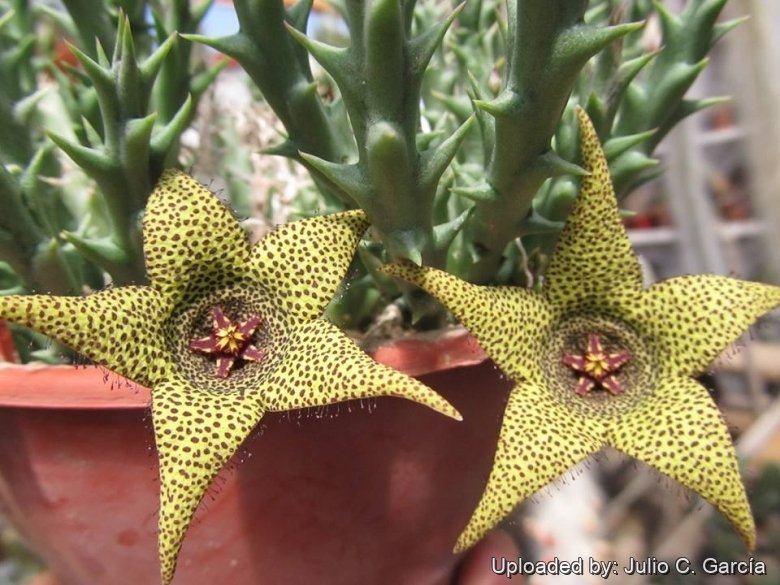
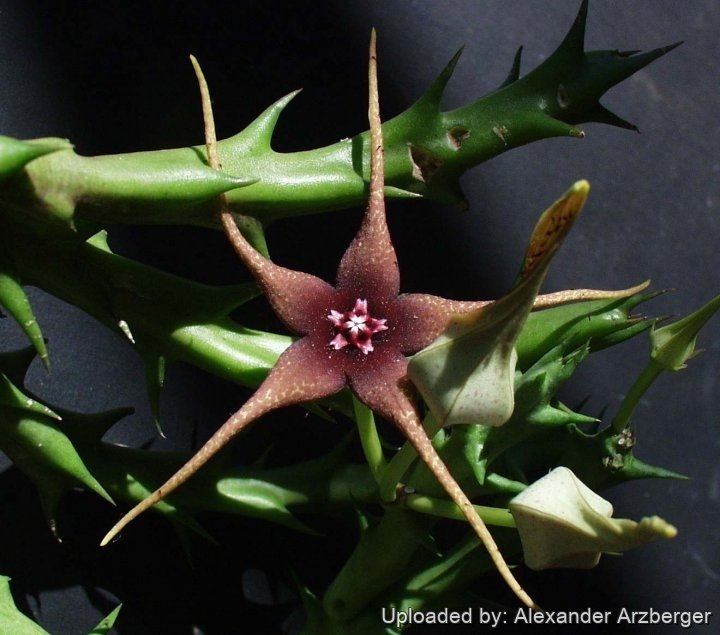
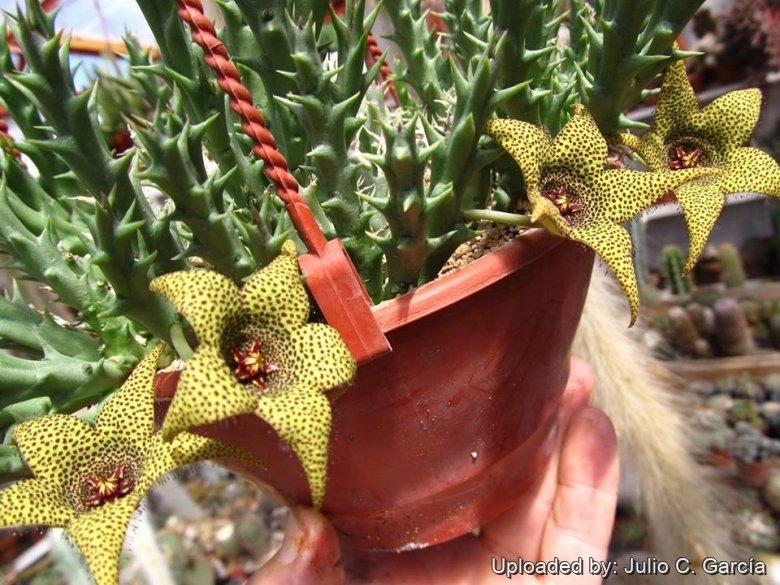
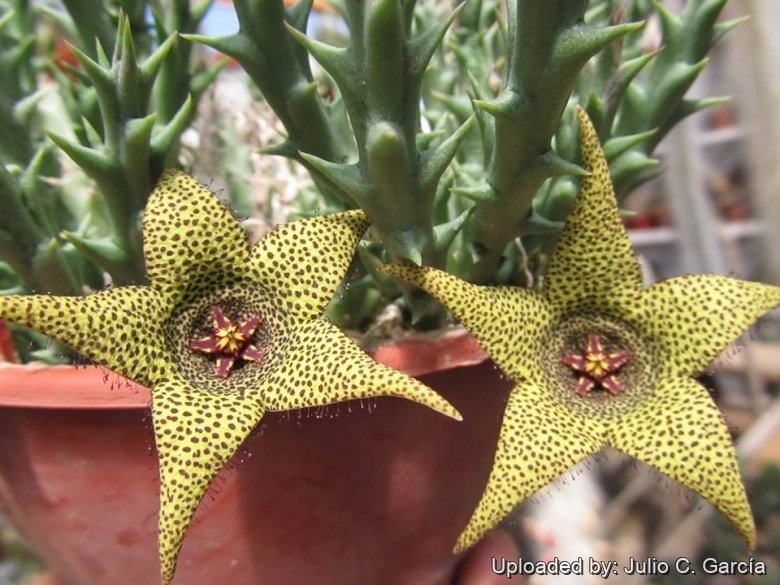
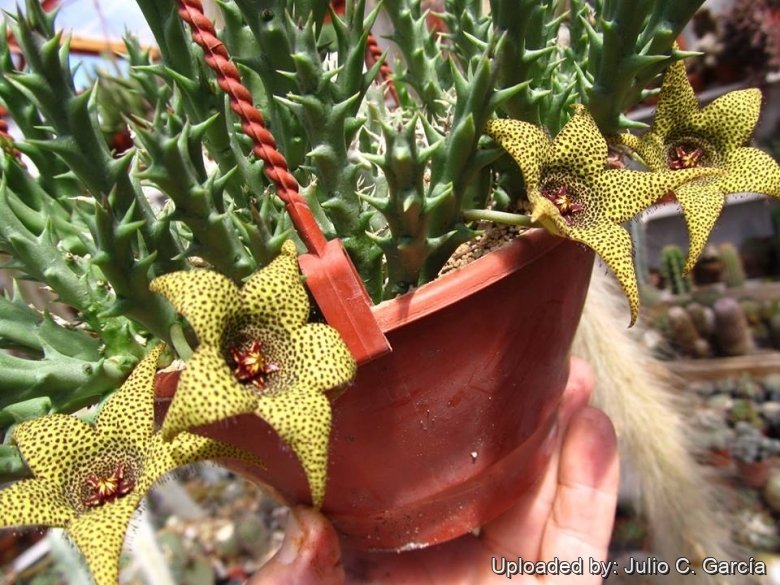
Caralluma caudata (now transferred to Orbea caudata by Bruyns or to Orbeopsis caudata by L.C.Leach) has five-pointed fleshy starry flowers produced in late Summer or Autumn. The blooms are delicate and beautiful but exude an intense smell of rotting meat. This perfume attracts blow flies which are the natural pollinators.
Habit: It is a low clumping perennial succulent species that spread over the ground forming lax cushions. Plant to 9 cm tall and up to 20 cm in diameter.
Stems: 8-10 cm long 7-10 mm across, excluding teeth. Teeth long-tapering, spine-like, more or less spaced, horizontally spreading or up-curved 9-10 mm long and 5-8 mm broad at the base. Epidermis brownish-green or dark olive-green or grey-green more or less mottled with brownish or purple.
Flowers: Usually solitary or few together in pseudo-umbels near base of stem, rarely more than 2 open at once. Flowering stalks, erect, 5-20 mm long 2-3 mm large. Flowers buds up to 3,8 cm long 5-angled terminating in a slight spiral. Bracts 2,5 mm stiff. Corolla 4-9 cm in diameter, very deep-cleft, basin-shaped at the base, lobes up to 22 mm long, outside whitish stippled with red, inside not wrinkled variably downy or papillose, yellowish to dark-yellow with reddish or violet spots (rarely completely dark purple). Lobes lanceolate-acuminate to caudate, 22-40 cm long, 6-9 mm wide, horizontally spreading, border ciliate below, recurred above. Hairs purple to violet vibratile. Corona yellowish-red 4-7 mm in diameter, often entirely within the central purple depression. Outer corona-lobes 1,5 mm long, inner corona-lobes simple, lying over anthers, without extended horn. Pollinia 0,5 mm long 0,35 mm wide, bean- or D-shaped
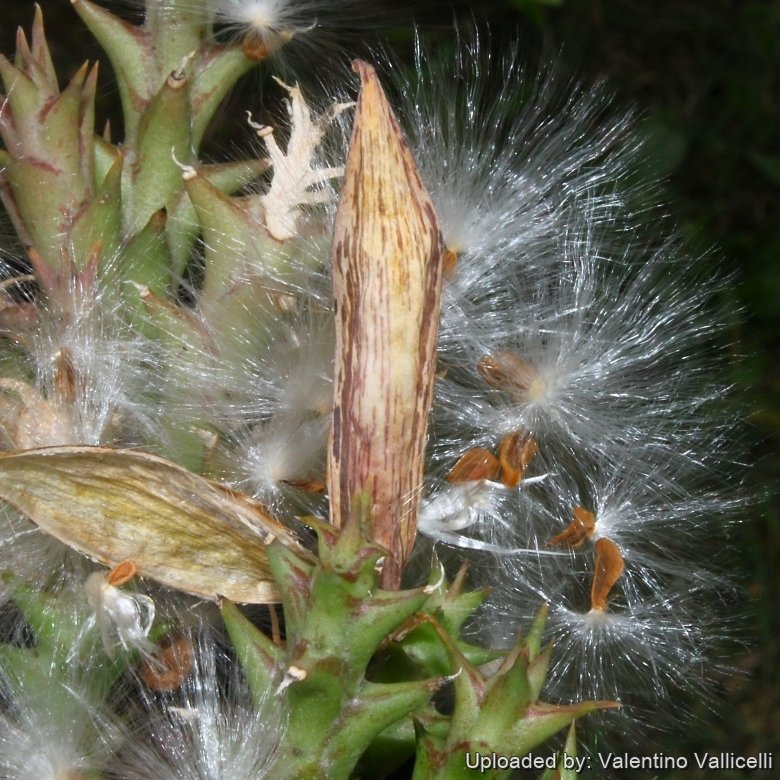
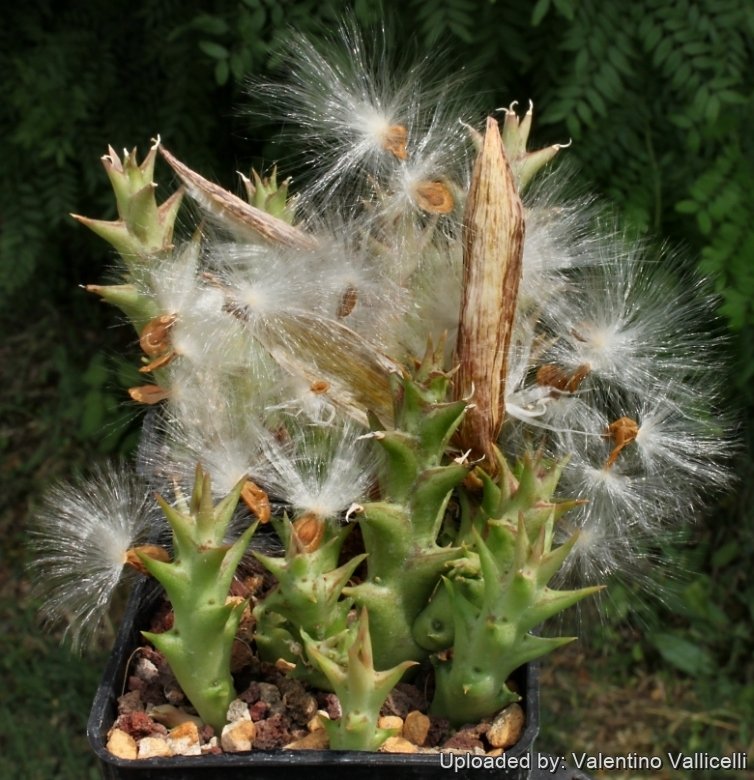
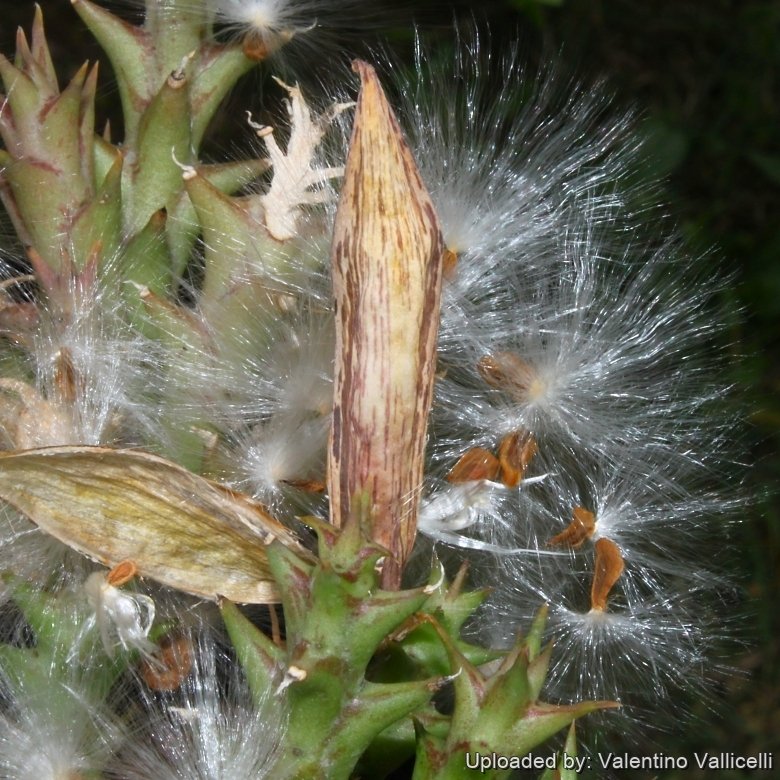
Blooming season: This species produces few flowers simultaneously in late summer to autumn. Following successful pollination of flowers pairs of seed horns are produced, packed with seeds attached to silky parachutes.
Origin and Habitat
Malawi, Tanzania, Zambia, Malawi, Mozambique, Zimbabwe, South East Angola, North East Namibia and Botswana.
Type locality: (Nyasaland Namasi)
Habitat: It grows in dry, rocky places dominated by different shrub communities. It grows almost always in half-shaded position under the protection bushes and small trees. This species is from widely separated localities, hence the several varieties.
Cultivation and Propagation
Caralluma caudata is a xerophytic plant adapted to dry soils, but despite its provenance it is without doubt an easy species to grow and not difficult as commonly supposed only bearing in mind that this species benefits from slightly warmer winter than others.
Growth rate: It is a relatively rapidly growing and easily flowering species that will make large clumps given the best conditions. Most plants will offset readily, and clumps can be produced in a few years.
Soils: It likes very porous mineral cactus mix soil, pH 7,5 to 8,5 (mildly alkaline), but can become too elongated if compost is too rich.
Repotting: This plant needs plenty of space for its roots, repotting should be done every other year or when the it has outgrown its pot. Use pot with good drainage.
Watering: It needs regular watering, especially during the hottest summer days; provide also some light watering if the green house temperatures in winter are elevated. Either excessive or very scarce watering can induce rot.
Fertilization: Feed with a high potassium fertilizer in summer.
Frost Tolerance: For safe cultivation it is best to avoid freezing temperatures (minimum 5° C). In the rest period no high atmospheric humidity!!
Sun Exposure: Best for half-shade but grow well in full sun and full shade too. Tends to bronze in strong light, which encourages flowering, but is likely to suffer from sun scorch or stunted growth if over exposed to direct sunlight during the hottest part of the day in summer.
Diseases: This species is relatively resistant to cryptogamic diseases than others and is quite resistant to the “Balck spot” disease of Asclepiads. Rot it is only a minor problem with Caralluma caudata if the plants are watered and “aired” correctly. If they are not, fungicides won’t help all that much.
Uses: It is an excellent plant for container growing. Cascading, clustering, great for a hanging display. Stems may possibly become purple and limp in winter, but revitalize in early spring. It always looks good and stays small. It look fine in a cold greenhouse and frame or outdoor in a rockery.
Propagation: Seeds and cuttings. Cuttings will root only in hot weather. Cuttings must be kept very dry to root. Seeds germinate readily if they are sown when fresh.
Bibliography
Major references and further lectures
-
White & Sloane. “The Stapdleae” edn 2. Abbey San Encino Press, 1937
-
James Cullen, Sabina G. Knees, H. Suzanne Cubey “The European Garden Flora Flowering Plants: A Manual for the Identification of Plants Cultivated in Europe, Both Out-of-Doors and Under Glass” Cambridge University Press, 11/Aug/2011
-
Carl August Lückhoff “The stapelieae of Southern Africa” A. A. Balkema, 1952
-
Doreen Court “Succulent Flora of Southern Africa” A.A. Balkema, 2000
-
Hermann Jacobsen “A handbook of succulent plants: descriptions, synonyms, and cultural details for succulents other than Cactaceae, Volume 1” Blandford Press, 1960
-
P. V. Bruyns “Monograph of Orbea and Ballyanthus: (Apocynaceae- Asclepiadoideae- Ceropegieae”) American Society of Plant Taxonomists, 2002
-
Alison Heath, Roger Heath “Field guide to the plants of northern Botswana, including the Okavango Delta: useful in countries and geographical areas adjacent to northern Botswana in the Zambesi Basin” Royal Botanic Gardens, Kew, 15/Jun/2010
-
Bruyns, P.V. “Monograph of Orbea and Ballyanthus (Apocynaceae-Asclepiadoideae-Ceropegieae)” Systematic Botany Monographs 63 Pages 102 - 106. 2002
-
Bruyns, P.V. “Stapeliads of Southern Africa and Madagascar” Volume I Umdaus Press, Hatfield, South Africa Pages 257 - 259. 2005
-
Golding, J.S. (ed.) “Southern African Plant Red Data Lists.” Southern African Botanical Diversity Network Report No. 14. SABONET. Pretoria. Page 162. 2002
-
Leach, L.C. “A contribution towards a new classification of Stapelieae (Asclepiadaceae) with a preliminary review of Orbea Haw. and descriptions of three new genera” Excelsa Taxonomic Series No. 1 Aloe, Cactus and Succulent Society of Zimbabwe Page 68. as Orbeopsis caudata subsp. rhodesiaca 1978
-
Mapaura, A & Timberlake, J. (eds) “A checklist of Zimbabwean vascular plants” Southern African Botanical Diversity Network Report No. 33 Sabonet, Pretoria and Harare Page 21. 2004
From llifle page Caralluma praegracilis
Origin and Habitat
Zululand; S. Rhodesia?
Source: Caralluma praegracilis, LLIFLE - Encyclopedia of living forms, CC-BY-SA, retrieved 2026-10-25.