Publication: J. S. African Bot. 29: 105 1963.
Description
Caralluma hexagona is an upright or ascending, strongly branching, succulent. It forms dense mats or clumps to 20 cm tall, with subterranean runners. It is a well-worth growing because of its tiny but interesting flowers with marginal purple hairs (not always present) that wave in the slightest breeze. It is an extremely variable species, which can possibly be split up into several taxa that have proved rather difficult to identify. Plants from Saudi Arabia does not fit well into the concepts of the species described from North Yemen and further south. Similarly, collections from Oman, and further west in the Yemen Arab Republic (North Yemen), differ sufficiently that doubt as to their identity exists.
Stems: Grey-green or green, 3 - 5 (-8) cm long, 1.5 - 2 cm thick, bluntly 4-ribbed.
Ribs: Flattened, undulate-dentate. Tubercles oblong, slightly spreading, apically with hard scar-tissue.
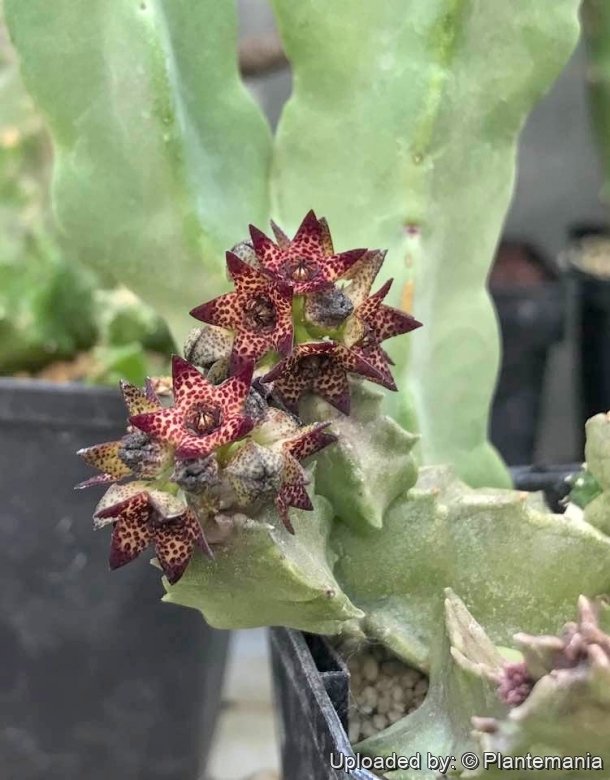
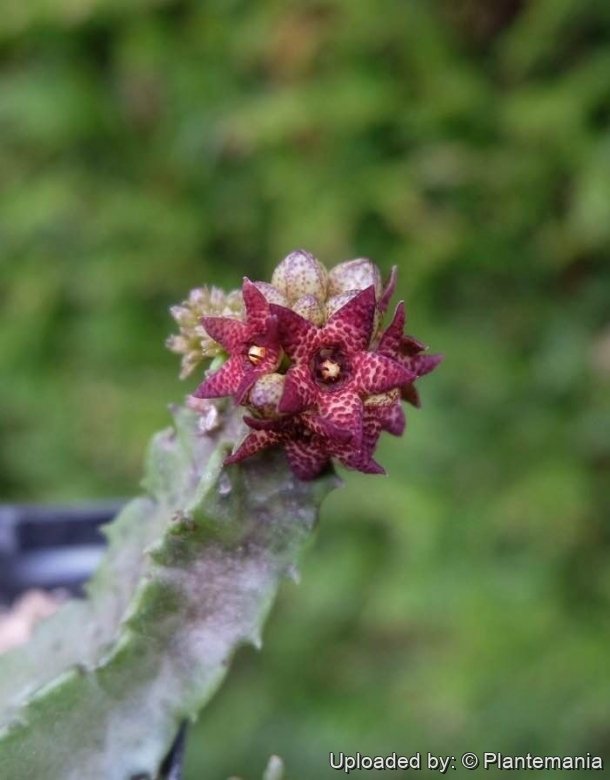
Inflorescences: 5- to 15- (to 20-) flowered. Peduncle short, long-tapering. Bracts short, linear. Pedicels green, 4-10 mm long, 1.5-3 mm wide.
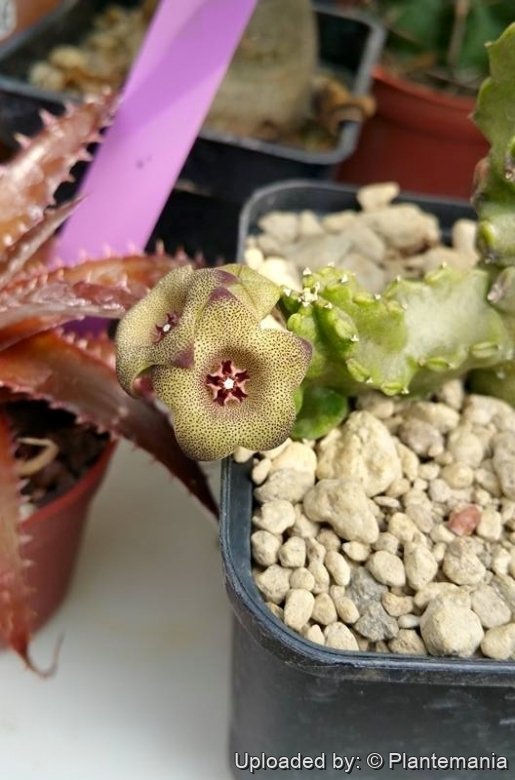
Flowers: Sepals finely dotted with red, 1-3 long, about 1 mm wide, deltoid or linear, acute. Corolla outside greenish-white, densely dotted with red, dots small, convex, inside greenish or cream-coloured, densely dotted with purplish-red, 2.2 cm in diameter, flat or campanulate. Corolla-tube, 4 x 6 mm long, enclosing or just basally encircling the corona. Corolla-lobes triangular, 8 mm long, margins slightly revolute, inside tuberculate, lobes apically hairy, hairs dark purple, seed 2 mm, simple, compressed, vibratile. Corona 6 mm in diameter. Outer corona-lobes pale red, brownish-purple to bluish, margins pink, basally white, lobes 1.5 mm long, deeply bifid, curved outwards, appendages of neighbouring lobes sometimes overlapping, with distinct furrows median and in the area where fused with the inner-corona. Inner-corona pale red or pink, apically yellowish, lobes about 1 mm long, lanceolate to ribbon-like, apically tapering, obtuse, strongly broadened in the area where fused with the outert corona; Anthers 0.5 mm broad, apically ovoid.
Related species: Caralluma hexagona is a close relative of the tall growing Caralluma awdeliana, Caralluma petraea and Caralluma arabica and does not seem to be especially closely allied to Caralluma europaea, which has a similar mat-forming habit.
Origin and Habitat
Saudi Arabia, Yemen, Oman. In Oman this species reaches its easternmost occurrence.
Habitat and ecology. Caralluma hexagona grows in rocky habitats, usually in shallow soil in crevices between large stones or in rock outcrops. The greyish colour of the inner surface of the outer corona-lobes presumably caused by the secretion of nectar which rapidly dries out to form a thin, crystalline deposit, coupled with the evil, dung-like odour of the flowers and the clavate cilia that are often present on the margins towards the end of the corolla-lobes, acts as an attractant for the pollinators of these flowers.
Cultivation and Propagation
Caralluma hexagona is quite difficult to grow and propagate.
Propagation: It is rooted from side-branches.
Bibliography
Major references and further lectures
-
Focke Albers, Ulrich Meve “Illustrated Handbook of Succulent Plants: Asclepiadaceae: Asclepiadaceae” Volume 4 Springer, 2002
-
Plowes, D. (1995). “A reclassification of Caralluma R. Br. (Stepelieae: Asclepiadaceae)”. Haselotnia 3: 49–70.
-
Cactus and Succulent Journal, Volume 47 1975
-
P. V. Bruyns “Miscellaneous notes on Stapelieae (Asclepiadaceae)- A note on Caralluma hexagona Lavranos” Bradleya, volume 5, pp. 87-89, 1987
-
Caralluma hexagona Lavranos in J. S. Afr. Bot. 29:105 (1963)
-
Caralluma shadhbana Lavranos in Flow. PI. Afr. 44(3): t.1743 (1977)
-
Caralluma foulcheri-delboscii var. greenbergiana Lavranos in Cact. Succ. J. (US) 39(1): 6 (1967)
From llifle page Sulcolluma mirbatensis
Description
Sulcolluma mirbatensis is one of the controversial species of the genus Sulcolluma, a small group of stapeliads generally included within (as a synonym of) Caralluma hexagona, suggesting that there is not really a fundamental difference between them, and hard to name accurately without knowing where they come from, and there remains a considerable confusion surrounding the true identity of this these plants. All sulcollumas exhibit a distinctive groove in the upper surface of their stem tubercles. The most distinctive feature of S. mirbatensis, is its erect inner corona lobes, unlike the other members of the genus whose have their inner corona lobes incumbent on the anthers. Another important character is that S. mirbatensis possesses the smallest flowers of the group [1].
Origin and Habitat
Oman (Arabian Peninsula, Asia-Temperate). This new species occurrence here in the far eastern edge of the Dhofar region marks this as the eastern most representative of the genus Sulcolluma.
Type locality: Dhofar Province, on granites at the base of Jebel Samhan, Dhofar’s highest mountain, appox. 8 km N/NE of the small coastal village of Mirbat, alt. 20 m. Latitude: 17° N. Longitude: 54° E
Habitat and ecology: Sulcolluma mirbatensis is found growing on granite, instead of the much more prominent limestone, which forms the greater part of the Dhofar [1].
Bibliography
Major references and further lectures
- Tom A. McCoy “Sulcolluma mirbatensis McCoy, an unique new species from the Sultanate of Oman” Cactus and Succulent Journal 84(2):100-103. 2012 doi: http://dx.doi.org/10.2985/0007-9367-84.2.100
Source: Sulcolluma mirbatensis, LLIFLE - Encyclopedia of living forms, CC-BY-SA, retrieved 2026-10-26.