Publication: Gesamtbeschr. Kakt. i. 88. 1897
From llifle page Cereus forbesii
Description
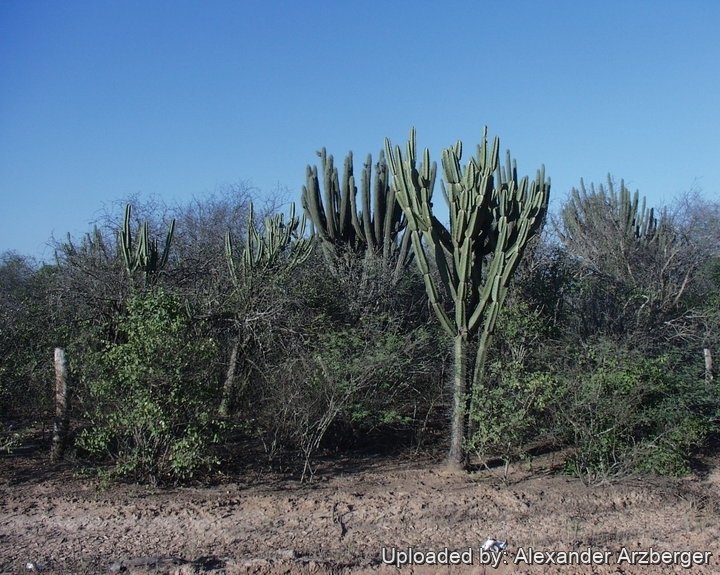
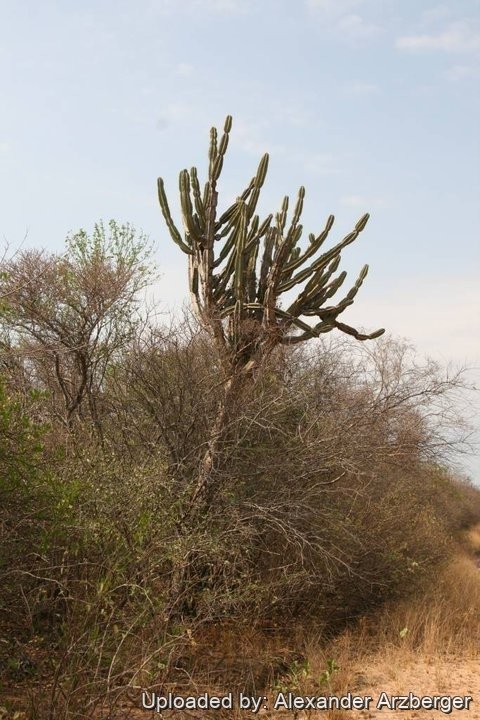
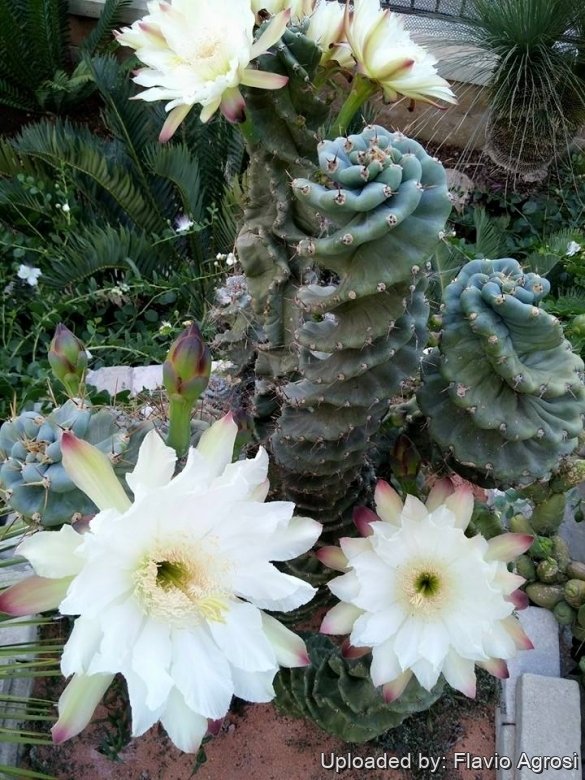
Cereus forbesii is a much branched shrubby or treelike cactus, with blue-green cylindrical-columnar stems armed with long spines. It attains a height of about 2 meters (sometimes 7 m or more tall with a distinct trunk up to 40 cm in diameter). In spring to early summer it produces large funnel-form flowers which are white or pinkish white inside and reddish in the exterior.
Stem: Branches cylindrical, succulent, 5 to 10 cm thick (to 13 cm at the base), glaucous blue when young becoming grey-green or light olive-green later.
Ribs: 4 to 7(-8), compressed, obtuse, 20-25 mm hight, attenuating in the older part of the plant.
Areoles: Small (4-5 mm Ø), round, with scarce short yellowish-white wool becoming grey or blackish with age.
Radial: about 2-5, short, stout, 1 to 2 cm long, yellowish to pale brown with darker bases becoming grey with age, mostly from the lower part of the areole.
Central spine: Single or rarely 2 or 3, stouter and darker than the radials up to about 4,5 cm long. Older spine on the trunk often very long stout up to 10-11(-16) cm long.
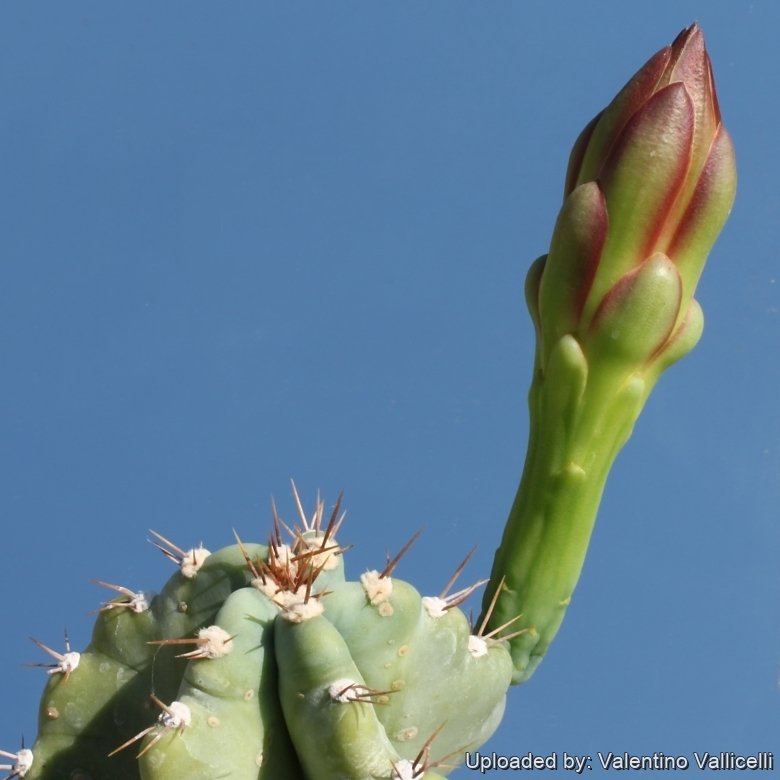
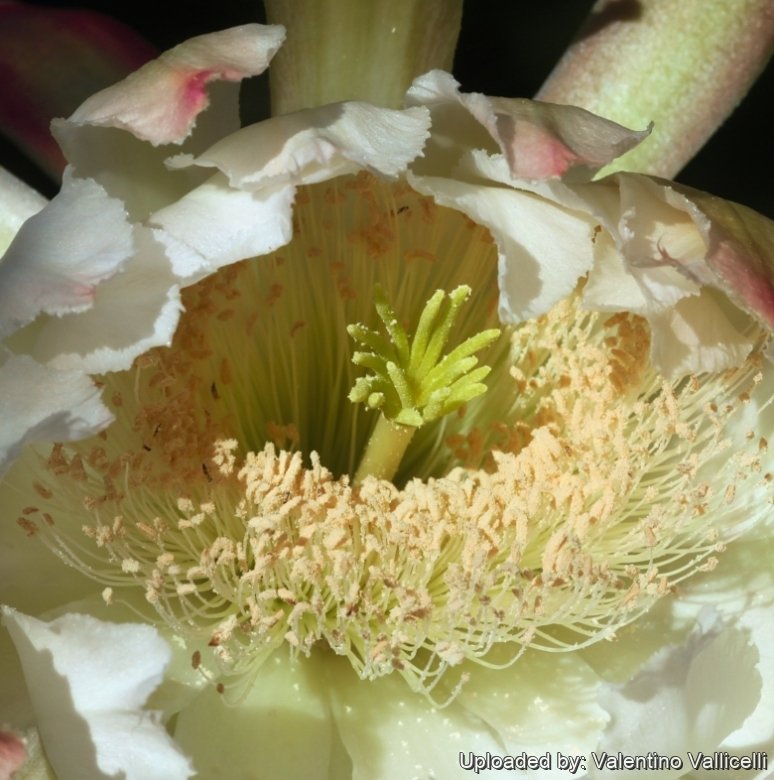
Flowers: Solitary, lateral, white to reddish,16.5-20 cm long, 8-12 cm in diameter. Pericarpel 25 mm long 18 mm wide. Tube pale green, naked with few small scales. Outer perianth-segments reddish with a green midrib, obtuse, the inner white or pinkish. Filaments white, greenish near the base. Anthers dark-brown or blackish. Pollen grains cream. Style green below, white up to 10 cm long. Stigma-lobes about 16-20 yellowish-white, up to 2 cm long.
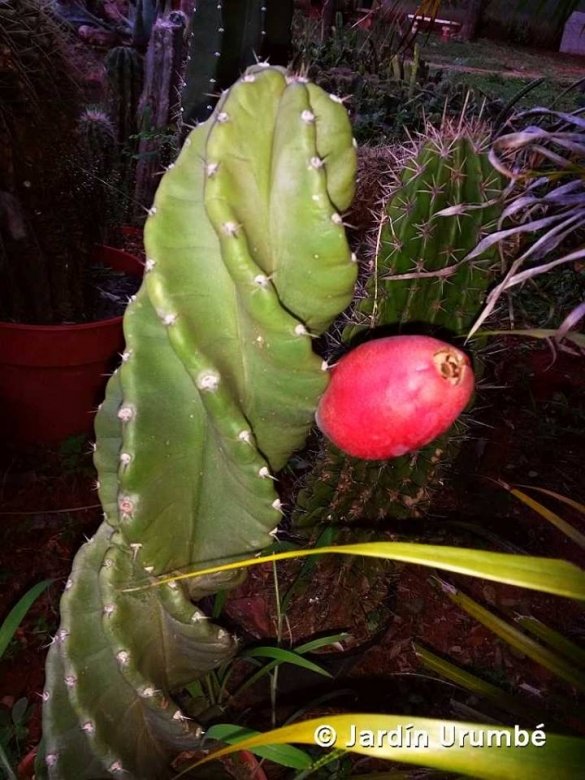
Fruits: Big, fleshy, red with a bluish pruine coat at maturity, pulp abundant lilac with small black seeds.
Systematic: Cereus forbesii Salm-Dyck, Cereus validus Haworth and Cereus pachyrhizus Schumann are among numerous names with a confused history which apparently apply to Argentinian or Paraguayan species close to Cereus uruguayanus. For a long time Cereus forbesii has been considered a synonym of “Cereus uruguayanus” Haw., but the description of C. validus by Haworth is very short and incomplete and there is a lot of confusion about the taxonomy of this plant. Some authors have proposed recently to invalidate the name C. forbesii. Of which there is neither a sufficiently detailed type nor a figure identifiable. Hunt et al. (2006) synonymized C. forbesii Otto with Cereus hankeanus (Web.) K. Sch., the excellent figure of it by Gürke in “blühende Kakteen” would be neotype. C. forbesii is the most commonly used name locally and may be a different species to C. hankeanus. For now the wider concept of the taxon has been assessed. In the “cactusinhabitat booklet - South America 2011/2013” the confusion of names is discussed in an article by Giovanna Anfratti & Alberto Magli. In the article they wrote: “The subsequent studies we conducted in habitat in 2011, between Argentina (Córdoba and Salta) and Bolivia (Tarija) highlighted, in accordance with Kiesling (1999, 2: 428), that the best description for the taxa in question is C. forbesii, and not C. hankeanus. The description of C. hankeanus is wrong, either it has less ribs or less spines than the actual population. Therefore we prefer to reintroduce C. forbesii, and insert C. hankeanus among its synonyms.” … “With regards to C. validus, as is mentioned by Hunt et al. (2006, text: 42) Haworth’s description (1831) comparing it to Cereus tetragonus (Linnaeus) P. Miller (now Acanthocereus tetragonus) with reference to the spines on the hypanthium, leads us to think that he is not referring to Cereus as is currently conceived. Instead Cereus forbesii auctt. not Haworth is to be considered synonym with C. forbesii”…
Origin and Habitat
Cereus forbesii is endemic to Argentina (Catamarca, Chaco, Córdoba, Formosa, norte de San Luis, Jujuy, La Rioja, Salta y Santa Fe), Bolivia (Chuquisaca, Santa Cruz y Tarija), and Paraguay.
Altitude range: 500 to 2000 meters above sea level.
Habitat and ecology. This species grows in a variety of habitats. It occurs in arid plains, in forests, on hills, and on the edges of salt flats in the Chaco region among Prosopis shrubs together with Stetsonia coryne and Opuntia quimilo. Cereus forbesii is widespread, locally abundant and common, and there are no major threats affecting it.
Cultivation and Propagation
They are of easy culture but cold intolerant. Make sure they are not exposed to freezing temperatures ( Hardy to -2°C) or they may die. They need a well drained soil mix. Water regularly in summer but allow to dry fully before watering again. During the winter months they should be rather kept dry. Since they are rapid growers, they need plenty of space for their roots. Repotting should be done every other year, or when the plant has outgrown its pot.
Sun Exposure: Light shade when young, full sun later.
Propagation: From cuttings in spring (let them dry till the ends callous well). Then replant them in fresh cactus soil that is ever so slightly moist, and keep them that way till they root), or by Seeds (Seeds should be sown in a well-drained soil mix. Surface sowing is the best; seeds germinate in 14-28 days at 25° C.
Bibliography
Major references and further lectures
-
Juan Carlos Chebez “Nuestros arboles” Editorial Albatros, 2010
-
N. L. Britton, J. N. Rose: “The Cactaceae. Descriptions and Illustrations of Plants of the Cactus Family.” Volume II, The Carnegie Institution of Washington, Washington 1920
-
Edward Anderson “The Cactus family” Timber Press, Incorporated, 2001
-
Fuentes Claros, A. F. “Contribution to the woody flora of the lowland forests of eastern Santa Cruz; additions to the Guía de árboles de Bolivia”. Revista Soc. Boliv. Bot. 2(1): 46–59.1998.
-
Urs Eggli, Leonard E. Newton: “Etymological Dictionary of Succulent Plant Names” Springer, Berlin/Heidelberg 2010
-
“Desert Plant Life”, Volume 4 - Desert magazine publishing Company, 1932
-
Kiesling, R. “Cactaceae.” In Zuloaga, F. O., & Morrone, O. “Catálogo de las Plantas Vasculares de la República Argentina, II.” Monographs in Systematic Botany from the Missouri Botanical Garden, 74: 423-489.1999.
-
Giovanna Anceschi & Alberto Magli “The reintroduction of Cereus forbesii” Otto in: cactusinhabitat booklet “South America 2011/2013”, Modo infoshop, June 2013
-
Oakley, L. & Pin, A. 2013. Cereus hankeanus. The IUCN Red List of Threatened Species 2013: e.T152176A606083. http://dx.doi.org/10.2305/IUCN.UK.2013-1.RLTS.T152176A606083.en. Downloaded on 13 July 2016.
Source: Cereus forbesii, LLIFLE - Encyclopedia of living forms, CC-BY-SA, retrieved 2026-10-25.
From llifle page Cereus forbesii cv. Spiralis
Description
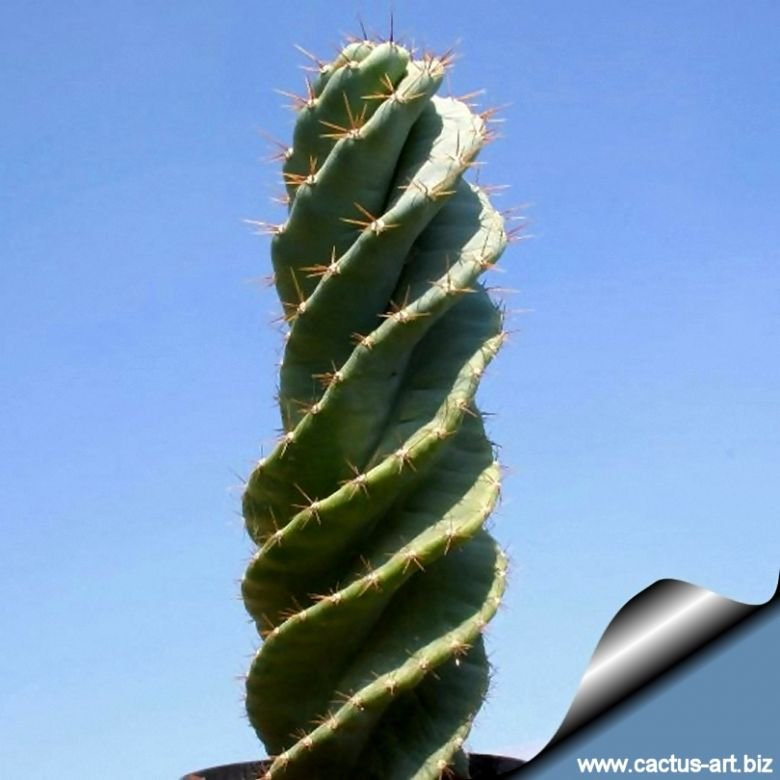
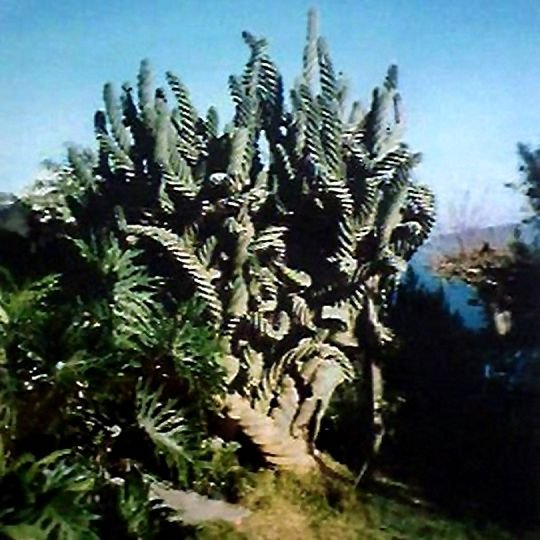
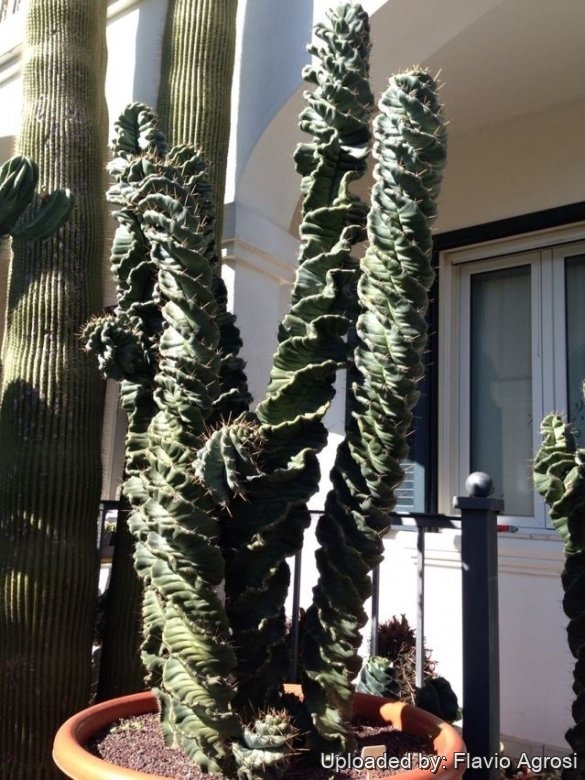
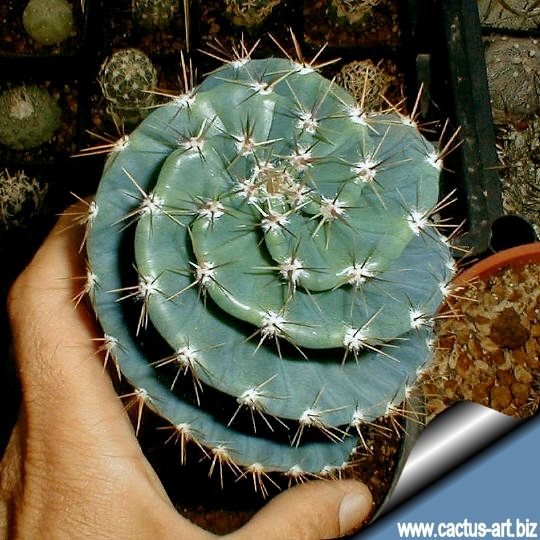
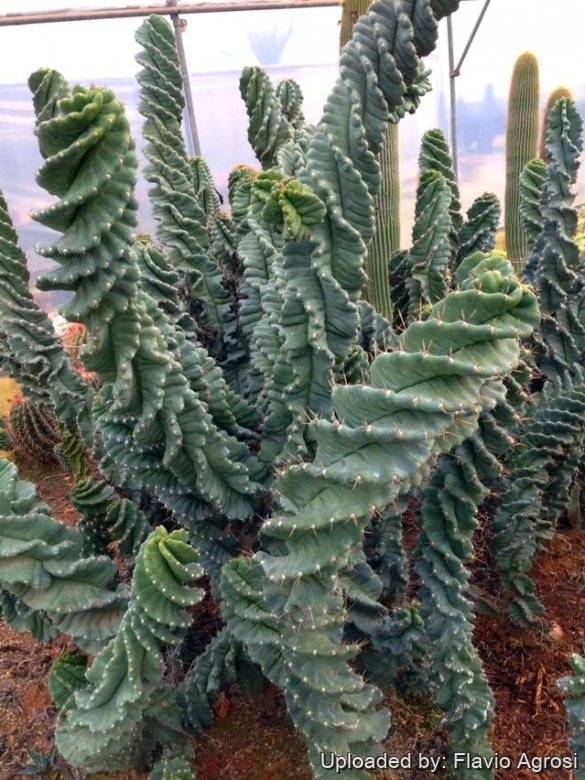
The spiral cereus (Cereus forbesii cv. Spiralis ), is a shrubby or treelike species dubiously thought of as a mutant Cereus forbesii. It is a (usually) trunkless cactus that forms numerous tall, ascending, columnar stems which branch at the base in a candelabra-like arrangement. Stems have a waxy bloom on the surface and reach a height of 2-4 metres (but can grow up to 5 m high or more), and are 10 to 12 cm in diameter. They have five to nine widely-spaced ribs. A few branches from the original plant were imported in Europe around 1980 for a very hight price. The original clone was characterized by strong grey stems covered with a dense pruina coating and with short spines (Also known as “short spined clone”), but nowadays almost all the plant on the trade are seed grown specimens derived from cross pollination with (presumably) Cereus forbesii cv. Spiralis or Cereus stenogonus, they are usually a darker blue-green colour usually with longer spines, and there remains a considerable confusion surrounding the true identity of this plants.
It is a heavy bloomer and large purple fruits are easily produced when flowers are pollinated. It is self-sterile.
Origin and Habitat
Brazil?
Source: Cereus forbesii cv. Spiralis, LLIFLE - Encyclopedia of living forms, CC-BY-SA, retrieved 2026-10-25.
Gallery