Publication: Syn. Pl. Succ. 13 1812
Description
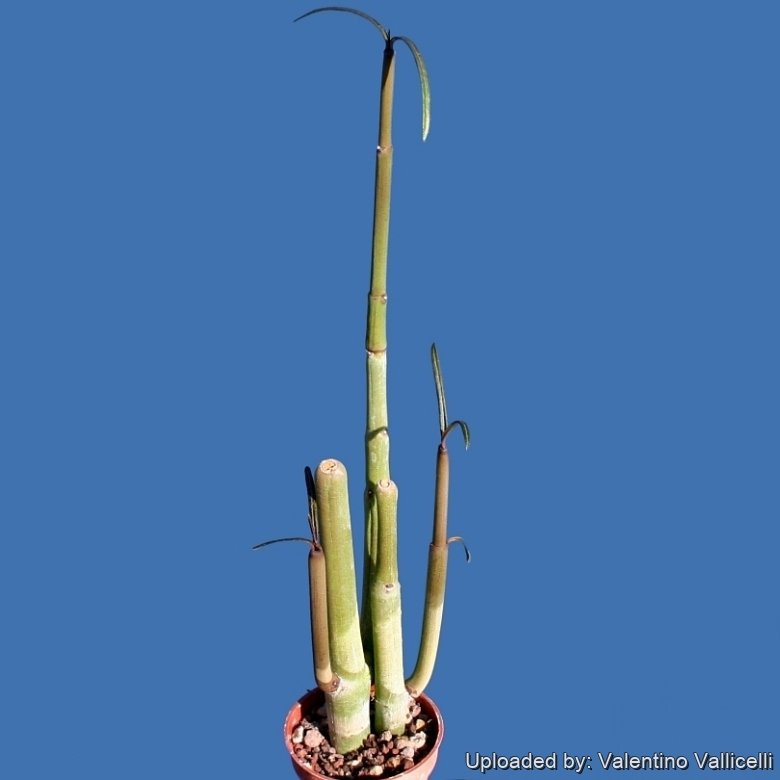
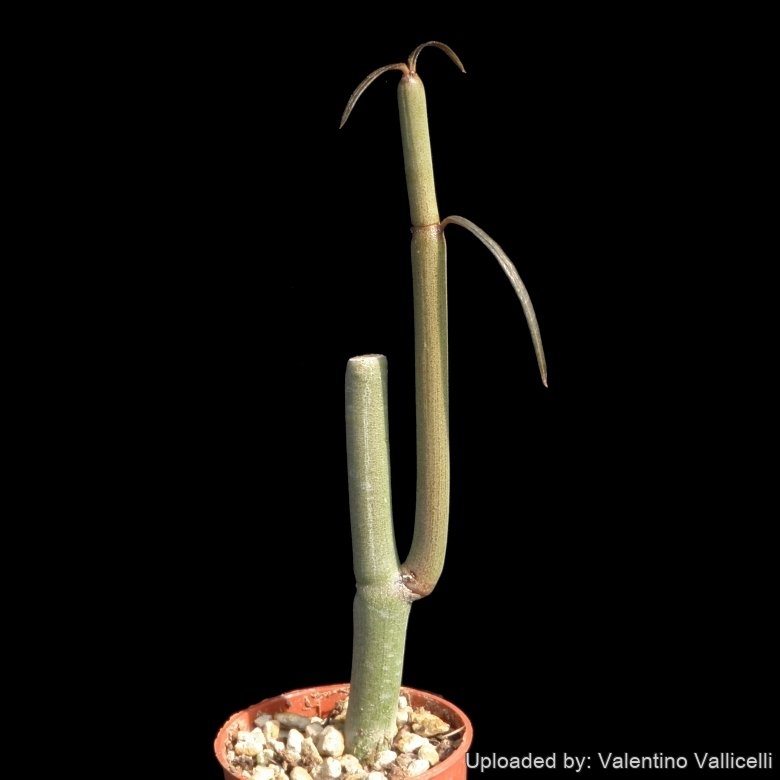
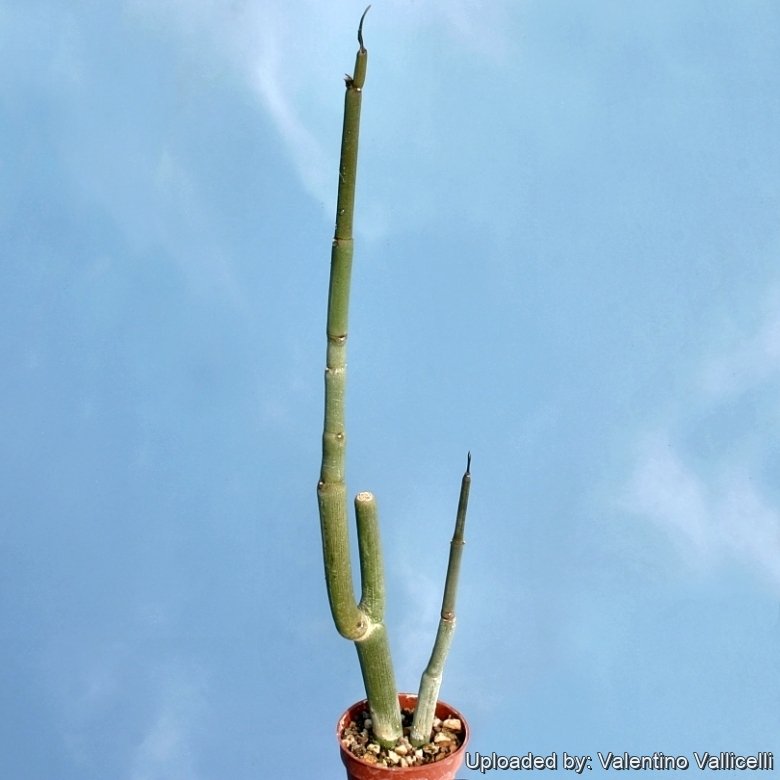
Ceropegia dichotoma is the most succulent shrubby Ceropegia related to Ceropegia fusca and probably to Ceropegia rupicola. It starts as a single, firm, ascending stick, that in time makes a whole colony of basally branched succulent stems, covered with white wax under sunny conditions. Adult specimens look something like grey organ pipes.
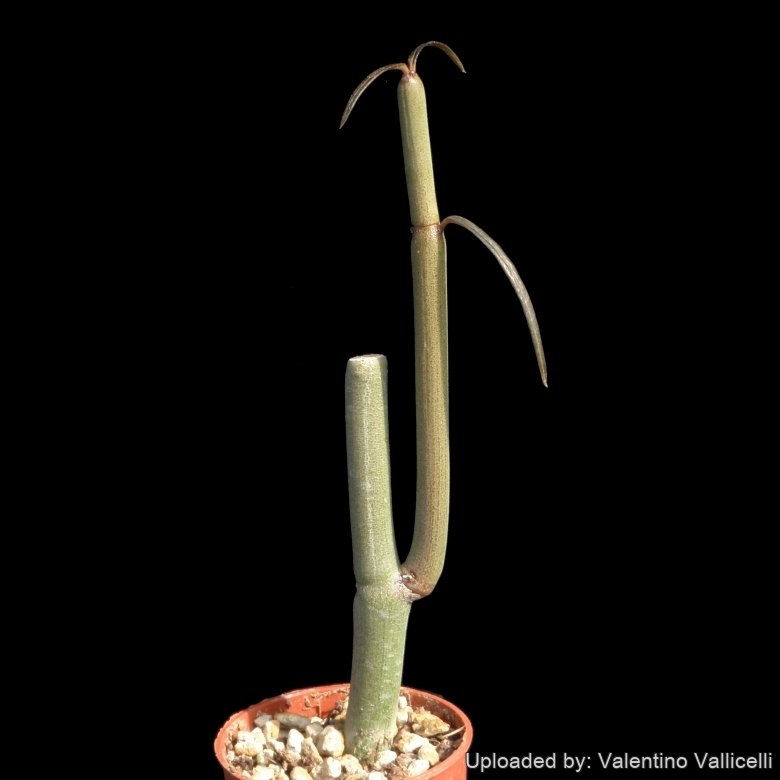
Stems: Highly succulent, smooth with some constrictions which make them look like a row of small long sausages, 30-120 cm tall (but usually no higher than 60 centimetres and practically without leaves for most of the year), mainly erect, partly prostrate or decumbent. Terete 5-20 mm in diameter, green, olive-green or light-brown to whitish-green due to a wax layer.
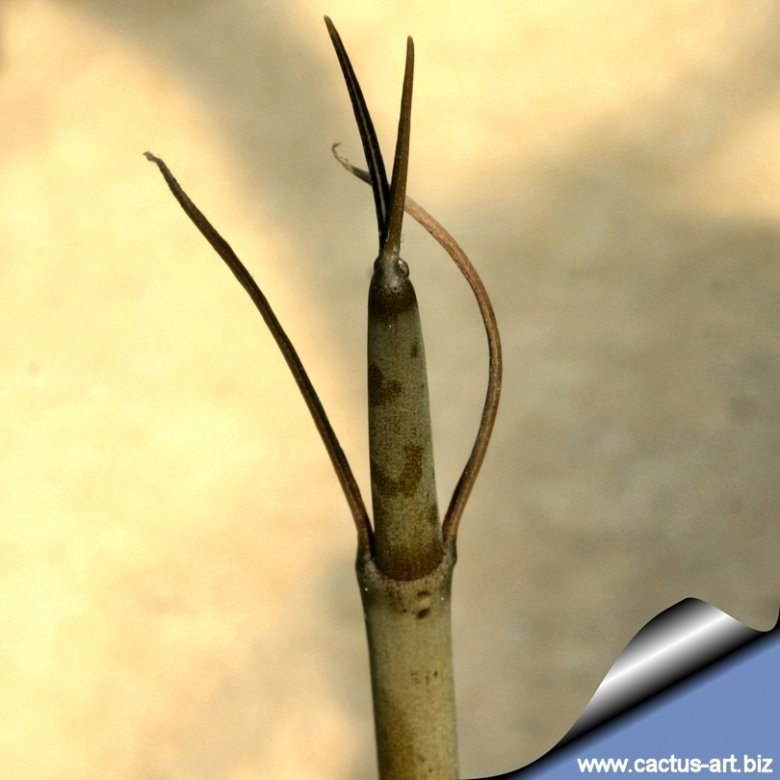
Leaves: Sessile, linear-elliptic, 2-120 mm long, 3-8 mm wide slightly succulent, green, vein paler, mergins revolute. Leaves appear in the winter at each node and on the tip of the stem and are approx 5 cm long arranged in opposite pairs, they are deciduous and wilt quickly if there isn’t enough water.
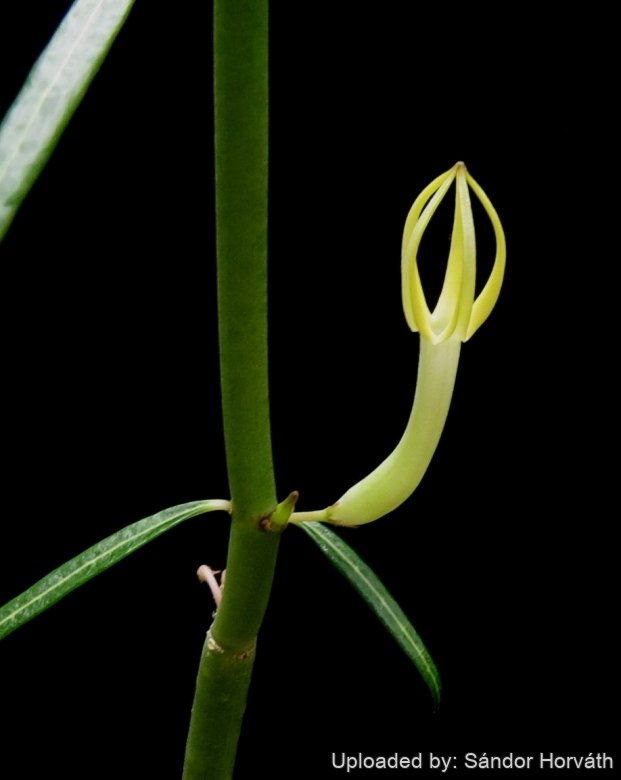
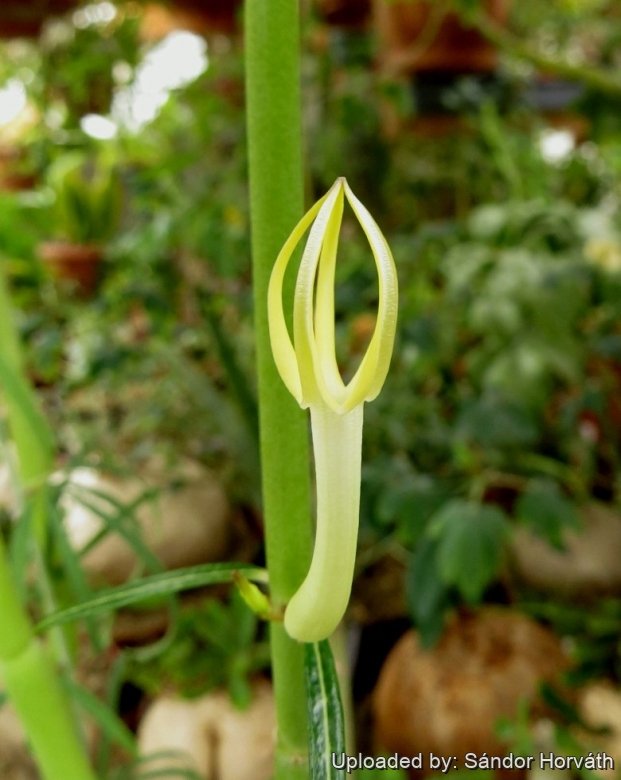
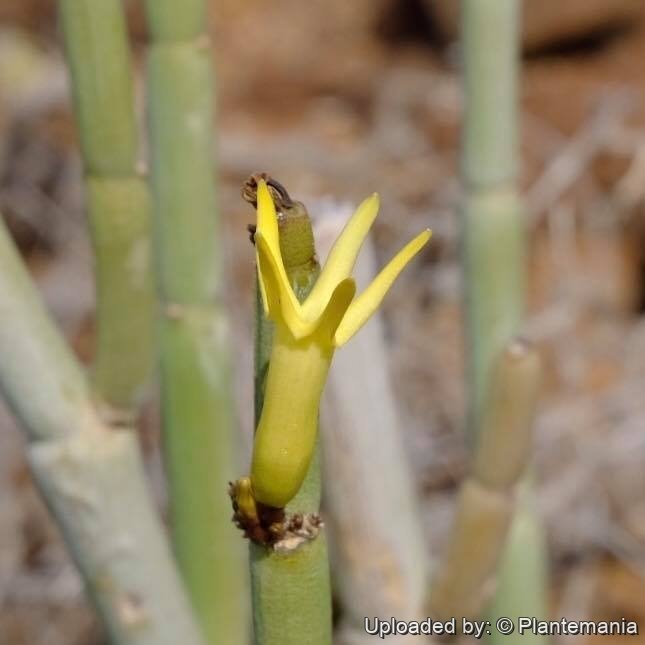
Flowers: The inflorescence is a terminal (sometimes in axillary) and almost sessile pseudo-umbels on upper stem section, bearing 1-15 florets (But usually 2 to 6). The individual flowers are lantern-shaped, yellow. Corolla 3-4 cm long, corolla tube 10-16 mm long, Corolla lobes, 5, yellow, narrowly triangular, fused to form a conical to ovoid cage, they are characteristically rolled outward, so that the windows are open wide. Pedicel 2-6 mm long, Sepals triangular 1-2 mm long acute.
Blooming season: Autumn and winter.
Fruits: The fruit is a pair of large horn-shaped capsules up to 12 cm long.
Origin and Habitat
Ceropegia dichotoma is endemic to the Canary Islands archipelago. Tenerife (in the East: Anaga region, e.g. in the ridge above Faro de Anaga and on the West parts: Teno region, e.g. Barranco de los Cochinos), La Palma, La Gomera, Hierro, Lanzarote)
Habitat: This species occours abundantly in nature in the Tabaibal-Cardonal zone at up to about 600 m altitude where it forms large upright open shrubs. It is found preferably on white or cream-colored older grainy soils or rock crevices with good drainage, in sun exposed spots and prolonged dry climate
Cultivation and Propagation
Full to part sun, moderate water in warm season, drier in winter. It requires hot conditions and how much sun as possible to grow well. Can be grown outdoor in mild climate where it proves to grow well semi-neglected. It is also very resistant and is very rare to see an aphid or a sick part, be only aware of mealy bugs.
Bibliography
Major references and further lectures
-
Hermann Jacobsen “Abromeitiella to Euphorbia” Blandford Press, 1960
-
Hermann Jacobsen “A Handbook of Succulent Plants: Descriptions, Synonyms, and Cultural Details for Succulents Other Than Cactaceae”, Volume 1 Blandford Press, 1960
-
Focke Albers, Ulrich Meve “Illustrated Handbook of Succulent Plants: Asclepiadaceae” Volume 4 Springer, 2002
-
Per Sunding “The Vegetation of Gran Canaria” Univ.-Forlaget, 1972
-
“The Indoor Garden”, Volumes 23-26 Indoor Gardening Society of America, 1986
-
“Botanica: The Illustrated A-Z of Over 10,000 Garden Plants and how to Cultivate Them” Mynah, 1997
-
Werner Rauh “The Wonderful World of Succulents: Cultivation and Description of Selected Succulent Plants Other Than Cacti” Smithsonian Institution Press, 1984
-
James Cullen, Sabina G. Knees, H. Suzanne Cubey “The European Garden Flora Flowering Plants: A Manual for the Identification of Plants Cultivated in Europe, Both Out-of-Doors and Under Glass” Cambridge University Press, 11 August 2011
-
Wikipedia contributors. “Ceropegia dichotoma.” Wikipedia, The Free Encyclopedia. Wikipedia, The Free Encyclopedia, 9 Dec. 2015. Web. 2 Jan. 2016.
-
Herbert F. J. Huber: “Revision of the genus Ceropegia”. In: Memórias da Sociedade Broteriana, Volume 12, 1957, S.1-203, Coimbra
-
Pérez, M. Á. C. “Native Flora of the Canary Islands”. Everest, León.1999.
-
Peter Schönfelder und Ingrid Schönfelder “Die Kosmos Kanarenflora”. 2. Aufl., 319 S., Franckh-Kosmos Verlags-GmbH & Co KG Stuttgart
From llifle page Ceropegia hians
Origin and Habitat
Ins. Canar. (La Palma).
Source: Ceropegia hians, LLIFLE - Encyclopedia of living forms, CC-BY-SA, retrieved 2026-10-25.
Cultivars and forms (1)
Subspecies (1)
Gallery