Publication: Illustr. Handb. Succ. Pl.: Aizoaceae A-E (ed. H.E.K.Hartmann) 124 (2002 publ. 2001) comb. nov.
From llifle page Cheiridopsis cigarettifera
Description
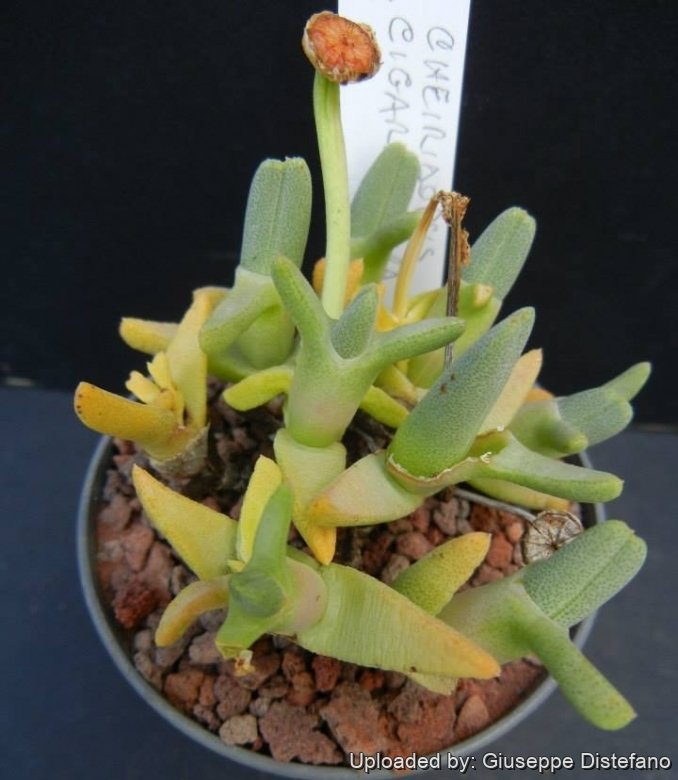
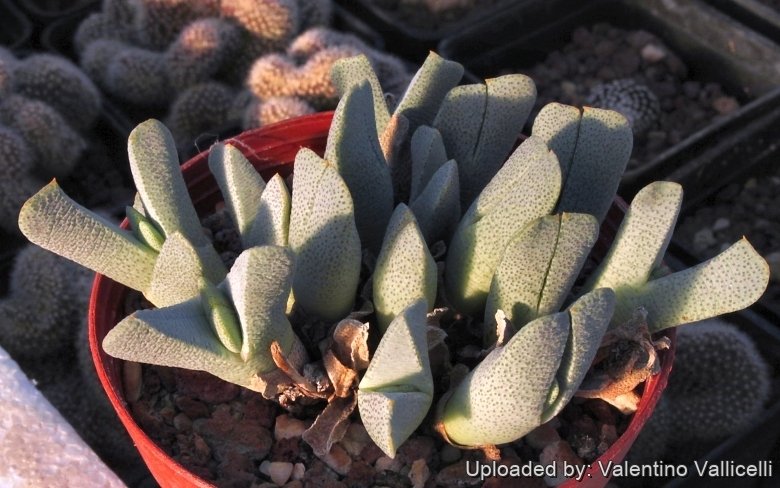
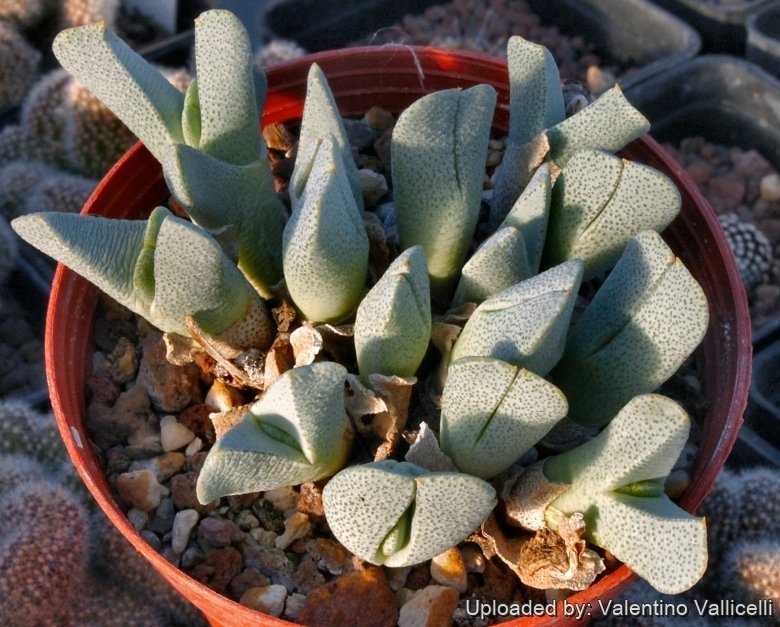
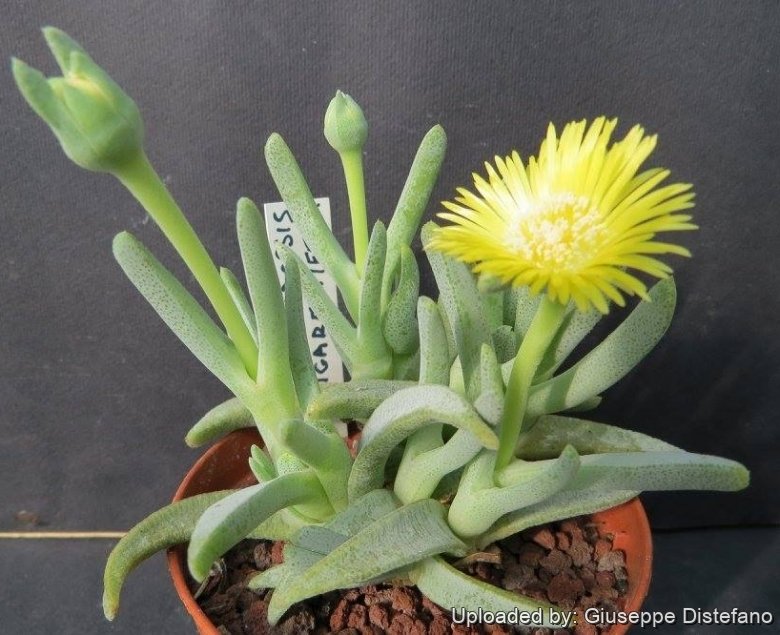
Mat forming stemless succulent 15-30 cm in diameter and 10 cm high.
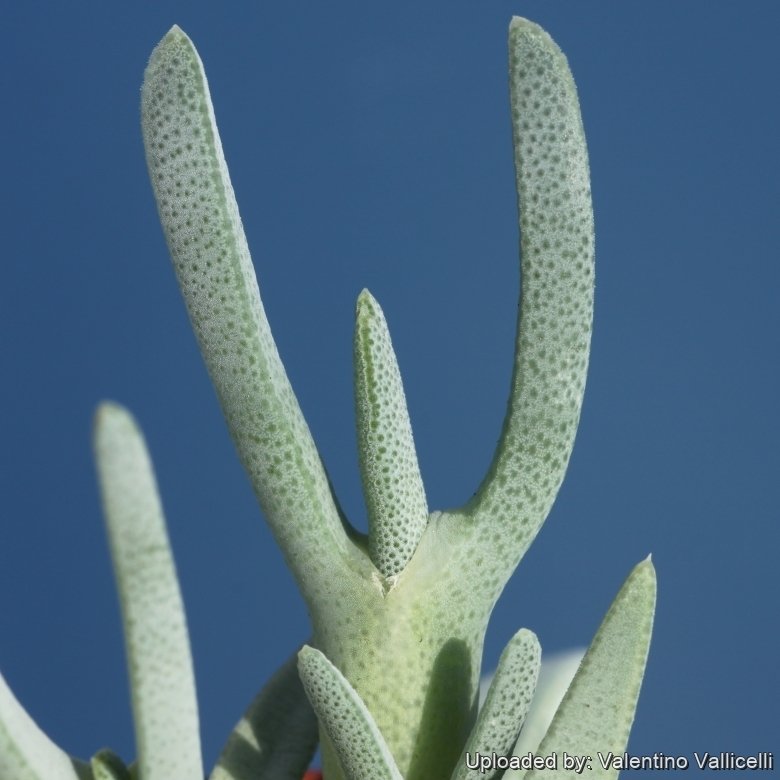
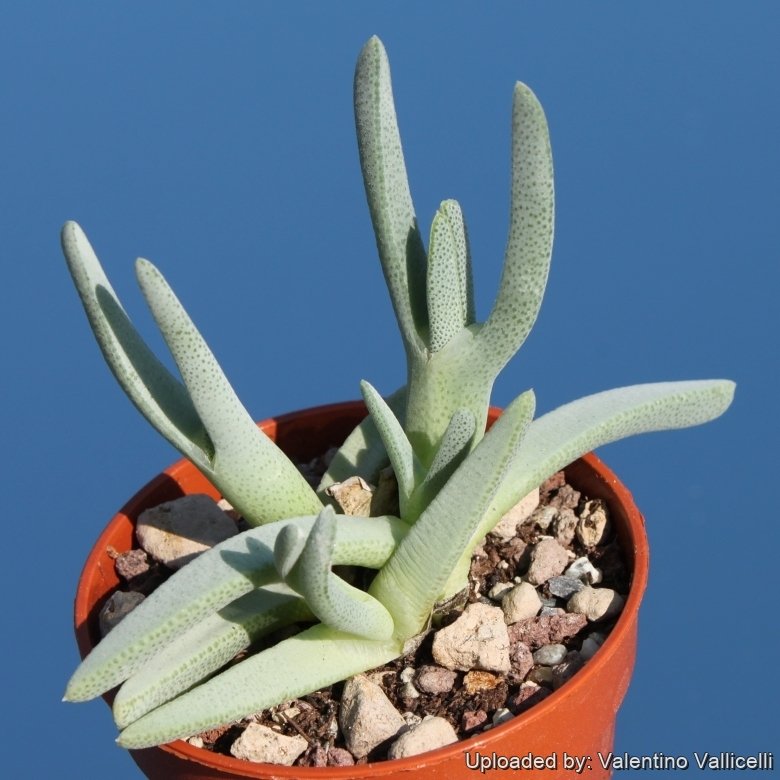
Leaves: Narrow, tapering, keeled, up to 5 cm long whitish-grey in colour. This colouring intensifies in summer, while during the winter rains the plants become greener. This species is called “cigarettifera” ( cigatte-making) because the leaves that are developed after flowering are more slender, close together, fused for about a third of their length and remain erect during the resting period, when the young leaves are hidden in dry sheaths of the old leaves remembering a cluster of cigarettes.
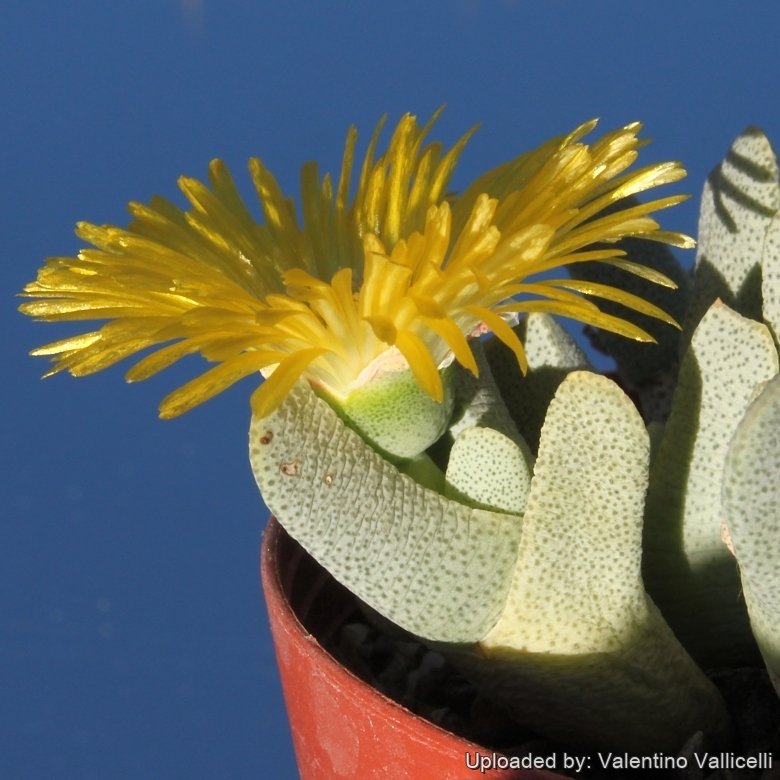
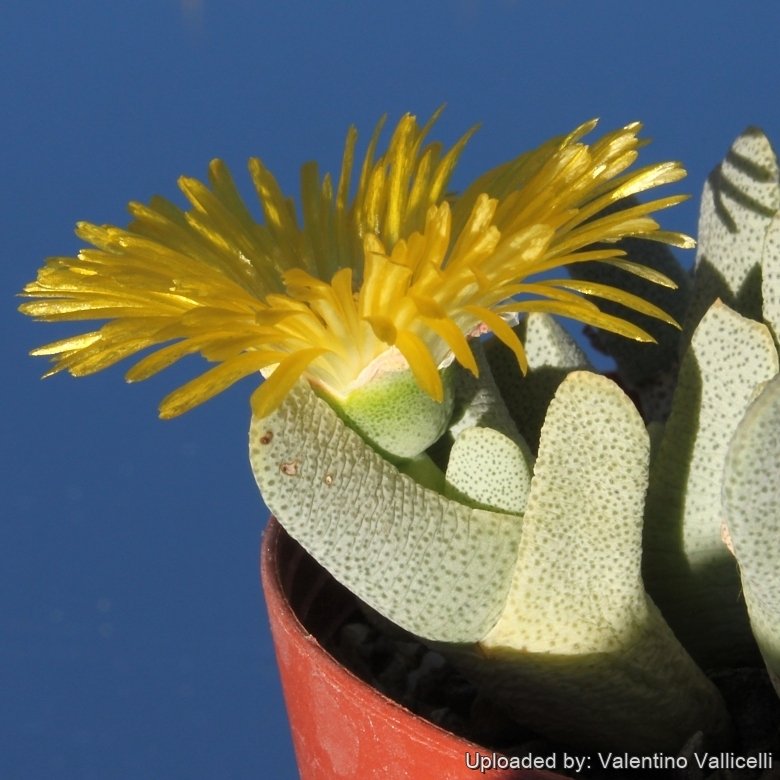
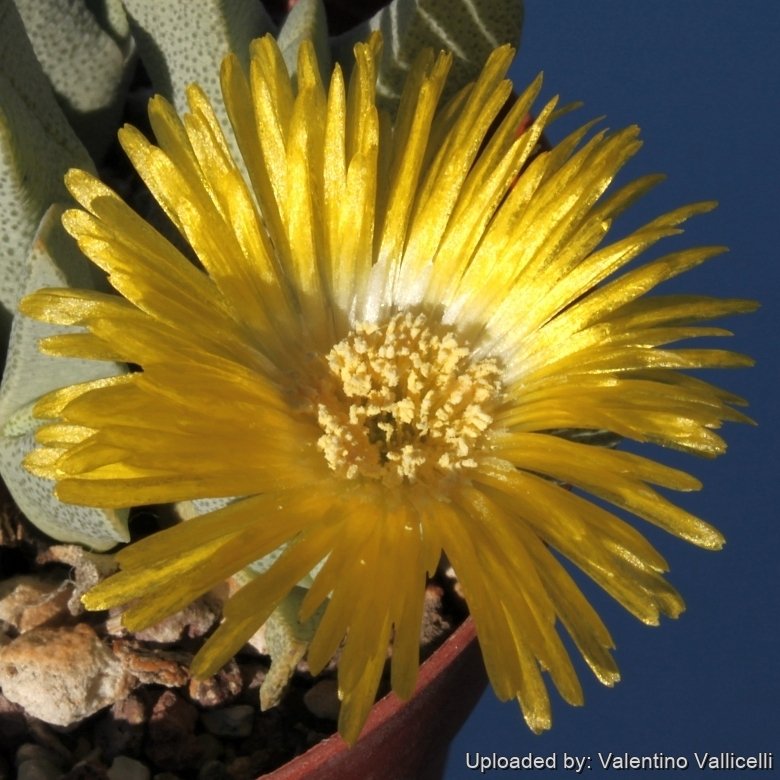
Flowers: Bright yellow up to 4 cm in diameter.
Blooming seson: Spring.
Origin and Habitat
Western Cape, South Africa.
Cultivation and Propagation
Cheiridopsis is a “winter” grower which are most active from late winter until later spring and heading for summer dormancy, but in favourable growing conditions it keeps going over the summer too and doesn’t need particular care. It is relatively easy to grow.
Soil: Requires good drainage as it it is prone to root rot. It can grows outdoor in sunny, dry, rock crevices (protection against winter wet is required) It can also be cultivated in alpine house, in poor, drained soil.
Fertilization: It thrives in poor soils and seems sensitive to an excess of potassium.
Watering: Water minimally in summer, only when the plant starts shrivelling, water more abundantly when they are growing in the autumn and spring. Requires little water otherwise its epidermis breaks (resulting in unsightly scars).
Light: It needs a bright sunny or light shade exposure in winter, but keep cool and shaded in summer.
Hardiness: It prefer a very bright situation and will take a light frost (Hardy to -5°C) if it is in dry soil. USDA zones 9A-11.
Uses: Container, rock garden.
Propagation: Seed in spring or (or rarely) cuttings. It is easily propagated by seed.
Bibliography
Major references and further lectures.
-
Heidrun E. K. Hartmann “Aizoaceae F-Z” Springer, 2002
-
James Cullen, Sabina G. Knees, H. Suzanne Cubey “The European Garden Flora Flowering Plants: A Manual for the Identification of Plants Cultivated in Europe, Both Out-of-Doors and Under Glass - Casuarinaceae to Aristolochiaceae” Cambridge University Press, 11/ago/2011
-
Hermann Jacobsen, Vera Higgins “Succulent Plants: Description, Cultivation and Uses of Succulent Plants, Other Than Cacti” Williams and Norgate, Limited, 1935
Source: Cheiridopsis cigarettifera, LLIFLE - Encyclopedia of living forms, CC-BY-SA, retrieved 2026-10-25.
From llifle page Cheiridopsis quaternifolia
Description
Calibanus hookerii is an interesting looking plant that is related to the agaves, it looks like a trunk-less Nolina, topped by perennial grasslike silver-blue leaves that expand from a woody caudex (Swollen succulent root).
Caudex: The caudiciform base is hemispherical and woody with a fissured or plate-like brownish-grey bark and sits halfway out of the soil. It is very slow growing, generally it is 0,30 to 1 m in diameter but can eventually grow to 5 meters in diameter,
Leaves: Thin, wiry, flexible, grass-like, raspy surfaced that grows upright in the center of the plant and then arch down as they mature. They are somewhat concave and keeled, the margins are rounded. The leaves will get 30 to 90 cm long and are only 2-3 mm wide. They are blue green in colour. They appear on the plant as a crown formed by numerous bundles arising from the top of the caudex. The number of the bundles increase as the plant increase in size.
Flowers: The Calibanus is dioecious (there are male and female plants) or rarely some plants are hermaphrodite.. The clusters of flowers (panicles) are rigid about 10-20 cm long and partially hidden in the foliage. The flowers are pink or purplish and very tiny.
Fruit: Female plants bear globose, ovoid, three angled berries, 8-9 mm long, 6-7 mm in diameter. The fruits are straw-brownish to reddish and indehiscent.
Seeds: Mellon shaped, 3-4 x 3 mm wide.
Origin and Habitat
North central Mexico (Hidalgo, Tamaulipas and San Luis Potosi).
Habitat and ecology: It grows in grit, in a dry mountainous habitat, where it receives quite copious water in the short growing-period. These plants are very drought tolerant, and have developed a caudex (water storage organ) at and below ground level, a common survival strategy in dry climates.
Cultivation and Propagation
Calibanus hookeri is a very tolerant plant that can withstand temperatures of -15 Celsius degrees, but its exact hardiness is unknown. Because of its extreme drought tolerance, it makes a great container plant for light shade to full sun, or is an excellent foliage accent in a dry garden in warm regions. Might look its best in a vase shaped terra cotta pot to allow the leaves to drape downwards. It needs moderate water when actively growing, little water the rest of the time, if established. Outdoor it needs heavy soil with excellent drainage and circulating dry air. It is a tough plant. Having been bred to endure dry air and drought, it will survive for years in less than ideal conditions. It can stay in the same pot for a number of years since it prefers to be a bit rootbound.
Propagation: Seeds; it cannot be reproduced by cuttings of the caudex (or leaves).
Source: Cheiridopsis quaternifolia, LLIFLE - Encyclopedia of living forms, CC-BY-SA, retrieved 2026-10-25.
From llifle page Mesembryanthemum vescum
Cultivation and Propagation
The Cheiridopsis vesca is a “winter” grower which is most active from late winter until later spring and heading for summer dormancy, but in favourable growing conditions it keeps going over the summer too and doesn’t need particular care. It is relatively easy to grow.
Soil: Requires good drainage as it it is prone to root rot. It can grows outdoor in sunny, dry, rock crevices (protection against winter wet is required) It can also be cultivated in alpine house, in poor, drained soil.
Fertilization: It thrives in poor soils and seems sensitive to an excess of potassium.
Watering: Water minimally in summer, only when the plant starts shrivelling, water more abundantly when they are growing in the autumn and spring. Requires little water otherwise its epidermis breaks (resulting in unsightly scars).
Light: It needs a bright sunny or light shade exposure in winter, but keep cool and shaded in summer.
Hardiness: It prefer a very bright situation and will take a light frost (Hardy to -5°C) if it is in dry soil. USDA zones 9A – 11.
Uses: Container, rock garden.
Propagation: Seed in spring or (or rarely) cuttings. It is easily propagated by seed.
Source: Mesembryanthemum vescum, LLIFLE - Encyclopedia of living forms, CC-BY-SA, retrieved 2026-10-26.
Gallery