Publication: Gen. Conophytum 232: 1993
Description
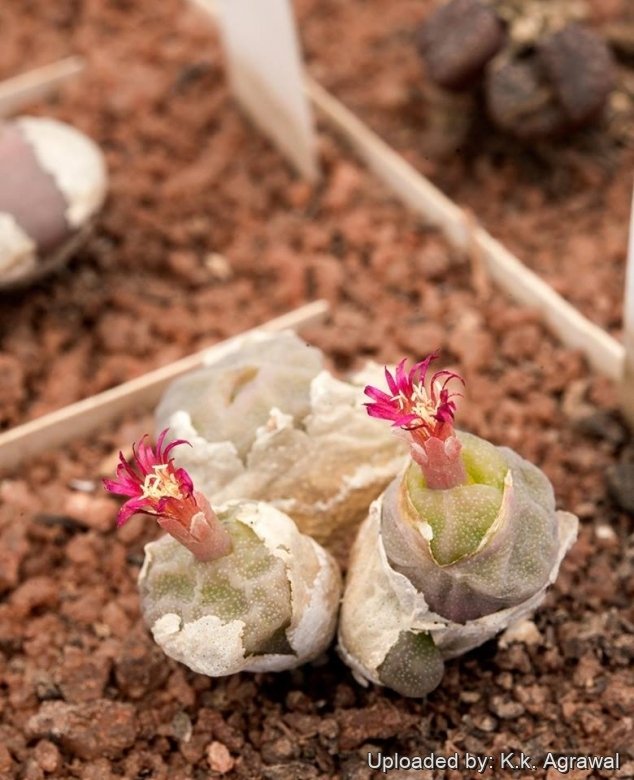
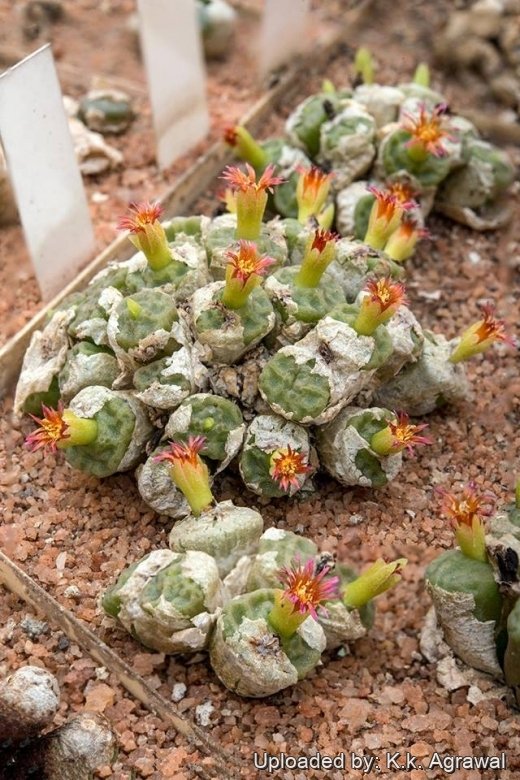
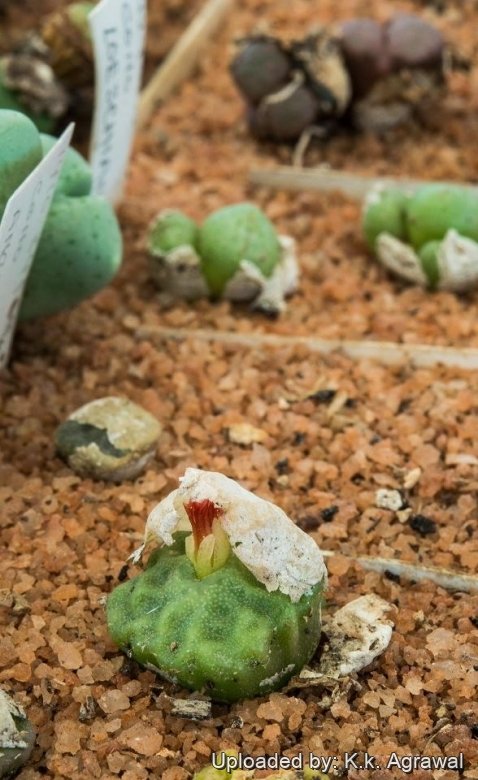
Plant caespitose, forming a dense cluster or fan in age. It is very famous for its rough square body.
Stem: Almost stemless, internodes invisible.
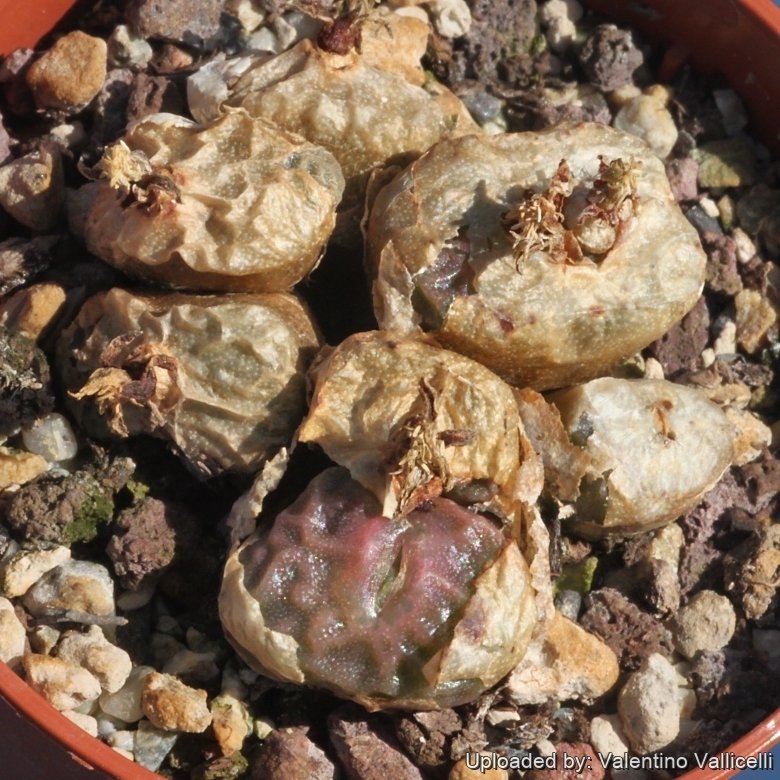
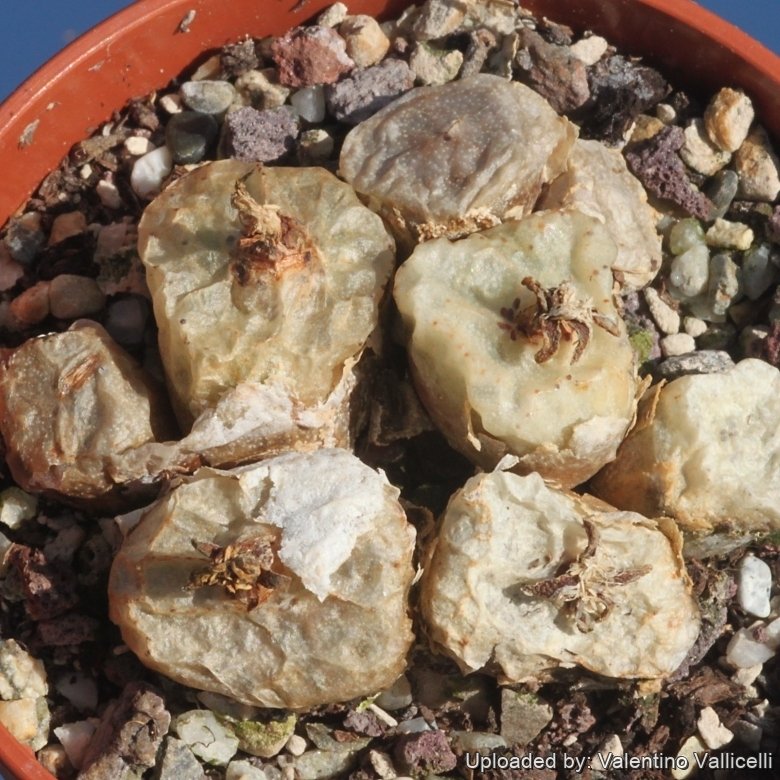
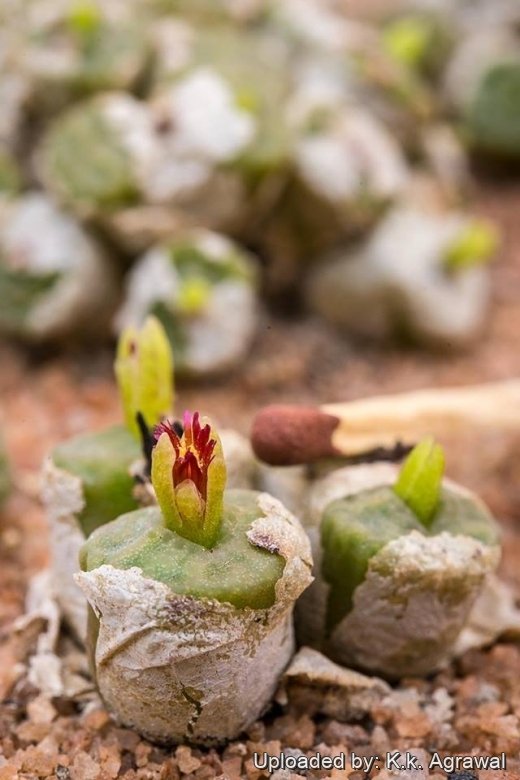
Body (paired leaves): About 18 mm wide and 10 mm tall, cylindric basally, cubiform apically, square in tranverse section, with truncate or concave apex, dark brown, tan-purplish, fleshy pink or greenish, very rugose, unspotted, glabrous. Sheath whitish, squamous, flaking, persistent, with brown tannin spots.
Flowers: Nocturnal, few petaled, narrow and often untidy reddish to brown.
Fruit: The fruit is a 4-8-locular capsule.
Origin and Habitat
Northern Cape (Richtersveld, Namaqualand), South Africa.
Type locality: Oemsberg, Richtersveld
Altitude range: 700-980 metres above sea level.
Habitat: Grows on quartz or granite rocks deeply seated in crevices.
Cultivation and Propagation
They are relatively dificult to grow. These plants grow on winter rain and head for summer dormancy. The growing season in northern hemisphere is from September to March. They require little water; otherwise its epidermis breaks (resulting in unsightly scars). Water minimally in summer, (only occasional misting). Water regularly in winter after the previous year’s leaves have dried up. Require good drainage. They enjoy full sun or half-shade and in summer they need to be kept in a cool area. Hardy to -2°C. Ensure a very good ventilation. Avoid to repot frequently. They may stay in the same pot for many years. Plants grown in larger containers have frequently relatively poor flowers. They might improve when the plants are given their own, small individual pots.
Propagation: They can be reproduced both by cuttings and seeds. Take the cutting from a grown-up mother plant. Each cutting must contain one or more heads along with a fraction of root.
Bibliography
Major references and further lectures
-
Heidrun E.K. Hartmann “Illustrated Handbook of Succulent Plants: Aizoaceae A-E” Springer, 2002
-
Gideon Smith u.a. “Mesembs of the World: Illustrated Guide to a Remarkable Succulent Group.” Briza Publications, 1998
-
Japan Succulent Society “Colour Encyclopedia of Succulents” Japan Succulent Society January 1, 1981
-
Hermann Jacobsen “A handbook of succulent plants: descriptions, synonyms, and cultural details for succulents other than Cactaceae, Volume 1” Blandford Press, 1960
-
Werner Rauh “The Wonderful World of Succulents:Cultivation and Description of Selected Succulent Plants Other Than Cacti” Smithsonian Institution Press, 1984
-
James Cullen, Sabina G. Knees, H. Suzanne Cubey “The European Garden Flora Flowering Plants: A Manual for the Identification of Plants Cultivated in Europe, Both Out-of-Doors and Under Glass” Cambridge University Press, 11/ago/2011
-
Steven A. Hammer “Dumpling and his wife: new views of the genus Conophytum” EAE Creative Colour Ltd., 2002
-
Burgoyne, P.M. 2006. Conophytum angelicae (Dinter & Schwantes) N.E.Br. subsp. angelicae. National Assessment: “Red List of South African Plants” version 2014.1. Accessed on 2014/07/16
-
Association pour l’étude taxonomique de la flore d’Afrique tropicale. Réunion plenière, Hans-Dieter Ihlenfeldt, H. Baijnath “Proceedings of the twelfth Plenary Meeting of AETFAT: Volume 2” Hamburg, September 4-10, 1988, Hubert, 1990
Gallery