Publication: Dumpling & His Wife: New Views of Gen. Conophytum 165 2002
From llifle page Conophytum speciosum
Description
Small matt-forming succulent, freely dividing and variably caespitose, with single or double bodies, or forming dense mats or cushions
Stems: Appear stemless when young but they may be short stemmed with age.
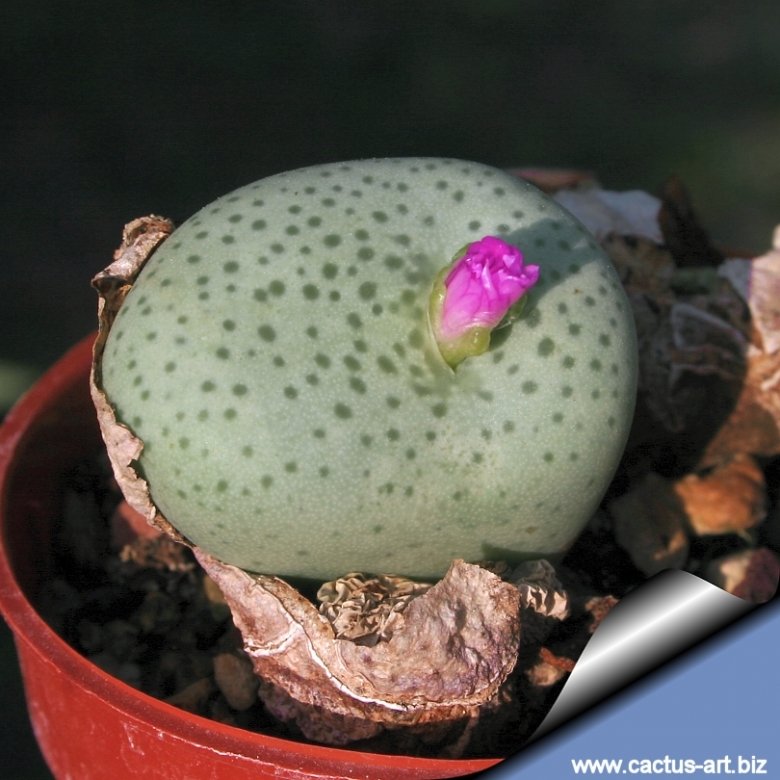
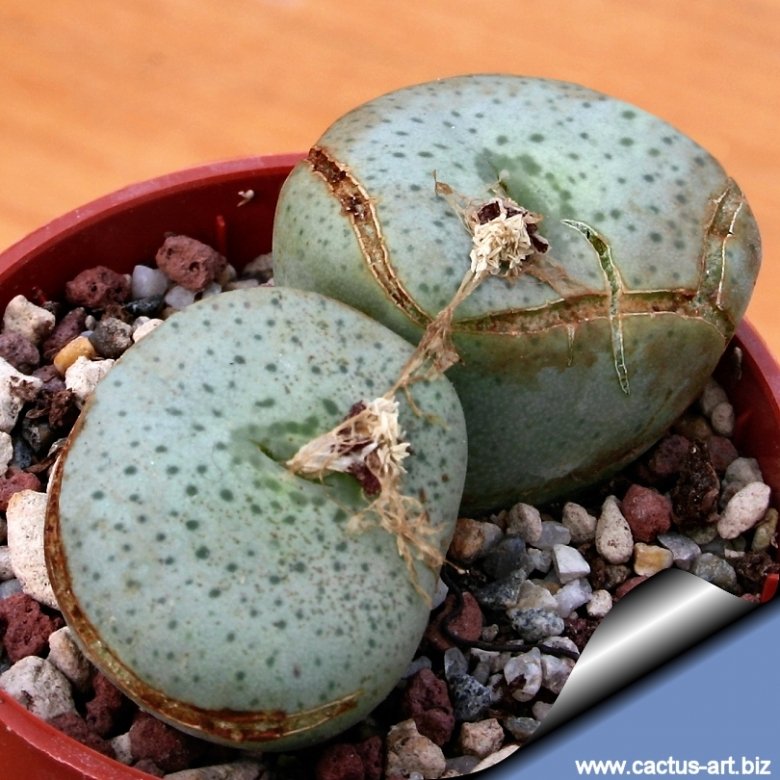
Bodies (paired leaves): Approx 20 mm large and 30 mm tall, turbiniform, apex disc-shaped truncate, often concave, pale bluish green with dark green spots coalescing toward the fissure. The sheaths are papery and firm, sometimes friable and spotted.
Flowers: Usually pink-magenta The form “speciosum” has very nice flowers.
Blooming season: August- October, flowers are long lasting.
Fruit: The capsules are 5-6 locular, small, flat and slightly aromatic.
Remarks: The Cotyledons are obconical and truncate, this species has a short juvenile phase.
Origin and Habitat
Namaqualand, North Cape, South Africa
Habitat: Grows on granite rocks, often on moss.
Cultivation and Propagation
C. speciosum is easy to grow. These plants grow on winter rain and head for summer dormancy. More or less dormant in summer. The plant requires little water; otherwise its epidermis breaks (resulting in unsightly scars). Water throughout the year although minimally in summer, (only when the plant starts shrivelling), but it will generally grow even in summer if given water. Water regularly in winter after the previous year’s leaves have dried up. Requires good drainage. Keep cool and shaded from hot sun in mid-summer; it needs full sun or light shade in the other seasons. Hardy to -2°C. Ensure a very good ventilation. Avoid to repot frequently. This plant may stay in the same pot for many years. Plants grown in larger containers have frequently relatively poor flowers. It might improve when the plants are given their own, small individual pots.
Propagation: It can be reproduced both by cuttings and seeds. Take the cutting from a grown-up mother plant. Each cutting must contain one or more heads, along with a fraction of root.
Source: Conophytum speciosum, LLIFLE - Encyclopedia of living forms, CC-BY-SA, retrieved 2026-10-25.