Publication: Natl. Cact. Succ. J. (U. K.) 33(1): 7 (1978)
Description
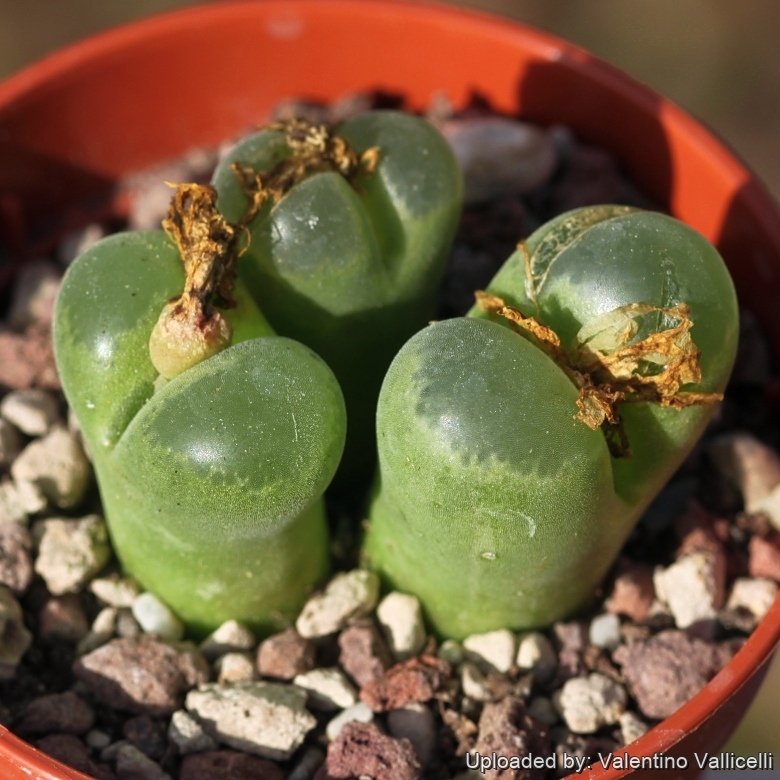
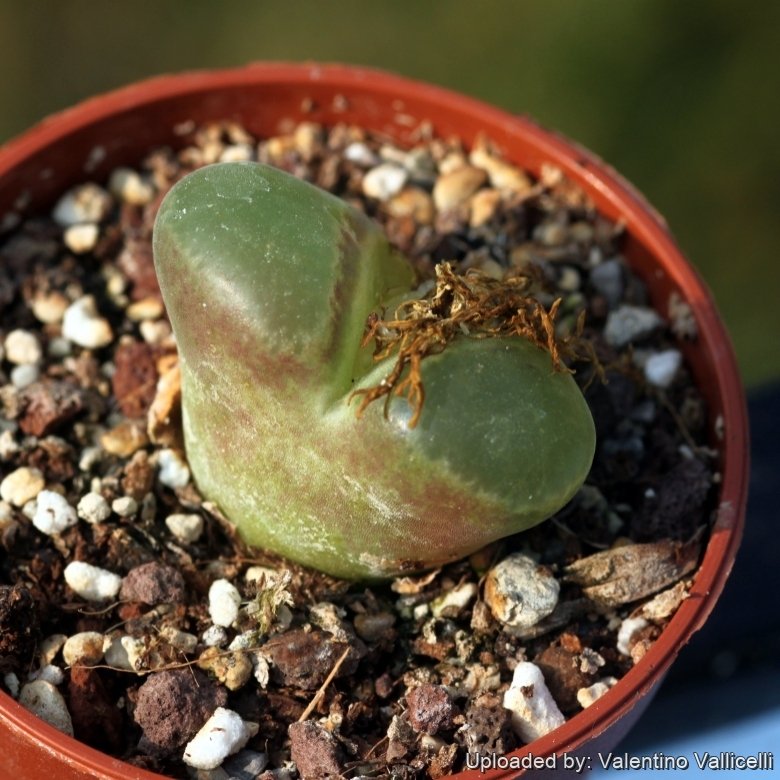
Conophytum lydiae, also known as Ophthalmophyllum lydiae, is a dwarf leaf-succulent with beautiful, green bodies, with striking pink flowers. Single or sparsely branched with age.
Bodies (paired leaves): 20-30 mm tall, 12-20 mm wide, 5-10 mm thick, soft in substance, cylindric to urn-shaped, that grows less symmetrically as it ages, bilobed at the apex, lobes closely pressed together, fissure shallow, upper face irregularly convex or obliquely truncate, greenish and windowed. Windows sharply bordered, translucent and shining or half obscured crossing the whole leaf top, often olive-green, reddish or deep purple at the sides, glabrous or very finely papillate. The opacity of its sides sometimes extends to the apex. Sheath yellowish-brown, thin and brittle.
Flowers: Autumnal, diurnal, faintly scented. Bracteoles very fleshy, exserted for 3-5 mm, keeled, acute, glabrous. Calyx-tube 6-8 mm long, sepals 6(-8), dark green. Corolla-tube 8-10 mm long, fused with the calyx-tube for 2-5 mm. Petals 35-55 in 2-3 series, 8-12 mm long, 2 mm wide and often broadly spathulate pink or white often tipped reddish-pink which intensifies over time. Inner petals (filamentaceous staminodes) short, numerous. Stamens to 45, filaments pale green, anthers pale yellow; style to 4 mm long, stigmas 6, to 10 mm long, pale yellowish green.
Fruits (capsules): 6-chambered 3x5 mm, pale brown. Capsules are hygrochastic, a mechanism whereby seeds are dispersed by raindrops. When it rains, the keels of the wet seed capsules push open valves. Raindrops hitting the open seed capsule splatter seeds in different directions, thus ensuring recruitment and the subsequent survival of the species.
Seeds: Very numerous, 0.55 mm long.
Remarks: Similar transparent windows, as been described for Fenestraria rhopalophylla and certain other species of Conophytum ( e.g. in Conophytum maughanii)
Origin and Habitat
Namaqualand, Northern Cape, South Africa.
Habitat: They strive for life in quartz plains under bushes or among stones in undisturbed places where original vegetation is remaining and where it is very difficult to spot. They grow mostly buried in the ground. The transparent fenestrate leaf tips are often above the sand and allow light into the leaves for photosynthesis.
Cultivation and Propagation
The Conophytums belonging to the Ophthalmophyllum group are some of the world’s most fascinating plants and are sought by the collector of succulent plants. They grow on winter rain and heads for summer dormancy. They are notoriously difficult to grow because they rot very easily. Paying attention to the particular growing requirement of Ophthalmophyllum is especially important. If you provide the Ophthalmophyllum with the right conditions, they will reward you with their unique shape, size, colour and a proliferation of blooms in autumn. However, Ophthalmophyllum are tricky plants that are very particular about their growing conditions and require the right maintenance in order to keep happy. But don’t be afraid even the best growers have plants that mysteriously dry up, or leave during the night. While Ophthalmophyllum are picky about their care, if you are patient and remember the basics, your efforts will be rewarded. Being small plants, a representative collection can be grown on a patio table, a sunny windowsill or a shelf in the greenhouse.
The growing season in northern hemisphere is from September to March.
Soil: It grows best in sandy-gritty soil and requires good drainage as it it is prone to root rot. It can grows outdoor in sunny, dry, rock crevices (protection against winter wet is required) It can also be cultivated in alpine house, in poor, drained soil.
Repotting: Repotting every year is not recommended. They may stay in the same pot for many years. Plants grown in larger containers have frequently relatively poor flowers. They might improve when the plants are given their own, small individual pots.
Fertilization: Feed it once during the growing season with a fertilizer specifically formulated for cactus and succulents (poor in nitrogen), including all micro nutrients and trace elements diluted to ½ the strength recommended on the label. It thrives in poor soils and need a limited supplies of fertilizer to avoid the plants developing excess vegetation, which is easily attacked by fungal diseases.
Watering: The Ophthalmophyllum thrive in dry and desert regions and are able to stand extended periods of drought and require careful watering. Water minimally in summer, (only occasional misting), water more abundantly after the previous year’s leaves have dried up when they are growing in the autumn and spring, but let the soil dry between soaking. Requires little water otherwise its epidermis breaks (resulting in unsightly scars). If grown in a container, bottom watering by immersing the container is recommended. Ensure a very good ventilation.
Light: It enjoy some shade (avoid direct sun as it grows wild among rocks and under the shade of other plants) and in summer it need to be kept in a cool area.
Hardiness: It prefer a very bright situation and require a minimum temperature 5°C (But will take a light frost and is hardy down to -7° C for short periods if it is in dry soil). USDA zones 9A – 11.
Uses: Container, rock garden.
Pests and diseases: It is vulnerable to mealybugs and rarely scale.
Propagation: It can be reproduced both by seed in autumn or (or rarely) cuttings. Take the cutting from a grown-up mother plant. Each cutting must contain one or more heads along with a fraction of root and permit to dry out a couple of days, lay it on the soil and insert the stem end partially into the soil. Try to keep the cutting somewhat upright so that the roots are able to grow downward. It is relatively difficult to root Ophthalmophyllum from cuttings and generally pointless as well, so quick are they from seed.
Bibliography
Major refences and further lectures
-
Heidrun E. K. Hartmann (2001) “Illustrated Handbook of Succulent Plants: Aizoaceae A – E” Springer
-
Hammer, S. 1993. “The Genus Conophytum - A Conograph.” Succulent Plant Publications, Pretoria.
-
Hammer, S. 2002. “Dumpling and His Wife: New Views of the Genus Conophytum.” East Anglia Engraving Creative Colour Ltd, Norwich, England.
-
Germishuizen, G. & N. L. Meyer, eds. 2003. “Plants of southern Africa: an annotated checklist.” Strelitzia 14.
-
S. M Walters “The European Garden Flora Flowering Plants: Casuarinaceae to Aristolochiaceae” Cambridge University Press, 1989
-
Victor, J.E. & Hammer, S.A. 2006. Conophytum lydiae (H.Jacobsen) G.D.Rowley. National Assessment: Red List of South African Plants version 2015.1. Accessed on 2015/12/17
From llifle page Conophytum haramoepense
Description
Conophytum lydiae, also known as, Ophthalmophyllum haramoepense, is a succulent plant apparently identical to Conophytum lydiae, but with (perhaps) more reddish sides, a green top, and brilliant pink flower. The species name haramoepense indicate the plants are found in Haramoep near Aggeneys (Namaqualand, South Africa), but they are in fact almost identical and not easily distinguishable from Conophytum lydiae to which this plant must be rightly placed. In the past identification of the genus Conophytum and especially Conophytum lydiae was problematic. In fact the plants in habitat show different growth phases and their appearance can change dramatically throughout the year and under different growing conditions. Such variations has led to establishment of several unnecessary names for this species.
For more details see: Conophytum lydiae |.
Origin and Habitat
Haramoep near Aggeneys (Namaqualand, South Africa)
Habitat and ecology: Conophytum haramoepense strives for life in quartz plains under bushes or among stones in undisturbed places where original vegetation is remaining and where it is very difficult to spot. It grows mostly buried in the ground. The transparent fenestrate leaf tips are often above the sand and allow light into the leaves for photosynthesis.
Bibliography
Major refences and further lectures
-
Heidrun E. K. Hartmann (2001) “Illustrated Handbook of Succulent Plants: Aizoaceae A – E” Springer
-
Hammer, S. 1993. “The Genus Conophytum - A Conograph.” Succulent Plant Publications, Pretoria.
-
Hammer, S. 2002. “Dumpling and His Wife: New Views of the Genus Conophytum.” East Anglia Engraving Creative Colour Ltd, Norwich, England.
-
Germishuizen, G. & N. L. Meyer, eds. 2003. “Plants of southern Africa: an annotated checklist.” Strelitzia 14.
-
S. M Walters “The European Garden Flora Flowering Plants: Casuarinaceae to Aristolochiaceae” Cambridge University Press, 1989
Source: Conophytum haramoepense, LLIFLE - Encyclopedia of living forms, CC-BY-SA, retrieved 2026-10-25.