Publication: Gen. Conophytum 237. 1993
Description
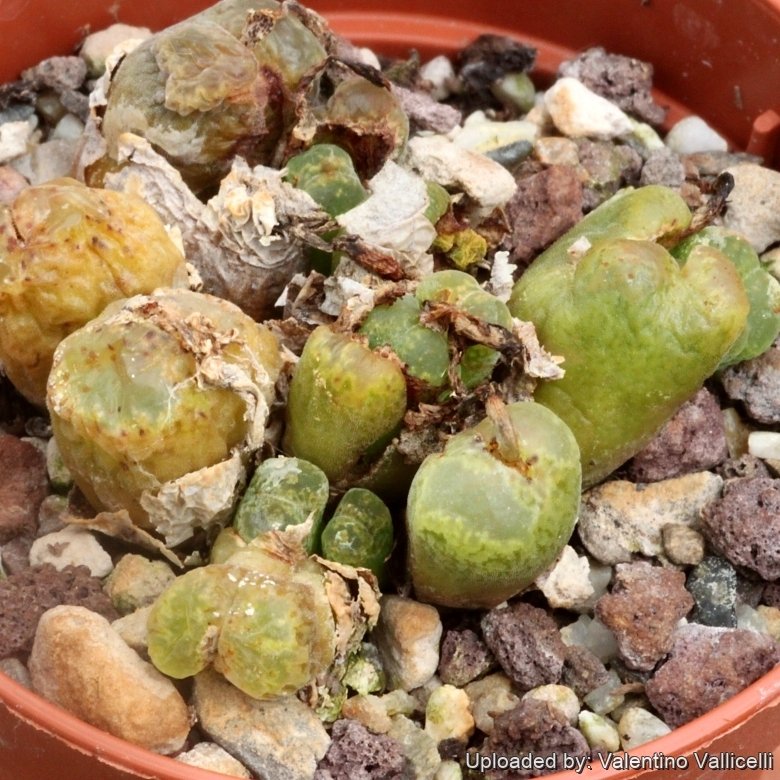
Conophytum pellucidum subs. cupreatum is a tiny, rock-like, perennial succulent with very beautiful coppery-brown bodies with lines and spots. It branches profusely forming compact mat less than 1-2 cm tall. The bodies resemble minuscule Lithops and show the best colouration when given ample light and a clay soil.
Stem: Stem-less (internodes invisible) or very short and forming rhizomatous branches at soil level.
Body (Paired leaves): 10-20 mm tall and 6-12 mm in diameter, cylindric to turbiniform (inverse conical), apex of the pair fused, not lobed, convex, never bullate, glabrous or finely papillate, coppery-brown with lines and spots, with green to brown windows often with rusty island
Flowers: White to pink, unshented, filamentous staminodes yellow to red forming a tube.
Blooming season: They tend to flower early, often in midsummer or early autumn. They are short-day plant (flowers only when day length is less than 12 hours.)
Fruit: Small, tan coloured usually 4-locular.
Origin and Habitat
Vanrhynsdorp, Western Cape, South Africa.
Altitude range: 870-1050 metres above sea level.
Habitat: Grows on granite or gneiss domes in crevices or among crushed rocks or on quartz substrate, often with moss. Often grows along Lithops.
Cultivation and Propagation
Conophytum pellucidum and its varieties are among the most popular of this genus but relatively difficult to grow. These plants grow on winter rain and head for summer dormancy. The growing season in northern hemisphere is from September to March. During this period they can be lightly watered about once a week or (better) misted every day and will become plump. In Africa, the mist from morning fog provides moisture. Otherwise their epidermis breaks (resulting in unsightly scars). Water minimally in summer, (only occasional misting). Start watering again in autum after the previous year’s leaves have dried up. Require good drainage. They enjoy full sun or half-shade and in summer they need to be kept in a cool area. Hardy to -2°C. Ensure a very good ventilation. Avoid to repot frequently. They may stay in the same pot for many years. Plants grown in larger containers have frequently relatively poor flowers. They might improve when the plants are given their own, small individual pots.
Propagation: They can be reproduced both by cuttings and seeds. Seed must be sown in the spring or summer. The seedlings should not be disturbed until they are well rooted, after the first or second year they should be big enough to separate and be planted into their own pots. Take the cutting from a grown-up mother plant. Each cutting must contain one or more heads along with a fraction of root.
Notes
The conical shaped bodies of Conophytum pellucidum do not easily absorb sunlight, but have translucent window parts in the top surface that allow sunlight to be captured and utilized even when the plant are at the soil level or retracted below the surface of the soil. This is an interesting evolutionary adaptation to overcome this light problem; their leaves are a simple optical system that permits light striking the windows to be diffused onto the green, photosynthesizing surface situated underground. So, with a minimum of exposure to the outside environment, a maximum area of photosynthetic tissue is ensured.
Bibliography
Major references and further lectures
-
Alfred Byrd Graf “Hortica: a color cyclopedia of garden flora in all climates and indoor plants” Roehrs Co., 1992
-
Heidrun E.K. Hartmann “Illustrated Handbook of Succulent Plants: Aizoaceae A-E” Springer, 2002
-
Gideon Smith u.a. “Mesembs of the World: Illustrated Guide to a Remarkable Succulent Group.” Briza Publications, 1998
-
Japan Succulent Society “Colour Encyclopedia of Succulents” Japan Succulent Society January 1, 1981
-
Hermann Jacobsen “A handbook of succulent plants: descriptions, synonyms, and cultural details for succulents other than Cactaceae, Volume 1” Blandford Press, 1960
-
Werner Rauh “The Wonderful World of Succulents:Cultivation and Description of Selected Succulent Plants Other Than Cacti” Smithsonian Institution Press, 1984
-
James Cullen, Sabina G. Knees, H. Suzanne Cubey “The European Garden Flora Flowering Plants: A Manual for the Identification of Plants Cultivated in Europe, Both Out-of-Doors and Under Glass” Cambridge University Press, 11/ago/2011
-
Steven A. Hammer “Dumpling and his wife: new views of the genus Conophytum” EAE Creative Colour Ltd., 2002
9)Burgoyne, P.M. 2006. Conophytum pellucidum Schwantes subsp. cupreatum. National Assessment: “Red List of South African Plants” version 2014.1. Accessed on 2014/07/17
From llifle page Conophytum meridianum var. pulverulentum
Description
Calibanus hookerii is an interesting looking plant that is related to the agaves, it looks like a trunk-less Nolina, topped by perennial grasslike silver-blue leaves that expand from a woody caudex (Swollen succulent root).
Caudex: The caudiciform base is hemispherical and woody with a fissured or plate-like brownish-grey bark and sits halfway out of the soil. It is very slow growing, generally it is 0,30 to 1 m in diameter but can eventually grow to 5 meters in diameter,
Leaves: Thin, wiry, flexible, grass-like, raspy surfaced that grows upright in the center of the plant and then arch down as they mature. They are somewhat concave and keeled, the margins are rounded. The leaves will get 30 to 90 cm long and are only 2-3 mm wide. They are blue green in colour. They appear on the plant as a crown formed by numerous bundles arising from the top of the caudex. The number of the bundles increase as the plant increase in size.
Flowers: The Calibanus is dioecious (there are male and female plants) or rarely some plants are hermaphrodite.. The clusters of flowers (panicles) are rigid about 10-20 cm long and partially hidden in the foliage. The flowers are pink or purplish and very tiny.
Fruit: Female plants bear globose, ovoid, three angled berries, 8-9 mm long, 6-7 mm in diameter. The fruits are straw-brownish to reddish and indehiscent.
Seeds: Mellon shaped, 3-4 x 3 mm wide.
Origin and Habitat
North central Mexico (Hidalgo, Tamaulipas and San Luis Potosi).
Habitat and ecology: It grows in grit, in a dry mountainous habitat, where it receives quite copious water in the short growing-period. These plants are very drought tolerant, and have developed a caudex (water storage organ) at and below ground level, a common survival strategy in dry climates.
Cultivation and Propagation
Calibanus hookeri is a very tolerant plant that can withstand temperatures of -15 Celsius degrees, but its exact hardiness is unknown. Because of its extreme drought tolerance, it makes a great container plant for light shade to full sun, or is an excellent foliage accent in a dry garden in warm regions. Might look its best in a vase shaped terra cotta pot to allow the leaves to drape downwards. It needs moderate water when actively growing, little water the rest of the time, if established. Outdoor it needs heavy soil with excellent drainage and circulating dry air. It is a tough plant. Having been bred to endure dry air and drought, it will survive for years in less than ideal conditions. It can stay in the same pot for a number of years since it prefers to be a bit rootbound.
Propagation: Seeds; it cannot be reproduced by cuttings of the caudex (or leaves).
Source: Conophytum meridianum var. pulverulentum, LLIFLE - Encyclopedia of living forms, CC-BY-SA, retrieved 2026-10-25.
Gallery