Publication: Gard. Chron. III, 71: 261 1922
Description
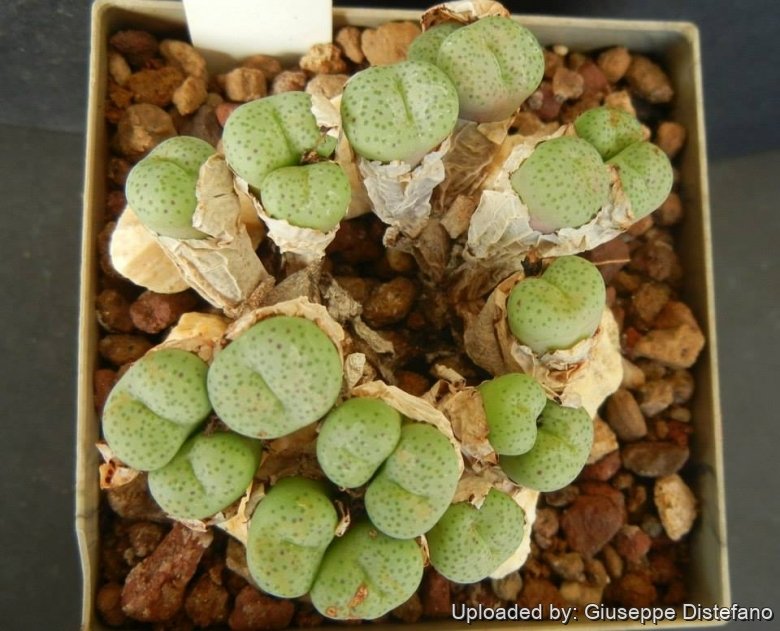
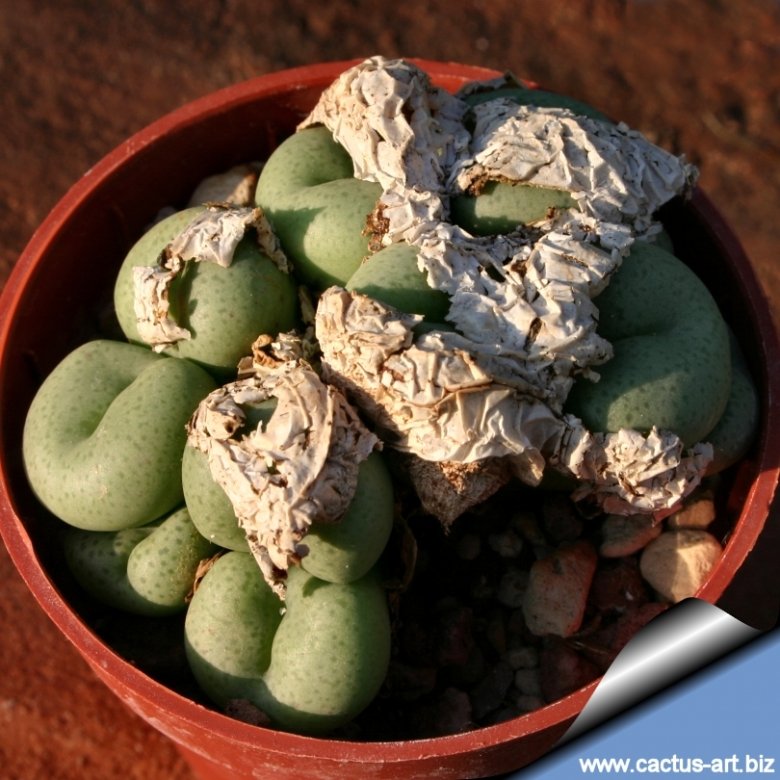
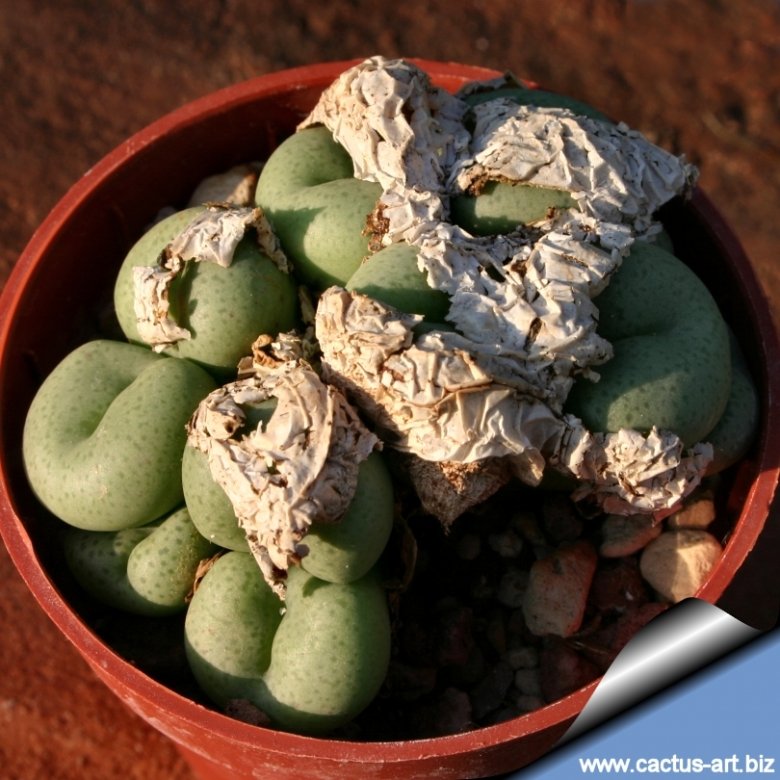
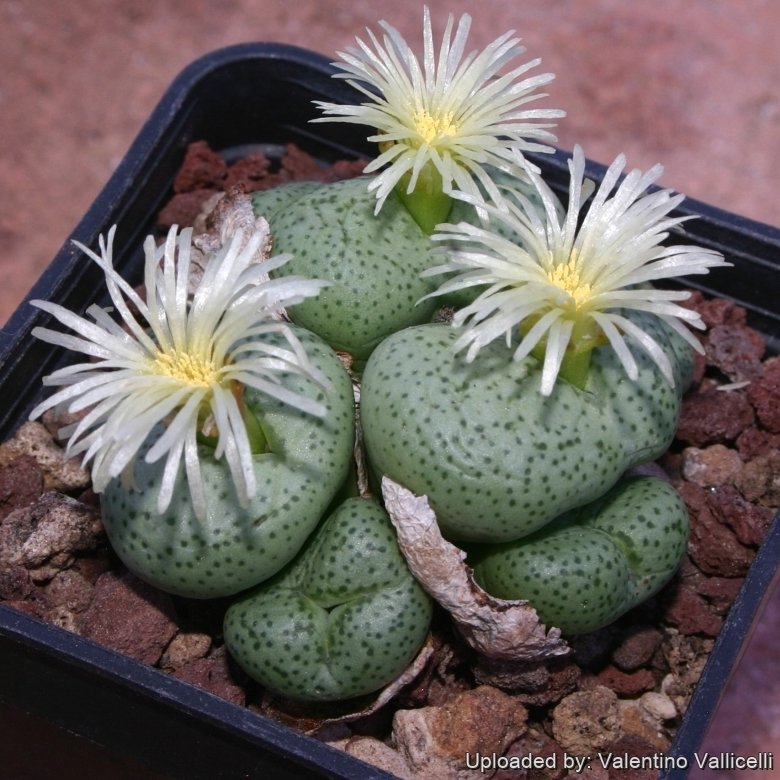
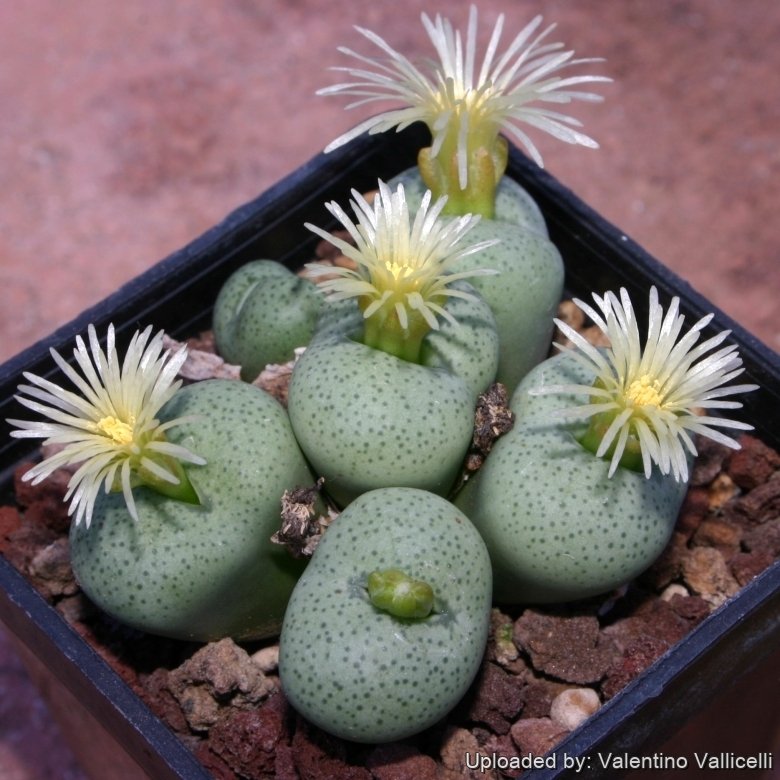
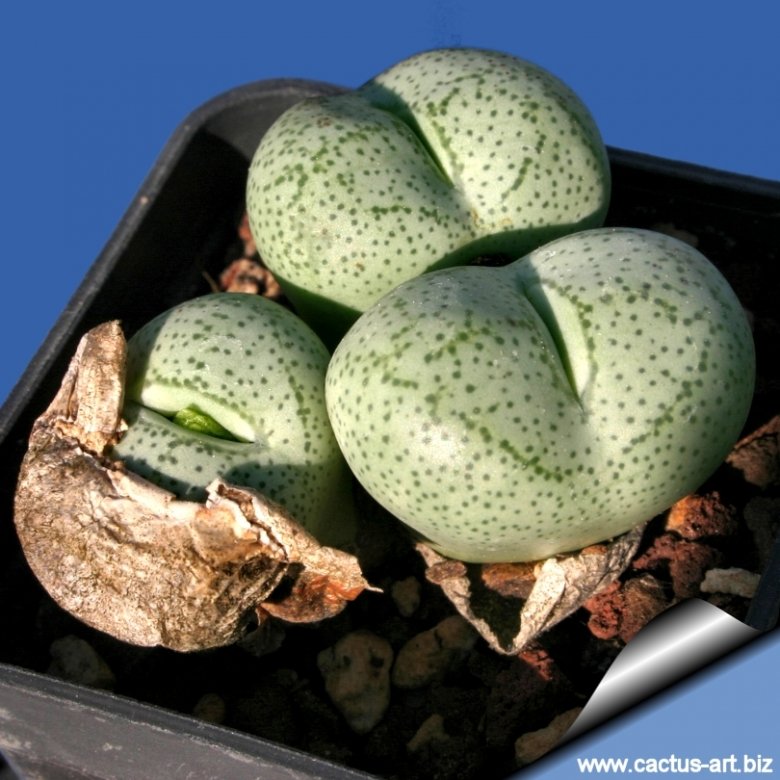
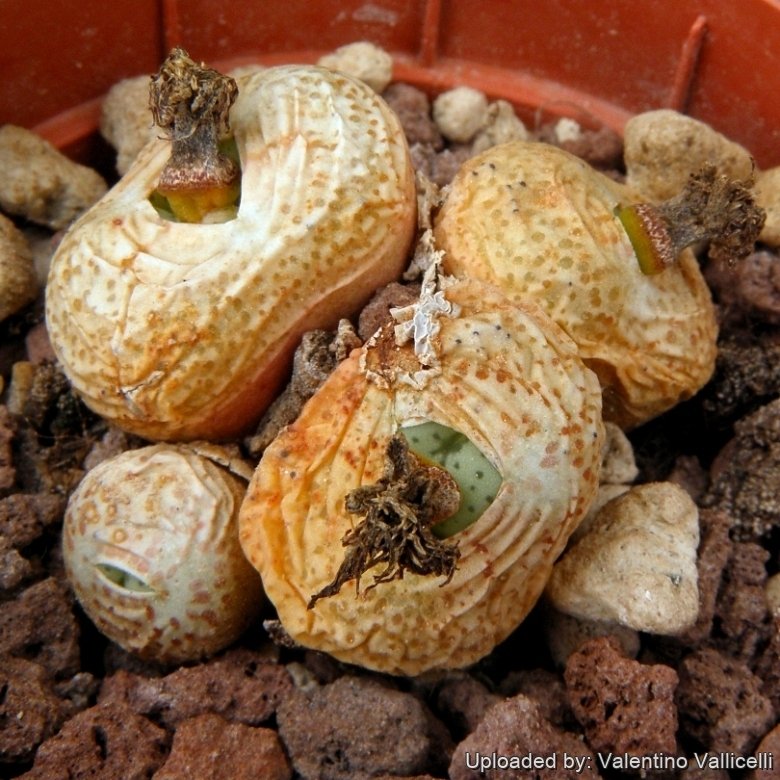
Conophytum truncatum is a slow-growing, clump-forming, perennial succulent that forms huge tight mounds of sometimes many hundreds of pea-shaped heads, each one of them consisting of one pair of reduced, fused succulent leaves that get absorbed and regenerated every year. This species comprises many morphological and geographical variant that was early classified as different independent species, but nowadays all this forms are considered part of a multiform species, where each form is linked to others by populations of plants with intermediate characteristics.
Stem: Stemless.
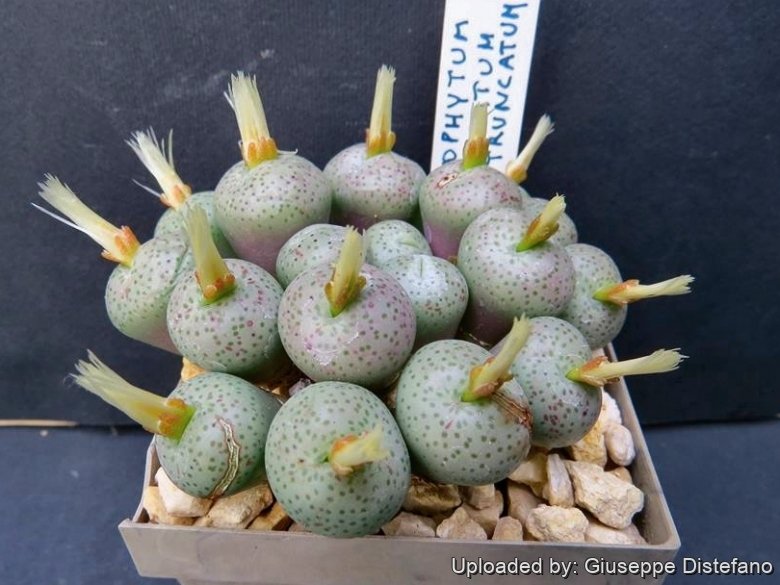
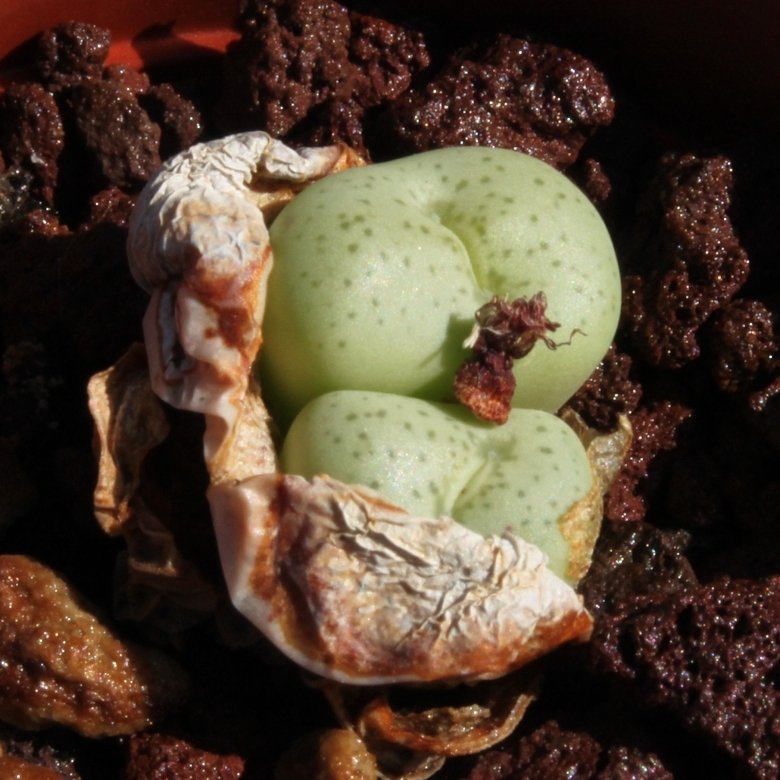
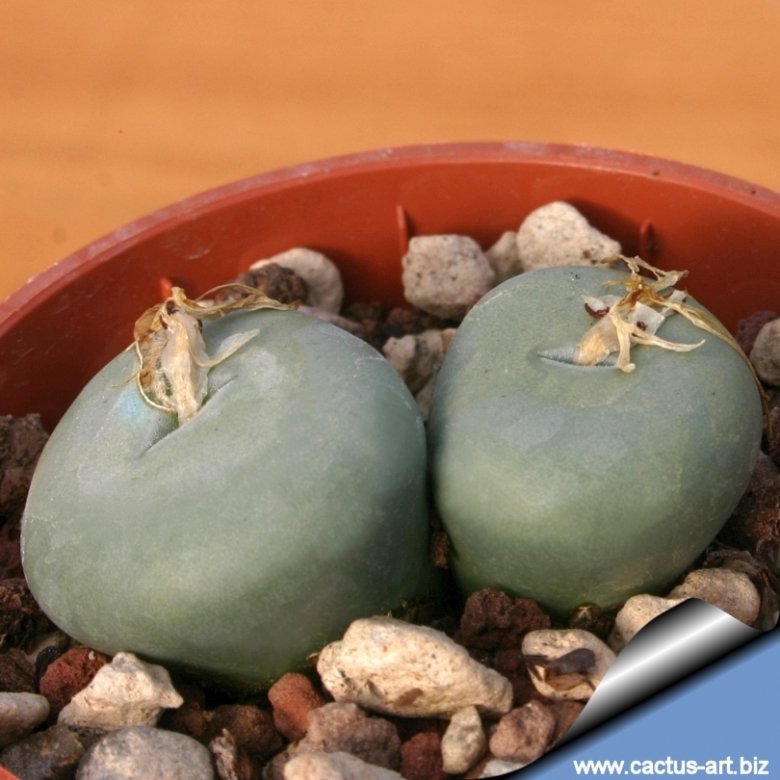
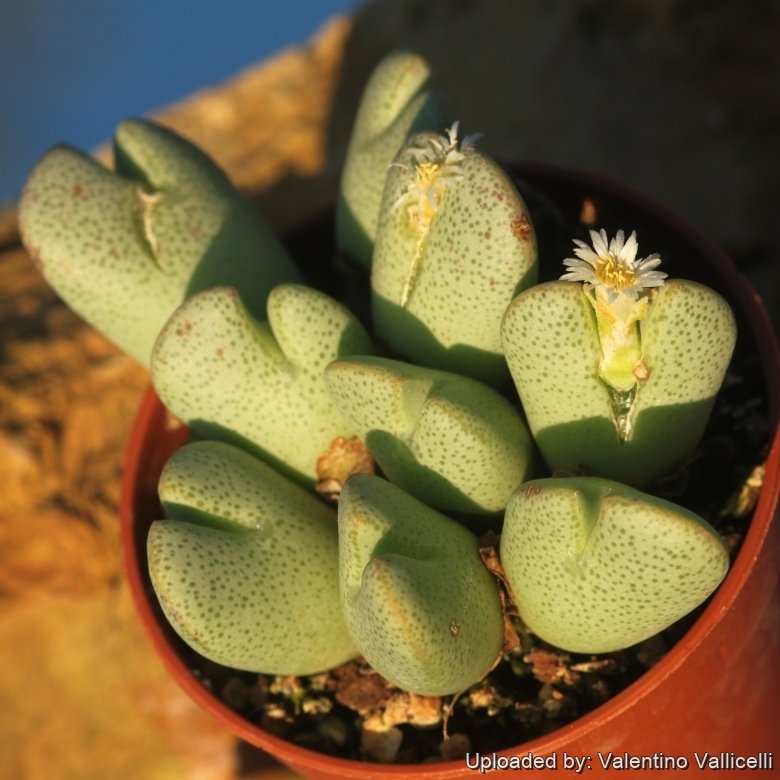
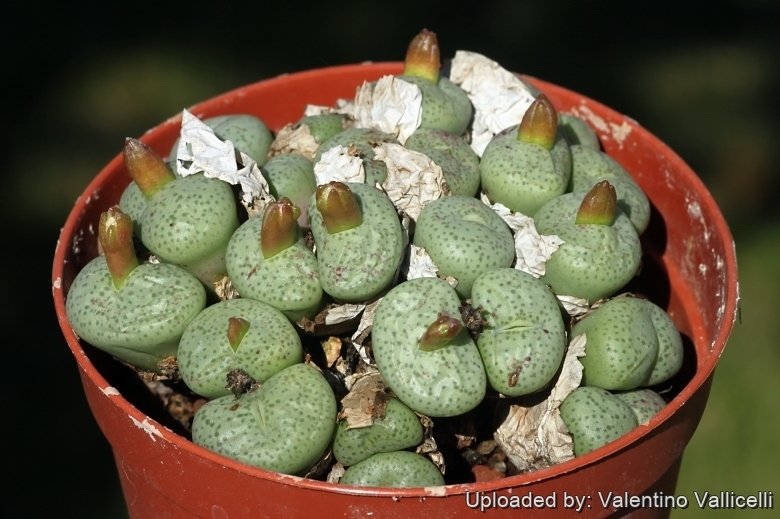
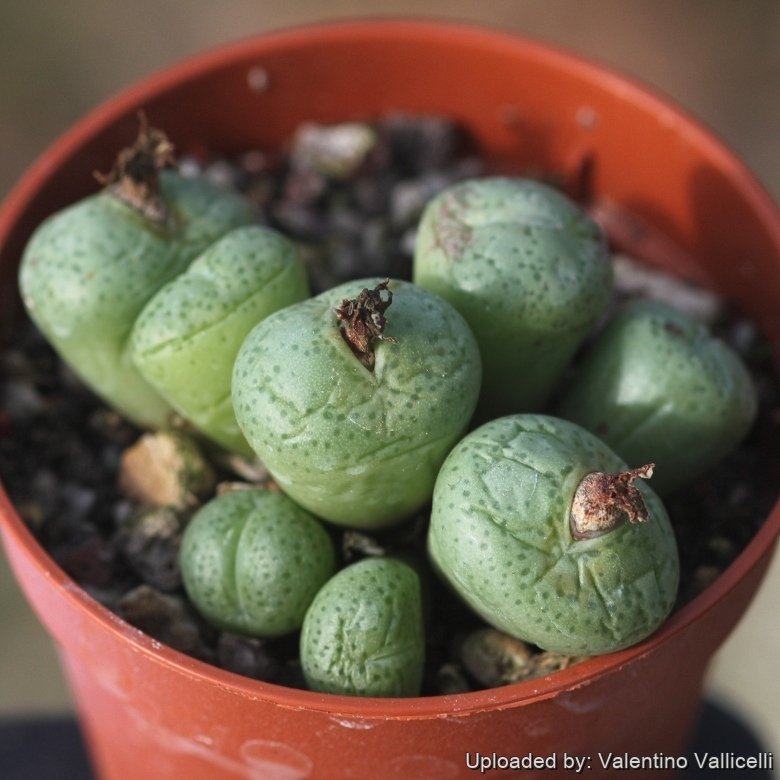
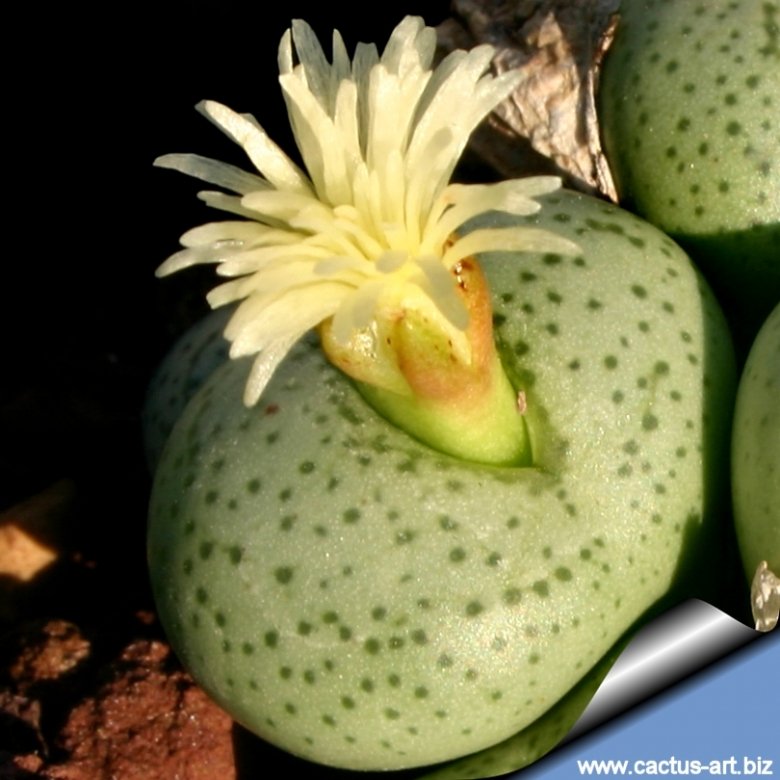
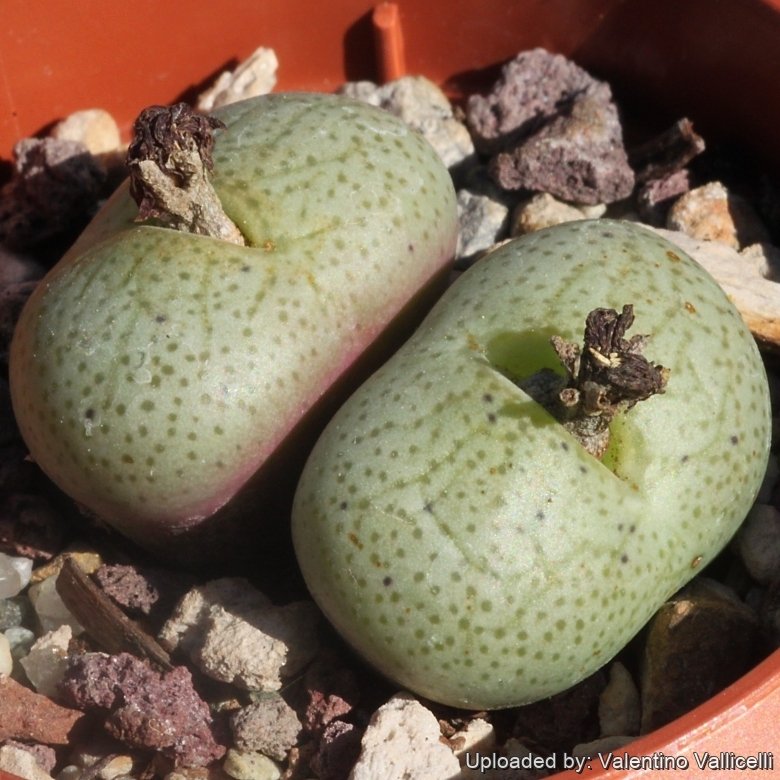
Bodies (paired leaves): It is very variable in form, colour and markings with a sunken fissure at the flattened tip. Stems ranges from small (4-5 mm in diam.) to large (25 mm in diam.!); from completely unmarked specimens to very heavily dark spotted or lined, and from bright green, grey-green, blue-green to having a heavy reddish colouration all often within a single population!
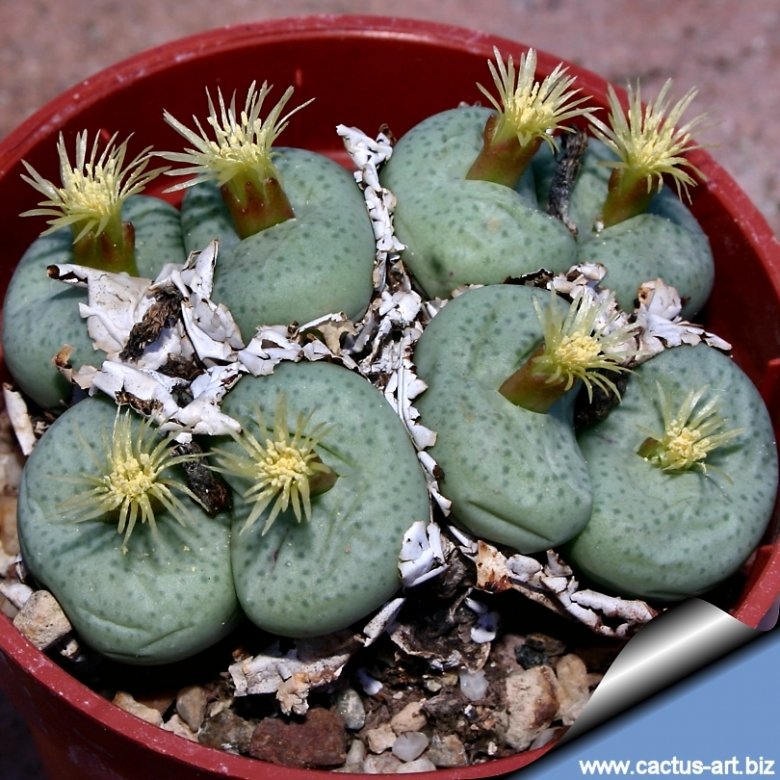
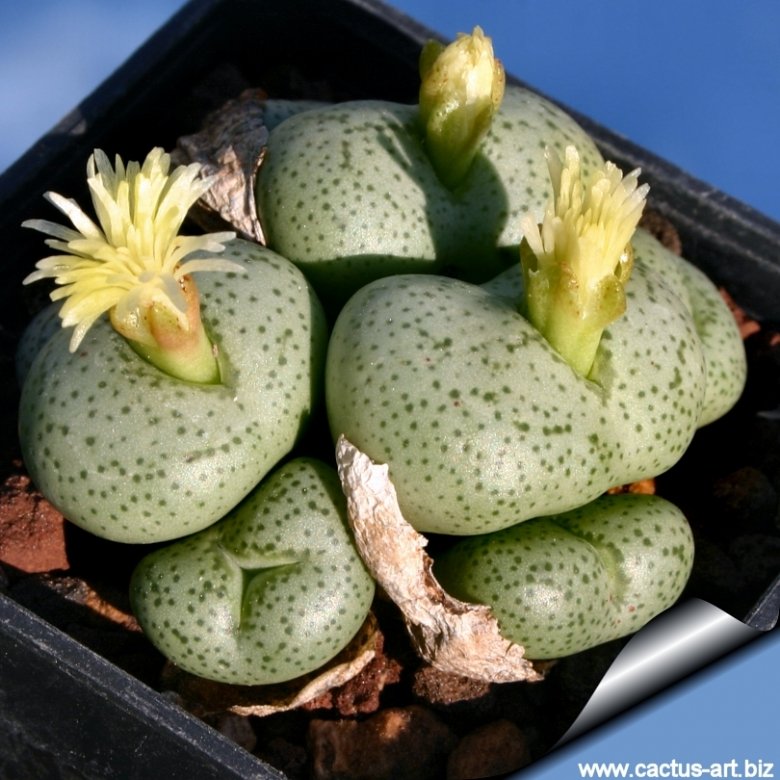
Flowers: The small flowers with spidery petals are nocturnal, and typically in shades of ivory-white, creamy, straw-yellow or salmon and very faint scented.
Blooming: season: Plants flower during the fall months; each blossom opens at night. During the day the flowers close.
Roots: Very rudimentary filamentous root system
Origin and Habitat
Widespread in the Little Karoo , Western Cape, South Africa. C. truncatum is the the easternmost species.
Type locality: Camanasie
Habitat: C. truncatum are winter grower succulents found in extreme dry areas in shale or quartzite rock crevices (or on gravel) - known as obligate rock dwellers - where they don’t have to compete with other plants for water, space and light. They are found generally growing on east, south or west-facing rocky outcrops and slopes - very seldom north-facing (too hot). They are often found growing in amongst mosses and lichens and other shade lovers. They grow, receiving a bit of winter rain, none at summer, but ocean fog moves inland in the evenings, and this moisture sustains a wealth of succulent life in this harsh semi-desert region. Their flowers are pollinated by nocturnal moths.
Cultivation and Propagation
All the forms of C. truncatum are easy to grow. These plants grow on winter rain and head for summer dormancy. They require little water; otherwise its epidermis breaks (resulting in unsightly scars). Water minimally in summer, (only when the plant starts shrivelling), but it will generally grow even in summer if given water. Water regularly in winter after the previous year’s leaves have dried up. Requires good drainage. Keep cool and shaded in summer, it needs full sun or light shade. Hardy to -2°C. Ensure a very good ventilation. Avoid to repot frequently. This plant may stay in the same pot for many years.
Propagation: It can be reproduced both by cuttings and seeds. Take the cutting from a grown-up mother plant. Each cutting must contain one or more heads along with a fraction of root.
Notes
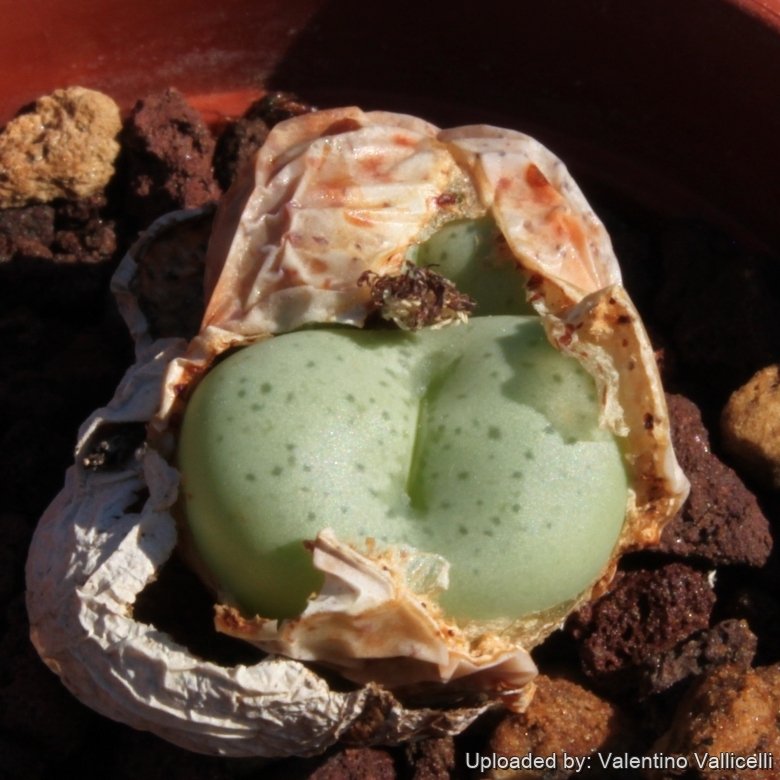
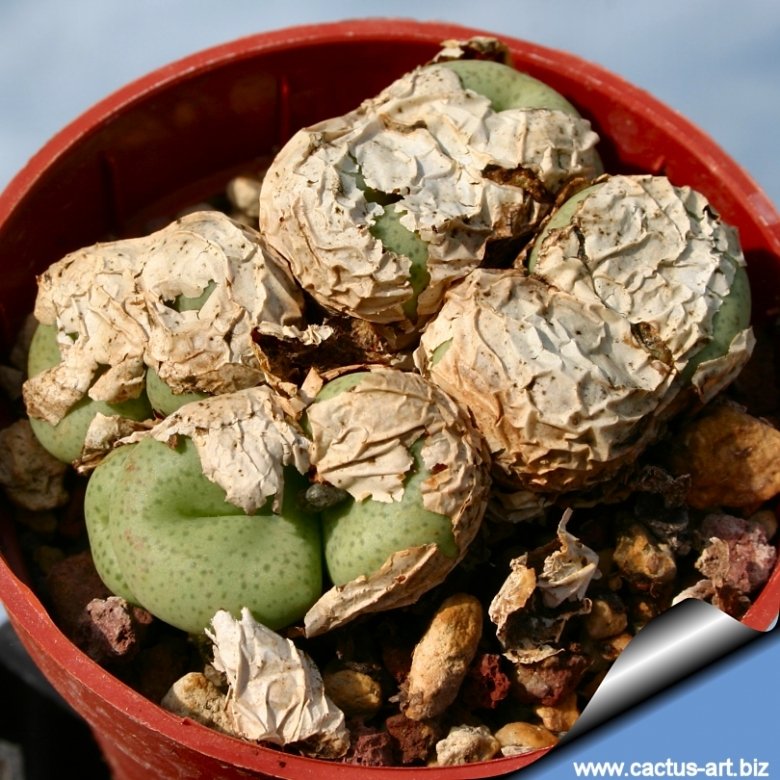
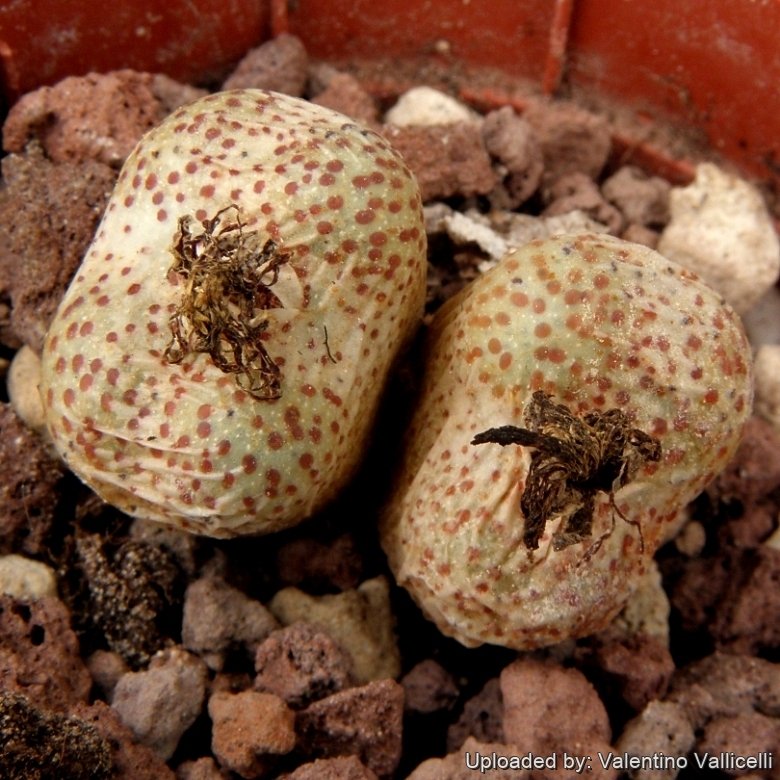
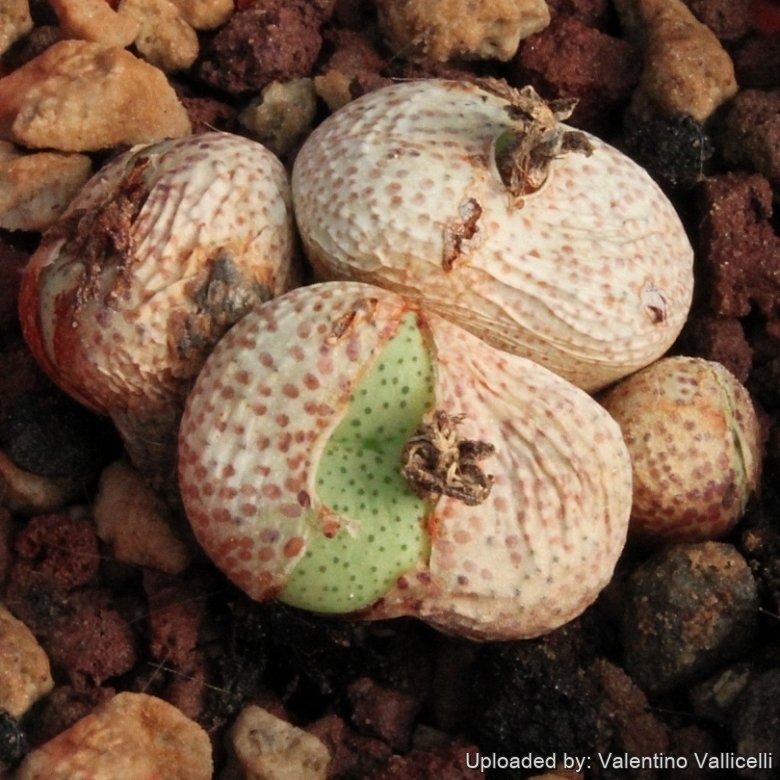
Plants of the genus Conophytum are also known as ‘living pebbles’. During the rest period (the summer months in Europe) a new body forms inside the old, gradually taking all the substances from it until all that remains is the skin, which dries and protects the young plant from the heat of the sun and excess evaporation of water. The resting Conophytum protected by this dry cover resembles a pebble and hence the name ‘living pebble’. The growth period of most species is from August to March. The temperature should be about 10 to 12°C
Bibliography
Major references and further lectures
-
Burgoyne, P.M. 2006. Conophytum truncatum (Thunb.) N.E.Br. subsp. truncatum var. truncatum. National Assessment: “Red List of South African Plants” version 2013.1. Accessed on 2014/02/03
-
Nicholas Edward Brown, A. Tischer, M. C. Karsten “Mesembryanthema; Descriptions: With Chapters on Cultivation and General Ecology” L. Reeve, 1931
-
Gordon D. Rowley “The illustrated encyclopedia of succulents” Crown Publishers, 01/Aug/1978
-
James Cullen, Sabina G. Knees, H. Suzanne Cubey “The European Garden Flora Flowering Plants: A Manual for the Identification of Plants Cultivated in Europe, Both Out-of-Doors” Cambridge University Press, 11/Aug./2011
-
Hammer, S. 1993. “The Genus Conophytum - A Conograph.” Succulent Plant Publications, Pretoria.
-
Hammer, S. 2002. “Dumpling and His Wife: New Views of the Genus Conophytum.” East Anglia Engraving Creative Colour Ltd, Norwich, England.
-
Ernst Van Jaarsveld, Ben-Erik Van Wyk, Gideon Smith “Succulents of South Africa: A Guide to the Regional Diversity” Tafelberg Publishers, Limited, 01/lug/2000
-
Heidrun E.K. Hartmann “Illustrated Handbook of Succulent Plants: Aizoaceae A-E” Springer, 2002
-
Werner Rauh “The Wonderful World of Succulents: Cultivation and Description of Selected Succulent Plants Other Than Cacti” Smithsonian Institution Press, 1984
-
Hermann Jacobsen “Lexicon of Succulent Plants” Littlehampton Book Services Ltd. 1974
From llifle page Conophytum multipunctatum
Description
Conophytum multipunctatum is one of the forms of the morphologically variable Conophytum truncatum. It is a dwarf almost stemless mat-forming succulent, distinguished from the type species for the pale grey-green bodies closely patterned with very numerous, fine, dots. Conophytum multipunctatum is not accepted by many botanists that treat it as synonym, but it still has a value for a collector because they identify plants with particular characters.
Bodies (paired leaves): up to 2 cm long and 1.5 cm in diameter, slightly pear-shaped, truncated above with depressed fissure. Upper side with rather peculiar humps of irregularly circular outline, pale grey-green, the whole upper whole upper surface and the upper part of the sides closely patterned with very numerous, fine, dots.
Flowers. Nocturnal white.
Origin and Habitat
Uniondale Division, Cape Province, South Africa
Cultivation and Propagation
All the forms of Cconophytum truncatum are easy to grow. These plants grow on winter rain and head for summer dormancy. They require little water; otherwise its epidermis breaks (resulting in unsightly scars). Water minimally in summer, (only when the plant starts shrivelling), but it will generally grow even in summer if given water. Water regularly in winter after the previous year’s leaves have dried up. Requires good drainage. Keep cool and shaded in summer, it needs full sun or light shade. Hardy to -2°C. Ensure a very good ventilation. Avoid to repot frequently. This plant may stay in the same pot for many years.
Propagation: It can be reproduced both by cuttings and seeds. Take the cutting from a grown-up mother plant. Each cutting must contain one or more heads along with a fraction of root.
Bibliography
Major references and further lectures
-
Tischer “Conophytum multipunctatum, Tisch. spec. nov. (§ Truncatella)” Cact. Succ. J. Gr. Brit. 6: 37 (1937); et: Cact. J. (Croydon) 6: 37-38 (1937)
-
Cact. Succ. J. (Los Angeles) 54: 169 (1982)
Source: Conophytum multipunctatum, LLIFLE - Encyclopedia of living forms, CC-BY-SA, retrieved 2026-10-25.
From llifle page Conophytum peersii
Description
The Witberg buttons (Conophytum peersii) is a local or morphological form of Conophytum truncatum with pale bluish-green bodies dotted with dark green spots, but not easily differentiated from the standard Conophytum truncatum, and hard to tell apart only by body characteristics.
Habit: It is a slow-growing, clump-forming, perennial succulent that forms huge tight mounds of sometimes many hundreds of pea-shaped heads, each one of them consisting of one pair of reduced, fused succulent leaves that get absorbed and regenerated every year.
Stem: Stemless.
Bodies (paired leaves): Pea-shaped with a sunken fissure at the flattened tip, marked with dark spots, and from grey-green to blue-green to having a heavy reddish colouration.
Flowers: The small flowers with spidery petals are nocturnal, and typically in shades of ivory-white, creamy, straw-yellow or salmon and very faint scented.
Blooming season: Plants flower during the fall months; each blossom opens at night. During the day the flowers close.
Roots: Very rudimentary filamentous root system.
Origin and Habitat
West of Klaarstroom, Western Cape Province, South Africa.
Habitat: Conophytum peersii are winter grower succulents found in extreme dry areas in shale or quartzite rock crevices - known as obligate rock dwellers - where they don’t have to compete with other plants for water, space and light. They are found generally growing on east, south or west-facing rocky outcrops and slopes - very seldom north-facing (too hot). They are often found growing in amongst mosses and lichens, and many noteworthy succulent plants can be seen in this area, including the panga mesemb (Bijlia dilatata). They grow, receiving a bit of winter rain, none at summer, but ocean fog moves inland in the evenings, and this moisture sustains a wealth of succulent life in this harsh semi-desert region. Their flowers are pollinated by nocturnal moths.
Source: Conophytum peersii, LLIFLE - Encyclopedia of living forms, CC-BY-SA, retrieved 2026-10-25.
From llifle page Conophytum subglobosum
Description
Conophytum truncatum is a slow-growing, clump-forming, perennial succulent that forms huge tight mounds of sometimes many hundreds of pea-shaped heads, each one of them consisting of one pair of reduced, fused succulent leaves that get absorbed and regenerated every year.
The so called “subglobosum” differs for the more rounded (not truncated) pair of leaves.
Stem: Stemless.
Bodies (paired leaves): It is very variable in form, colour and markings with a sunken fissure at the flattened tip. Stems ranges from small (4-5 mm in diameter.) to large (25 mm in diameter); from completely unmarked specimens to very heavily dark spotted or lined, and from bright green, grey-green, blue-green to having a heavy reddish coloration all often within a single population!
Flowers: The small flowers with spidery petals are nocturnal, and typically in shades of ivory-white, creamy, straw-yellow or salmon and very faint scented.
Blooming season: Plants flower during the fall months; each blossom opens at night. During the day the flowers close.
Roots: Very rudimentary filamentous root system.
Origin and Habitat
Widespread in the Little Karoo , Western Cape, South Africa.
Habitat: They are winter grower succulents found in extreme dry areas in shale or quartzite rock crevices (or on gravel) - known as obligate rock dwellers - where they don’t have to compete with other plants for water, space and light. They are found generally growing on east, south or west-facing rocky outcrops and slopes - very seldom north-facing (too hot). They are often found growing in amongst mosses and lichens and other shade lovers. They grow, receiving a bit of winter rain, none at summer, but ocean fog moves inland in the evenings, and this moisture sustains a wealth of succulent life in this harsh semi-desert region. Their flowers are pollinated by nocturnal moths.
Cultivation and Propagation
All the forms of Conophytum truncatum are easy to grow. These plants grow on winter rain and head for summer dormancy. They require little water; otherwise its epidermis breaks (resulting in unsightly scars). Water minimally in summer, (only when the plant starts shrivelling), but it will generally grow even in summer if given water. Water regularly in winter after the previous year’s leaves have dried up. Requires good drainage. Keep cool and shaded in summer, it needs full sun or light shade. Hardy to -2°C. Ensure a very good ventilation. Avoid to repot frequently. This plant may stay in the same pot for many years.
Propagation: It can be reproduced both by cuttings and seeds. Take the cutting from a grown-up mother plant. Each cutting must contain one or more heads along with a fraction of root.
Source: Conophytum subglobosum, LLIFLE - Encyclopedia of living forms, CC-BY-SA, retrieved 2026-10-25.
Gallery