Publication: Gard. Chron. ser. 3, 72(1856): 54. 1922 [22 Jul 1922] (as “uvaeforme”)
Description
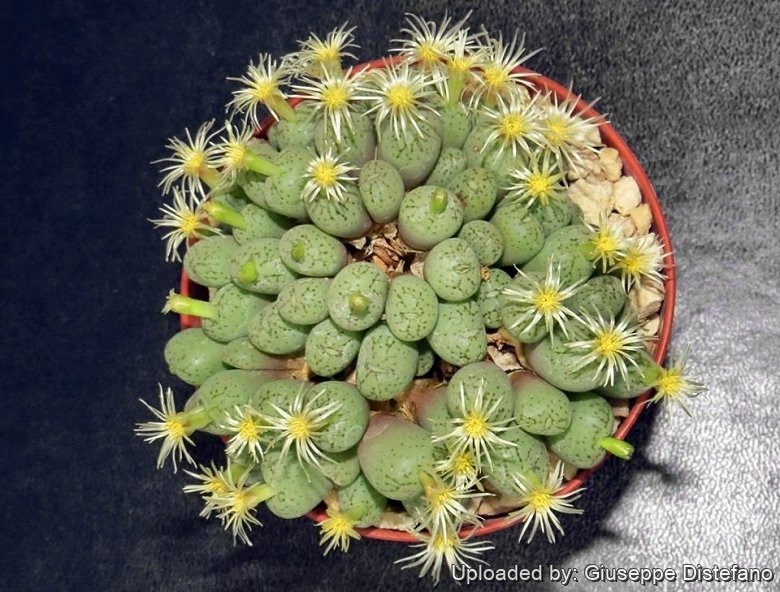
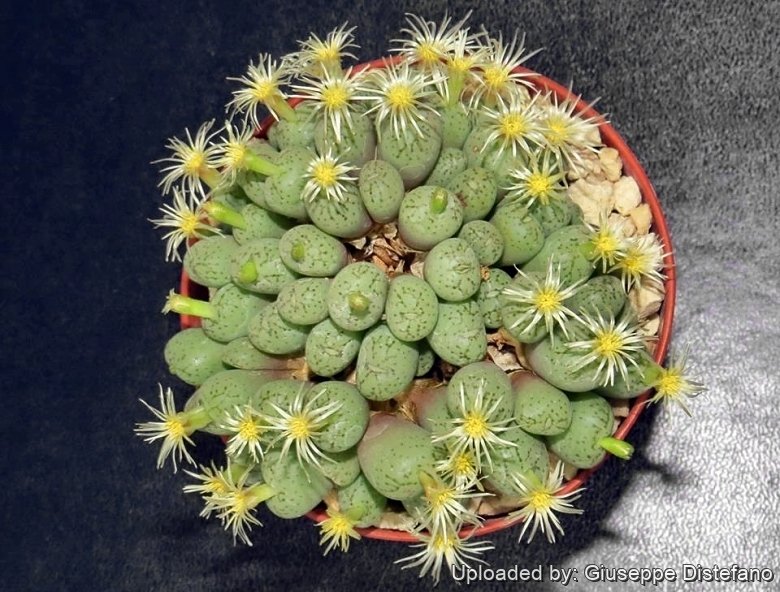
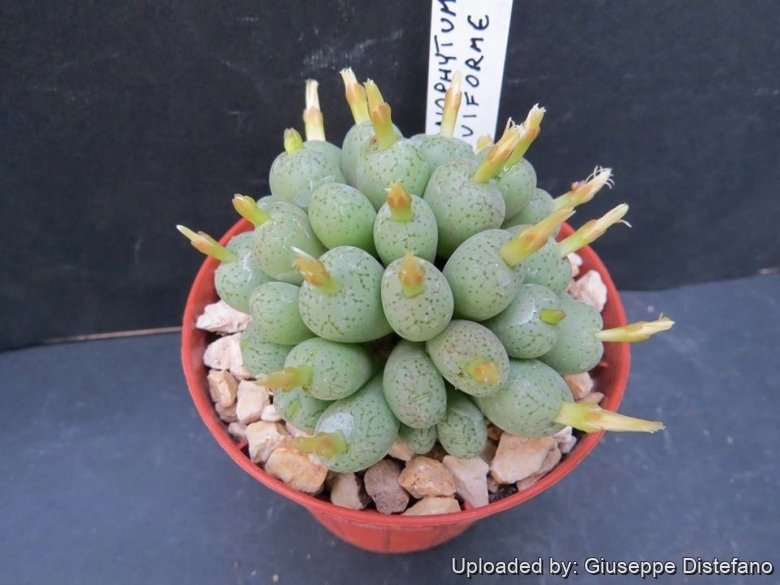
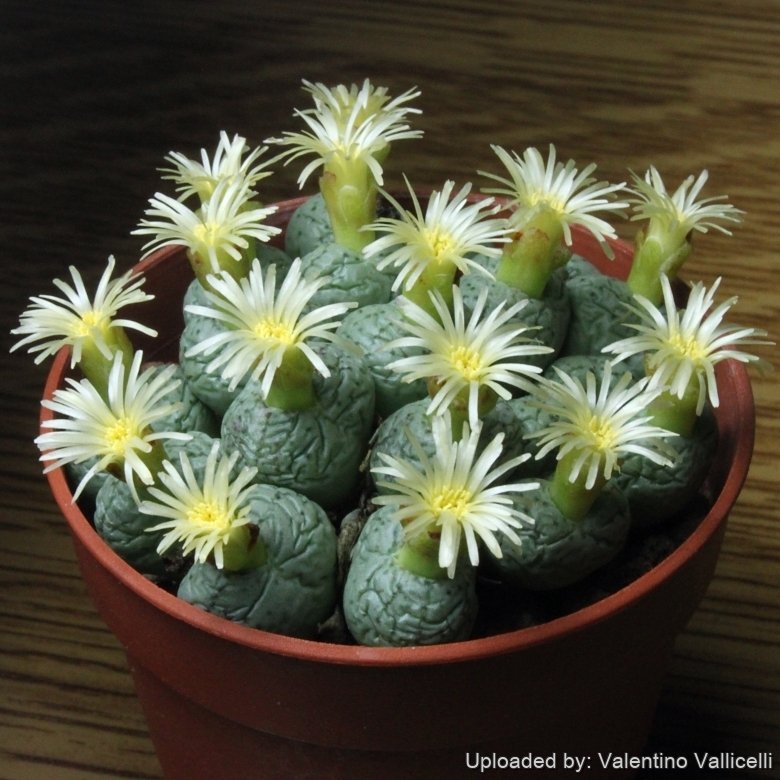
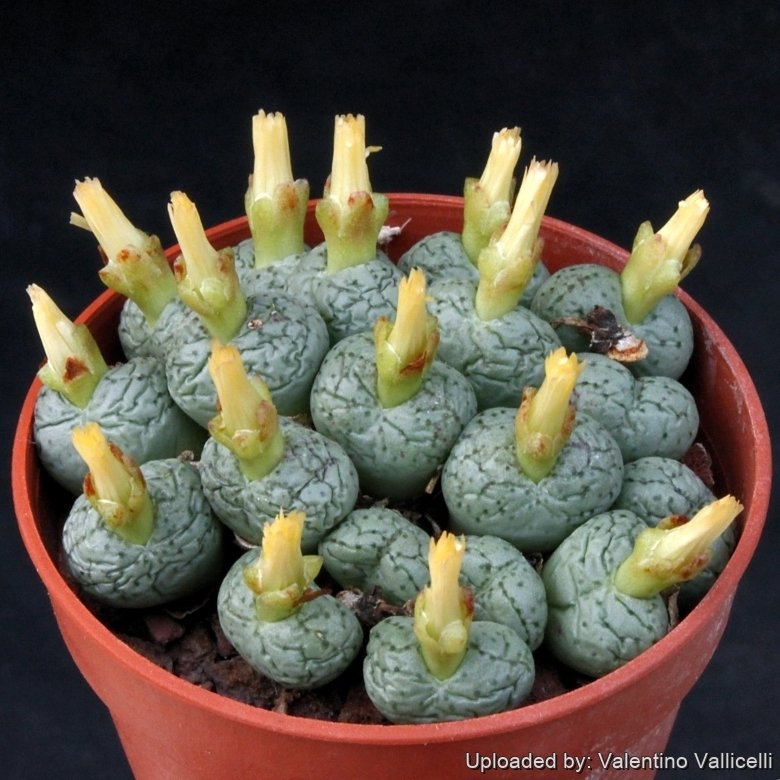
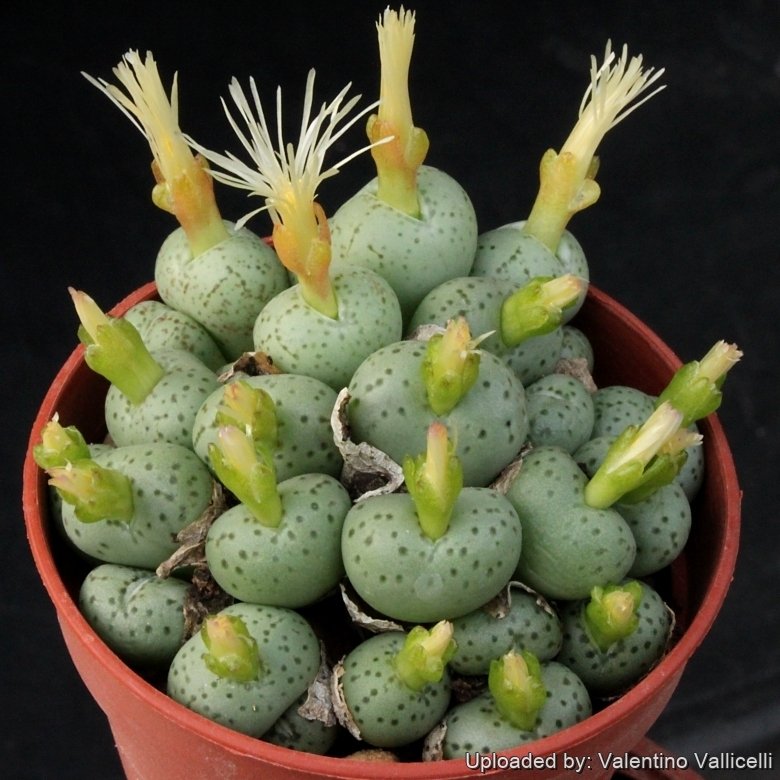
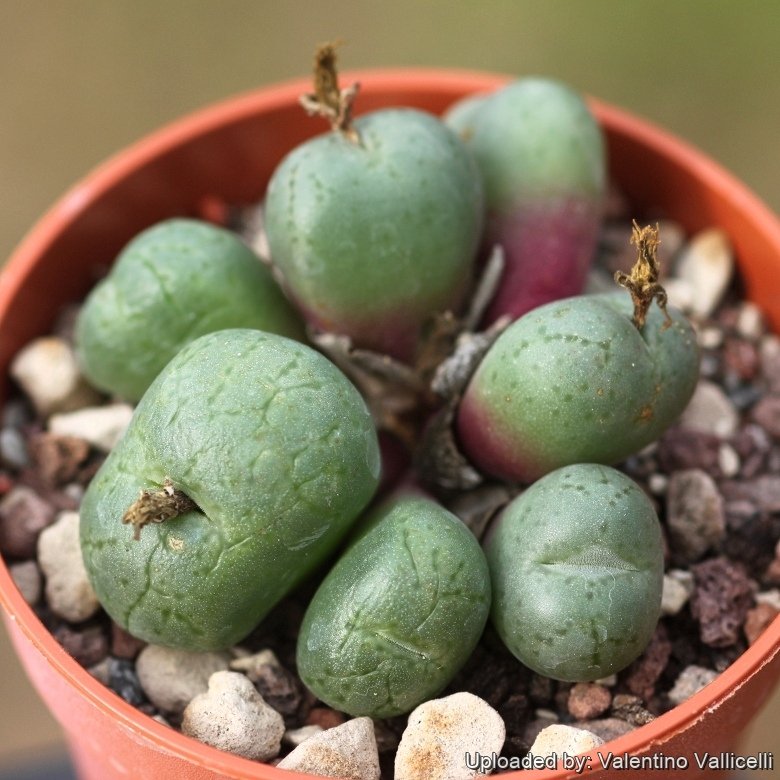
Conophytum uviforme is a dwarf perennial succulent, up to 4 cm tall often forming fairly large mats or domes of small but nicely marked greyish-green to earth-coloured bodies. It is one of the most popular species widely grown by collectors. Some specimens are very attractively coloured and marked.
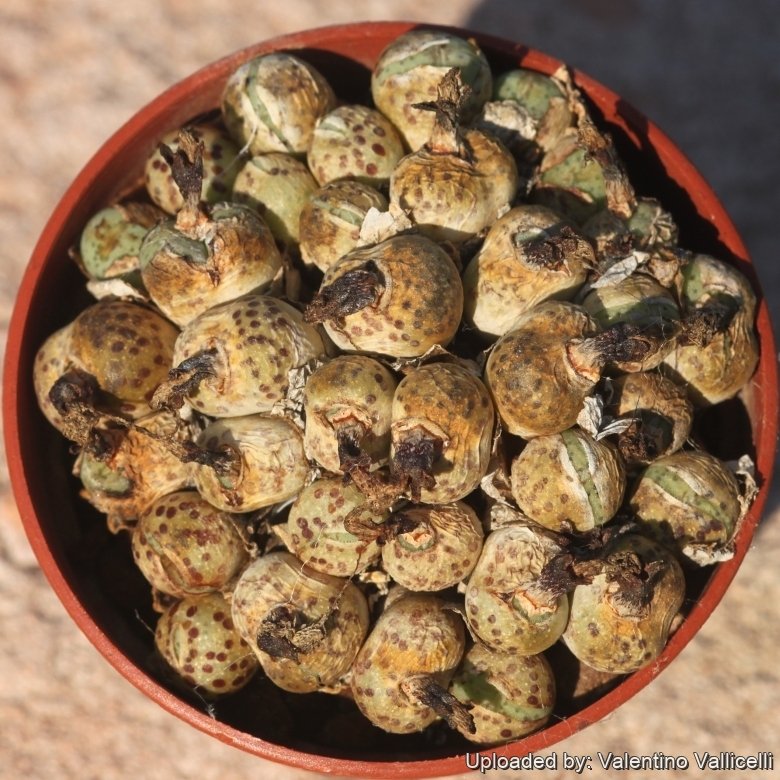
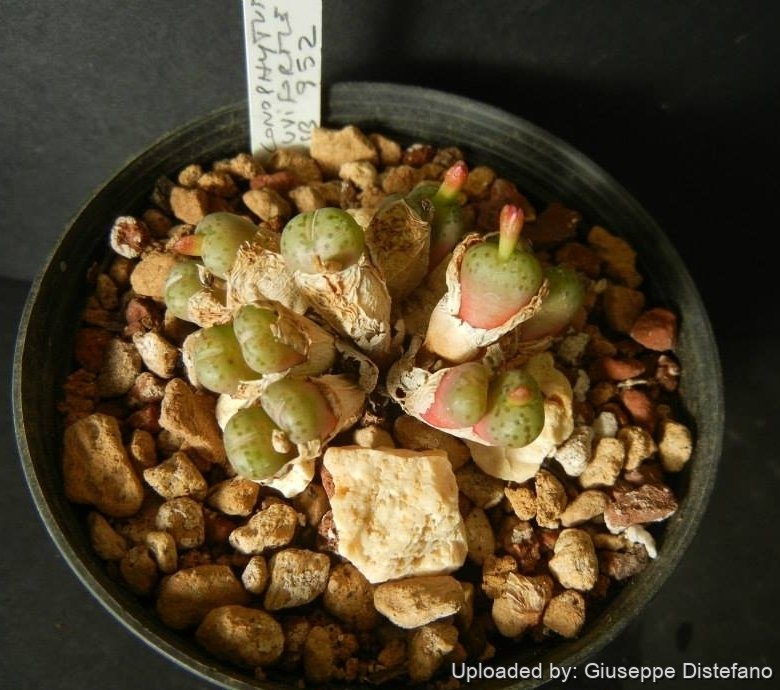
Bodies (Paired leaves): 10-12(-25) mm tall 10-12(-15) mm in diameter, globose to egg-like, apex sometimes slightly bilobed or truncate, glabrous or covered with short, thick trichomes, pale green, greyish-green, yellowish, pinkish-grey, glaucous, brownish, or bronze, with numerous dots more or less in lines on the top. In spring the colour of the old leaves fades, and they shrivel to a thin dry sheath that protects next season’s growth during the summer resting phase.
Flowers: Solitary with a prominent perianth tube, petals white, beige or straw coloured, rarely pale pink or carmine. The stamen in a central column.
Blooming season: Autumn.
Fruit: 4-6-chambered.
Origin and Habitat
South Africa, Northern cape (Calvinia, Namaqualand), Western Cape (Vanrhynsdorp, Vredendal)
Altitude: 200-1200 m.
Habitat: It is ubiquitous in the field and grows in crevices on shale, limestone, quartz, granite, or sandstone often under shrubs. Other commonly associated plant species in the habitat include Euphorbia hamata, Bulbine mesembryanthemoides, Trachyandra tortilis, Argyroderma, delaetii, Argyroderma congregatum, Aloe krapohliana, Conophytum minutum, Conophytum calculus and Tylecodon wallichii.
Cultivation and Propagation
Conophytum uviforme is a “winter” grower which is most active from late winter until later spring and heading for summer dormancy, but in favourable growing conditions it keeps going over the summer too and doesn’t need particular care. All the forms of Conophytum uviforme have the advantage of extreme ease of growth.
Soil: Requires good drainage as it it is prone to root rot. It can grows outdoor in sunny, dry, rock crevices (protection against winter wet is required) It can also be cultivated in alpine house, in poor, drained soil.
Watering: It requires little water; otherwise its epidermis breaks (resulting in unsightly scars). Water minimally in summer, (only when the plant starts shrivelling), but it will generally grow even in summer if given water. Water regularly in winter after the previous year’s leaves have dried up. Requires good drainage.
Fertilization: Feed it once during the growing season with a fertilizer specifically formulated for cactus succulents (poor in nitrogen), including all micro nutrients and trace elements diluted to ½ the strength recommended on the label. It thrives in poor soils and need a limited supplies of fertilizer to avoid the plants developing excess vegetation, which is easily attacked by fungal diseases.
Exposure: Keep cool and shaded in summer, it needs full sun or light shade.
Temperature: Hardy to -2°C. Ensure a very good ventilation.
Repotting: Avoid to repot frequently. This plant may stay in the same pot for many years.
Uses: Container, rock garden.
Pests and diseases: It is vulnerable to mealybugs and rarely scale.
Propagation: It can be reproduced both by cuttings and seeds. Take the cutting from a grown-up mother plant. Each cutting must contain one or more heads along with a fraction of root. It is easily propagated by seed. The small seeds can be sown in pots of fine, well-drained sand, any time during the spring and summer months when temperatures are warm. Cover the seeds with a very fine layer of grit and water from below with a fungicide to prevent damping off. For the first 3-4 days cover the pots with a sheet of glass/clear perspex to keep the humidity levels high. Remove the glass and replace it with light shadecloth and mist once or twice a day for the next two weeks after which most seeds should have germinated. From then on mistings can be reduced to every second and then every third day as the little plants grow.
Bibliography
Major refences and further lectures
-
Heidrun E. K. Hartmann (2001) “Aizoaceae A – E” Springer
-
Linda R. Berg “Introductory Botany: Plants, People, and the Environment” Cengage Learning, 02/Mar/2007
-
Steven A. Hammer “Dumpling and his wife: new views of the genus Conophytum” EAE Creative Colour Ltd., 2002
-
Dieter J. Von Willert “Life strategies of succulents in deserts: with special reference to the Namib desert” CUP Archive, 1992
-
Paul Keddy “Plants and Vegetation: Origins, Processes, Consequences” Cambridge University Press, 07/Jun/2007
-
George Willard Brown “Desert Biology: Special Topics on the Physical and Biological Aspects of Arid Regions” Volume 2 Academic Press, 01/Jun/1974
-
Roger Spencer “Horticultural Flora of South-eastern Australia.” Volume 2, Flowering Plants: “Dicotyledons. Part 1, the Identification of Garden and Cultivated Plants UNSW Press, 1995
-
Gard. Chron., ser. 3 72: 54 (1922)
-
Erhardt, W. et al. 2008. “Der große Zander: Enzyklopädie der Pflanzennamen.”
10)Germishuizen, G. & N. L. Meyer, eds. 2003. “Plants of southern Africa: an annotated checklist.” Strelitzia 14.
-
Huxley, A., ed. 1992. “The new Royal Horticultural Society dictionary of gardening.” (as: uvaeforme)
-
S. M Walters “The European Garden Flora Flowering Plants: Casuarinaceae to Aristolochiaceae” Cambridge University Press, 1989
From llifle page Conophytum hillii
Description
Conophytum hillii is another species of the Conophytum uviforme complex distinguished by grey-red bodies.
Note: Conophytum uviforme is a very variable species comprising many morphological and geographical variant that was early classified as different independent species. Nowadays all this plant are considered part of a multiform species, where each form is linked to others by populations of plants with intermediate characteristics.
Habit: Conophytum hillii is a dwarf perennial succulent, up to 4 cm tall often forming fairly large mats or domes. Some specimens are very attractively coloured and marked.
Bodies (Paired leaves): Small, globose to egg-like, apex sometimes slightly bilobed or truncate, glabrous or covered with short, thick trichomes, pale grey-red, with more or less numerous dots on the top. In spring the colour of the old leaves fades, and they shrivel to a thin dry sheath that protects next season’s growth during the summer resting phase.
Flowers: Solitary with a prominent perianth tube, petals white, beige or straw coloured, rarely pale pink or carmine. The stamen in a central column.
Blooming season: Autumn.
Fruit: 4-6-chambered.
Origin and Habitat
Vosfontein, Western Cape, South Africa.
Cultivation and Propagation
Conophytum hillii is a “winter” grower which is most active from late winter until later spring and heading for summer dormancy, but in favourable growing conditions it keeps going over the summer too and doesn’t need particular care. All the forms of Conophytum uviforme have the advantage of extreme ease of growth.
Soil: Requires good drainage as it it is prone to root rot. It can grows outdoor in sunny, dry, rock crevices (protection against winter wet is required) It can also be cultivated in alpine house, in poor, drained soil.
Watering: It requires little water; otherwise its epidermis breaks (resulting in unsightly scars). Water minimally in summer, (only when the plant starts shrivelling), but it will generally grow even in summer if given water. Water regularly in winter after the previous year’s leaves have dried up. Requires good drainage.
Fertilization: Feed it once during the growing season with a fertilizer specifically formulated for cactus succulents (poor in nitrogen), including all micro nutrients and trace elements diluted to ½ the strength recommended on the label. It thrives in poor soils and need a limited supplies of fertilizer to avoid the plants developing excess vegetation, which is easily attacked by fungal diseases.
Exposure: Keep cool and shaded in summer, it needs full sun or light shade.
Temperature: Hardy to -2°C. Ensure a very good ventilation.
Repotting: Avoid to repot frequently. This plant may stay in the same pot for many years.
Uses: Container, rock garden.
Pests and diseases: It is vulnerable to mealybugs and rarely scale.
Propagation: It can be reproduced both by cuttings and seeds. Take the cutting from a grown-up mother plant. Each cutting must contain one or more heads along with a fraction of root. It is easily propagated by seed. The small seeds can be sown in pots of fine, well-drained sand, any time during the spring and summer months when temperatures are warm. Cover the seeds with a very fine layer of grit and water from below with a fungicide to prevent damping off. For the first 3-4 days cover the pots with a sheet of glass/clear perspex to keep the humidity levels high. Remove the glass and replace it with light shadecloth and mist once or twice a day for the next two weeks after which most seeds should have germinated. From then on mistings can be reduced to every second and then every third day as the little plants grow.
Source: Conophytum hillii, LLIFLE - Encyclopedia of living forms, CC-BY-SA, retrieved 2026-10-25.
Cultivars and forms (3)
Subspecies (1)
Gallery