Publication: Kaktus-ABC [Backeb. & Knuth] 280. 1936 [12 Feb 1936]
Description
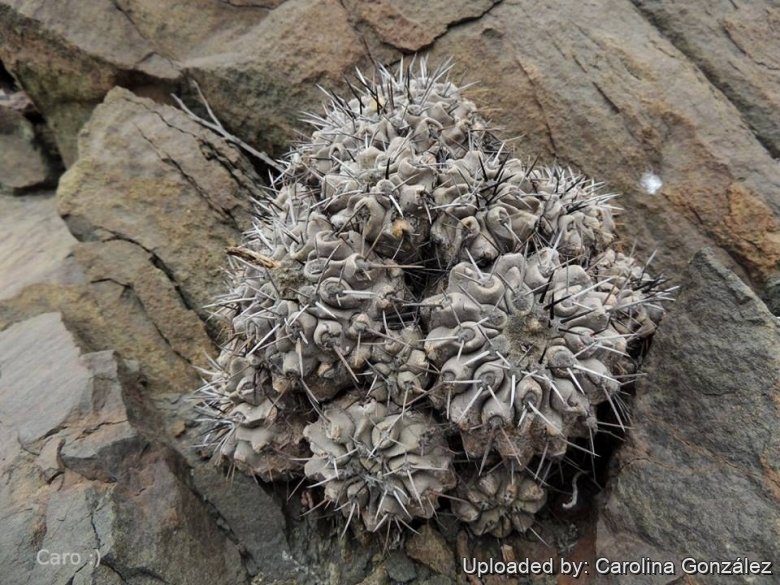
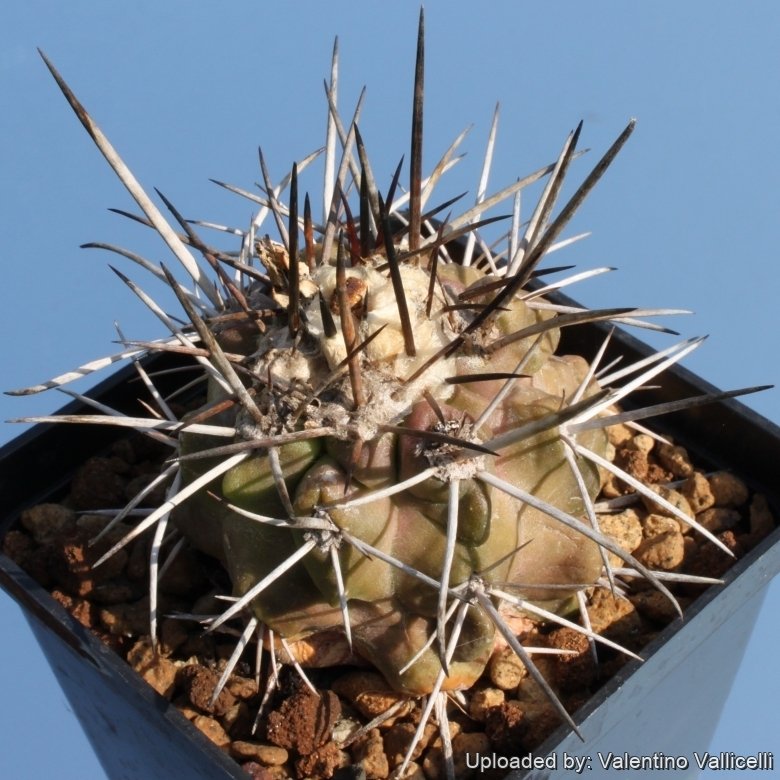
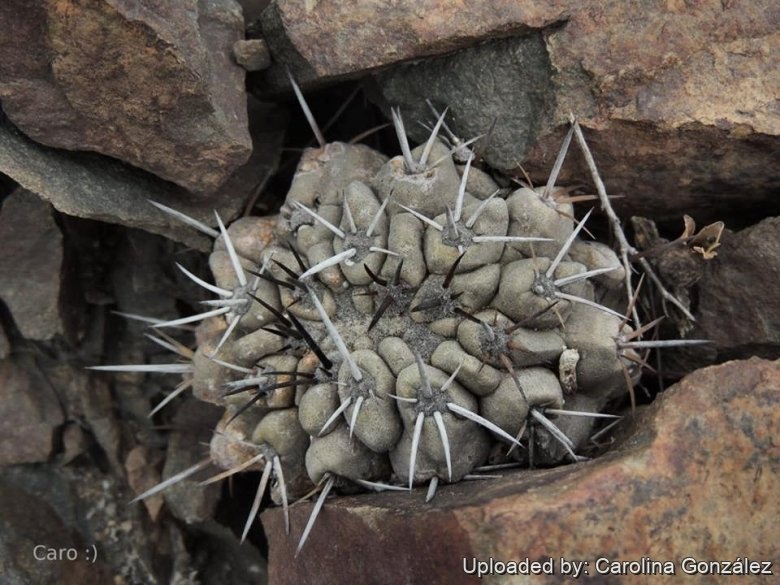
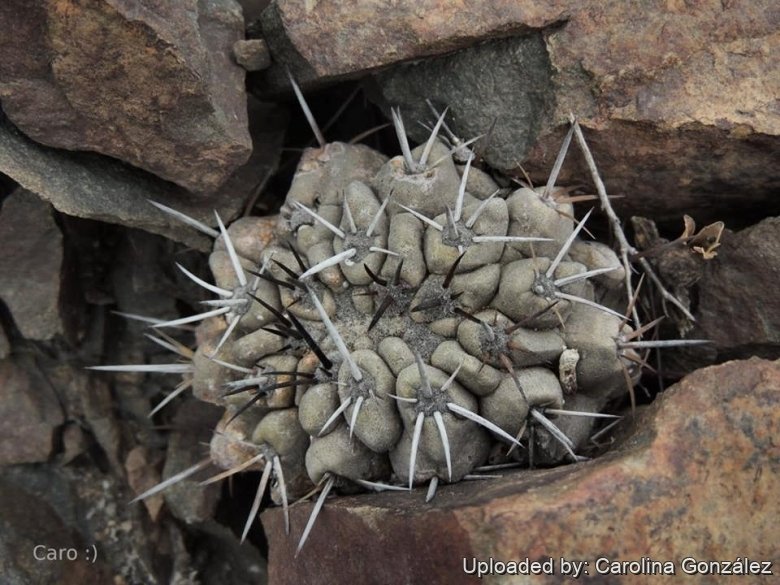
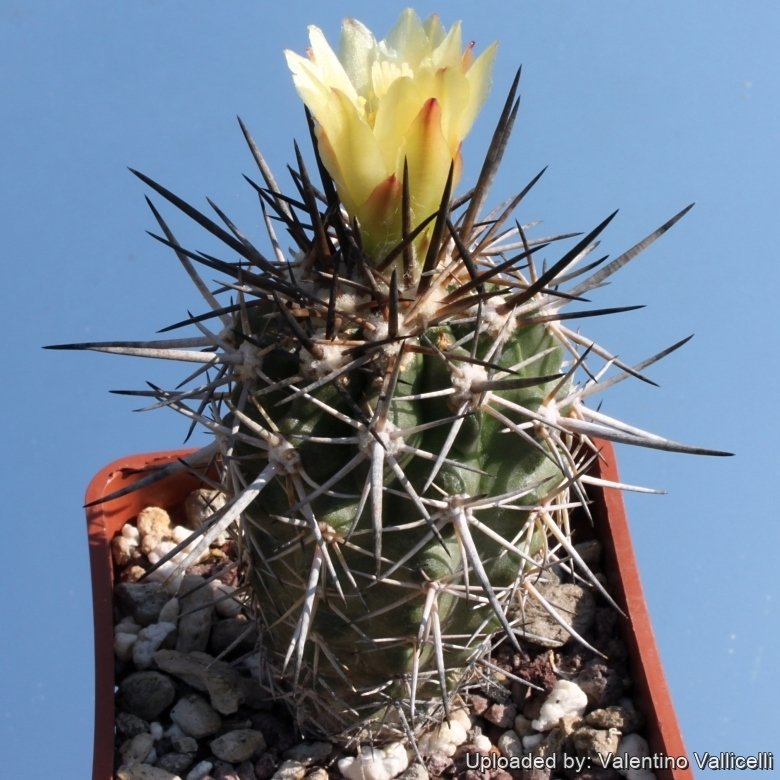
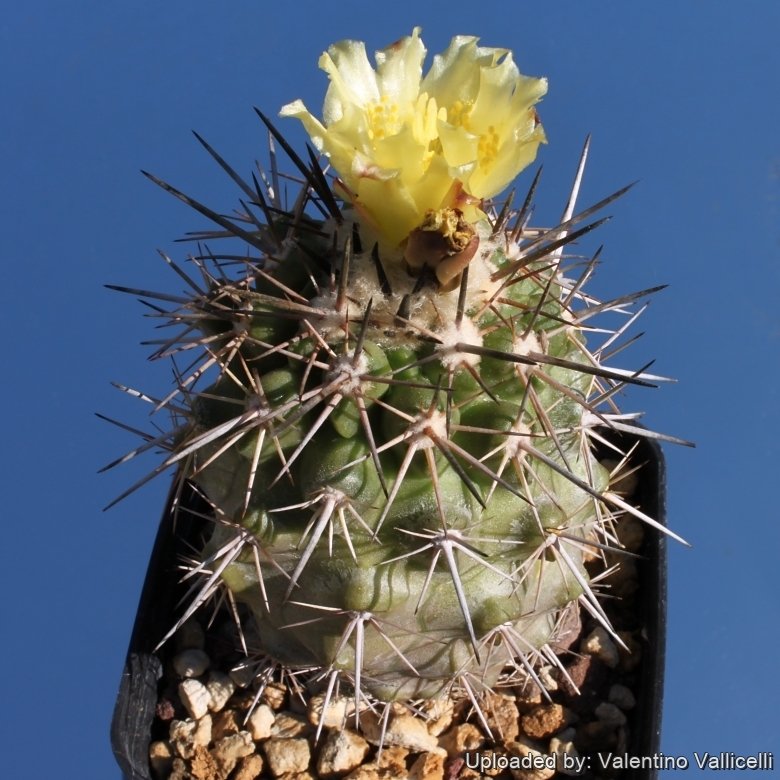
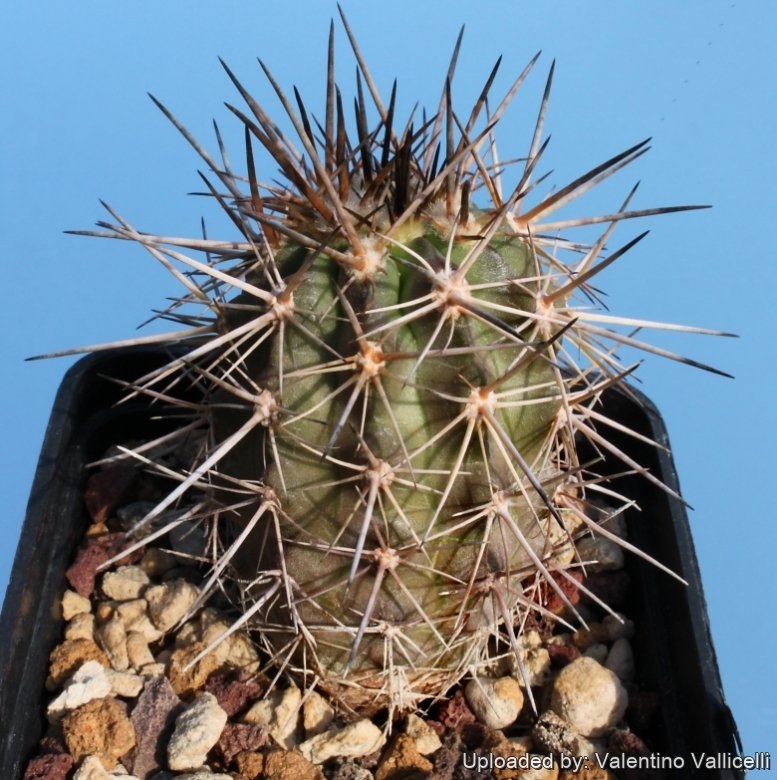
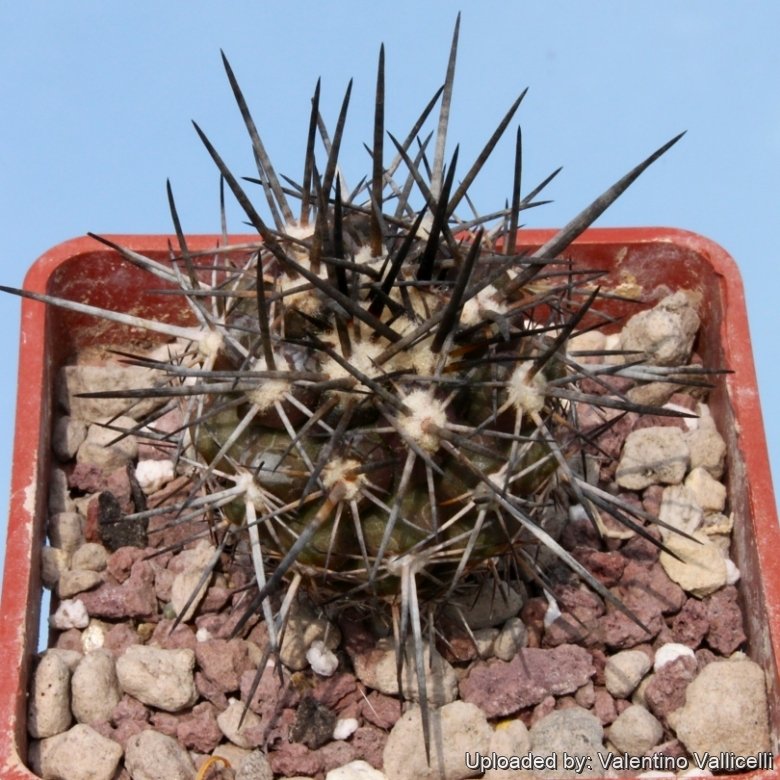
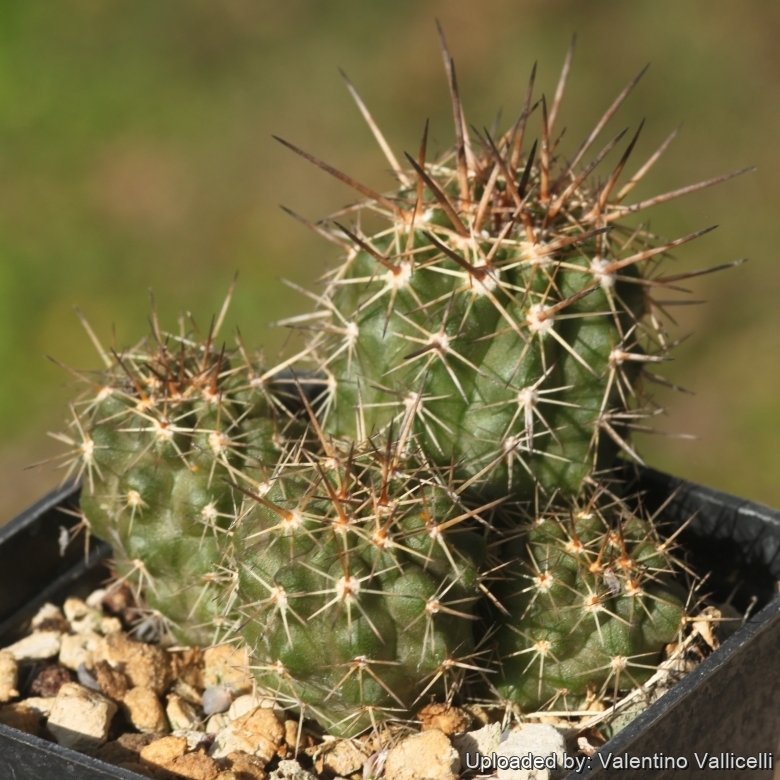
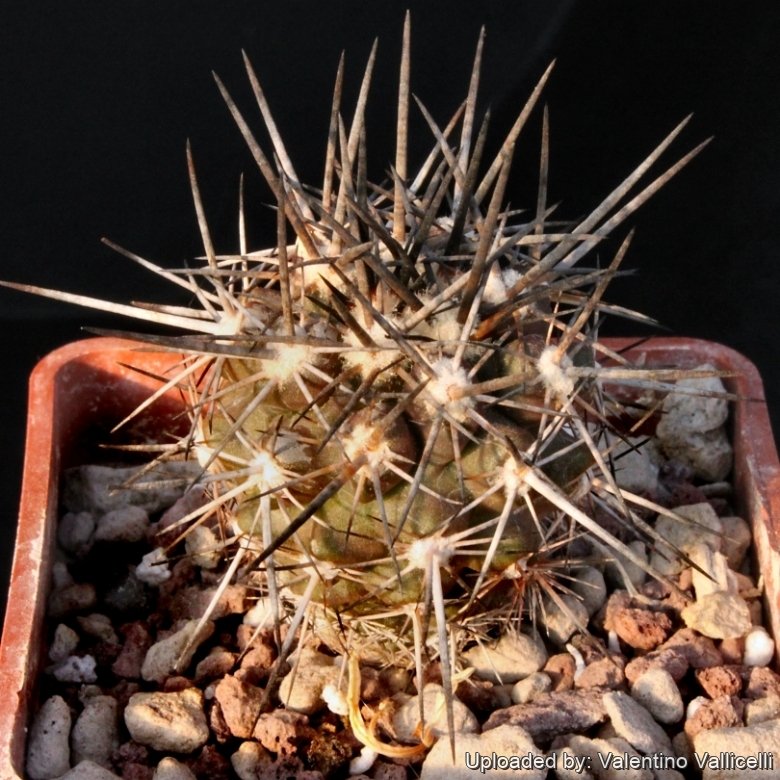
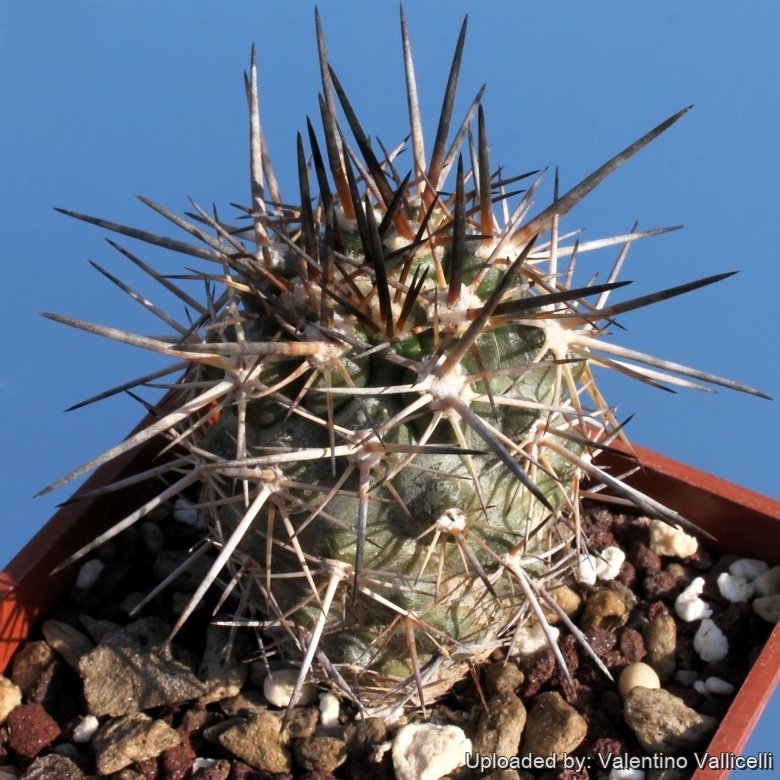
Copiapoa fiedleriana, first described by Schumann as Echinocactus fiedlerianus in 1903, was included in Copiapoa by Backeberg in 1935 and then reduced to a variety of Copiapoa coquimbana by Hoffmann in 1989. It is a strongly spined solitary to many-stemmed grey succulent of unusual form which you could describe as intermediate between Copiapoa coquimbana and Copiapoa megarhiza var. echinata, which occurs further north. The distinguishing characteristic of this species is a prominent protuberance below the areole, more pronounced than in any other species of Copiapoa. Typical plants from Huasco usually lack central spines, but it is quite variable and plants with or without central spines are found close to each other even in the some pupulation.
Derivation of specific name: The specific epithet honors the German master carpenter and cactus lover Rudolf Fiedler from Berlin.
Roots: Large, napiform, fleshy.
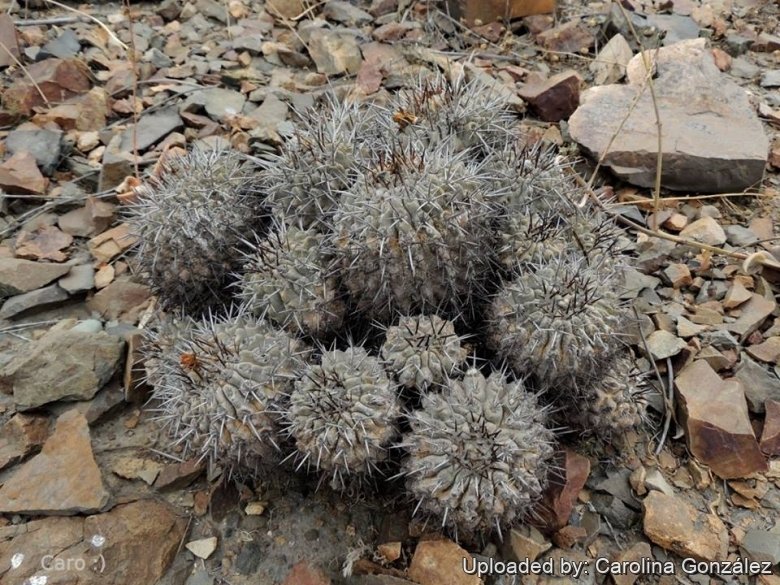
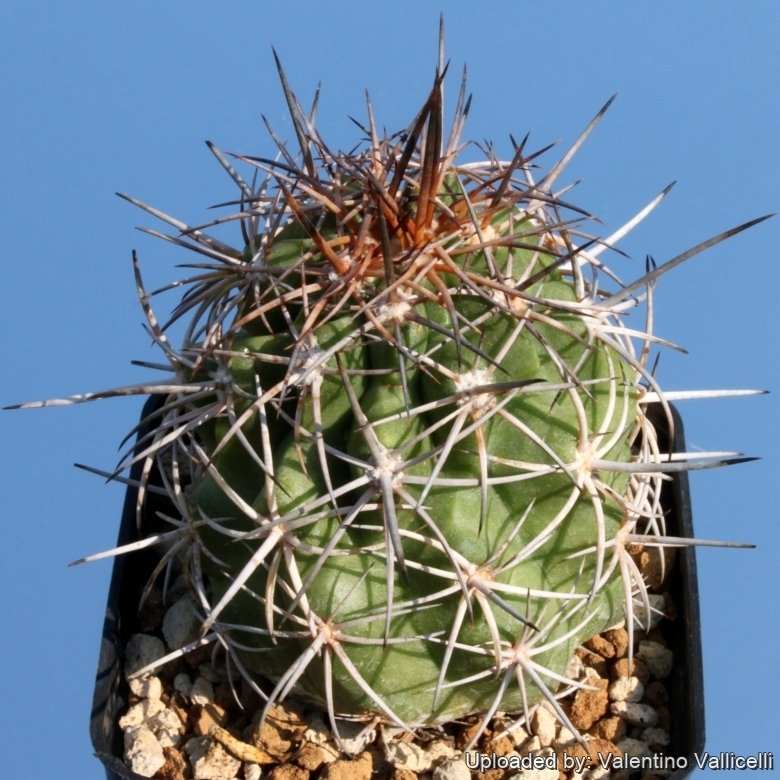
Stems: Globose, not elongated, grey-green to brown, 5-8 cm tall and in diameter. Cespitose from the base, forming dense cushions.
Ribs: 15-20, straight, deeply crenate, laterally compressed, conspicuously tuberculate below the areoles.
Areoles: Round to oval 4-7 mm long, grey, 20 mm apart.
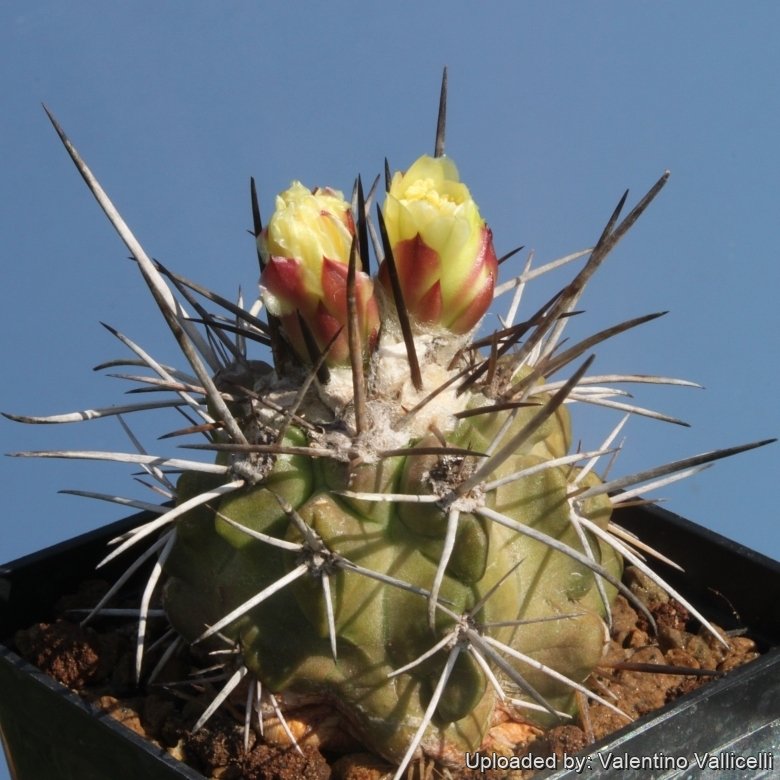
Spines: Blackish or brown, greyish with age.
Central spines: Usually absent (if present usually 1 to 4 porrect and stiff similar in size and colour to the radials).
Radial spines: 4-8, needle-like, rigid, straight to slightly curved, 8-30 mm long.
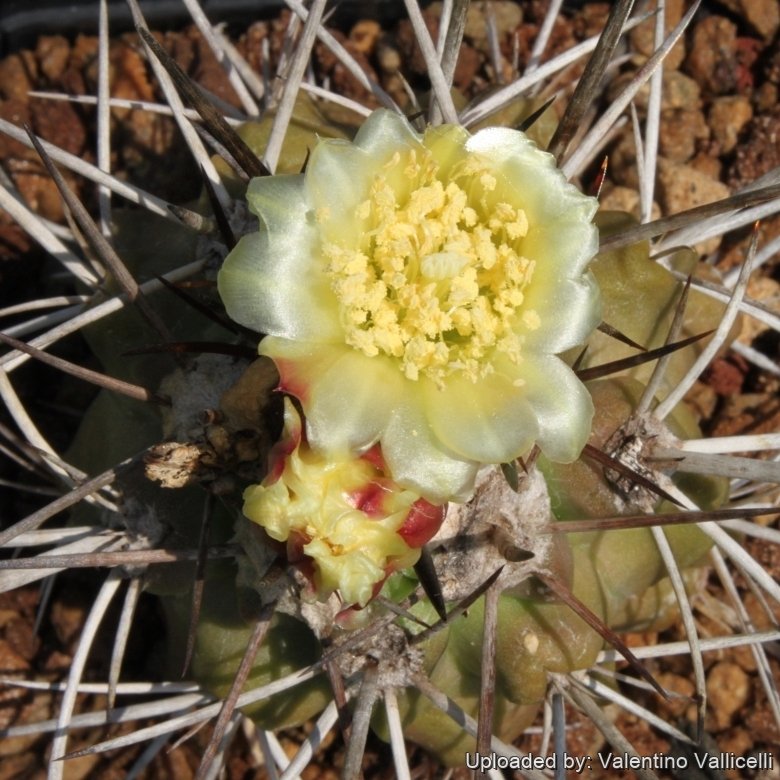
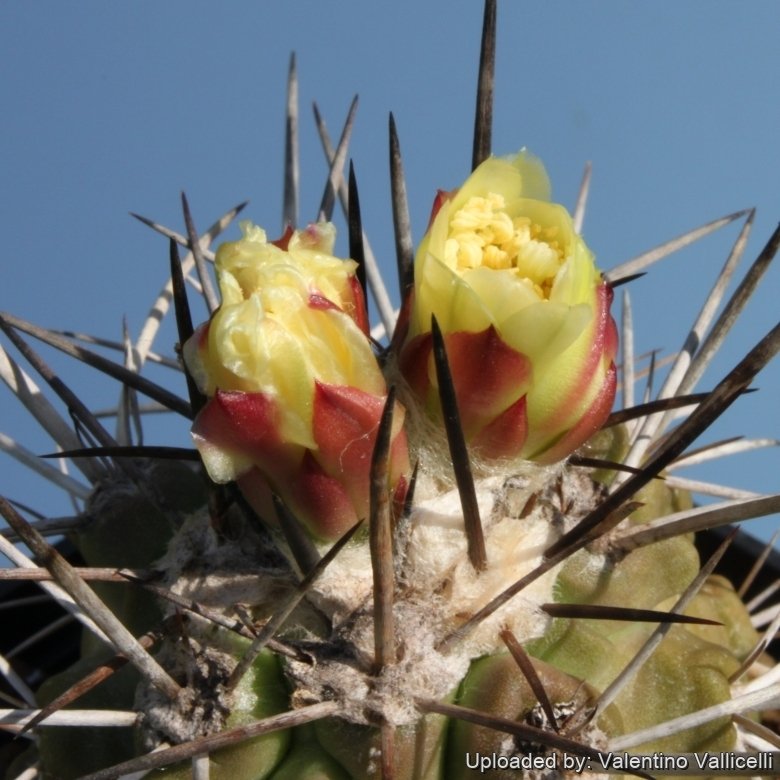
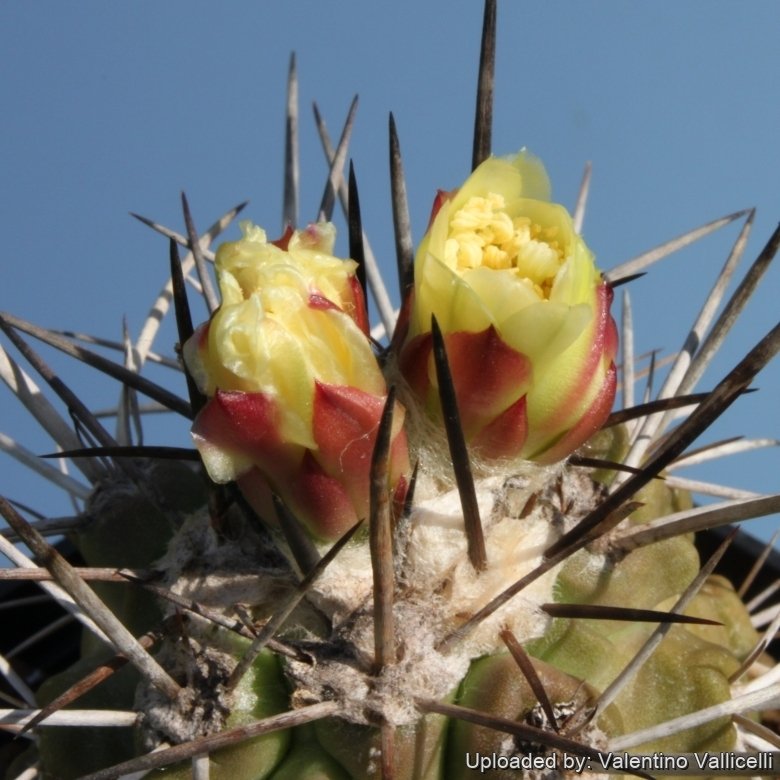
Flowers: Yellow, 2.5-3 cm long. Inner tepals lemon-yellow, outer tepals with a red central stripe on the tip.
Fruits: Globose 10-15 mm in diameter, greenish with few long reddish scales.
Seeds: c. 1.5 mm long.
Taxonomy note. Copiapoa fiedleriana is possibly the same plant as Echinocactus cupreatus Poselger ex Hildmann (1885), which was based on a cultivated plant of unknown origin, but interestingly the description made reference to protuberances, so this, together with body colour, suggests that it might that it might have been this plant.
Origin and Habitat
Copiapoa fiedleriana is endemic to Chile, where it occurs in Atacama, around Huasco to north of Carrizal Bajo. Extent of occurrence of approximately 800 km2. C. fiedleriana was originally described from the sea shore at Huasco, near the mouth of the valley in which Nicolasa is situated.
Altitude range: It grows at elevations of 0 to 600 m asl.
Habitat and Ecology: The species grows not along the coast but in dry coastal hills (lomas costeras) overlooking the lower reaches of the Huasco valley, where it forms clumps of dark-bodied, spherical heads. The area is rich in other cactus species with Eriosyce villosa, Eriosyce napina, Eulycbnia acida and Echinopsis coquimbana growing in association. The species is overall decreasing even if locally abundant (there are several hundreds of individuals), and there is a continuing decline of habitat quality and the number of mature individuals due to the effect of off-road vehicles, urbanization and industry in the species range.
Cultivation and Propagation
This species need full sun otherwise the bodies tended to elongate in cultivation, but should be protected from excessive heat and sun in summer, Require light watering, good drainage, and deep pot to accommodate tap root. Keep warm and dry in winter to avoid rot. Frost tolerance 0°C.
Propagation: Seeds (offsets rarely), Grafting is often used to speed growth rate and to create a back-up to plants in collection.
Bibliography
Major references and further lectures
-
Graham Charles “Copiapoa. The Cactus file Handbook 4” Cirio Pub. Services, 1999
-
Faundez, L., Guerrero, P., Walter, H.E. & Saldivia, P. 2013. Copiapoa fiedleriana. The IUCN Red List of Threatened Species 2013: e.T152115A598694. http://dx.doi.org/10.2305/IUCN.UK.2013-1.RLTS.T152115A598694.en. Downloaded on 19 February 2016.
-
F. Ritter “Kakteen in Sudamerika” Volume 3. 1980
-
A. Hoffmann, H. Walter “Cactáceas en la flora Silvestre de Chile” Ediciones Fundacion Claudio Gay, Santiago, Chile. Second Edition. 2004
-
Edward Anderson “The Cactus family” Timber Press, Incorporated, 2001
-
James Cullen, Sabina G. Knees, H. Suzanne Cubey “The European Garden Flora Flowering Plants: A Manual for the Identification of Plants Cultivated in Europe, Both Out-of-Doors and Under Glass” Cambridge University Press, 11/Aug/2011
-
David R Hunt; Nigel P Taylor; Graham Charles; International Cactaceae Systematics Group. “The New Cactus Lexicon” dh books, 2006
-
N. L. Britton, J. N. Rose “The Cactaceae. Descriptions and Illustrations of Plants of the Cactus Family.” Volume 3, The Carnegie Institution of Washington, Washington 1922
-
Curt Backeberg. “Die Cactaceae” volume 3, 1959
-
Curt Backeberg, Frederik Marcus Knuth: “Kaktus-ABC. En haandbog for fagfolk og amatører.” Kopenhagen 1936
-
Florencia Señoret Espinosa, Juan Pablo Acosta Ramos “Guía de Campo Cactáceas Nativas De Chile” Corporación Chilena de la Madera (CORMA) 2013 Retrieved 02 February 2016 from <http://www.corma.cl/\_file/material/cactaceas\_chilenas\_2013.pdf\>
From llifle page Copiapoa echinata
Description
It is a small and usually branched very spiny cactus.
Stem: Spherical 50-100 mm in diameter dull greyish-green.
Root: Long tap-root.
Ribs: 10-20
Areoles: 4-6 mm wide with grey felt abour 5-8 mm apart.
Spines: Usually straight black or brown becoming to grey as they ages up to 30 mm long. Radial spines 6-10, central spines 1-4 very similar in size and colour to the radials.
Flower: Unscented, funnel-shaped 3-4 cm long, pale yellow. Tube with few yellow scales. Tepals 5-6 mm large yellow with reddish tips. Anthers sulphur yellow. Stigma 12-lobed yellow.
Fruit: Spherical about 10 mm in diameter, green with 2-3 brownish-green scales.
Seed: 1,4 × 0,9 × 0,6 mm, black, shining.
Origin and Habitat
Monte Amargo river (Copiapó ) to Carrizal Bajo.
Source: Copiapoa echinata, LLIFLE - Encyclopedia of living forms, CC-BY-SA, retrieved 2026-10-25.
Gallery