Publication: Cactus & Co. 14(4): 10 (5-15, figs.). 2011 [2010 publ. Feb 2011]
Description
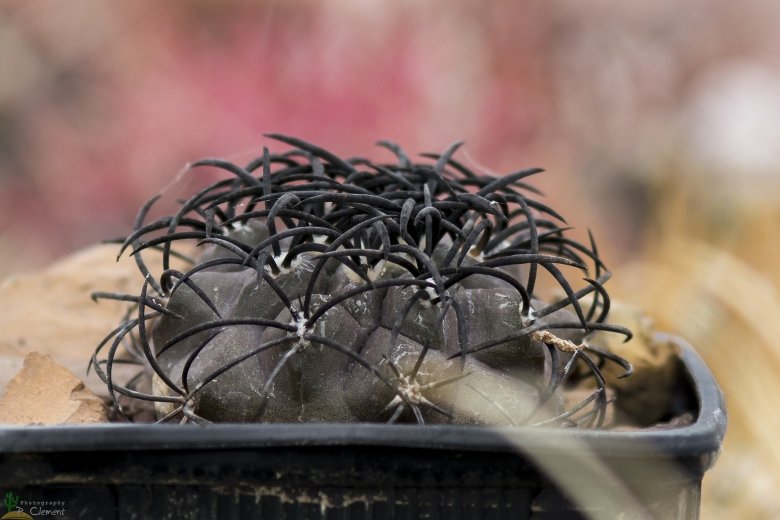
Copiapoa griseoviolacea appears to be an attractive southern form of Copiapoa dura (Copiapoa echinoides) from which it differs by its epidermis and dense spine covering. It may grow solitary or often in more or less dense clumps.
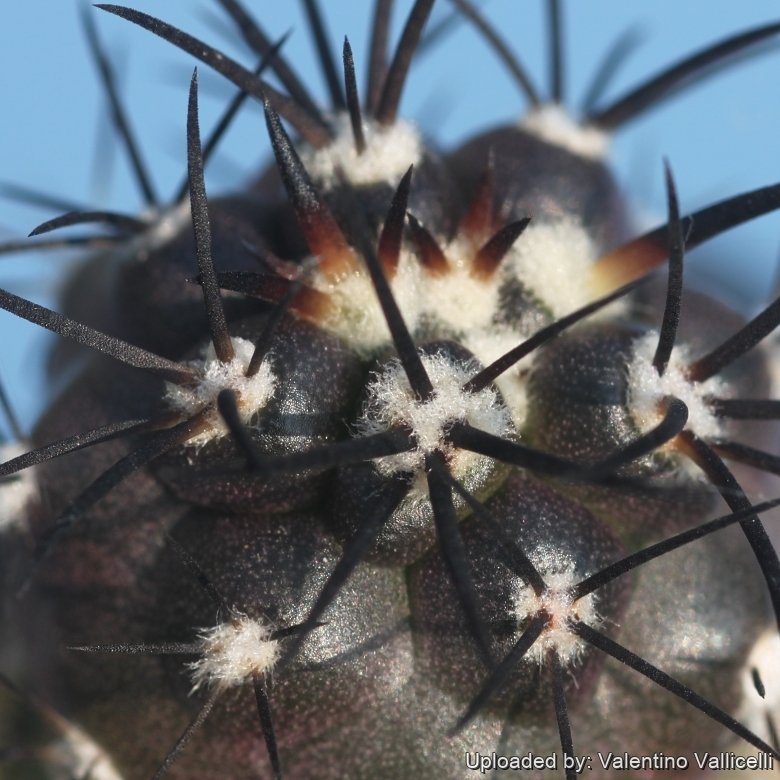
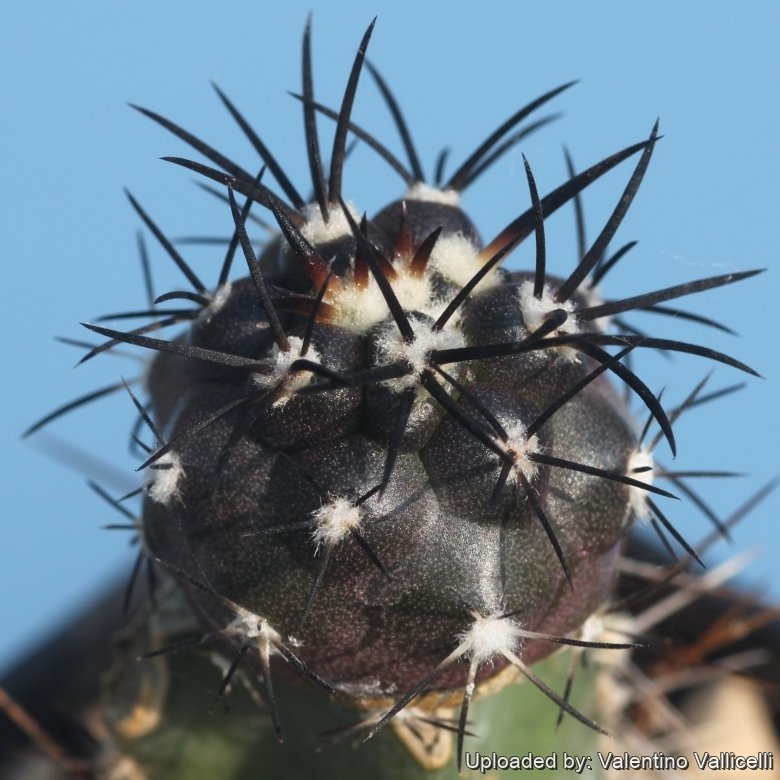
Stem: Spherical-flattened, firm, woolly apically, epidermis dark tannish-green densely covered by a thick farinose violet-grey layer of wax, hence the name.
Spines: Anthracite grey, stout, curved inward and interlacing.
Origin and Habitat
South of Huasco River ( south Freirina), region 03 Atacama, Central Chile (Southern South America)
Altitude: 320-830 m.
Habitat: Copiapoa griseoviolacea grows abundantly at the bottom of hills in the dry river banksof the Huasco River with few sparse specimens scattered on up to the top of the hill.
Cultivation and Propagation
The location has to be warm and bright, and it has to be in direct sun. Otherwise the bodies tend to elongate in cultivation, but they should be protected from excessive heat and sun in summer. In the spring and late summer, water moderately. Between these times there are dry rest periods. In the winter keep the plant absolutely dry. The roots need a lot of room, so make sure that the pot is large enough. Use regular cacti soil with very good drainage.
Keep warm and dry in winter (10°C) to avoid rot. Not highly tolerant of a great deal of frost. (Frost tolerance 0°C)
Propagation: Seeds (offsets rarely), Grafting is often used to speed growth rate of seedlings and to create a back-up to plants in collection.