Publication: Cactées 35 1868
Description
This is a very variable species, normally solitary, rarely sprouting.
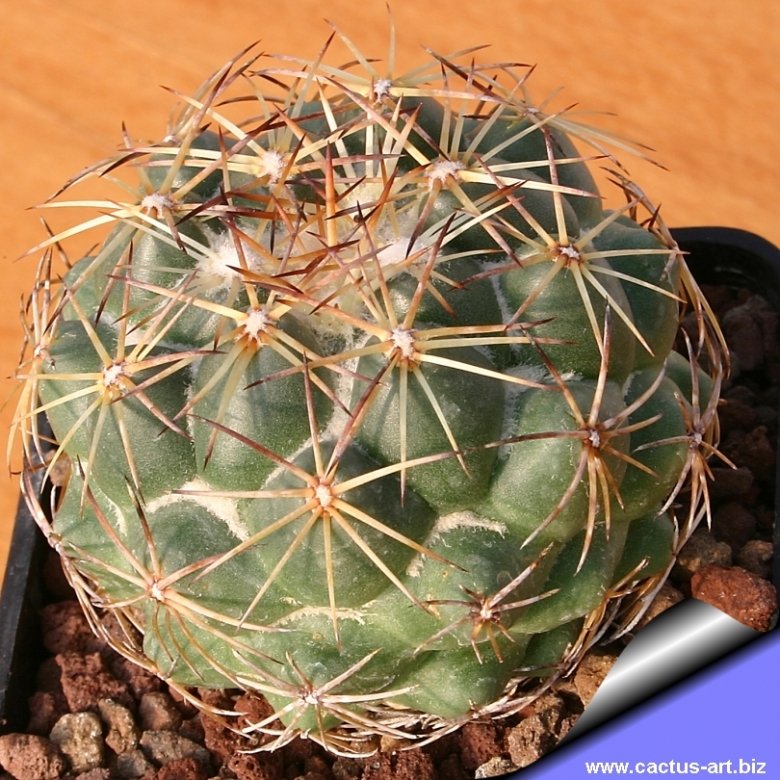
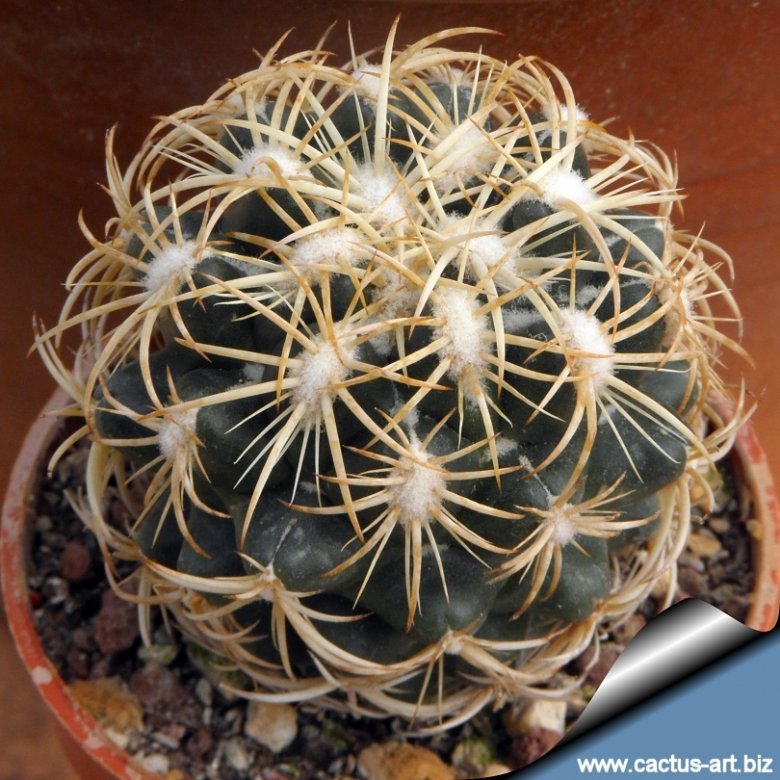
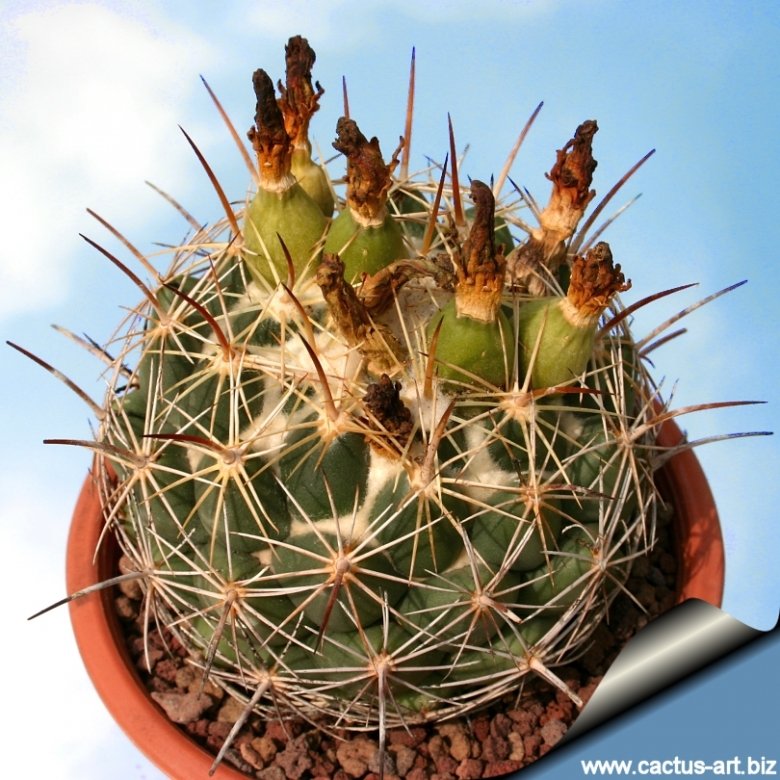
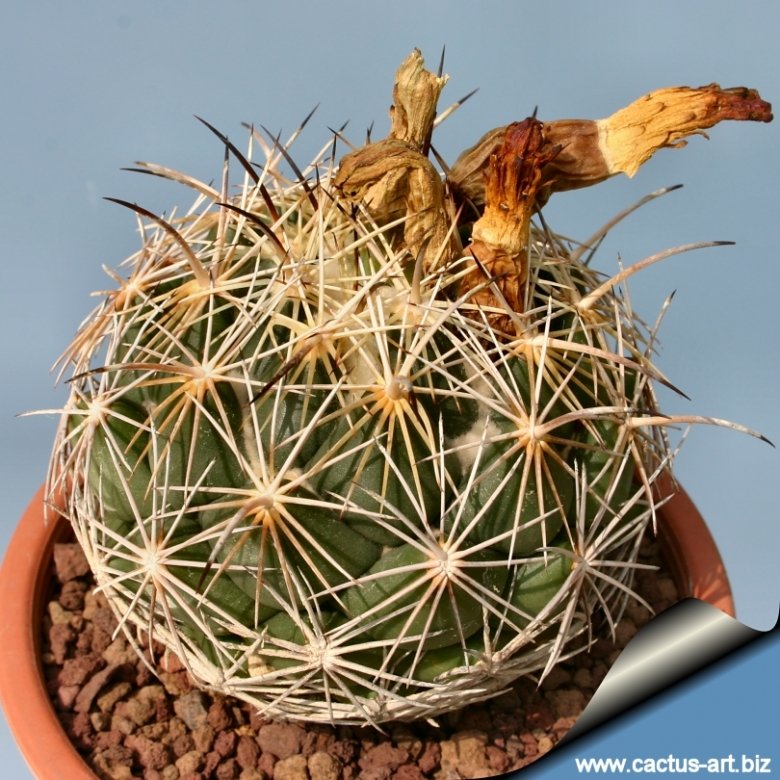
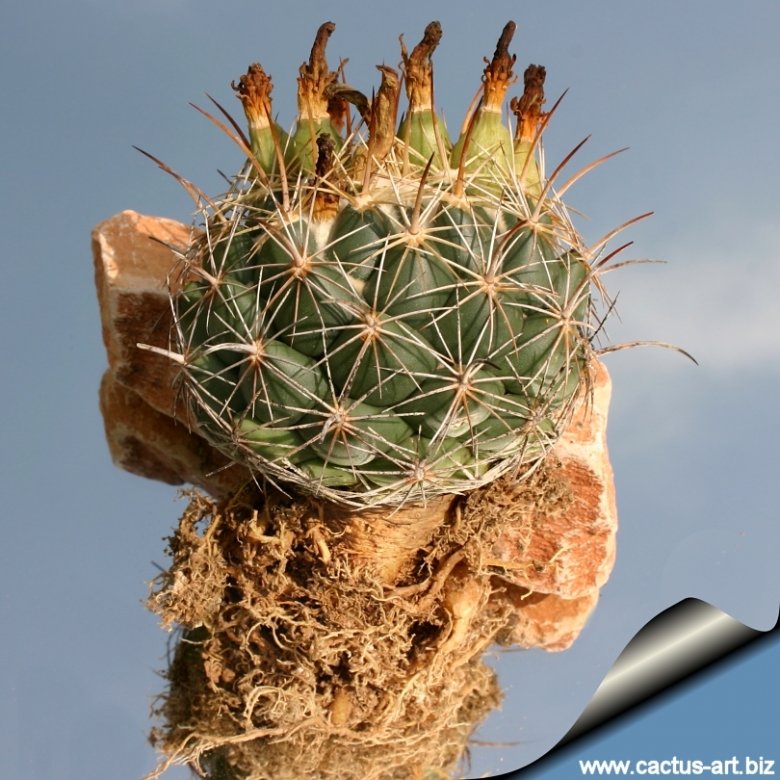
Stem: Flat globose to cylindrical, up to 8-15 cm in diameter, 6-12 cm tall, dull olive-green, apex depressed, with a blunt, depressed apex covered with e wool.
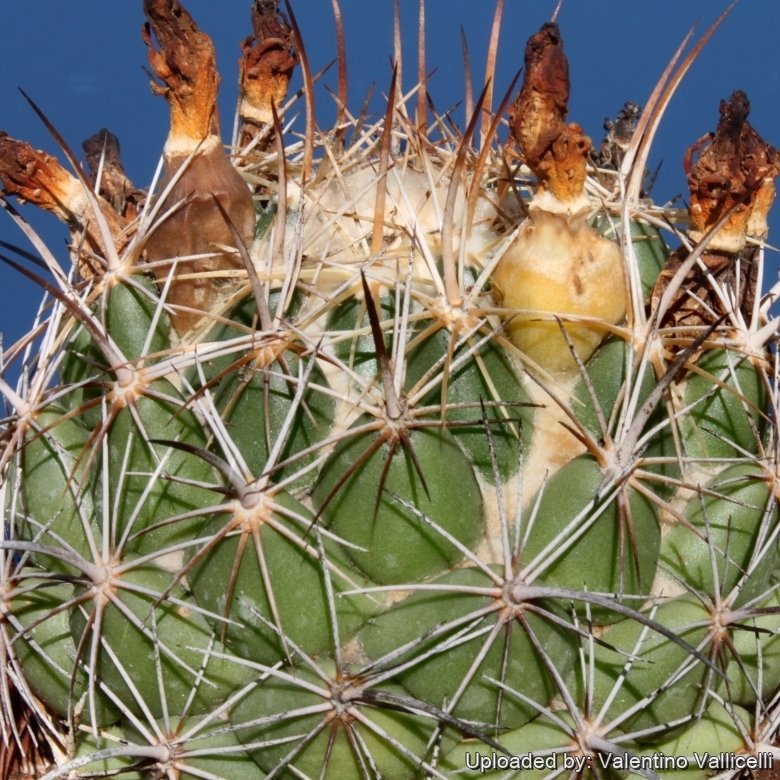
Tubercles: Tubercles are spirally arranged in series of 5 and 8. Conical, rhomboid at the base, obliquely cut, grooved above; on new growth the groove may show some felt. Basal diameter 12-16 mm, 8-14 mm tall. Axil at first woolly, then naked.
Areoles: Oval, 3mm long, 2,5 mm wide (when central spines absent), round 2 mm Ø (when central spine present)
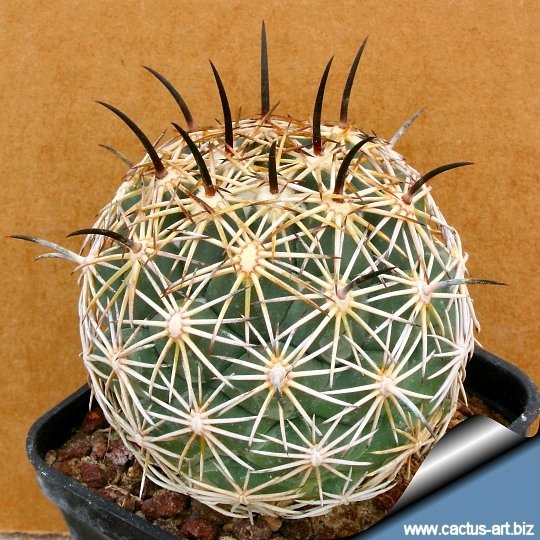
Radial spines: 10 to 20 fairly stout, pale whitish, yellow or horn-coluoured, sometimes darker tipped, 0.9-1.6 cm long, horizontal, irregularly radiating, interwoven, needle-like, straight or slightly curved; in youth pectinate. Occasionally 3-4 thinner spines, more densely set.
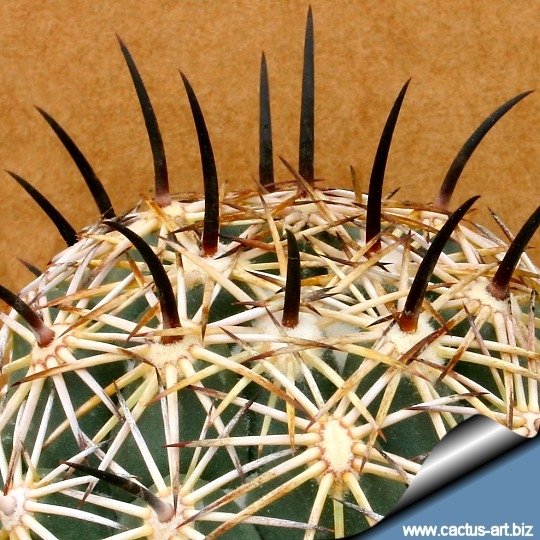
Central spines: 0 or 1( to 3), dark brown, becoming grey from the base, subulate. The dominant central is straight, porrect, or curved downward, usually about 1 cm long, but it may be longer on older plants (up to 1,8 cm); the other two protruding laterally, and curved.
Roots: Fibrous root or semi-taproot.
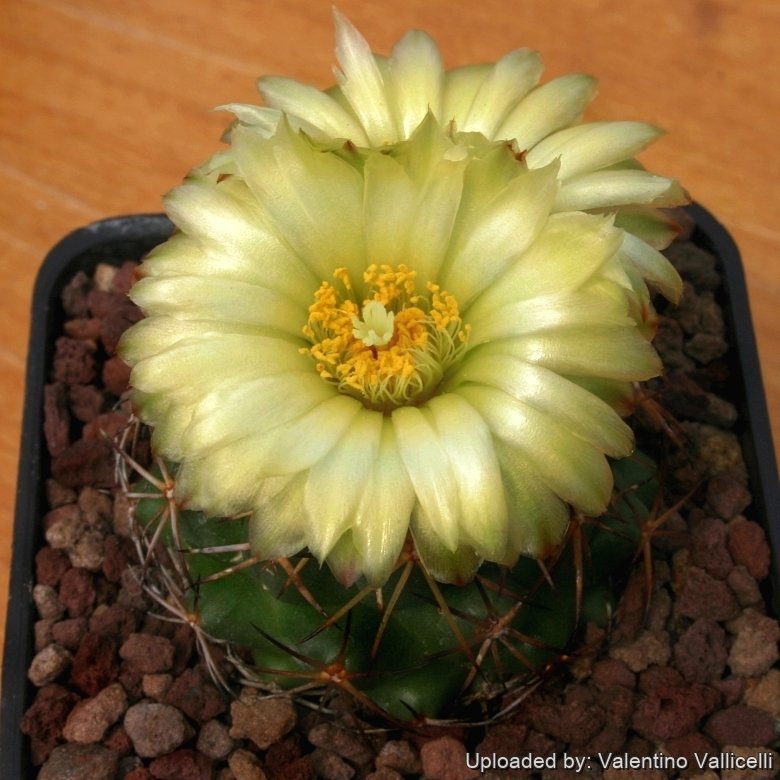
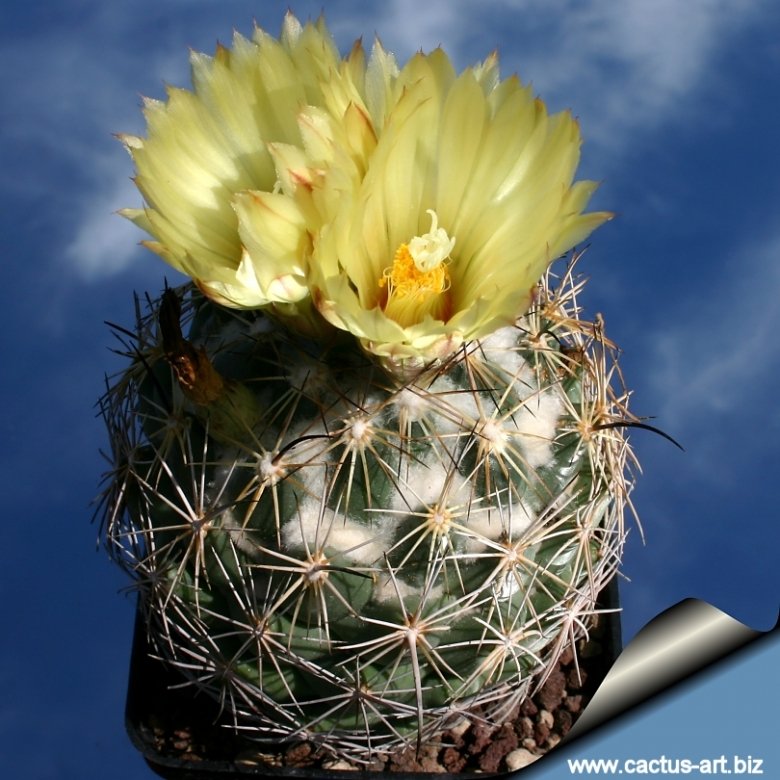
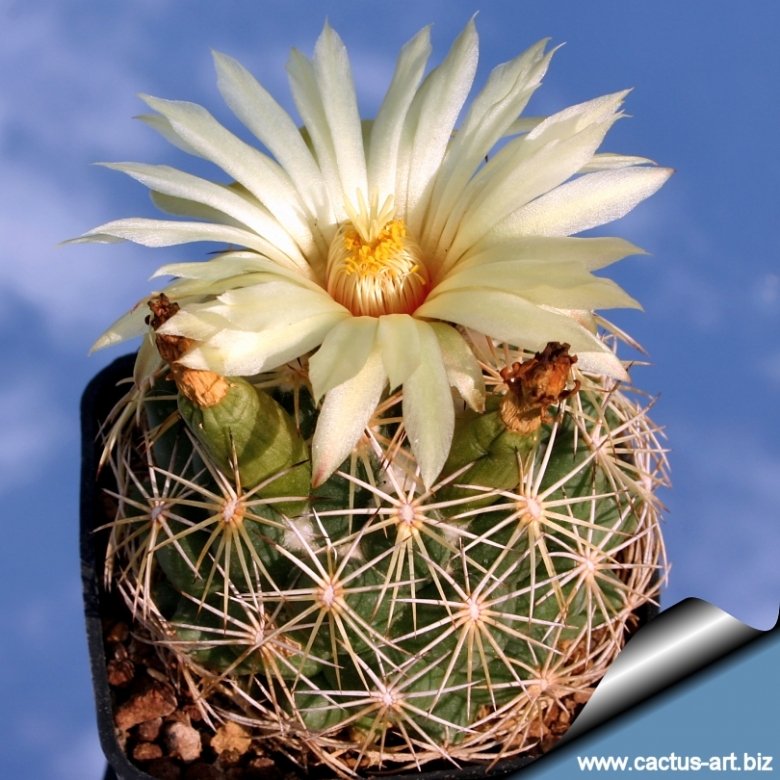
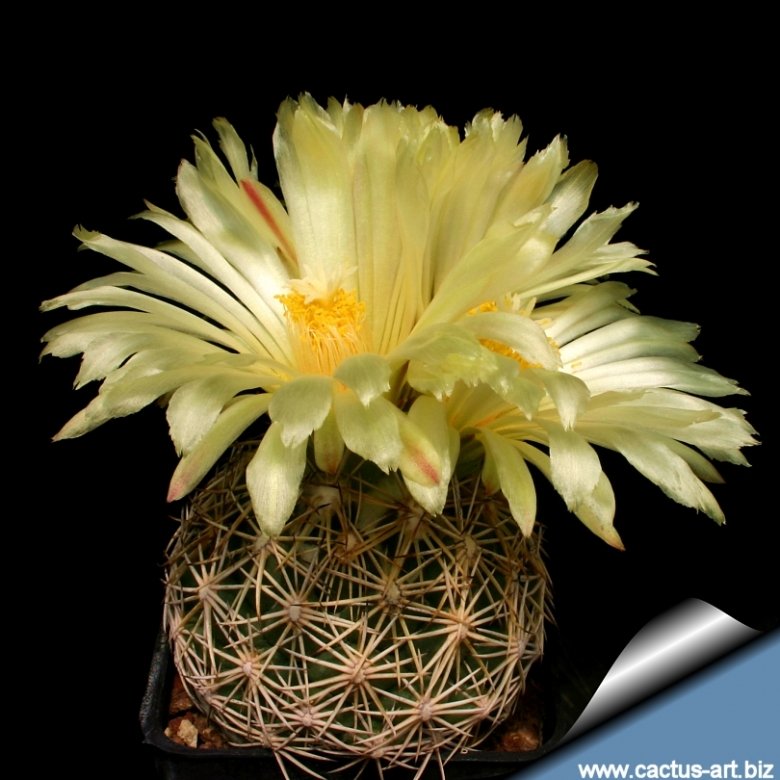
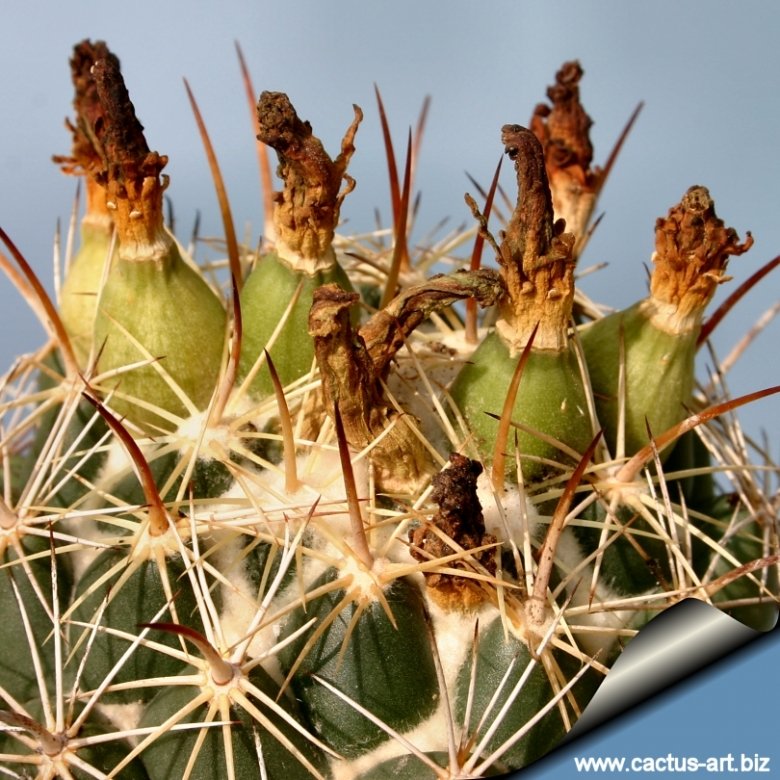
Flowers: Very big, 5-7 cm wide, yellow (occasionally red), funnel shaped, 6-7 cm. The linear segments are lemon-yellow, sometimes red at the base. Filaments reddish to reddish-yellow. Anthers yellow, stigma pale yellow, stigma lobes whitish.
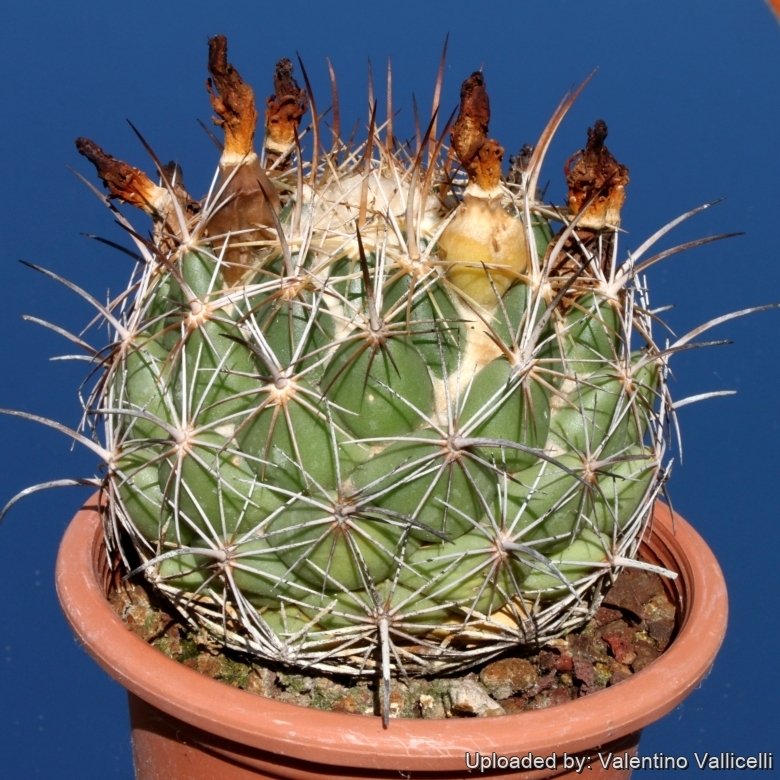
Fruits: Green, juicy with attached flower remnants, 20-25 mm long, 10 mm wide.
Seeds: Reniform (kidney-shaped), brown, 1,3 mm long.
Origin and Habitat
The main distribution is in the Mexican states of Querétaro and Hidalgo, south to the Valle de Mexico, north to Guanajuato and sporadically in San Luis Potosí.
Habitat: Limestone gravel on low hills and plain.
Cultivation and Propagation
In culture C. cornifera is without problems, and regularly shows its large yellow flowers. It does best in slight shade, but does well in full sun too. It is sensitive to overwatering (rot prone), and needs a very porous soil with good drainage. It flowers quite early, but needs about 8-12 years to reach the typical, definite outlook. It tolerates fairly low temperatures as long as it is kept dry (hardy to -5° C or less for short periods of time).
Propagation: Propagation is by seed.
Notes
Coryphantha cornifera is thought to be the taxon classified in 1828 by de Candolle as Mammillaria radians, but this is unclear, partly because of various name changes over the years. However the range of both Coryphantha radians and Coryphantha cornifera is identical, and at most locations adult plants, either without central spines (“radians”), or with 1-4 central spines (“cornifera”) can be found. The arrangement of the central spines is variable. With the exception of the absence or existence of centrals, all the other characteristics are absolutely identical, namely size and form of tubercles, number, size and arrangement of radial spines, flowers, fruits and seeds. Furthermore this species is one of those Coryphanthas which pass a purely radial-spined long youth stage in which they are already floriferous. Most of the plants after several years develop the central spines, giving the plant its sea urchin appearance.
From llifle page Aulacothele radians
Description
C. cornifera/radians is a very variable species, normally solitary, rarely sprouting.
Stem: Flat globose to cylindrical, up to 8-15 cm in diameter, 6-12 cm tall, dull olive-green, apex depressed, with a blunt, depressed apex covered with e wool.
Tubercles: Tubercles are spirally arranged in series of 5 and 8. Conical, rhomboid at the base, obliquely cut, grooved above; on new growth the groove may show some felt. Basal diameter 12-16 mm, 8-14 mm tall. Axil at first woolly, then naked.
Areoles: Oval, 3mm long, 2,5 mm wide (when central spines absent), round 2 mm Ø (when central spine present)
Radial spines: 10 to 20 fairly stout, pale whitish, yellow or horn-coluoured, sometimes darker tipped, 0.9-1.6 cm long, horizontal, irregularly radiating, interwoven, needle-like, straight or slightly curved; in youth pectinate. Occasionally 3-4 thinner spines, more densely set.
Central spines: 0 or 1( to 3), dark brown, becoming grey from the base, subulate. The dominant central is straight, porrect, or curved downward, usually about 1 cm long, but it may be longer on older plants (up to 1,8 cm); the other two protruding laterally, and curved.
Roots: Fibrous root or semi-taproot.
Flowers: Very big, 5-7 cm wide, yellow (occasionally red), funnel shaped, 6-7 cm. The linear segments are lemon-yellow, sometimes red at the base. Filaments reddish to reddish-yellow. Anthers yellow, stigma pale yellow, stigma lobes whitish.
Fruits: Green, juicy with attached flower remnants, 20-25 mm long, 10 mm wide.
Seeds: Reniform (kidney-shaped), brown, 1,3 mm long.
Cultivation and Propagation
In culture C. cornifera/radians is without problems, and regularly shows its large yellow flowers. It does best in slight shade, but does well in full sun too. It is sensitive to overwatering (rot prone), and needs a very porous soil with good drainage. It flowers quite early, but needs about 8-12 years to reach the typical, definite outlook. It tolerates fairly low temperatures as long as it is kept dry (hardy to -5° C or less for short periods of time).
Propagation: Propagation is by seed.
Source: Aulacothele radians, LLIFLE - Encyclopedia of living forms, CC-BY-SA, retrieved 2026-10-25.
From llifle page Coryphantha radians f. cristata
Description
Plants belonging to the genus Coryphantha are solitary cacti with flat globose to cylindrical stems up to 8-15 cm in diameter, 6-12 cm tall with a blunt, depressed apex covered with e wool.
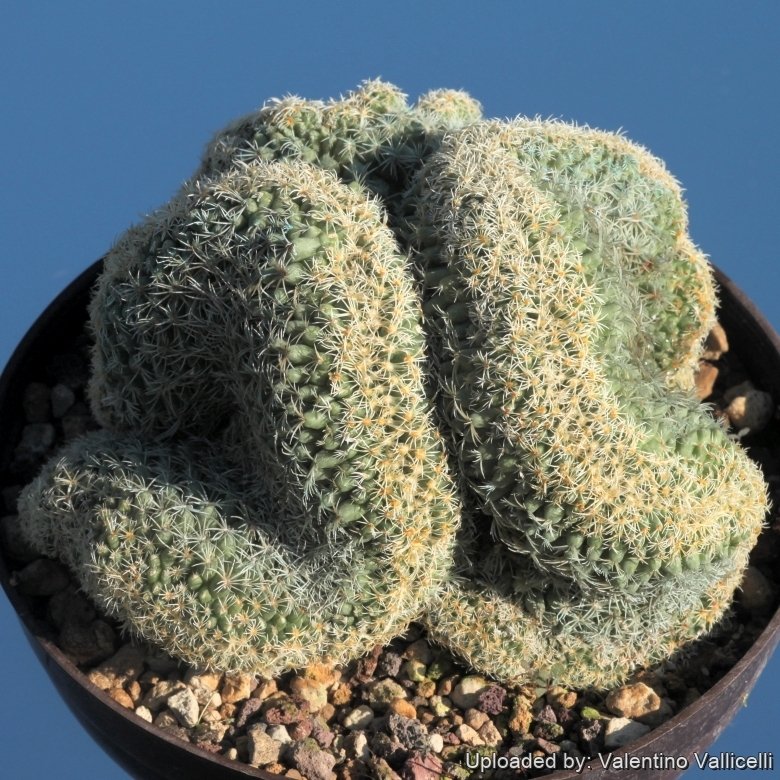
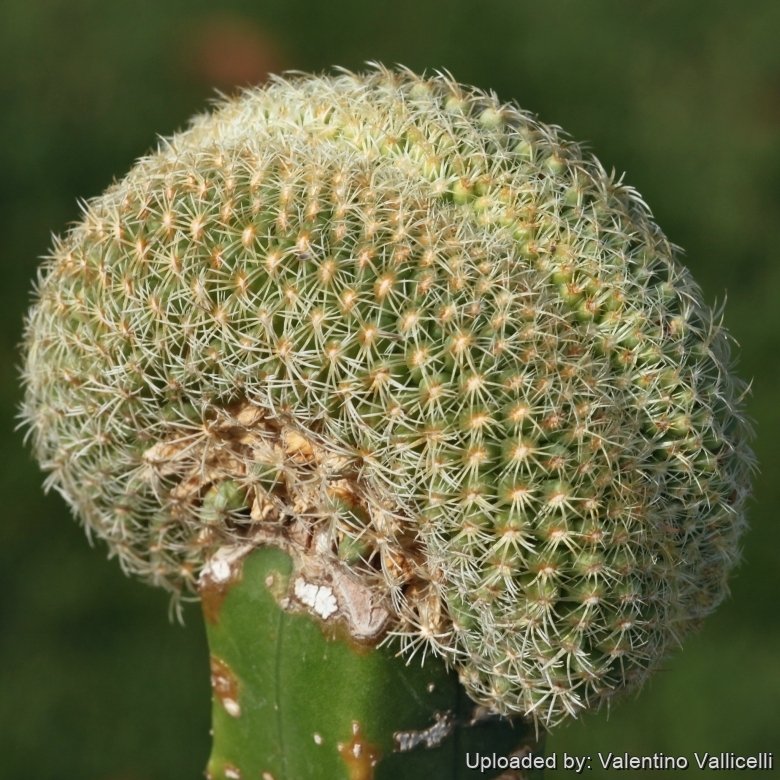
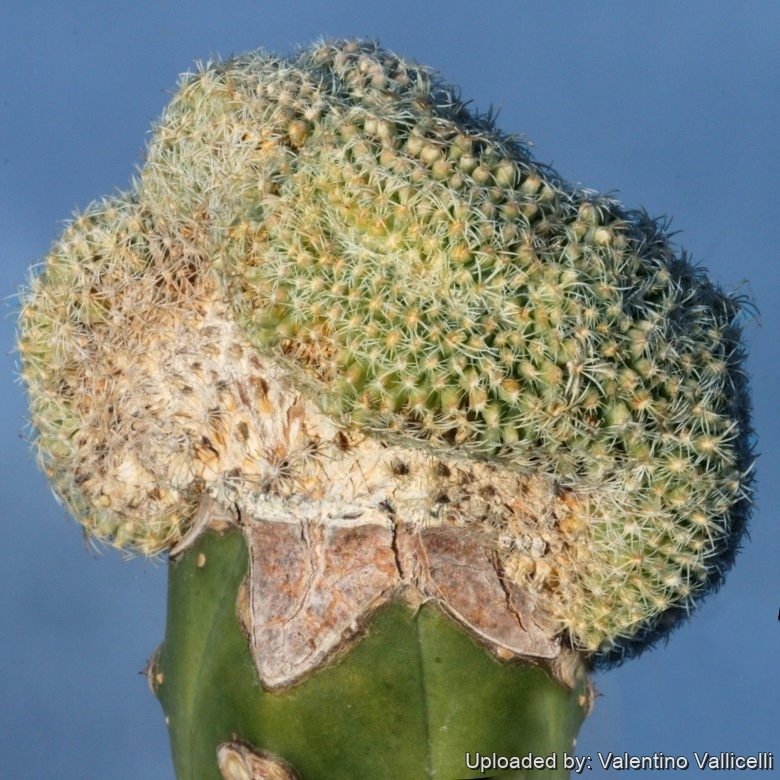
The beautiful crested form here depicted, is supposed by some to be a Coryphantha radians (but further investigation are needed)
Stem: Brain shaped, dull olive-green.
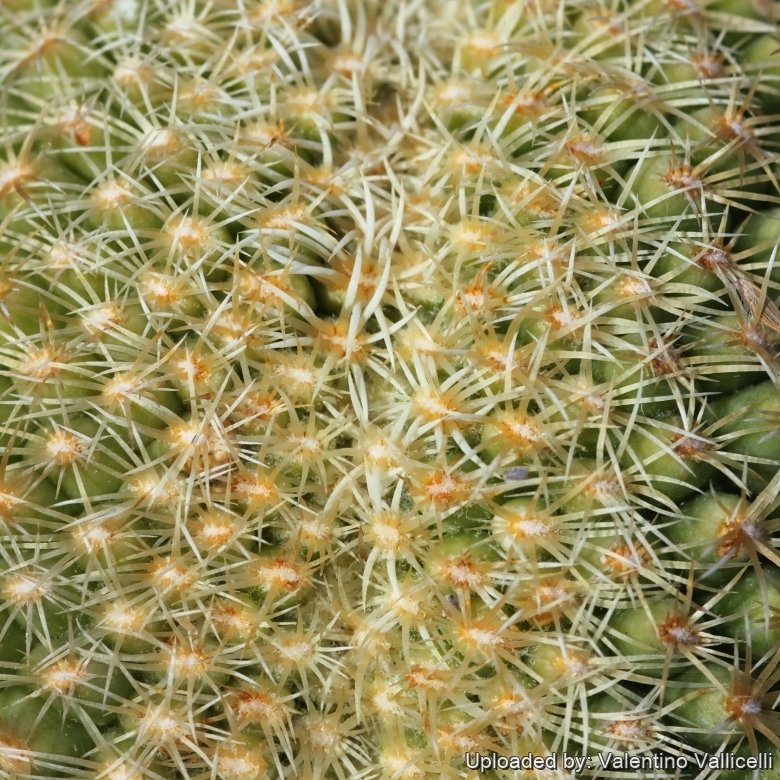
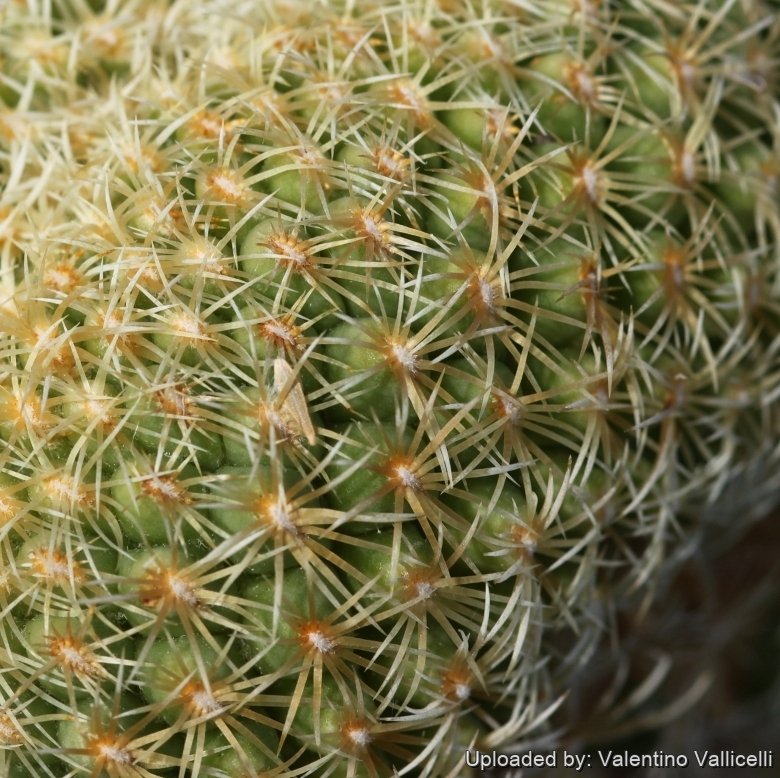
Tubercles: Conical, rhomboid at the base, obliquely cut, grooved above; on new growth the groove may show some felt.
Areoles: Oval to round about 2 mm Ø, at first woolly later naked.
Radial spines: 10 to 20 fairly rigid, pale cream-white to yellowish 3-6 mm long, densely set, horizontal, radiating, straight or slightly curved.
Central spines: Absent.
Roots: Fibrous root or semi-taproot.
Flowers: Not seen.
Fruits: Not seen.
Seeds: Not seen.
Remarks: Coryphantha cornifera / radians is a very variable species, normally solitary, rarely sprouting.
Origin and Habitat
Garden origin (Nursery produced cultivar)
Cultivation and Propagation
It is not too difficult in a greenhouse, although grows quite slowly. It is usually seen as a grafted plant but can grow on its own roots too.
Soil: Use a mineral well permeable soil with little organic matter (peat, humus).
Exposure: They need a good amount of light shade to full sun this help to keep the plants healthy, although slow growth.
Watering: Water sparingly from March till October (weekly during summertime, if the weather is sunny enough), with a little fertilizer added. Less or no water during cold winter months, or when night temperatures remain below 10° to prevent root loss. It is sensitive to overwatering (rot prone).
Fertilization: Feeding may not be necessary at all if the compost is fresh then, feed in summer only if the plant hasn’t been repotted recently. Do not feed the plants from September onwards as this can cause lush growth which can be fatal during the darker cold months.
Hardiness: Keep perfectly dry in winter at temperatures from 5 to 15 degrees centigrade. (but it is relatively cold resistant and hardy to -5° C, or possibly colder for short periods) In the rest period no high atmospheric humidity!! (Temperature Zone: USDA 9-11)
Crested growth: Unlike ‘monstrose’ varieties of plants, where the variation from normal growth is due to genetic mutation, crested growth can occur on normal plants. Sometimes it’s due to variances in light intensity, or damage, but generally the causes are unknown. A crested plant may have some areas growing normally, and a cresting plant that looks like a brain, may revert to normal growth for no apparent reason. If you have any of the crested part left you need to remove the normal growth and leave the crested part behind this will need to be done regularly.
Propagation: Grafting or cuttings. Plants are usually grafted onto column-shaped cacti but proved to be able to produce their own roots if degrafted. Cuttings will take root in a minimum temperature of 20° C (but better in hot weather). Cuttings of healthy shoots can be taken in the spring and summer. Cut the stem with a sharp, sterile knife, leave the cutting in a warm, dry place for a week or weeks (depending on how thick the cutting is) until a callus forms over the wound. Once the callus forms, the cutting may be inserted in a container filled with firmed cactus potting mix topped with a surface layer of coarse grit. They should be placed in the coarse grit only; this prevents the cut end from becoming too wet and allows the roots to penetrate the rich compost underneath. The cuttings should root in 2 to 6 weeks. Large crested piece must be placed on the soil surface without burying the plant base down in the soil.
Source: Coryphantha radians f. cristata, LLIFLE - Encyclopedia of living forms, CC-BY-SA, retrieved 2026-10-25.
Gallery