Publication: Monatsschr. Deutsch. Kakteen-Ges. 11: 249, fig. 1931
Description
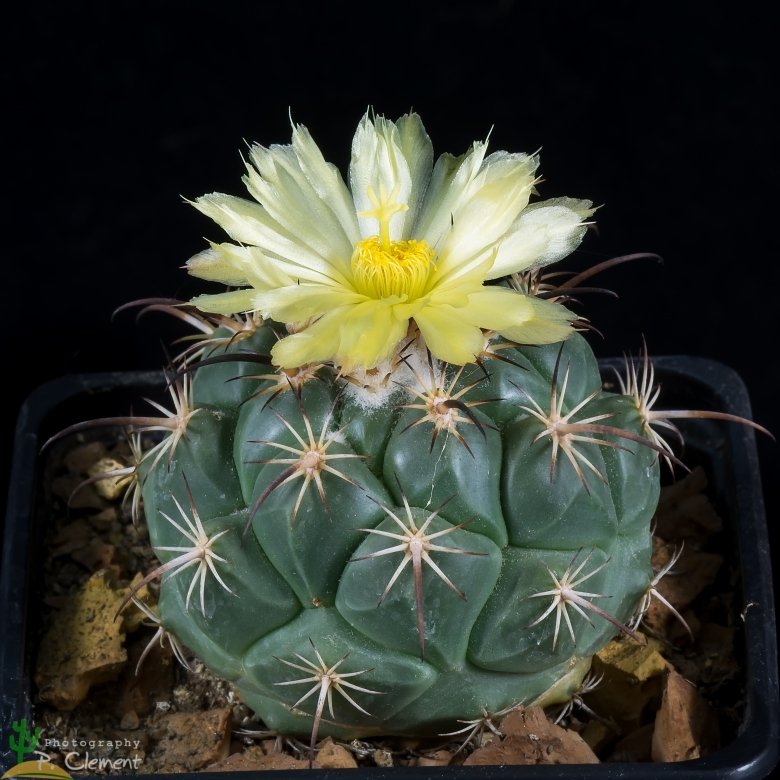
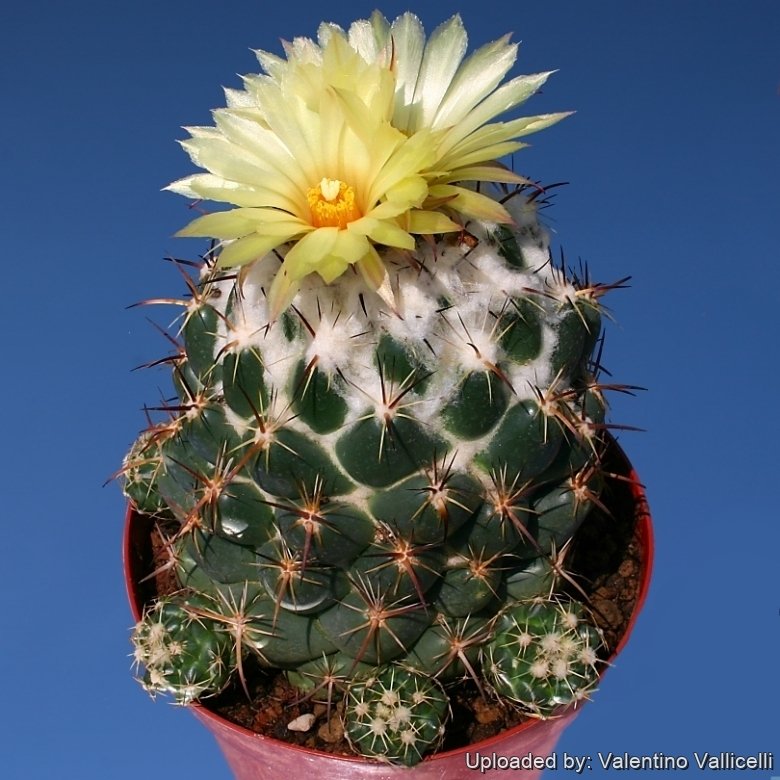
Coryphantha longicornis is a large growing and solitary or group forming cactus with woolly stem tips.
Stem: Fat squat globose to short cylindrical glossy green or dull green, up to more than 9-20(-30) cm high and 10-15 cm broad.
Tubercles: Spirally arranged, conical/ovate, more or less erect, very firm, 14–17 mm wide up to 2 cm long with a narrow, bare groove above; on new growth the groove may show some felt. Axil bare or slightly woolly with one gland.
Areoles: Woolly when young.
Central spines: 3, rigid, stiff, white to brown, often with black tips, about 1.2-2,5 cm long. The lower one is curved and descending, while the upper and lateral ones are shorter.
Radial spines: About 12, translucent whitish, acicular, acicular, equal straight or curved, short, gray at tips , 5-15 mm long.
Roots: Taproot.
Flowers: Diurnal pure yellow, funnel shaped, 3 to 6,5 cm diameter.
Fruits: Yellow green 15-20 mm long, juicy with attached flower remnants.
Origin and Habitat
Durango - Mexico (North America)
Cultivation and Propagation
In culture it is without problems, and regularly shows its large yellow flowers. It does best in slight shade, but does well in full sun too. It is sensitive to overwatering (rot prone), and needs a very porous soil with good drainage. It flowers quite early, but needs about 8-12 years to reach the typical, definite outlook. It tolerates fairly low temperatures as long as it is kept dry (hardy to -5° C or less for short periods of time).
Propagation: Propagation is by seed.
Notes
This is a variable species especially regarding the length of the lower central spine. The plants with shorter central spines are sometime referred as Coryphantha grandis, while those with longer centrals are referred as Coryphantha longicornis. (But this classification is arbitrary and intermediate form are commonly found either in habitat and in cultivation).
Bibliography
Major references and further lectures
-
Edward Anderson “The Cactus family” Timber Press, Incorporated, 2001
-
Nathaniel Lord Britton, Joseph Nelson Rose “Cactaceae: Descriptions and Illustrations of Plants of the Cactus Family” vol. 4 The Carnegie Institution of Washington, Washington 1923
-
James Cullen, Sabina G. Knees, H. Suzanne Cubey “The European Garden Flora Flowering Plants: A Manual for the Identification of Plants Cultivated in Europe, Both Out-of-Doors and Under Glass” Cambridge University Press, 11/Aug/2011
-
David R Hunt; Nigel P Taylor; Graham Charles; International Cactaceae Systematics Group. “The New Cactus Lexicon” dh books, 2006
From llifle page Coryphantha grandis
Description
Coryphantha grandis is a large form of Coryphantha longicornis with shorter central spines described by Lew Bremer in 1978 from N. Durango, Mexico. Coryphantha longicornis is quite variable especially regarding the length of the lower central spine and body size. The plants with shorter central spines and larger stems with more spiral ribs are sometime referred as Coryphantha grandis, while those with longer centrals are referred as Coryphantha longicornis. (But this classification is arbitrary and intermediate form are commonly found either in habitat and in cultivation) In the original description, the data given for the body size of C. grandis is: spiral count of 13:21 for the tubercles, and body to 16 cm high and 14 cm in diameter. But most plants in the field do not match the high spiral number given for the type plant. Usually varying from a count of 5:8 and 8:13. The tubercle size on the plant with 5:8 count is somewhat .larger than the other 3 with 8:13 count. The plants, within a very small variance, have a body size size of 10 cm. tall by 13 cm. in diameter. It can be assumed that a very large plant was used for the original description. A very large and old plant will have a higher spiral count than a smaller or younger plant. If the above mentioned remarks are true, then a plant that was not a representative of the average set of characters was used for the basis for the original description. Field observations suggests that there is not sufficient ground to differentiate this species from Coryphantha longicornis Boedecker. In all aspects when comparing the descriptions of the two species, the only area of significant difference is in the number of spirals on the body. But if a high proportion of plants at the type location of C. grandis still fit the description of C. longicornis, it would be better to enlarge the description of C. longicornis to allow for the case of a very large specimen with this higher spiral.
For more details see: Coryphantha longicornis.
Origin and Habitat
Coryphantha grandis grows in the broad valley of the Rio Nazas stretching east from El Palmito, Durango, Mexico.
Habitat and ecology: This species grows on limestone rocky soil, mostly on the south sides of hills in rather sparse grass. During the rainy season, the grass would give the plants a little shade. But during most of the year it would be nearly full sun conditions.
Bibliography
Major references and further lectures
-
The Journal of the Mammillaria Society, Volumes 17-19 Mammillaria Society, 1977
-
Steven Brack “Some Notes on Coryphantha grandis Bremer” May-June 1978 issue of the Cactus and Succulent Journal of America
-
James Cullen, Sabina G. Knees, H. Suzanne Cubey “The European Garden Flora Flowering Plants: A Manual for the Identification of Plants Cultivated in Europe, Both Out-of-Doors and Under Glass” Cambridge University Press, 11/Aug/2011
-
David R Hunt; Nigel P Taylor; Graham Charles; International Cactaceae Systematics Group. “The New Cactus Lexicon” dh books, 2006
Major references and further lectures
-
Edward Anderson “The Cactus family” Timber Press, Incorporated, 2001
-
Nathaniel Lord Britton, Joseph Nelson Rose “Cactaceae: Descriptions and Illustrations of Plants of the Cactus Family” vol. 4 The Carnegie Institution of Washington, Washington 1923
Source: Coryphantha grandis, LLIFLE - Encyclopedia of living forms, CC-BY-SA, retrieved 2026-10-25.