Publication: Cactaceae (Britton & Rose) 4: 30. 1923 [24 Dec 1923]
Description
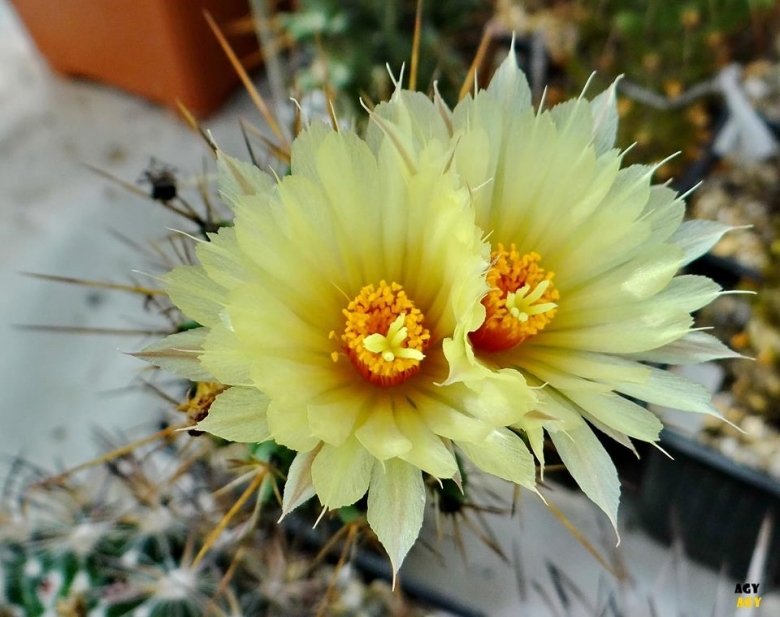
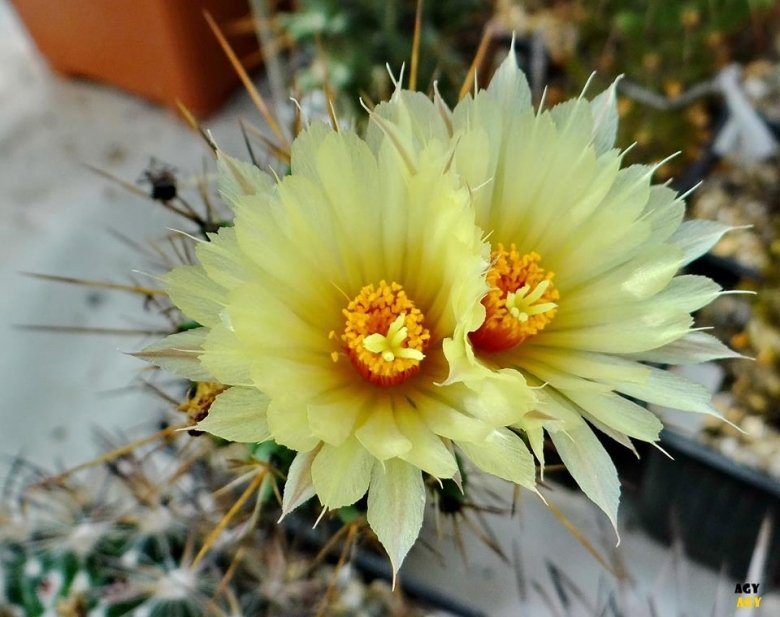
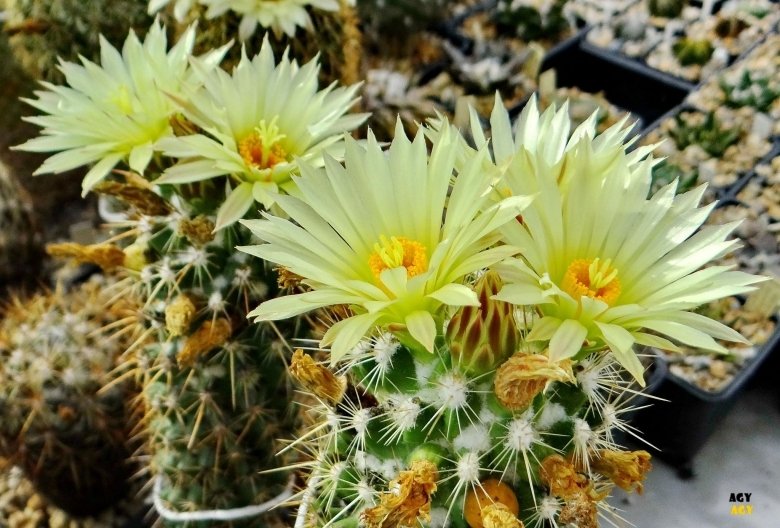
Coryphantha octacantha with olive green body and white and yellow spines, grows prolifically. Plants are solitary or branch basally to form clumps up to 30 or more cm tall. The axils of the tubercles are filled with white wool, with vivid scarlet glands at the base of the groove. The canary-yellow blossoms are very large and showy, the outer segments tinged with scarlet. This striking species is widely cultivated as an ornamental. Given the wide range of this species, it is quite variable and has received numerous names of controversial botanical value.
Stem: Oblong to short cylindrical, solitary or branching basally, deep green to olive green, up to 30 cm tall, and 10(-15) cm in diameter, initially erect but becoming prostrate with age.
Tubercles: Loosely arranged, conical, erect, elongated, somewhat 4-sided broad bases, to 25-30 mm long. Axils of tubercles with white wool and with one or two red gland at base of groove. The glands tend to exude a sugary solution when growing. A peculiarity of Coryphantha octacantha is that it may have grooved and grooveless tubercles on the same mature heads at the same time, or may change the form of its growth back and forth from the one to the other.
Areoles: This species has a common type of spine-areole, white-villous with strong central spines that are somewhat curved and numerous thin radial spines that tend to lie flat against the stem.
Radial spines: Usually 7-8, awl shaped, thin, rigid, straight, about equal, yellowish with dark tips or horn-colored with black tips, 10-15 mm long.
Central spine: 1-2, straight, erect, brownish, little longer and stouter than the others to 20-25 mm long.
Flowers: Very large, 4-6 cm in diameter (sometimes 9 cm broad), lemon yellow to straw-colored, with the outer segments tinged with red; perianth-segments glossy, linear-oblong, obtuse, outer ones entire, inner ones serrate and mucronate at apex; filaments orange-red; style red; stigma-lobes 6, linear, yellow.
Fruits: Oblong, to 25 mm long.
Origin and Habitat
Coryphantha octacantha is endemic to Mexico. It has been reported to be present in the states of Aguascalientes, Guanajauto, Hidalgo, and Querétaro, also it rarely occurs in the states of San Luis Potosí and in Tamaulipas. This is a widespread species found at innumerable localities, with a very large population, and with many plants occurring in huge groups in remote areas.
Habitat and Ecology: The species grows in dry grassland on limestone gravel or alluvial soils at the foot of hills and on ridges. Although there is some illegal collection, this does not appear to be a major threat. The main threat to the species is increasing frequency of fires to renew grazing areas for livestock.
Cultivation and Propagation
Coryphantha octacantha is popular with collectors and easy to grow. It comes from an area of summer rainfall. Keep drier in winter (but for outdoor cultivation it is quite resistant to wet conditions, too). Quite cold resistant, hardy about to about -10° C, but the frost resistance varies a lot from clone to clone. Needs good drainage. Keep drier in winter, Full sun to partial shade.
Propagation: Seeds (no dormancy requirement, they germinate best at 25°C) or by offsets (if available), or occasionally grafted.
Bibliography
Major references and further lectures
-
Edward Anderson “The Cactus family” Timber Press, Incorporated, 2001
-
James Cullen, Sabina G. Knees, H. Suzanne Cubey “The European Garden Flora Flowering Plants: A Manual for the Identification of Plants Cultivated in Europe, Both Out-of-Doors and Under Glass” Cambridge University Press, 11/Aug/2011
-
David R Hunt; Nigel P Taylor; Graham Charles; International Cactaceae Systematics Group. “The New Cactus Lexicon” dh books, 2006
-
N. L. Britton, J. N. Rose “The Cactaceae. Descriptions and Illustrations of Plants of the Cactus Family.” Volume 4, The Carnegie Institution of Washington, Washington 1923
-
Curt Backeberg “Die Cactaceae: Handbuch der Kakteenkunde” Gustav Fischer Verlag, Stuttgart New York 1982–1985
-
Reto Dicht, Adrian Lüthy “Coryphantha: Cacti of Mexico and Southern USA” Springer Science & Business Media, 14 March 2006
-
Arthur C. Gibson, Park S. Nobel “The Cactus Primer” Harvard University Press, 1990
-
Cecile Hulse Matschat “Mexican Plants for American Gardens” Houghton Mifflin, 1935
-
Sánchez , E., Guadalupe Martínez, J., Lüthy, A.D. & Dicht, R.F. 2013. Coryphantha octacantha. The IUCN Red List of Threatened Species. Version 2015.1. <www.iucnredlist.org>. Downloaded on 08 June 2015.
-
Terry Hewitt “Cacti” Lorenz Books, 1998
-
Urs Eggli, Leonard E. Newton “Etymological Dictionary of Succulent Plant Names” Springer Science & Business Media, 29 June 2013
-
Del Weniger “Cacti of the Southwest: Texas, New Mexico, Oklahoma, Arkansas, and Louisiana” University of Texas Press, 1969
From llifle page Aulacothele clava
Description
Coryphantha clava continues to exist in the whole cactus literature until today, although its description does not show any differences to the ones of the complex around Coryphantha octacantha, and should be fully synonymized with the latter. Coryphantha clava, with a club-shaped, deep green body and white and yellow spines, grows prolifically. Plants are solitary or branch basally to form clumps. The axils of the tubercles are filled with white wool, with a vivid scarlet gland at the base of the groove. The pale-yellow blossoms are very large and showy, the outer segments tinged with scarlet. This striking species is widely cultivated as an ornamental. Given the wide range of this species and its appearance, it was collected and sent to Europe very early.
Derivation of specific name: “clava’, club; for the shape of the stem segments.
Stem: Cylindrical to club-shaped, deep green, up to 30 cm tall, initially erect but becoming prostrate with age.
Tubercles: Erect, elongated, somewhat 4-sided Axils of tubercles with white wool and with a red gland at base of groove. The glands tend to exude a sugary solution when growing.
Areoles: Coryphantha clava has a common type of spine-areole, white-villous with a strong central spine that is somewhat curved and numerous thin radial spines that tend to lie flat against the stem.
Radial spines: Usually 7, straight, horn-colored, about equal.
Central spine: A little longer and stouter than the others.
Flowers: Very large, sometimes 9 cm broad, pale yellow, with the outer segments tinged
with red; perianth-segments glossy, linear-oblong to spatulate, outer ones entire, inner ones serrate
and mucronate at apex; filaments orange; stigma-lobes 6, linear, yellow.
Origin and Habitat
Coryphantha clava (= Coryphantha octacantha) is endemic to Mexico. It has been reported to be present in the states of Aguascalientes, Guanajauto, Hidalgo, and Querétaro, also it rarely occurs in the states of San Luis Potosí and in Tamaulipas. This is a widespread species found at innumerable localities, with a very large population, and with many plants occurring in huge groups in remote areas.
Habitat and Ecology: The species grows in dry grassland on limestone gravel or alluvial soils at the foot of hills and on ridges. Accompanying species can be Echeveria secunda, Dasylirion acrotichum, Echinocereus cinerascens, Ferocactus latispinus, Myrtillocactus geometrizans, Stenocereus dumortieri, Opuntia imbricata, Coryphantha radians, Gymnocactus horripilus, Mammillaria geminispina, Echinocactus platyacanthus, and Neolloydia conoidea. Although there is some illegal collection, this does not appear to be a major threat. The main threat to the species is increasing frequency of fires to renew grazing areas for livestock.
Cultivation and Propagation
Coryphantha clava is popular with collectors and easy to grow. It comes from an area of summer rainfall. Keep drier in winter (but for outdoor cultivation it is quite resistant to wet conditions, too). Quite cold resistant, hardy about to about -10° C, but the frost resistance varies a lot from clone to clone. Needs good drainage. Keep drier in winter, Full sun to partial shade.
Propagation: Seeds (no dormancy requirement, they germinate best at 25°C) or by offsets (if available), or occasionally grafted.
Bibliography
Major references and further lectures
-
Edward Anderson “The Cactus family” Timber Press, Incorporated, 2001
-
James Cullen, Sabina G. Knees, H. Suzanne Cubey “The European Garden Flora Flowering Plants: A Manual for the Identification of Plants Cultivated in Europe, Both Out-of-Doors and Under Glass” Cambridge University Press, 11/Aug/2011
-
David R Hunt; Nigel P Taylor; Graham Charles; International Cactaceae Systematics Group. “The New Cactus Lexicon” dh books, 2006
-
N. L. Britton, J. N. Rose “The Cactaceae. Descriptions and Illustrations of Plants of the Cactus Family.” Volume 4, The Carnegie Institution of Washington, Washington 1923
-
Curt Backeberg “Die Cactaceae: Handbuch der Kakteenkunde” Gustav Fischer Verlag, Stuttgart New York 1982–1985
-
Reto Dicht, Adrian Lüthy “Coryphantha: Cacti of Mexico and Southern USA” Springer Science & Business Media, 14 March 2006
-
Arthur C. Gibson, Park S. Nobel “The Cactus Primer” Harvard University Press, 1990
-
Cecile Hulse Matschat “Mexican Plants for American Gardens” Houghton Mifflin, 1935
-
Sánchez , E., Guadalupe Martínez, J., Lüthy, A.D. & Dicht, R.F. 2013. Coryphantha octacantha. The IUCN Red List of Threatened Species. Version 2015.1. <www.iucnredlist.org>. Downloaded on 08 June 2015.
-
Terry Hewitt “Cacti” Lorenz Books, 1998
-
Urs Eggli, Leonard E. Newton “Etymological Dictionary of Succulent Plant Names” Springer Science & Business Media, 29 June 2013
Source: Aulacothele clava, LLIFLE - Encyclopedia of living forms, CC-BY-SA, retrieved 2026-10-25.
Gallery