Publication: Cactaceae Consensus Init. 6: 18. 1998
Description
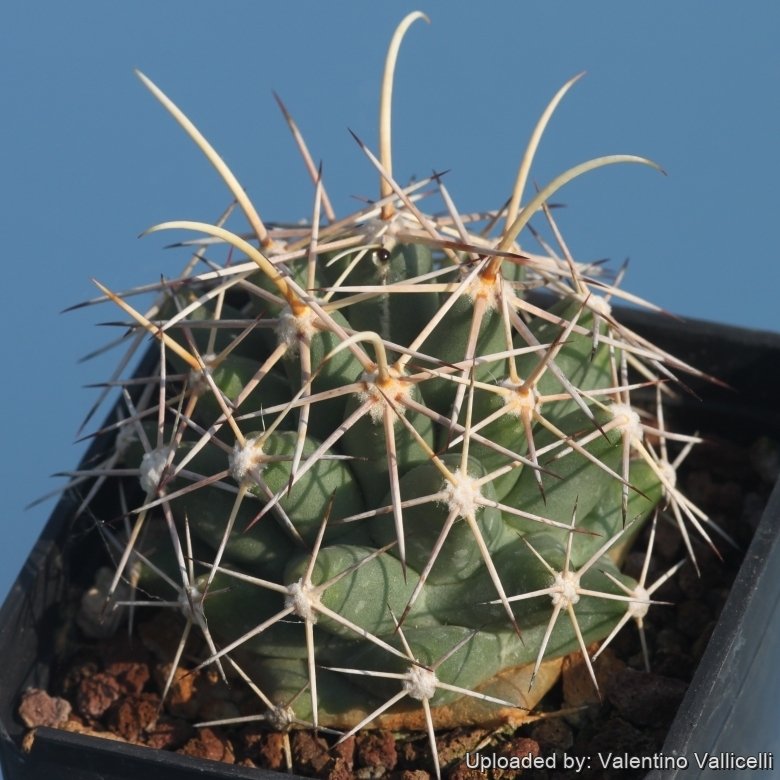
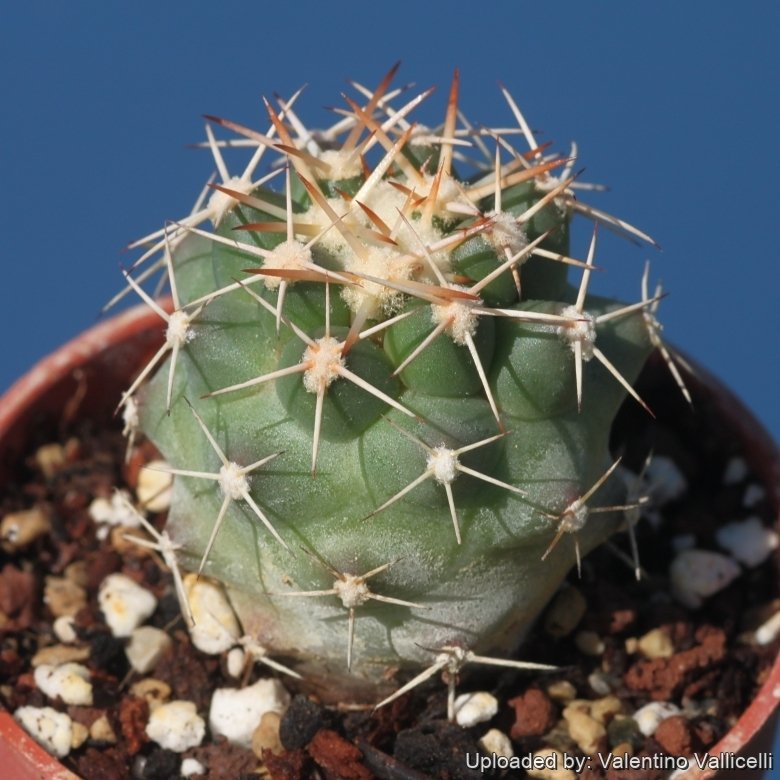
Coryphantha robustispina subs. scheeri is a low-growing solitary (occasionally multi-stemmed) cactus related to Coryphantha sulcata.
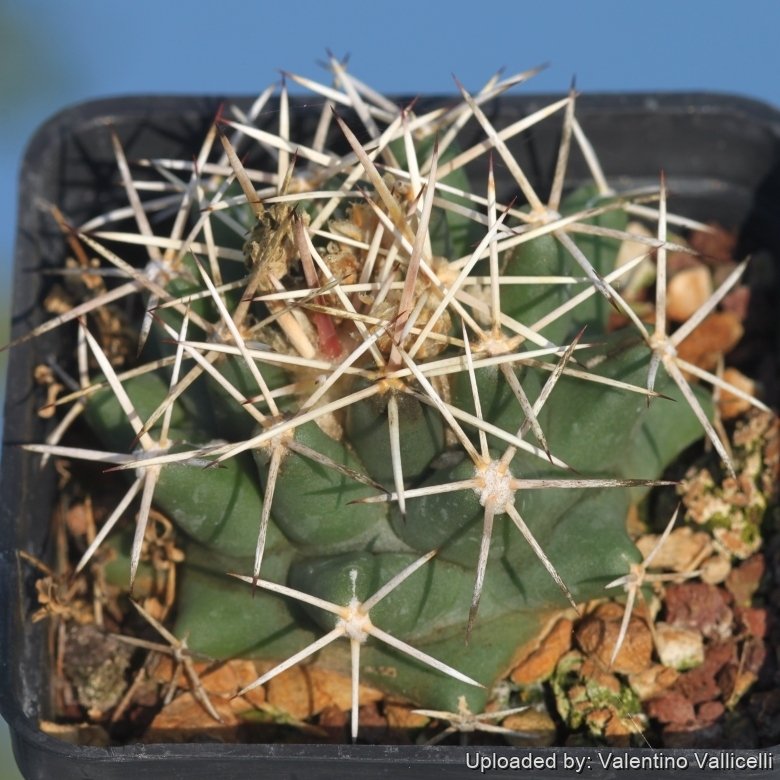
Stem: Hemispherical to egg shaped or somewhat conical, dull green, strongly tuberculate, 5-15 cm tall, 5-10(-15) cm in diameter or exceptionally taller especially in cultivation. Apex rounded wooly.
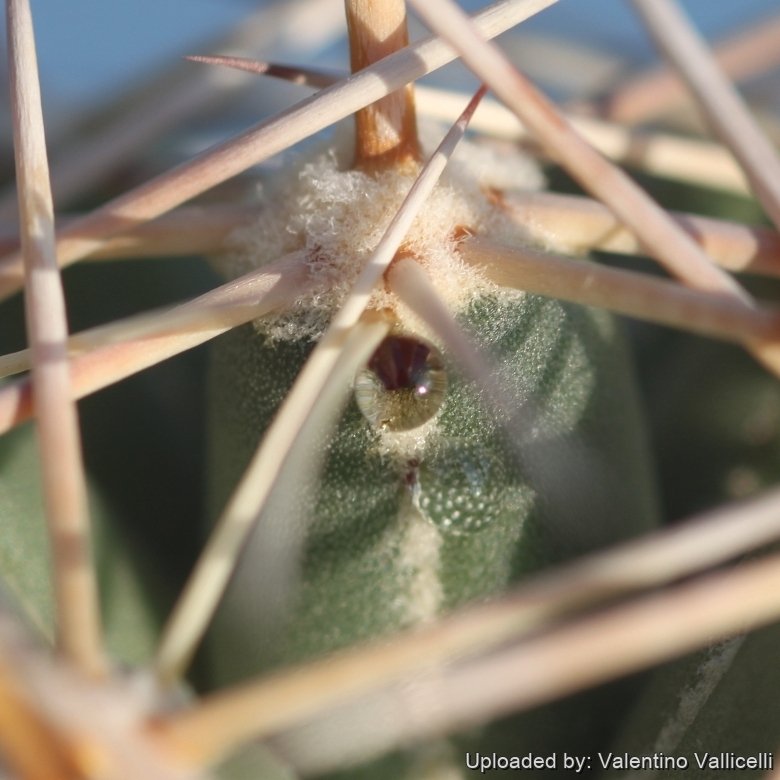
Tubercles: in 5-8 series, 7-12(-30) mm long, 15-19 mm wide, conical to cylindrical, prisma shaped at the base, fairly firm, prominently grooved and thick with 1 to 4 reddish-brown nectar glands. Furrow deep and woolly.
Axil: At first with white wool, then naked and broadened.
Areoles: Woolly when young, oval approx 3-4 mm wide, 5 mm long.
Central spines: Usually one (but up to 4) the dominant straight (sometime bent toward the apex), subulate (1,5)2,5-3,5(-5) cm long, the other straight upwards, slightly spreading outwards, slightly darker than radials.
Radial spines: (6-)8-13(-16) straight stiff, needle-like, yellowish to creamy-white with darker tips. Lower one often brownish (1-)2-2,5(-3.5) cm long, some upper radials often thinner, much like the central spine and closer set, the other horizontal spreading and radially arranged.
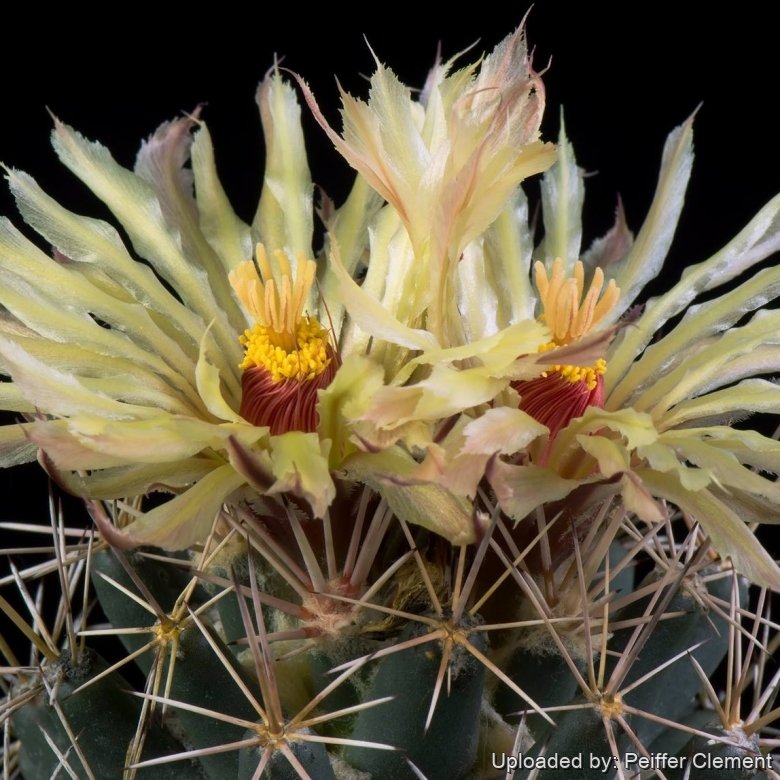
Flower: Funnel-shaped, silky, dark golden-yellow to greenish-yellow, rarely streaked or blushed with reddish in centre, 4-6.5 cm long, 5-7 cm in diameter, yellow stamens yellow to orange.
Blooming period: April-July, and possibly to as late as November.
Fruit: Green, ovoid to club-shaped, 3.5 to 5.5 cm long , 1.2 to 2 cm in diameter, the pulp juicy, sweet and mucilaginous, flowers remnant deciduous when mature.
Seeds: Brown, nearly smooth, about 2-3 mm long, somewhat flattened and kidney-shaped, with a lateral hilum.
Origin and Habitat
Distribution: New Mexico (Chaves and Eddy counties), Texas (Brewster, Crockett, Loving, Pecos, Reeves, Terrell, Ward, and Maverick counties), and Sonora and Chiuahua, Mexico.
Altitude: 1,000-1,100 m above sea level.
Habitat: Grows in flat plains or lower hill slopes in semidesert grassland and open woodland in the Chihuahuan desert vegetation, usually on fairly deep, gravelly or silty soils, occasionally on rocky benches or bajadas on limestone or gypsum.
Cultivation and Propagation
This plant grows in the same habitat as Echinocactus horizonthalonius, with which it has some cultivation problems in common: slow-growing, seldom reaching the same size as in nature, sensitive against over-watering (does better when grafted). Water sparingly. It needs good drainage. Keep drier in winter. Full sun to partial shade. In humid conditions, the exudation of nectar (if not completely removed by ants) can cause the formation of mould, which leads to ugly black-colouring of the epidermis. To prevent this, spray the plant with water to remove the nectar. And provide very good ventilation.
Frost hardiness: Can withstand temperatures down to -6,6º C. (or less for short periods).
Propagation: Seeds or grafting.
Bibliography
Major references and further lectures
-
Reto Dicht, Adrian Lüthy Coryphantha: Cacti of Mexico and Southern USA (Google eBook) Springer Science & Business Media, 14 March 2006
-
Nathaniel L. Britton, J. N. Rose “Cactaceae: Descriptions and Illustrations of Plants of the Cactus” Volume IV. The Carnegie Institution of Washington Washington, 24/Dec/1923
-
Edward Anderson “The Cactus family” Timber Press, Incorporated, 2001
-
James Cullen, Sabina G. Knees, H. Suzanne Cubey “The European Garden Flora Flowering Plants: A Manual for the Identification of Plants Cultivated in Europe, Both Out-of-Doors and Under Glass” Cambridge University Press, 11/Aug/2011
-
David R Hunt; Nigel P Taylor; Graham Charles; International Cactaceae Systematics Group. “The New Cactus Lexicon” dh books, 2006
-
Heil, K. & Corral-Díaz, R. 2013. Coryphantha robustispina. The IUCN Red List of Threatened Species. Version 2014.3. <www.iucnredlist.org>. Downloaded on 23 April 2015.
From llifle page Coryphantha scheeri var. valida
Description
Coryphantha scheeri v. valida is the New Mexican form of the widespread Coryphantha robustispina subs. scheeri (= Mammillaria scheeri Mühlenpfordt 1845). The var. valida was firstly described as Mammillaria scheeri var. valida by Engelmann in 1856 without having seen Mammillaria scheeri Mühlenpfordt. Engelmann had presumed that his var. valida might be just a somewhat larger and more heavily spined northern form of Mammillaria scheeri (from Chihuahua in northern Mexico). When visiting the collection of Prince Salm-Dyck, he found original plants of Mammillaria scheeri which corresponded completely with his var. valida, thus confirming his initial assumption. As Engelmann himself had realised already, var. valida does not contain enough distinct criteria to delineate a variety or subspecies and it should be fully synonymized with Mammillaria scheeri (Coryphantha robustispina subs. scheeri).
Origin and Habitat
New Mexico (Garfield, Dona Ana, and Sierra County), USA
Altitude range: Around 1850 metres above sea level.
Source: Coryphantha scheeri var. valida, LLIFLE - Encyclopedia of living forms, CC-BY-SA, retrieved 2026-10-25.
Gallery