Publication: Kakteen Sukk. 49(11): 257 (1998)
Description
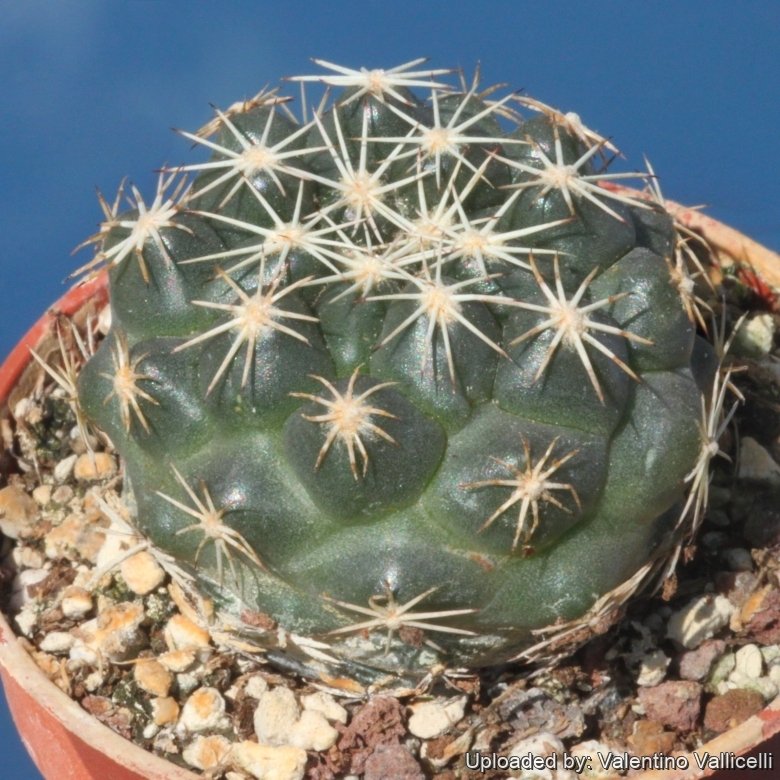
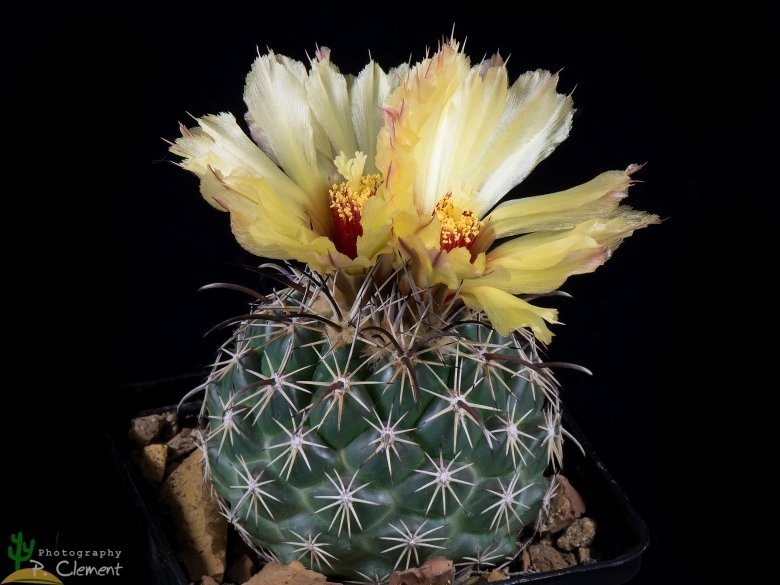
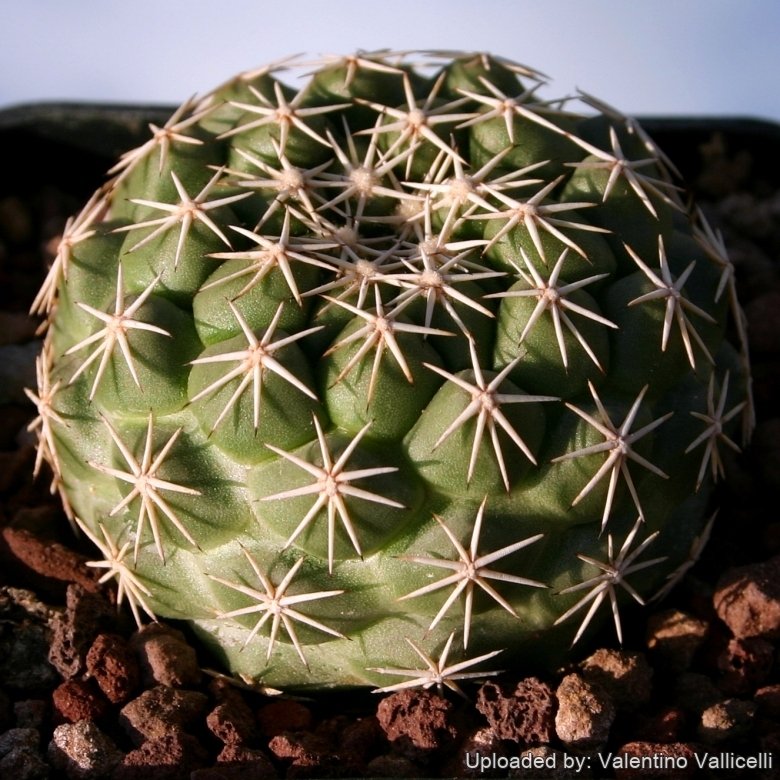
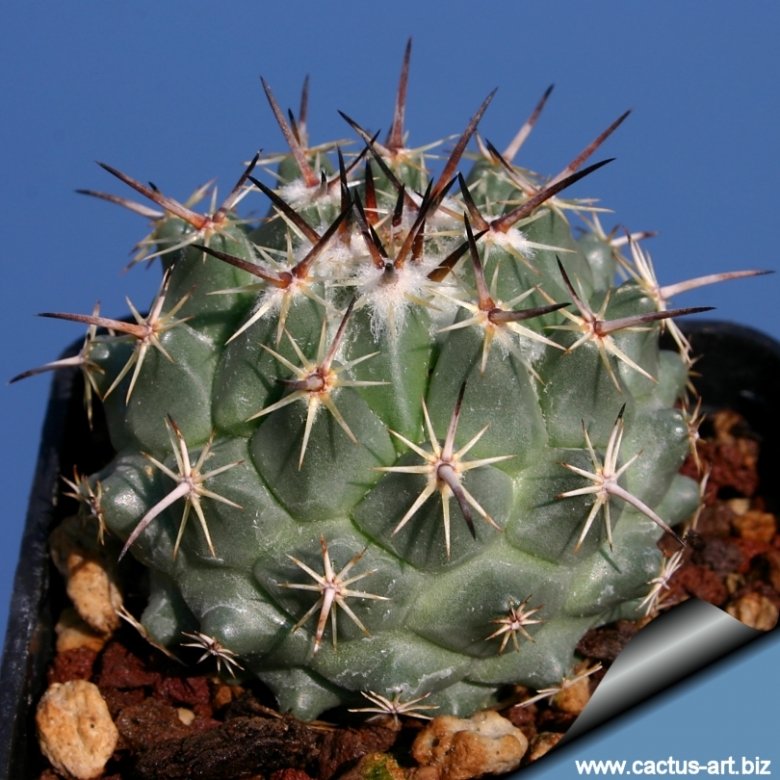
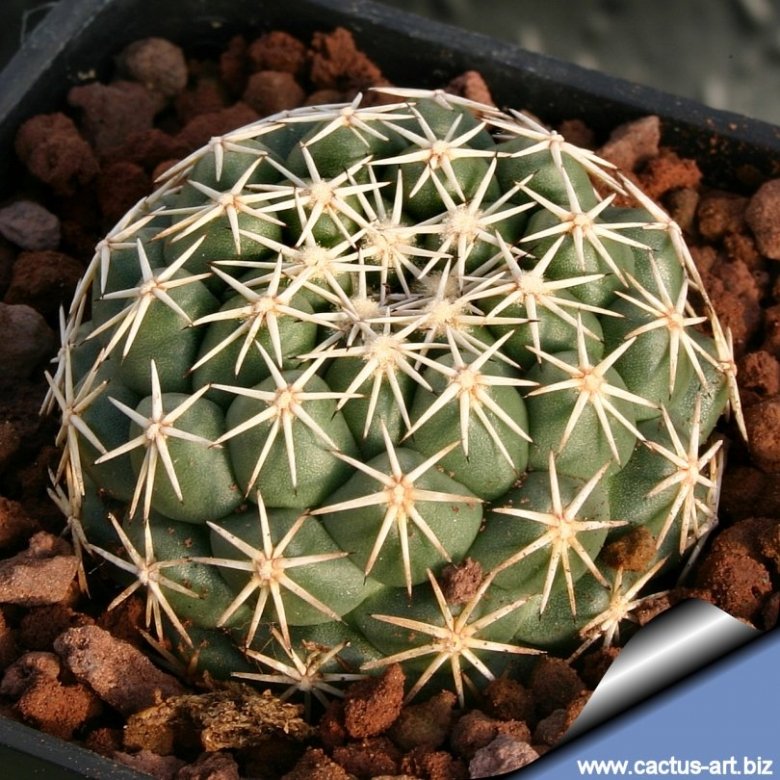
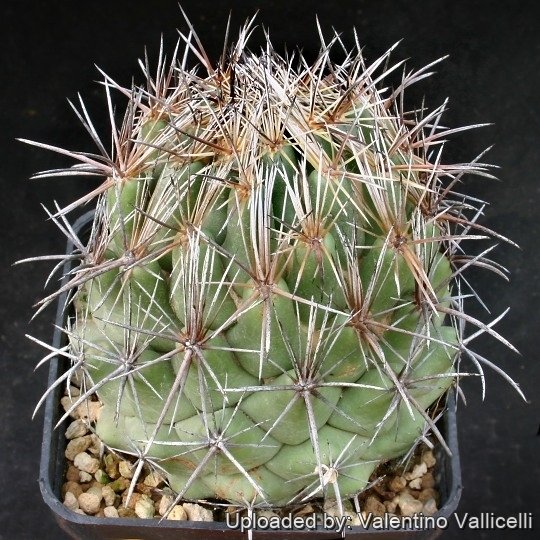
Coryphantha salinensis is a globose-cylindrical cactus that pass several stages of development in which its appearance changes very much: after several years of purely radial spination one single porrect central, curved downwards, appears and with the appearance of the upper 2-3, slightly protruding centrals curved to the sides the plant develops two types of radial spines, lower radiant, stiff, horn-coloured and upper, whitish, thinner, flexible in a bundle.
Derivation of specific name: “salinensis” for the occurrence near Salinas Victoria, Nuevo León, Mexico.
Roots: Fibrous.
Stems: Usually solitary, globose, ovoid, or short cylindrical, apex depressed, white-woolly, covered with bundled and inter-woven spines, dark grey-green to pale blue-grey, 5-10(-15) cm high, 5-8(-9) cm in diameter
Tubercles: In 8 and 13 series, conical, conical-cylindrical, roundish, in later years rhomboid basally and pyramidal, very firm, more or less erect, often imbricate and edges obliquely cut, width at the base 17 mm, length of upper surface 8 mm, of lower surface 18-22 mm long, with complete, in youth wooly groove. Axils conspicuously woolly in youth.
Areoles: Round, 3 mm diameter, woolly in youth.
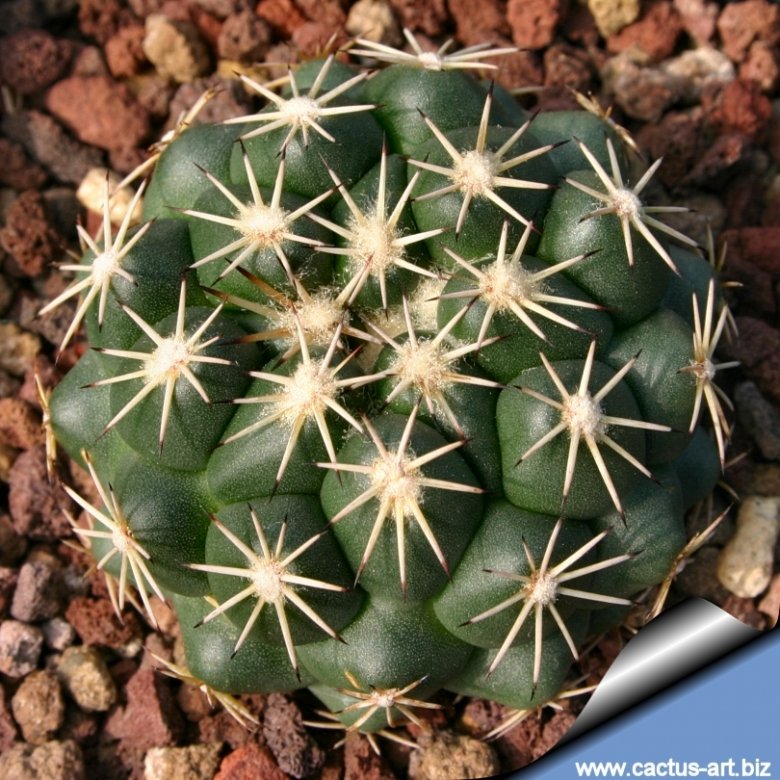
Central spines: Usually 4, often absent on juveniles, straight to strongly curved, dull white to brown to black, 12-15 mm long, the lower one dominant, porrect, curved downwards like a horn, subulate, 15-21 mm long, all upper central spines thinner.
Radial spines: 11-15(-20), equal at first, lower and later 5-7 spines unequal, stronger, firm, needle-like, straight, radiating, whitish with dark tips 10-15 mm long. upper 7-13 bundled, longer, 16-20 mm long, needle-like, straight, whitish with dark tips.
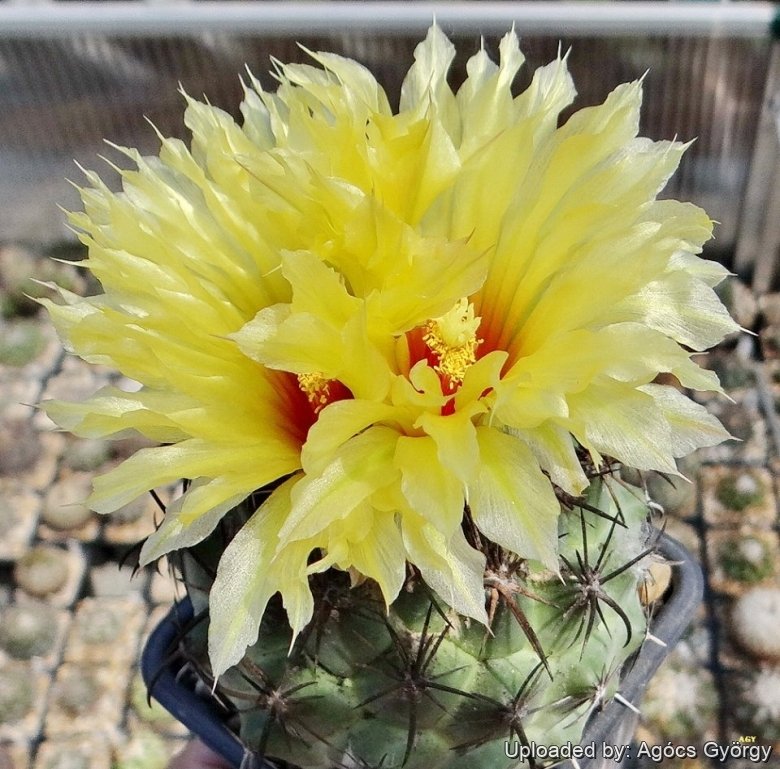
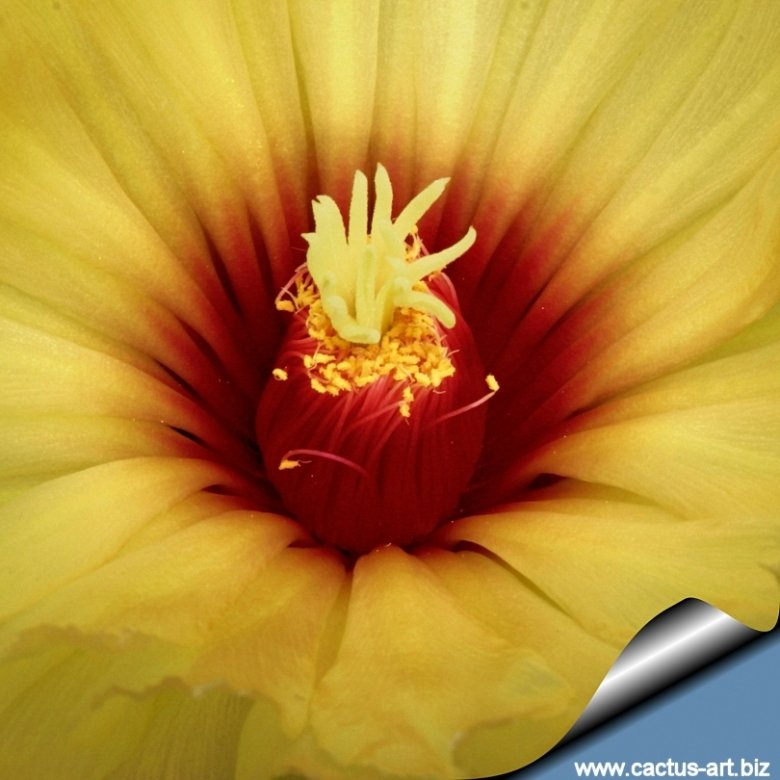
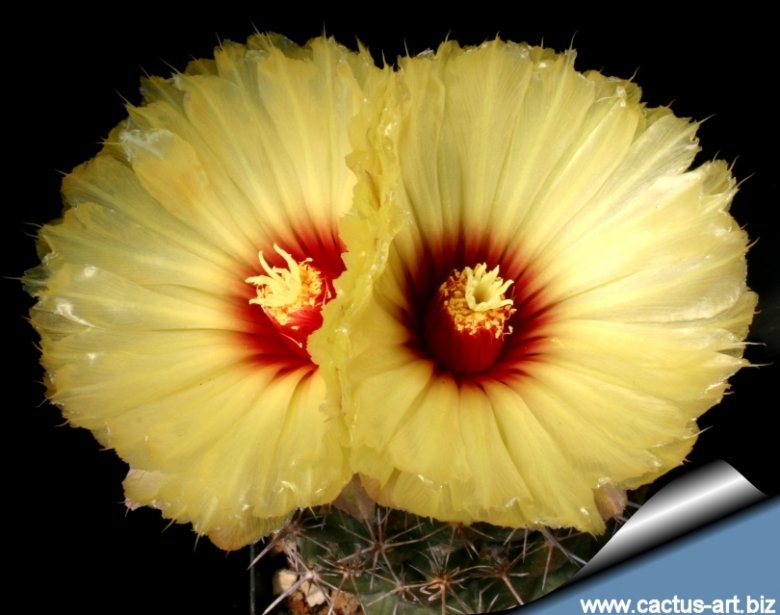
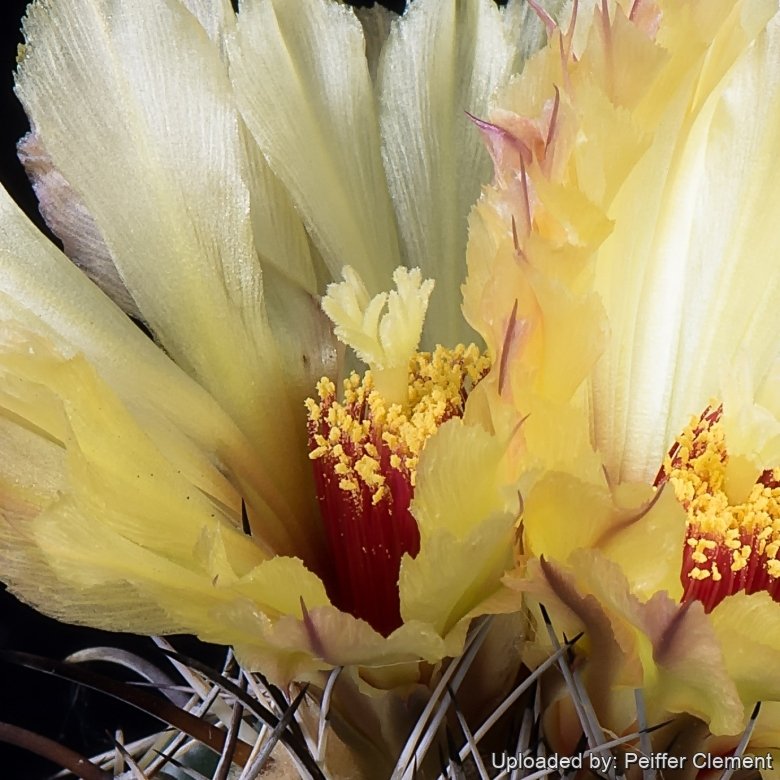
Flowers: Large ( 4-7 cm long, 4-7.5 cm in diameter) glossy yellow basally red, with greenish-brown dorsal midstripe, throat deep red, filaments red, anthers yellow, stigma whitish-yellow, lobes greenish-yellow.
Fruits: Green, juicy 15-20 mm, 10 mm diameter with attached dried flower remnants.
Seeds: Brown, reniform, 1.8 mm long, 1 mm wide.
Origin and Habitat
Mexico. Coryphantha salinensis has an extent of occurrence well over 20,000 km, ranging form Candela and Higueras (Coahuila), Sabinas, Bustamante, Codornices and Victoria, (Hidalgo) and in the North over Higueras (Coahuila), Rinconada, Monterrey-Monclova (Nuevo León) to Las Crucitas in the South in the State of Tamaulipas.
Habitat and ecology: Coryphantha salinensis occurs in desert scrub. It grows in alluvial plains and limestone gravel at the foot of the eastern slopes of the Sierra Madre Oriental. Coryphantha salinensis apparently intergrades and is sympatric with Coryphantha diffidlis. There do not appear to be any significant threats to this species.
Cultivation and Propagation
Small growing and easy to to care in normal cactus compost and very willing to flower, Because of it’s small size makes a great potted plant specimen, great for beginning collectors, water sparingly and allow to dry between watering, needs good drainage. Watering should be curtailed during the winter months. Full sun but is tolerant and prefers light shade during the hot Summer months. And provide very good ventilation. Frost Tolerance: Hardy to - 5°C if kept dry..
Propagation: Seeds (usually) or by the shoots of adult plants (if available).
Notes
The outstanding feature of this species is an abrupt and contrasting change from the juvenile aspect with, flattened, white spines and a smooth appearance to the adult with additional, dark, protruding spines and a ‘fierce’ appearance.
Bibliography
Major references and further lectures
-
Edward Anderson “The Cactus family” Timber Press, Incorporated, 2001
-
James Cullen, Sabina G. Knees, H. Suzanne Cubey “The European Garden Flora Flowering Plants: A Manual for the Identification of Plants Cultivated in Europe, Both Out-of-Doors and Under Glass” Cambridge University Press, 11/Aug/2011
-
David R Hunt; Nigel P Taylor; Graham Charles; International Cactaceae Systematics Group. “The New Cactus Lexicon” dh books, 2006
-
Reto Dicht, Adrian Lüthy “Coryphantha: Cacti of Mexico and Southern USA” Springer Science & Business Media, 2005
-
Goettsch, B.K. 2013. Coryphantha salinensis. The IUCN Red List of Threatened Species 2013: e.T152628A659137. http://dx.doi.org/10.2305/IUCN.UK.2013-2.RLTS.T152628A659137.en. Downloaded on 01 January 2016.
-
Urs Eggli, Leonard E. Newton “Etymological Dictionary of Succulent Plant Names” Springer Science & Business Media, 29 June 2013
-
Heinrich Poselger “Beitrag zur Kakteenkunde”. In: Allgemeine Gartenzeitung. 21(14): 106–107 1853.
-
Reto F. Dicht, Adrian D. Lüthy: “Feld wiederaufgefunden: Coryphantha salinensis (Poselger) Dicht & A. Lüthy comb. nov.” In: Kakteen und andere Sukkulenten. 49(11): 257, 1998.
-
“Coryphantha salinensis”. In: Wikipedia, Die freie Enzyklopädie. Bearbeitungsstand: 14. Dezember 2013, 14:41 UTC. URL: https://de.wikipedia.org/w/index.php?title=Coryphantha\_salinensis&oldid=125436070 (Abgerufen: 1. Januar 2016, 14:15 UTC)
From llifle page Coryphantha borwigii
Description
Usually solitary, but quite variable in habit.
Stem: Globose, ovoid, or short cylindrical dark green to pale blue grey, 5-10 cm tall, 5-8 cm in diameter.
Tubercles: Conical, rhomboid basally, very firm, more or less erect, often imbricate, up to 20 mm long.
Spines: C. borwigii pass several stages of development in which their appearance changes very much: after several years of purely radial spination one single porrect central dull white, brown or blackish up to 15 mm long, curved downwards, appears and with the appearance of the upper 2-3, slightly protruding centrals curved to the sides.
Radial spines: Equal at first up to 18 mm long, as the the plant ages develops two types of radial spines, lower radiant, stiff, horn-coloured and upper, thinner, flexible in a bundle.
Flowers: Large ( 4-7 cm in diameter) glossy yellow , they have red filaments and a red centre.
Fruits: Green, 15-20 mm long.
Origin and Habitat
Large area of Mexico (Chihuahua, Durango and Coahuila to Nuevo León)
Source: Coryphantha borwigii, LLIFLE - Encyclopedia of living forms, CC-BY-SA, retrieved 2026-10-25.
From llifle page Coryphantha roederiana
Description
This taxon is no longer positively identifiable since the the type no longer exist, it is supposed to correspond to Corypantha sulcata or (more probably) to Coryphantha salinensis.
Cultivation and Propagation
It is a summer-growing species of easy cultivation. It is sensitive to overwatering (rot prone) and slow-growing.
Soil: Grow it in an open sandy-gritty cactus compost.
Pots: It needs a relatively shallow pot to accommodate its fibrous roots and provide a very good drainage. They may stay in the same pot for many years.
Watering: Water in moderation, it prefer a completely dry place during winter. Mature individuals easily rot and die especially after planting so be extremely cautious with watering. Keep dry in winter or when night temperatures remain below 10° C. Water it less than average if in bigger pots.
Special need: Provide very good ventilation. Nearly all problems occur as a result of overwatering and poor ventilation, especially when weather conditions are dull and cool or very humid.
Fertilization: Feed them once during the growing season with a fertilizer specifically formulated for cactus and succulents (high potash fertilizer with a dilute low nitrogen), including all micro nutrients and trace elements diluted to ½ the strength recommended on the label. They thrive in poor soils and need a limited supplies of fertilizer to avoid the plants developing excess vegetation, which is easily attacked by fungal diseases.
Exposure: It will do its best with lots of sun and become stressed with inadequate light which could result in poor growth and unnatural shape.
Hardiness: It likes warmth (recommended minimum winter temperature 5° C) however plants kept perfectly dry can can survive low temperatures, approx. -5°, but for safe cultivation it is best to avoid freezing temperatures.
Use: It can be cultivated outdoors in raised beds, terraces if sheltered from winter rain.
Pests & diseases: These cacti may be attractive to a variety of insects, but plants in good condition should be nearly pest-free, particularly if they are grown in a mineral potting-mix, with good exposure and ventilation. Nonetheless, there are several pests to watch for:
- Red spiders: Red spiders may be effectively rubbed up by misting the plants from above.
- Mealy bugs: Mealy bugs occasionally develop aerial into the new leaves and flowers with disfiguring results, but the worst types develop underground on the roots and are invisible except by their effects.
- Scales, thrips and aphids: These insects are rarely a problem.
- Rot: Rot is only a minor problem if the plants are watered and “aired” correctly. If they are not, fungicides won’t help all that much.
Propagation: Seeds. The seeds can be sown in pots of fine, well-drained sandy soil, any time during the spring when temperatures are warm. Cover the seeds with a fine layer of grit and water from below with a fungicide to prevent damping off. For the 1-2 weeks cover the pots with a sheet of glass/clear perspex to keep the humidity levels high. Remove the glass and replace it with light shade-cloth and mist once or twice a day for the next two weeks after which most seeds should have germinated. From then on mistings can be reduced to every second and then every third day as the little plants grow.
Source: Coryphantha roederiana, LLIFLE - Encyclopedia of living forms, CC-BY-SA, retrieved 2026-10-25.
Gallery