Description
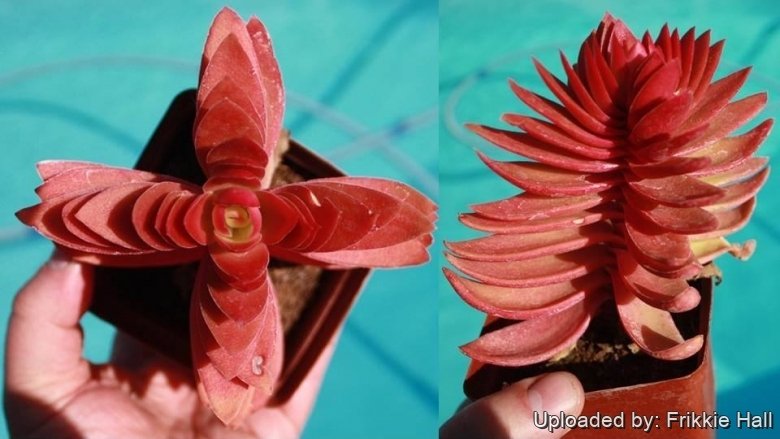
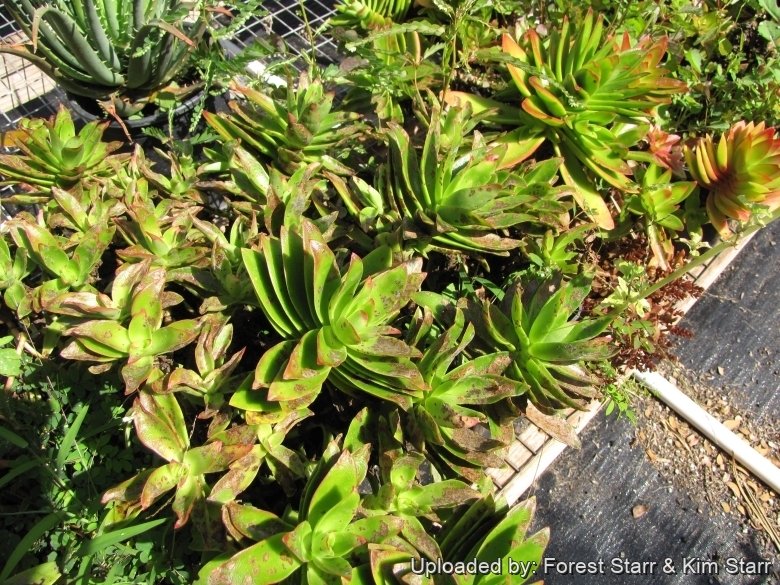
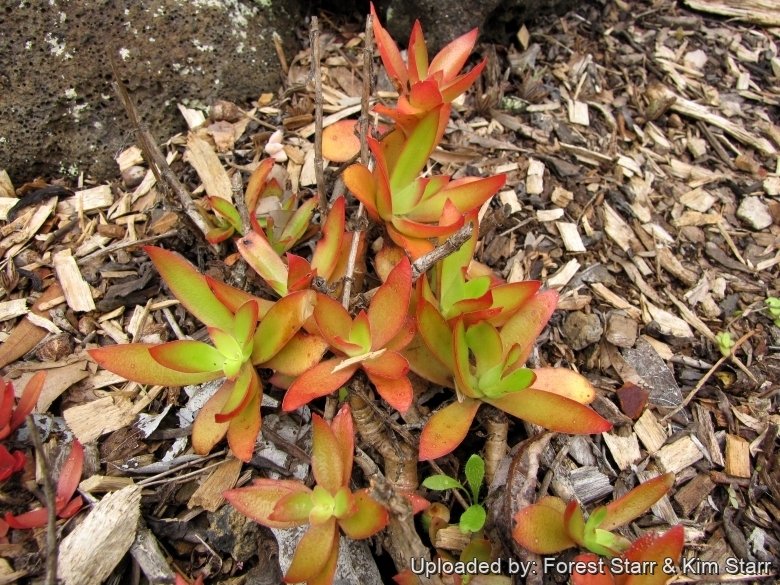
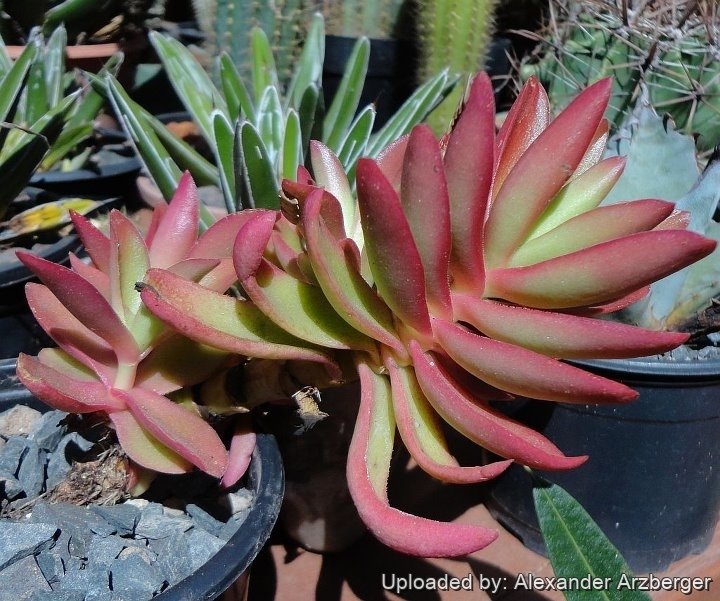
Crassula capitella cv. Campfire or the Campfire Plant is a branching succulent with flashy propeller-like leaves that form characteristic 4-ranked rosettes. In full shade it remains green, but in full sun it becomes a showy brilliant red/orange. The colour is brightest in winter in response to long cool nights and bright sunlight. It grows prostrate, spreads by runners and will eventually form a mat about 15 cm tall to 60-90 cm wide like ice plant. Plants form roots at their joints even before they touch the ground. It blooms in the summer or autumn and forms a scanty spike-like inflorescence with small white flowers. Plants get quite ‘long-shanked’ and ugly at this time, and flowers do not smell good. The rosette that bloom will die.
Classification: The classification of this cultivar in controversial. It is often listed as a cultivar of Crassula erosula or Crassula subacaulis ssp. erosula which it closely resembles but more likely it is hybrid of Crassula capitella.
Stems: Erect or decumbent, usually woody branched at the top.
Leaves: Narrow and pointed (linear-lanceolate), stacked in opposite pairs, sessile, 4-ranked in basal rosettes often recurved, cartilaginous, 20-70 mm long and 10-20 mm broad, usually decreasing in size toward the stem tips near the centre of the rosette, glabrous bright, lime green that morph through shades of yellow and orange, progressing to a bright flaming orange-red or purple at the tips. Sometimes the entire plant turns red. Margins ciliate with fine recurved hairs or papillae.
Inflorescences: The inflorescence emergeing from the centre of the rosettes is a 15-20 cm tall dichasia, a cymose inflorescence in which each branch bearing a flower gives rise to two other flowering branches.
Flowers: White pink-tinged , inconspicuous star-like, bisexual generally under 4 mm in length.
Blooming season: It may blooms from spring to autumn (mostly at the end of summer or early autumn). Crassula capitella cv. Campfire is a monocarpic species, meaning that each time they bloom, a rosette dies.
Origin and Habitat
Garden origin.
Cultivation and Propagation
Crassula capitella cv. Campfire, the Campfire Plant, is not difficult to cultivate, loves heat and is easy to root and grow. It thrive with bright light and ample airflow. The leaves on this succulent can either appear as bright apple green or flaming red. It makes a nice groundcover in subtropical climates and is drought tolerant and only want light watering.
Growth rate: Moderately fast (bordering on invasive!) plant for the garden.
Soil: It grows best in sandy-gritty soil. Good drainage is very important as it is prone to root rot.
Repotting: Repot every two years in spring. Do not radically cut off roots: about 10 percent of the root ball is right.
Fertilization: Feed it from mid spring to early autumn every four or five weeks with a fertilizer specifically formulated for cactus and succulents (poor in nitrogen), including all micro nutrients and trace elements diluted to ½ the strength recommended on the label. Do not feed plants during winter.
Watering Needs: It is a dry-tolerant plant. Water regularly in the growing season, but avoid water-logging and let dry between waterings. Water with caution in winter, as the plant can lose its roots if the soil stays cold and wet for extended periods. The lower the temperature the less water is needed. If grown in a container, bottom watering by immersing the container is recommended. Mist spraying is not needed, it must have very dry atmosphere.
Sun Exposure: Does well in filtered sun, but can handle some shade, too. In shade the leaves colour will remain more green, while in harsh full sun conditions the foliage can develop a pinkish tinge. In summer keep cool and provide some shelter from direct sun during the hottest hours. It can be sunburned if moved from shade/greenhouse into full sun too quickly. It tends to get leggy in deep shade.
Frost Tolerance: Protect from frost to prevent scarring. It requires a minimum temperature of about 5°C, but will take a light frost and is hardy down to -5° C for short periods if it is in dry soil. USDA zones 9A – 11. In areas prone to frost, grow in an intermediate greenhouse or conservatory, in pots. The plant may be kept indoors throughout the year at a minimum winter temperature of 10°C not exceeding 18°C. In summer, the temperature will rise higher, but as this is accompanied by better light it does not matter. In colder climates plant this in a container, so it can be moved into a protected area when cold.
Garden uses: They make wonderful rocker plants in hot, dry areas and also grow well in containers or luminous patios. These crassula plants are great for hanging baskets too.
Pests and diseases: May be susceptible to mealybugs and rarely scale. Protect from cold. Occasionally suffers from foliage edema which is thought to be the result of rapid changes in available moisture.
Maintenance: At the end of summer plants get quite long-shanked with dried flowering stalk and so is a good time of year to trim them back substantially.
Propagation: From seed but it is easily increased by cuttings. Cuttings root easily. It is also possible, to plant the leaves in good, sandy soil where they will take root - members of this family often propagate vegetatively in this way. Take leaf cuttings in spring and summer. Detach a leaf from an established plant by pulling or bending, and leave it to dry for a day. Insert the broken end of the leaf into a mix of one part slightly moist peat and two parts sharp sand Firm the mix around the bases of each cut-ting, which will later grow roots. The leaf cutting can then be repotted.
Bibliography
Major references and further lectures
-
Forest & Kim Starr “Crassula capitella (Campfire crassula)”. Plants of Hawaii. <http://www.starrenvironmental.com\>. Web. 27 Sep. 2014.
-
San Marcos Growers contributors “Crassula capitella ‘Campfire’ - Campfire Crassula”. San Marcos Growers <http://www.smgrowers.com\>. Web. 27 Sep. 2014.
-
Laurav Zinkan “Care and Growth of Color Change Crassula Capitella Succulent Plants”. TheGardenPages <http://www.thegardenpages.com/\>. Web. 12 Oct. 2014.
-
Debra Lee Baldwin “Succulent Container Gardens: Design Eye-Catching Displays with 350 Easy-Care Plants” Timber Press, 20/Jan/2010
-
Gordon Rowley “Crassula: A Grower’s Guide” Cactus & Company, 2003
-
Toelken, H.R. 1997. “A revision of the genus Crassula” in southern Africa. Annals of the Bolus Herbarium 8,1-595.
-
Urs Eggli “Illustrated Handbook of Succulent Plants: Crassulaceae” Springer Berlin Heidelberg, 05/Nov/2012
-
Wikipedia contributors. “Crassula capitella.” Wikipedia, The Free Encyclopedia. Wikipedia, The Free Encyclopedia, 3 Sep. 2014. Web. 14 Oct. 2014.
-
Doreen Court “Succulent Flora of Southern Africa” CRC Press, 01/Jun/2000
-
Debra Lee Baldwin “Succulent Container Gardens: Design Eye-Catching Displays with 350 Easy-Care Plants” Timber Press, 20/Jan/2010
-
John Wilkes “Encyclopaedia Londinensis” Volume 5 1810
-
James Cullen, Sabina G. Knees, H. Suzanne Cubey “The European Garden Flora Flowering Plants: A Manual for the Identification of Plants Cultivated in Europe, Both Out-of-Doors and Under Glass” Cambridge University Press, 11/Aug/2011
-
Alfred Byrd Graf “Exotica, series 4 international: pictorial cyclopedia of exotic plants from tropical and near-tropic regions” Roehrs Co. Publishers, 1985
-
Dr J.P. Roux “Flora of South Africa” 2003
Gallery